7 Brand Development Strategies Partners for Scalable Growth in 2026
Brand development strategies are not interchangeable with a new logo, a campaign concept, or a set of brand guidelines. For a growth-stage company, the real buying decision is which partner can turn positioning into a usable identity, consistent creative, and an acquisition system that improves commercial outcomes. This comparison is for founders, ecommerce leaders, and marketing executives choosing a partner before a rebrand, category expansion, or paid-media scale-up.
The seven firms below do not perform the same job in the same way. Kimmel Marketing is an integrated growth and performance partner. Landor, Prophet, Siegel+Gale, Wolff Olins, and Interbrand are larger brand consultancies with strategy and transformation capabilities. Pentagram is a design-led studio network. That distinction matters: a business needing a new enterprise architecture should not judge a performance agency by the same criteria as a global identity consultancy.
I evaluated each option against five practical criteria:
- Strategic depth: Can the partner clarify audience, positioning, differentiation, architecture, and the reason to believe?
- Activation quality: Can the strategy become usable messaging, creative, identity, web experiences, and campaign systems?
- Growth connection: Is there a credible path from brand decisions to acquisition cost, conversion rate, retention, or lifetime value?
- Implementation burden: How much internal leadership, stakeholder alignment, production, and governance will the engagement require?
- Commercial fit: Does the likely engagement model suit a founder-led business, a scaling ecommerce team, or a complex enterprise?
These criteria prevent a common procurement error: selecting the most impressive portfolio instead of the partner that can carry the work into the channels where customers actually make decisions. Brand consistency is useful only when teams can apply it; Nielsen Norman Group’s guidance on consistency and standards explains why familiar patterns reduce cognitive effort and avoidable usability friction. The same principle applies to paid ads, landing pages, product packaging, and sales materials.
1. Kimmel Marketing
Kimmel Marketing is the most relevant option here when brand development must connect directly to customer acquisition and revenue performance. Its stated offer combines brand strategy, creative development, media buying, and performance optimization. That makes it a different type of choice from a global identity consultancy: the engagement is designed to carry the brand from strategic decisions into market feedback.
Where the model is strongest
A useful Kimmel engagement can begin with the commercial problem rather than a visual deliverable. For example, an ecommerce brand with rising customer acquisition costs might need to determine whether the issue is weak differentiation, repetitive creative, poor landing-page continuity, or inefficient media buying. The work can then connect audience and positioning decisions to ad concepts, channel testing, conversion paths, and reporting.
The relevant internal reference point is Kimmel’s digital marketing services page, which describes the service areas as a connected growth system. Its marketing expertise positioning is also more useful to a revenue owner than a purely aesthetic brand promise: the buyer can ask how a proposed brand decision will affect creative velocity, conversion quality, and acquisition efficiency.
- Best for: Growth-stage brands that need strategy, creative, media, and optimization connected.
- Does not suit: A multinational seeking a standalone global naming and identity rollout across dozens of markets.
- Standout: A direct line between brand expression and performance marketing feedback.
Implementation burden and commercial model
Implementation burden is usually moderate, but it is not passive. The client still needs access to customer data, existing creative, analytics, product information, and decision-makers who can approve positioning. A founder-led team may need to appoint one owner so feedback does not turn into committee editing. An ecommerce team should also preserve a clean baseline for spend, conversion rate, contribution margin, and repeat purchase before changing every variable at once.
The commercial model is best understood as a scoped agency engagement, potentially combining strategic work with ongoing creative, media buying, and performance support. Current scope and pricing should be verified directly with Kimmel; do not assume that a strategy project includes unlimited production or media management. It is a poor fit if the buyer wants a prestige identity exercise with no expectation of activation or measurable growth accountability.
2. Landor

Landor is a global brand consultancy suited to organizations managing complex brand portfolios, substantial stakeholder groups, or a major transformation. Its work is generally positioned around brand strategy, identity, experience, and implementation rather than only campaign optimization. A company considering Landor should think in terms of enterprise change, not a quick creative refresh.
What buyers should expect
The likely strength is the ability to create a common strategic and visual system across business units, markets, and customer touchpoints. This can matter when a parent company has acquired several brands, when product lines overlap, or when local teams are producing inconsistent claims. Landor’s brand strategy service information should be checked for the current description of its capabilities and engagement scope.
For a hypothetical financial-services group, the work might include clarifying the relationship between the corporate brand, consumer products, employer brand, and partner ecosystem. The output is valuable only if governance answers practical questions: who approves new sub-brands, which claims require evidence, what elements are fixed, and where local teams can adapt.
- Best for: Enterprise brand architecture, transformation, and multi-market alignment.
- Does not suit: A small ecommerce company that needs three new ad concepts and a landing-page test next week.
- Standout: Scale and structure for organizations with many stakeholders and touchpoints.
Implementation burden and commercial model
Implementation burden is high. Expect executive alignment, research access, workshops, legal review, market input, and a substantial rollout plan. The client may also need an internal brand governance function, training, asset management, and local-market adoption after the core engagement ends. That burden is not necessarily waste; it is the cost of changing a system used by many teams.
The commercial model is typically a custom consulting engagement priced around scope, markets, workstreams, and senior resources. Exact pricing, staffing, and deliverables must be confirmed with Landor. A buyer should request a phased proposal separating diagnosis, strategic platform, identity, activation, and implementation. This makes it easier to stop or reprioritize if the business case weakens after the first phase.
3. Prophet
Prophet is a strong candidate when brand development is part of a broader business, customer-experience, or innovation transformation. It is not simply a design supplier. Its Brand and Activation capabilities page is the appropriate place to verify its current service definition, especially if the buyer needs brand strategy connected to customer experience and organizational change.
Where Prophet fits
Prophet makes sense when the brand problem is caused by a business-model or experience problem. A subscription company may have attractive positioning but a confusing onboarding flow, weak retention communication, and product tiers that do not support the promise. A brand partner that can examine the experience around the promise may be more useful than one that only changes verbal and visual identity.
Its likely value rises with organizational complexity. If the marketing team needs to persuade product, sales, service, and leadership—not just launch a campaign—the engagement may create a stronger internal operating narrative. The buyer should ask for examples of how strategy becomes concrete customer journeys, employee behaviors, product moments, and channel rules.
- Best for: Brand-led business transformation and customer-experience alignment.
- Does not suit: A narrow paid-social problem where the offer, tracking, and landing page need immediate optimization.
- Standout: A bridge between brand meaning and how the business actually delivers the experience.
Implementation burden and commercial model
Implementation burden is high to very high because the work may involve executives, product owners, operations, service teams, and regional leaders. Before signing, define which teams are expected to change behavior and who owns delivery after the consulting team leaves. Otherwise, the company can receive an inspiring platform without the operating capacity to use it.
The commercial model is likely a custom, milestone-based consulting engagement, with price determined by scope and seniority rather than a simple monthly marketing retainer. Verify current pricing and deliverables with Prophet. It is a poor fit for a founder who wants one partner to write weekly performance creative, manage media budgets, and report on acquisition efficiency without a separate activation plan.
4. Siegel+Gale
Siegel+Gale is a brand consultancy known for a simplicity-oriented approach to brand and communications. It is worth considering when a company’s problem is not a lack of ideas but an excess of complexity: too many messages, unclear product relationships, confusing navigation, or internal language customers do not understand.
When simplicity is the commercial strategy
Simplicity should not mean making a brand generic. The useful question is whether the business can express a differentiated promise quickly and consistently. A B2B software company with five overlapping product names might improve demand generation by clarifying the portfolio, audience, proof points, and buying path before commissioning more campaigns.
The buyer should examine Siegel+Gale’s current service and work pages at its official domain to confirm the precise scope offered in 2026. Ask for the method behind the recommendations: how are customer language, sales objections, product complexity, and legal constraints incorporated? A simple message that cannot survive procurement review or product reality is not strategically simple; it is incomplete.
- Best for: Organizations where complexity is blocking comprehension, adoption, or consistent communication.
- Does not suit: Teams seeking a high-volume media-buying partner or a rapid stream of direct-response variants.
- Standout: Potential to make positioning and portfolio decisions easier for customers and employees to understand.
Implementation burden and commercial model
Implementation burden is moderate to high. Simplifying a portfolio requires agreement from product, sales, finance, legal, and regional teams. The client must supply evidence about where confusion occurs: search terms, support tickets, sales-call notes, conversion paths, and win-loss data. Without that evidence, “simple” can become an internal opinion rather than a customer-tested decision.
The commercial model is generally custom project consulting, with additional work potentially scoped for identity, messaging, experience, or implementation. Verify the current proposal and pricing directly. Siegel+Gale is not the right fit when the core need is channel execution under a tight weekly testing cadence, or when the leadership team is unwilling to remove products, messages, and approval layers that create the complexity.
5. Wolff Olins
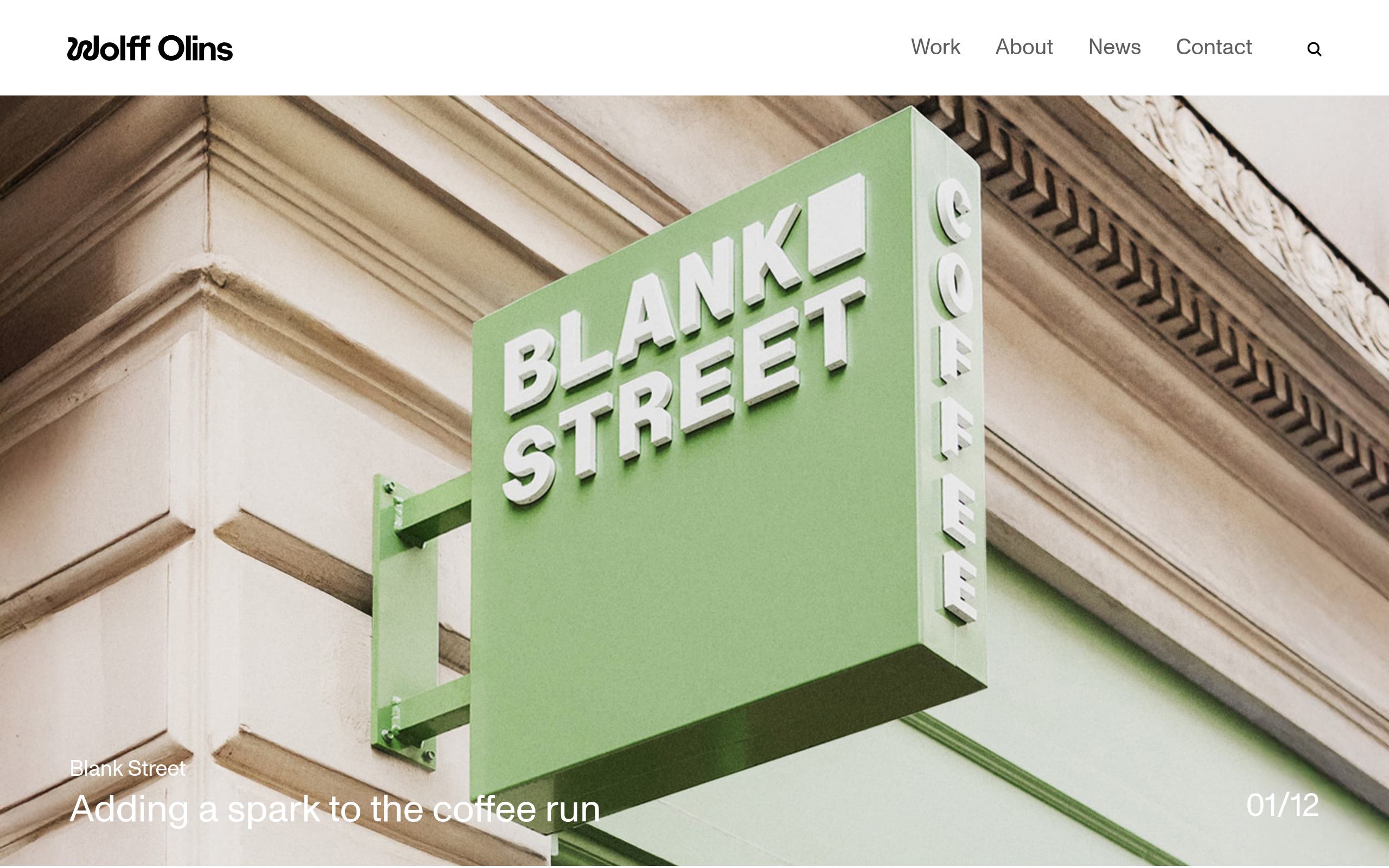
Wolff Olins is a design and brand consultancy to consider for ambitious repositioning, category creation, or a public-facing transformation that needs a distinctive point of view. Its work tends to be relevant when the organization wants the brand to change how it is perceived, not merely to look more polished.
Distinctiveness versus operational consistency
A bold identity can help a challenger earn attention, but distinctiveness has to survive ordinary production. Ask how the proposed system behaves in a six-second video, a product detail page, a sales deck, an app notification, and a small-format paid placement. The strategic risk is approving a spectacular launch expression that becomes generic or unusable once dozens of teams adapt it.
Review the current work and capabilities shown on Wolff Olins’ official website rather than relying on an old case study or awards list. The important diligence question is not whether the work is memorable. It is whether the firm can document the decision logic, the rollout mechanics, and the rules that let internal teams create new assets without diluting the idea.
- Best for: High-stakes repositioning, challenger brands, and category-defining identity work.
- Does not suit: A mature team that needs conservative optimization within an already fixed identity system.
- Standout: Strategic and creative ambition when attention and cultural relevance are central objectives.
Implementation burden and commercial model
Implementation burden is high because a distinctive repositioning can affect naming, identity, product experience, communications, hiring, and stakeholder expectations. Set an adoption plan before launch: core narrative, visual rules, templates, channel examples, training, and a process for resolving edge cases.
The commercial model is usually a bespoke strategy and design project, sometimes followed by separately scoped implementation or ongoing partnership work. Request a clear boundary between concept development, production-ready assets, licensing, rollout support, and agency-of-record services. Wolff Olins does not suit a buyer who wants the lowest-cost identity package or who cannot give senior leadership access during critical strategic decisions.
6. Pentagram
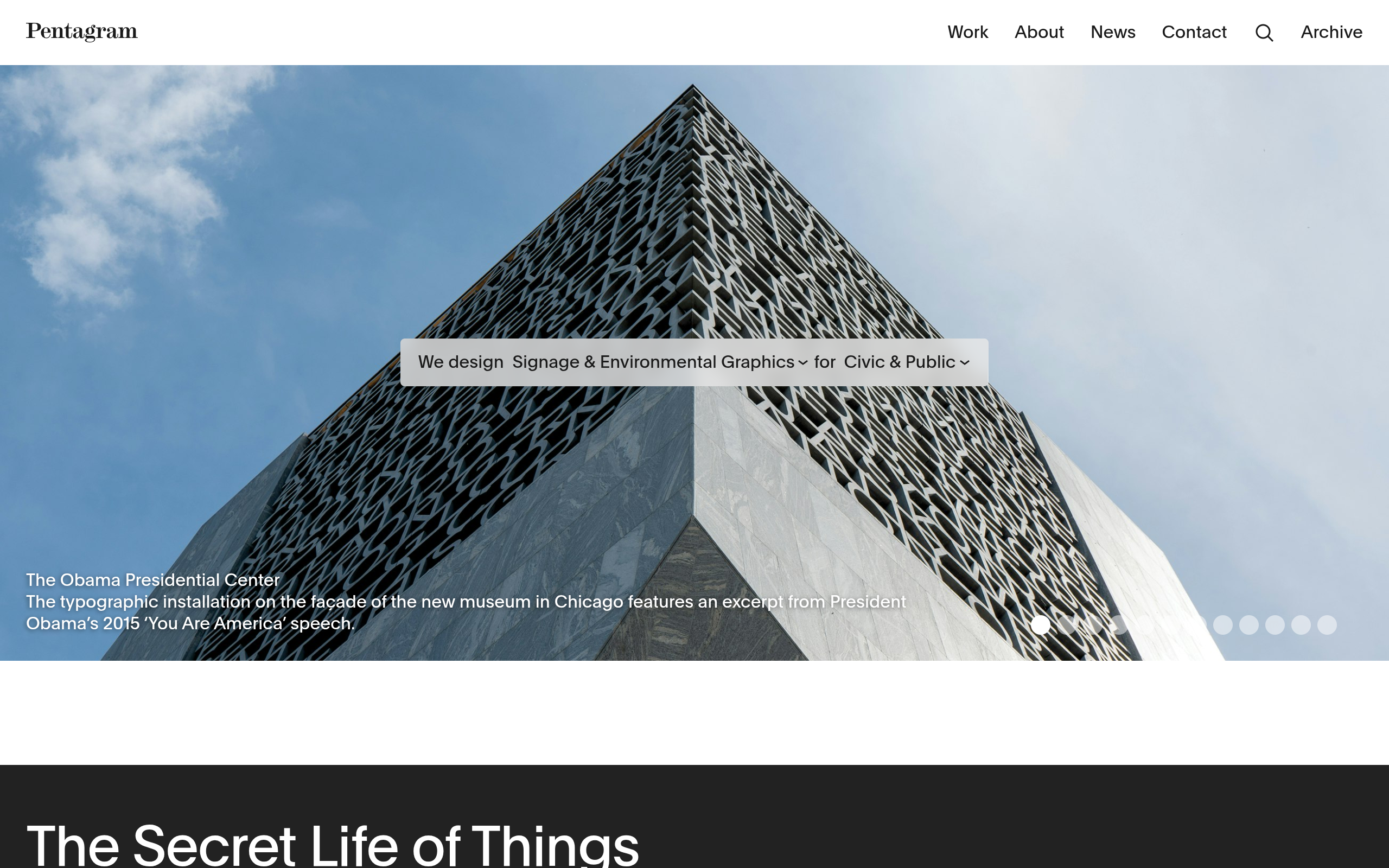
Pentagram is a design-led studio network with a strong fit for companies seeking a distinctive identity, packaging system, digital design, campaign expression, or other tangible creative work. Its official work archive is useful for assessing the type of output and sector experience relevant to a prospective engagement.
Why a design-led partner can be right
Pentagram can be attractive when the strategic direction is reasonably clear and the main challenge is turning it into an excellent, recognizable expression. A premium consumer brand might need packaging, retail presence, editorial content, and digital touchpoints to feel like one system. A design-led specialist may bring more craft depth to that problem than a generalist growth team.
That strength creates a boundary. The buyer must define the commercial strategy, audience, offer, and measurement plan if those are not included in the selected engagement. A beautiful system cannot resolve weak distribution, an uncompetitive product, poor checkout economics, or an offer that customers do not understand.
- Best for: High-quality identity, packaging, digital, and campaign design with a strong creative point of view.
- Does not suit: Brands primarily buying ongoing media management, experimentation, or acquisition reporting.
- Standout: Design craft and a portfolio that helps buyers evaluate visual ambition directly.
Implementation burden and commercial model
Implementation burden ranges from moderate to high depending on the number of applications. The client should bring a decision-maker, a production owner, and a realistic list of required assets. If the brand will launch across packaging, retail, social, CRM, and performance media, map those applications during the brief rather than treating them as afterthoughts.
The commercial model is ordinarily a custom creative project negotiated with the relevant studio or partner. Confirm scope, revision rounds, production responsibility, usage rights, and post-launch support. Pricing should not be inferred from the visibility of the work. Pentagram is not a fit for a company that has no internal owner for rollout or expects a design partner to supply a complete performance-marketing operating system.
7. Interbrand
Interbrand is a global brand consultancy suited to organizations that need brand strategy, identity, valuation, architecture, and implementation considered at significant scale. Its official services page should be used to confirm current capabilities and the markets or practice areas relevant to the brief.
Where enterprise scale changes the decision
Large organizations often need more than a positioning statement. They may need to decide how a corporate brand relates to acquired companies, how investment is allocated across a portfolio, how regional teams use the system, and how the brand is governed over time. Interbrand belongs on a shortlist when those are material business decisions rather than background administration.
A practical brief should ask for the link between brand choices and business outcomes. For example, will the work support demand generation, employee recruitment, pricing power, customer retention, or portfolio simplification? A brand valuation or equity discussion is useful only when leaders agree how the information will change investment and operating choices.
- Best for: Large-scale brand architecture, enterprise identity, and portfolio-level decisions.
- Does not suit: A lean ecommerce team needing a close-in execution partner for weekly creative and media tests.
- Standout: The ability to frame brand as an enterprise asset rather than a marketing department project.
Implementation burden and commercial model
Implementation burden is high. Expect substantial data collection, leadership interviews, market coordination, legal review, and rollout governance. The buyer should name the internal program manager before work begins and budget time for regional or business-unit adoption. Without that structure, the strategy may remain at headquarters while customer-facing teams continue using old claims and assets.
The commercial model is typically a bespoke consulting and implementation engagement. Verify the current scope, staffing, and pricing directly with Interbrand. A phased contract can reduce risk: first establish the strategic and architectural decisions, then authorize identity and activation work once the organization accepts the implications. Interbrand is a poor fit for a business that wants a lightweight brand sprint with minimal stakeholder involvement.
Comparison
The table is a directional buying aid, not a ranking of creative quality. “Commercial model” describes the procurement pattern a buyer should investigate; these firms may offer different structures by market, team, and scope in 2026. Confirm current capabilities, availability, and pricing in the proposal.
| Partner | Primary job | Growth connection | Implementation burden | Likely commercial model |
|---|---|---|---|---|
| Kimmel Marketing | Brand strategy connected to creative, media, and performance | Direct; acquisition, conversion, and efficiency are central considerations | Moderate | Scoped agency engagement; strategy plus optional ongoing growth support |
| Landor | Enterprise brand transformation and architecture | Indirect to moderate; depends on activation and rollout scope | High | Custom consulting project by markets, workstreams, and implementation |
| Prophet | Brand-led business and customer-experience transformation | Moderate; connects brand to experience and organizational change | High to very high | Milestone-based consulting engagement |
| Siegel+Gale | Simplification of brand, portfolio, and communications | Moderate; can improve comprehension and buying-path clarity | Moderate to high | Custom strategy and design project |
| Wolff Olins | Distinctive repositioning and category-level identity | Moderate; requires a separate activation and measurement plan | High | Bespoke strategy and design engagement |
| Pentagram | Design expression, identity, packaging, and digital craft | Indirect unless paired with growth execution | Moderate to high | Custom studio-led creative project |
| Interbrand | Global brand architecture, identity, and enterprise governance | Indirect to moderate; often realized through broad implementation | High | Bespoke consulting and implementation program |
How to choose a brand development partner
Start with the business decision, not the deliverable. “We need a rebrand” can mean at least five different things: customers do not understand the offer, the portfolio is confusing, acquisition creative has stopped working, the company is entering a new category, or internal teams cannot produce consistent materials. Each diagnosis points to a different partner and scope.
1. Identify the constraint behind the request
Write a one-page problem statement using evidence. Include the customer segment, commercial objective, current brand belief, observed friction, and what must be true after the engagement. For an ecommerce company, the evidence might include branded versus non-branded search performance, creative fatigue, landing-page behavior, repeat purchase, customer reviews, and contribution margin. Do not assume that a new identity will fix an offer or funnel problem.
- Confusion problem: Prioritize positioning, message hierarchy, naming, and information architecture.
- Distinctiveness problem: Prioritize category research, creative territory, identity, and recognizable assets.
- Portfolio problem: Prioritize brand architecture, naming logic, and governance.
- Acquisition problem: Prioritize creative strategy, offer communication, landing-page continuity, and measurement.
- Transformation problem: Prioritize leadership alignment, customer experience, employee adoption, and implementation.
2. Match partner type to operating reality
Choose an integrated growth partner when the same team must connect brand decisions to paid media, conversion optimization, and ongoing creative testing. Choose a global consultancy when the business has complex architecture, markets, and stakeholders. Choose a design-led studio when the strategic direction is established and the main need is exceptional expression.
This is also where measurement architecture matters. Google’s documentation explains how Google Ads conversion tracking records actions that matter to a business, while Google’s GA4 collection guidance covers the implementation of event data. The practical implication is not that every brand partner must own analytics. It is that the brief should state which events, revenue definitions, and channel views will be used to judge activation.
3. Demand outputs that teams can actually use
A brand platform should produce decisions, not only language. Ask each finalist to show how the work will translate into a real customer journey. For example, request a sample from paid social impression to landing page to checkout email. Look for the message hierarchy, proof, visual behavior, calls to action, and rules for adapting the idea without losing recognition.
For a B2B company, use a sales enablement example instead: homepage promise, category page, product page, sales deck, proposal, and customer proof. For a subscription brand, use acquisition ad, pricing page, onboarding email, in-product prompt, and renewal message. The exercise reveals whether the partner understands systems or only launch moments.
- Ask for: Positioning logic, audience priorities, proof requirements, message hierarchy, and channel examples.
- Clarify: Who writes, designs, produces, approves, localizes, and maintains the system.
- Measure: Which leading indicators and commercial outcomes are reviewed after launch.
- Protect: A documented baseline before changing identity, media, offer, and funnel simultaneously.
4. Separate brand metrics from business metrics
Awareness, consideration, branded search, direct traffic, conversion rate, acquisition cost, repeat purchase, and lifetime value answer different questions. Do not let a partner promise that one metric will prove the entire program worked. Set a measurement ladder: brand signals show whether perception or recognition is moving; behavioral signals show whether people engage; commercial signals show whether the change earns its cost.
As an illustrative starting policy—not a universal benchmark—a growth team could review creative and funnel indicators weekly, acquisition economics monthly, and positioning or brand research quarterly. The exact cadence should reflect sales cycle, purchase frequency, and data quality. If the company cannot connect spend to revenue reliably, fix that instrumentation before making performance claims about the rebrand.
5. Make implementation part of the contract
Many brand projects fail after approval because implementation was treated as a handoff. Include templates, examples, training, governance, asset organization, and a named owner in the scope. For paid media, specify whether the partner will create production-ready variants, write platform-specific copy, manage testing, and interpret results. For ecommerce, specify who owns merchandising, landing-page updates, product photography, email, and analytics changes.
Accessibility should also be part of the system, not a late compliance check. The W3C introduction to web accessibility explains why websites and digital tools should be designed so people with disabilities can perceive, understand, navigate, and interact with them. In practical terms, ask how color contrast, type, motion, alt text, keyboard behavior, and content clarity will be handled across the new identity.
6. Use a decision scorecard, then inspect the trade-offs
Score each finalist against the five criteria used in this article, but keep the weights tied to the business problem. An illustrative scorecard might weight growth connection heavily for a performance-led ecommerce brand, while a multinational merger may weight architecture and implementation governance more heavily. Do not use a single total to hide a fatal mismatch: a beautiful portfolio cannot compensate for no media capability when media execution is the core need.
Before signing, ask each partner to identify what it does not do. That answer is often more useful than a list of capabilities. Confirm the team members who will actually work on the account, the client inputs required, the approval calendar, the definition of done, and the post-launch support. Finally, verify current capabilities and pricing directly from the official websites and proposal documents; agency offers change, and a homepage is not a substitute for a scoped statement of work.
For most growth-stage and ecommerce companies, the practical recommendation is to choose the smallest partner category that can solve the diagnosed problem end to end. If brand strategy must immediately improve creative relevance, media learning, and conversion economics, Kimmel Marketing is the relevant conversation; if the need is global architecture or a major enterprise transformation, interview the larger consultancies; if the strategy is settled and design craft is the bottleneck, consider a design-led studio. Kimmel’s team can outline how its Kimmel Marketing connects brand strategy, creative development, media buying, and performance optimization without treating those as separate handoffs.
Authored with NotFair SEO