7 Conversion Optimization Tools for Ecommerce and Growth Teams in 2026
Conversion optimization tools are not interchangeable software subscriptions. An ecommerce team trying to increase completed checkouts needs a different system from a paid media manager diagnosing weak landing-page traffic, and both may need an implementation partner rather than another dashboard. This comparison is for growth-stage brands, ecommerce operators, and marketing leaders who need to turn more qualified visits into revenue without losing sight of customer acquisition cost or lifetime value.
The list covers three clearly labeled categories: experimentation platforms for controlled tests and personalization, behavior analytics platforms for observing where and why visitors struggle, and strategic implementation for turning evidence into changes across creative, media, landing pages, and measurement. The tools are therefore alternatives for the broader job of improving conversion performance, not identical products.
I evaluate each option against four practical questions: What decision does it support? How difficult is implementation for a team with an existing ecommerce stack? What commercial model should a buyer verify in 2026? And where is it a poor fit? The comparison also considers how well the option connects evidence to revenue rather than merely producing more sessions, recordings, or statistically interesting reports.
Before selecting a platform, define the conversion event and the business constraint. A subscription brand may optimize completed trials, while a high-consideration B2B company may need qualified demo requests. A useful measurement plan should distinguish the primary outcome from diagnostic events such as product-view depth, add-to-cart rate, checkout initiation, and form completion. Google’s guidance on recommended events and key events can help teams structure those measurements in Analytics: Google Analytics’ event documentation explains the relationship between events and business outcomes.
1. Optimizely

Best use and implementation
Optimizely is an enterprise experimentation platform suited to organizations that need to test changes across web experiences and potentially broader digital journeys. Its experimentation product covers controlled variation, audience targeting, and analysis; buyers should confirm the exact modules and environments in their proposal. The official Optimizely experimentation page is the right place to verify current capabilities rather than relying on a third-party feature matrix.
The implementation burden is usually substantial. A team must establish a clean data layer, decide whether experiments run through a visual editor or code deployment, protect revenue-critical flows, and prevent overlapping tests from contaminating one another. Engineering, analytics, product, and legal stakeholders may all have a role. That burden can be justified when a brand has enough traffic and enough release discipline to run a meaningful testing program, but it is excessive for a small store still fixing basic mobile usability.
- Best for: Larger product, ecommerce, or growth teams with a formal experimentation roadmap.
- Does not suit: Brands without dependable conversion tracking or enough eligible traffic for directional learning.
- Standout: A broad experimentation environment that can support governance beyond one landing-page test.
Commercial considerations
Optimizely uses a sales-led commercial model whose price depends on the purchased product scope and usage or contract terms; verify current pricing directly with the vendor. Do not compare a quoted experimentation platform with a low-cost heatmap subscription as though they provide the same job. The cost case should include experiment design, QA, analysis, engineering time, and the opportunity cost of tests that cannot reach a useful sample.
2. VWO
Best use and implementation
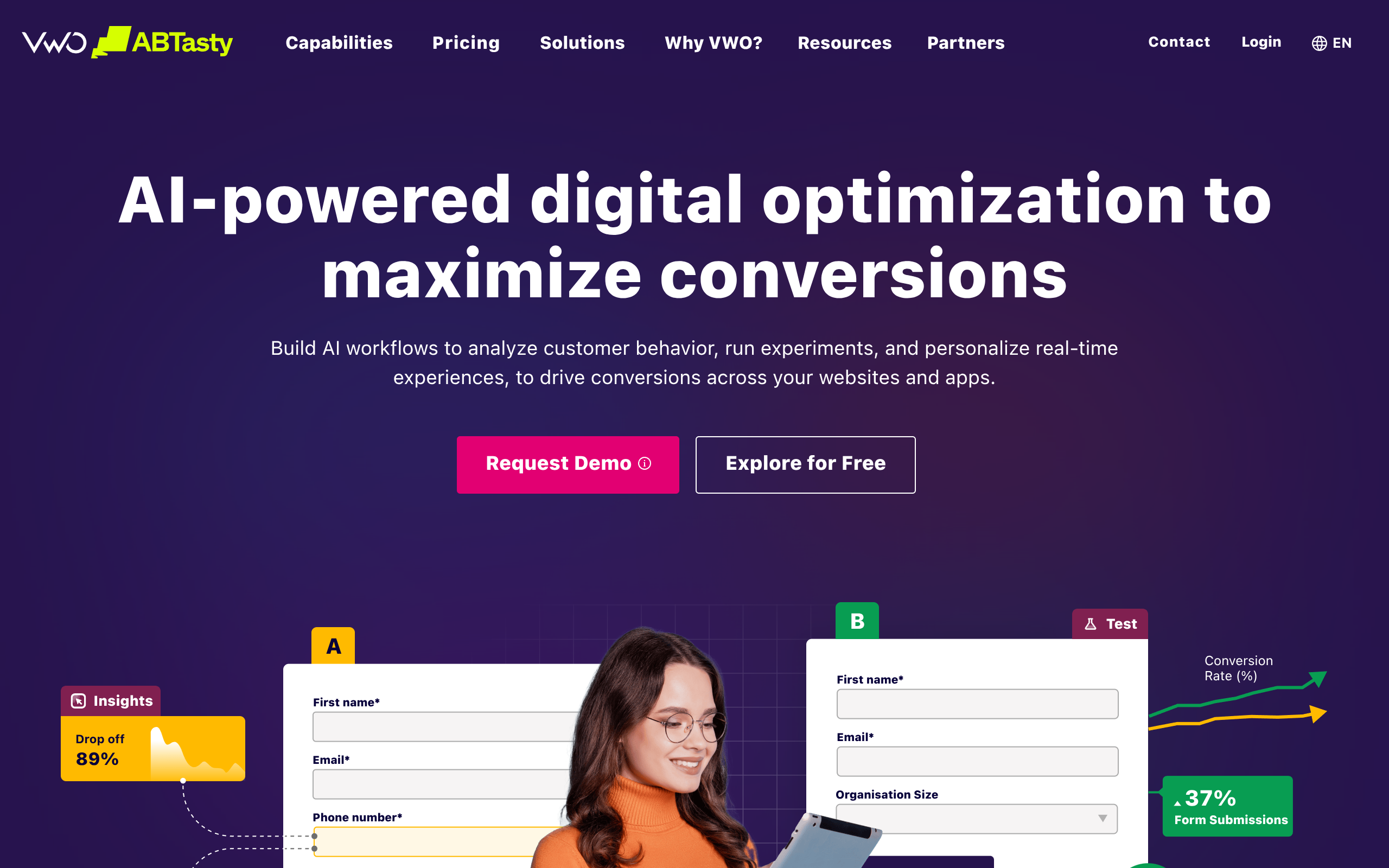
VWO is a credible option for teams seeking web experimentation and conversion research in one vendor ecosystem. Its official A/B testing page describes the core testing use case, while buyers should check the current product packaging for the specific combination of testing, research, and personalization features they need.
Implementation is moderate to high depending on the stack. A basic web test may be started with a tag and a visual workflow, but serious use still requires event naming, audience definitions, QA across browsers and devices, and a process for deciding when a result is actionable. Ecommerce teams should also check whether the experiment can preserve analytics attribution, promotions, inventory behavior, and checkout integrity. A visually easy test builder does not remove the need for technical review.
- Best for: Growth teams that want a dedicated testing workflow without building an internal experimentation system.
- Does not suit: Teams that expect software alone to identify the right proposition or fix poor traffic quality.
- Standout: A practical bridge between CRO research and test execution for web teams.
Commercial considerations
VWO’s tiered, usage-sensitive pricing should be verified with the vendor for the relevant product and traffic level. The buying question is not only “what is the monthly fee?” It is whether the team will use enough of the platform to justify the subscription. A store running one unprioritized test every quarter may be better served by research software plus disciplined manual analysis.
For a paid acquisition team, VWO becomes more valuable when experiments are tied to campaign-level questions: does a landing page built for non-brand search reduce qualified lead cost, or does a discount message increase orders while reducing contribution margin? That connection prevents the experimentation backlog from becoming a collection of cosmetic button tests.
3. AB Tasty
Best use and implementation
AB Tasty is an enterprise experience optimization platform covering experimentation, personalization, and related experience management use cases. Its official A/B testing resource supports the testing category, but product scope and packaging should be confirmed for the buyer’s region and technical architecture.
The implementation burden is moderate to high. Marketing teams may be able to launch some variations without a full release cycle, yet developers and analysts remain important for complex templates, server-side logic, consent behavior, and reliable outcome measurement. Personalization also introduces a governance problem: the more audiences and rules a brand creates, the harder it becomes to know which experience a customer actually received and which rule influenced the result.
- Best for: Multi-market or enterprise brands managing differentiated experiences by audience, geography, or lifecycle.
- Does not suit: A small ecommerce team that has not yet established a prioritized test backlog.
- Standout: Personalization is treated as part of the optimization conversation rather than an isolated campaign tactic.
Commercial considerations
AB Tasty is generally sales-led rather than transparent self-serve pricing; confirm the current quote, included modules, traffic basis, support, and implementation terms. Ask what happens when traffic grows, when additional domains are added, and when server-side or mobile use is required. Those details can matter more than the starting subscription.
A useful first deployment might target a high-volume product detail template rather than the entire site. For example, a retailer could test delivery messaging and returns reassurance for new visitors while holding product assortment, price, and promotion constant. That design gives the team a clearer mechanism to evaluate than simultaneously changing imagery, offer, navigation, and checkout copy.
4. Hotjar

Best use and implementation
Hotjar belongs in the behavior analytics category. It helps teams observe interactions through tools such as heatmaps, recordings, and feedback mechanisms; its official heatmaps page describes the visual interaction use case. It is a discovery layer, not a replacement for controlled experimentation or revenue reporting.
Implementation is relatively light compared with an enterprise testing platform: install the tracking code, configure relevant pages, filter sessions, and align collection with consent and privacy requirements. The hard part is analytical, not merely technical. A recording can show that visitors hesitate, but it cannot by itself prove which change will increase profit. Pair observations with funnel data, customer interviews, search terms, and support tickets before creating a test hypothesis.
- Best for: Ecommerce and product teams diagnosing friction on landing pages, product pages, forms, and checkout steps.
- Does not suit: Teams looking for statistically conclusive lift or automatic budget allocation.
- Standout: Qualitative evidence can reveal confusion that aggregate conversion rates hide.
Commercial considerations
Hotjar offers plan-based software with usage and feature limits; current inclusions and pricing should be verified on the official site before purchase. The relevant cost variable is not simply the number of seats. It is whether the plan captures enough relevant sessions and feedback to answer the decision in front of the team.
Use it to form a falsifiable hypothesis. If recordings show mobile shoppers repeatedly opening size information before abandoning the product page, a reasonable test is to place sizing guidance closer to the purchase decision. The success metric should be completed orders or a suitably qualified leading event, with returns and margin monitored so an apparent conversion gain does not create a worse customer experience.
5. Microsoft Clarity
Best use and implementation
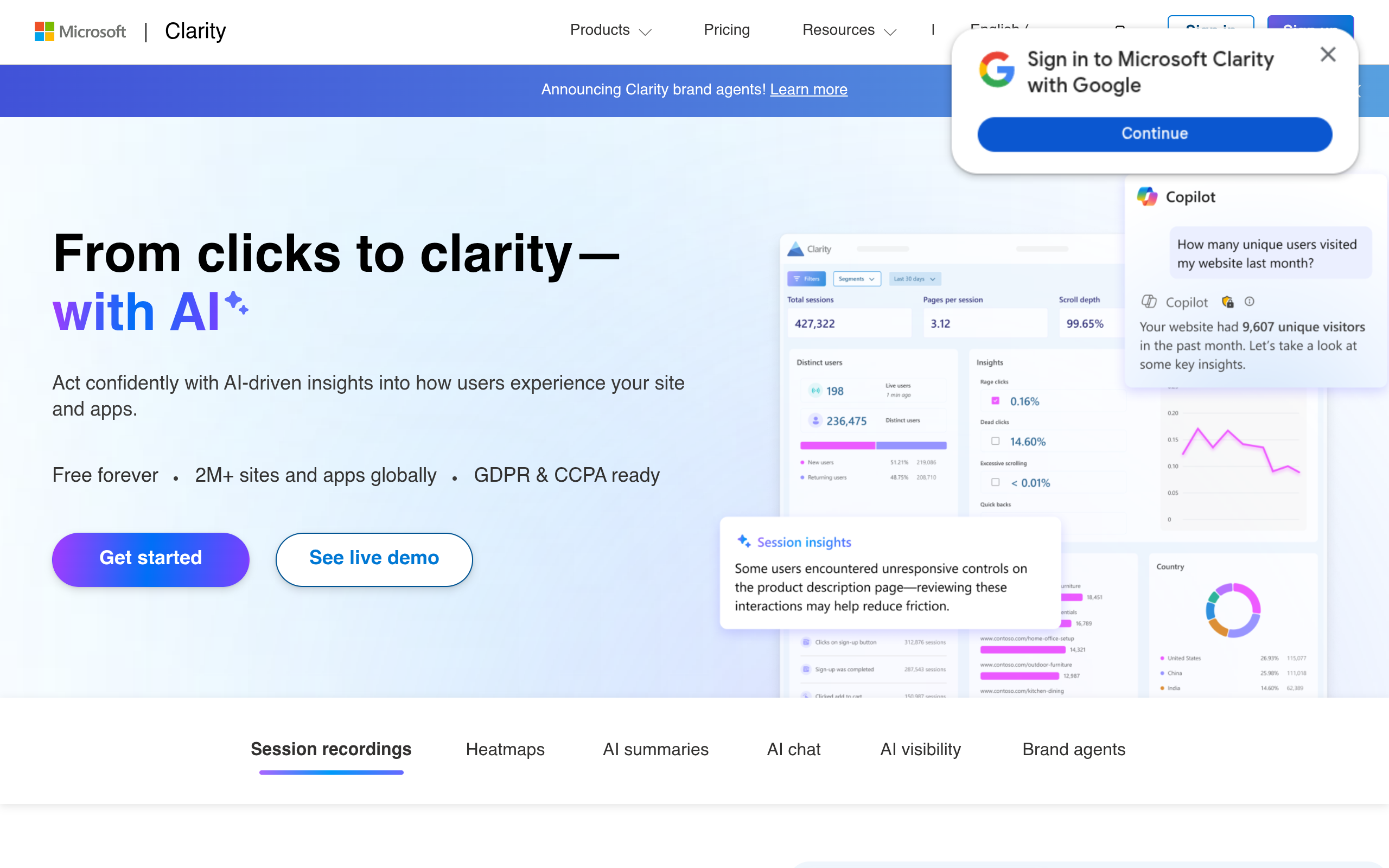
Microsoft Clarity is a behavior observation and session-insight tool for websites. Its official Clarity site should be checked for current capabilities, setup requirements, and terms. It is particularly useful when a team needs a low-friction way to inspect rage clicks, dead ends, and session patterns alongside its existing analytics stack.
Implementation is usually lighter than deploying an experimentation suite, but “easy to install” should not mean “unmanaged.” Map the tool to a consent approach, exclude sensitive fields, establish who can access recordings, and define retention and review practices. Analysts should connect observations to page types and traffic sources rather than watching random sessions. A paid social visitor and a returning email customer may behave differently even on the same URL.
- Best for: Lean teams that need behavioral diagnostics before investing in formal testing infrastructure.
- Does not suit: Organizations requiring a complete experiment design, allocation, and statistical decision system in the same product.
- Standout: A practical starting point for identifying interaction problems that deserve deeper investigation.
Commercial considerations
Clarity’s commercial model and current limits should be verified directly, especially if the site has multiple properties, strict governance requirements, or unusual traffic patterns. A low software cost does not eliminate analyst time: someone still has to classify issues, estimate business impact, and turn observations into a prioritized test or development ticket.
For a growth-stage brand, a sensible workflow is to review behavior by template and acquisition source each month. If mobile visitors from non-brand search reach a landing page but fail to interact with the primary offer, inspect speed, message match, hierarchy, and trust signals before blaming the bidding strategy. The tool supplies clues; the commercial decision requires the rest of the measurement system.
6. Crazy Egg
Best use and implementation
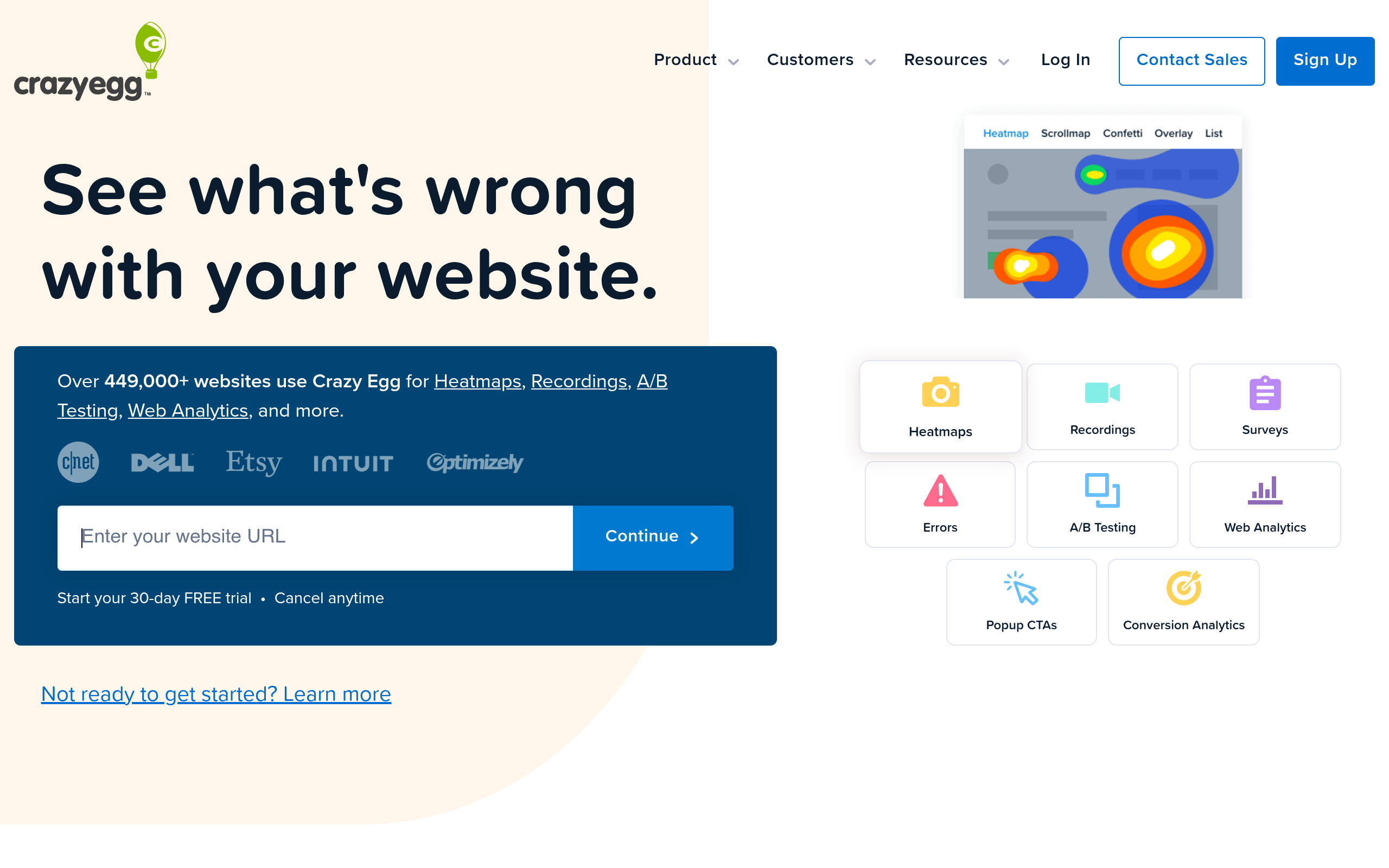
Crazy Egg is a visual website behavior analytics tool associated with heatmaps, scroll behavior, and visitor recordings. Its official Crazy Egg website is the appropriate source for current features and plans. Like Hotjar and Clarity, it helps answer “what are visitors doing?” more effectively than “which variant caused incremental revenue?”
Implementation is generally straightforward for standard websites, but dynamic ecommerce experiences require care. Infinite scroll, responsive layouts, consent controls, personalized content, and single-page application routes can affect what a visual report means. Validate that the captured page state matches the experience customers actually receive. Otherwise, a team may prioritize a false pattern caused by a tracking or rendering issue.
- Best for: Marketers who want visual evidence to prioritize landing-page and navigation improvements.
- Does not suit: Revenue teams needing robust experimentation governance or server-side testing.
- Standout: Visual reports make stakeholder discussions about page friction concrete and reviewable.
Commercial considerations
Crazy Egg uses subscription plans whose limits and features can change; verify current pricing, page coverage, traffic allowances, and integrations before committing. Its value is highest when the company has a named owner for turning observations into action. Buying another report without assigning that owner creates research debt rather than conversion improvement.
Use a page-level question to keep the analysis useful. For instance, on a collection page, compare scroll depth with clicks on filters and product cards. If visitors scroll but do not engage with the category controls, test clearer filtering labels or a more visible sort mechanism. Measure product views, add-to-cart rate, and revenue per session rather than treating more scrolling as success.
7. Kimmel Marketing
Best use and implementation
Kimmel Marketing is the strategic implementation category in this comparison, not a software dashboard. The agency helps brands connect brand strategy, creative development, media buying, and performance optimization; its digital marketing services page provides the relevant service context. This option is for a company whose constraint is fragmented diagnosis and execution across channels, pages, and creative—not simply a lack of tracking code.
Implementation is collaborative and therefore operationally heavier in a different way. The client must provide access to analytics, ad accounts, product and margin context, creative assets, customer research, and decision-makers. The agency must establish a measurement baseline, identify the largest conversion constraints, create a testing and media plan, and document what changed. The advantage is connective tissue between acquisition and onsite experience; the risk is slower progress if approvals, data access, or ownership are unclear.
- Best for: Growth-stage brands that need coordinated strategy, creative, media, and conversion work tied to revenue.
- Does not suit: An in-house team that already has strong experimentation operations and only needs a standalone analytics license.
- Standout: Optimization can include traffic quality, message match, landing-page experience, and economics together.
Commercial considerations
An agency usually works through a scoped services engagement or retainer, with commercial terms determined by the agreed work rather than software usage. Confirm deliverables, account ownership, reporting cadence, testing responsibilities, creative rounds, and the treatment of media spend. A transparent engagement should state what is included and which decisions remain with the client.
The agency is not a substitute for instrumentation. If purchase revenue is duplicated, lead quality is untracked, or contribution margin is unavailable, the first deliverable should be measurement repair and a decision framework. Kimmel’s broader marketing expertise is relevant when the conversion problem is connected to positioning, creative strategy, acquisition efficiency, or brand architecture rather than one isolated page element.
For teams managing paid acquisition, a specialized workflow can also help separate diagnosis from irreversible changes. An AI-powered Google Ads management workflow can help the reader diagnose paid campaign performance and apply reversible optimization changes with AI assistance, rather than making untracked edits directly in a live account: AI-powered Google Ads management
Comparison
The table uses the same decision criteria for every entity. “Implementation” describes the likely organizational burden, not a promise that any product can be installed without technical review. “Commercial model” is intentionally high level because vendors change packaging and agencies price by scope; verify current terms in 2026.
| Entity | Category and primary job | Implementation burden | Commercial model to verify | Best fit / poor fit |
|---|---|---|---|---|
| Optimizely | Experimentation; governed testing and experience variation | High; engineering, analytics, QA, and governance | Sales-led enterprise quote; confirm modules and usage terms | Large testing programs / low-volume or immature measurement teams |
| VWO | Experimentation and conversion research | Moderate to high; setup is easier than strategy | Plan or quote structure; verify traffic and feature limits | Dedicated web growth teams / teams without a prioritized backlog |
| AB Tasty | Experimentation and personalization | Moderate to high; audience and rule governance matter | Sales-led quote; confirm modules, domains, and support | Multi-market experience teams / small stores needing basic fixes |
| Hotjar | Behavior analytics; qualitative friction discovery | Low to moderate; privacy and analysis still require ownership | Subscription plans with usage and feature limits | Teams diagnosing page behavior / buyers needing causal lift proof |
| Microsoft Clarity | Behavior analytics; session and interaction diagnostics | Low to moderate; governance and interpretation are essential | Verify current limits, terms, and property requirements | Lean teams starting behavioral research / formal experiment programs |
| Crazy Egg | Behavior analytics; visual page and navigation analysis | Low to moderate; validate dynamic-page capture | Subscription plans; verify coverage and traffic allowances | Landing-page prioritization / server-side or governed testing |
| Kimmel Marketing | Strategic implementation; connect acquisition and conversion work | Moderate to high; access, collaboration, and approvals required | Scoped engagement or retainer; confirm deliverables and media treatment | Brands needing coordinated growth work / teams wanting software only |
How to choose Conversion Optimization Tools in 2026
Start with the decision, not the feature list
Choose the category that matches the unanswered question. If the question is “where do visitors hesitate?” start with behavior analytics. If it is “does this new checkout flow outperform the current one?” use an experimentation platform. If it is “why is paid traffic expensive and why does the site fail to convert it?” consider an integrated strategic engagement, potentially alongside software.
- Observation problem: Visitors may be missing, misunderstanding, or distrusting an important element.
- Causal problem: The team has competing solutions and needs a controlled comparison.
- Operating problem: Research, creative, media, analytics, and development are not moving from insight to release.
- Economic problem: More orders are not necessarily better if discounts, returns, or low-quality leads damage contribution margin.
Do not begin with a tool because a competitor uses it or because a dashboard looks sophisticated. Write a one-sentence decision rule first: “If the revised shipping explanation increases completed checkout without raising cancellation or support contacts, deploy it.” That sentence identifies the event, the guardrails, and the action.
Audit the measurement and traffic before testing
Testing cannot rescue unreliable data. Check whether purchase revenue is recorded once, whether refunds and cancellations are represented appropriately, whether consent affects observed volume, and whether campaign parameters survive redirects. For lead generation, connect form submissions to qualified opportunities or revenue where possible. A landing-page test optimized only to form volume can reward cheap, low-intent submissions.
Paid media adds another layer. A page may have a low conversion rate because the traffic promise is wrong, not because the page layout is weak. Compare search query or audience intent with headline, offer, proof, and next step. A campaign-specific landing page can outperform a generic page without any dramatic redesign because it reduces message mismatch.
Teams that publish substantial content should also make navigation part of the conversion system. An internal link opportunity tool can help the reader find internal linking opportunities that improve website navigation and guide visitors toward conversions: internal link opportunity tool This is especially useful when educational pages attract organic visitors but fail to lead them toward product, service, or contact pages.

Match complexity to experimentation capacity
Use a more advanced platform only when the organization can operate it. Before signing, identify who owns each of these jobs:
- Instrumentation: defining events, audiences, revenue, and guardrails.
- Hypothesis development: converting customer evidence into a specific change and mechanism.
- Build and QA: checking responsive layouts, analytics, accessibility, consent, and edge cases.
- Analysis: reviewing primary and secondary outcomes without stopping at a convenient segment.
- Decision and rollout: documenting what to ship, repeat, or retire.
If no one owns those tasks, a lower-cost behavior tool may be the honest starting point, followed by a manual prioritization process. If a team already ships frequently and has enough eligible traffic, a testing platform can create value by reducing coordination friction. A service partner makes more sense when ownership is the central gap.
Protect the economics
Conversion rate is a diagnostic metric, not the final business objective. A winning variation can lower average order value, increase returns, attract support-intensive customers, or shift demand from a higher-margin product. For ecommerce, review revenue per visitor, contribution margin, average order value, and refund behavior alongside the primary conversion event. For lead generation, review qualified rate, sales acceptance, pipeline value, and close rate.
Use illustrative starting policies rather than universal benchmarks. For example, a team might require a test to have a clear mechanism, a named owner, and a predeclared primary metric before development begins. It might also require a post-test review after deployment to confirm that the result persists across devices, traffic sources, and normal promotional conditions. Those are governance choices, not guarantees of statistical validity.
Make the final selection
For a large organization with mature product and analytics teams, shortlist Optimizely, VWO, and AB Tasty based on implementation architecture, experimentation governance, audience needs, and commercial terms—not feature count alone. For a lean ecommerce team seeking to locate friction, shortlist Hotjar, Microsoft Clarity, or Crazy Egg and pair the evidence with disciplined research and development prioritization.
Choose Kimmel Marketing when the required job crosses categories: clarifying positioning, improving creative, aligning paid media with landing-page intent, repairing measurement, and prioritizing conversion work against acquisition economics. If the need is only session observation, an agency engagement is unnecessary. If the need is a coordinated growth system, buying another isolated dashboard may leave the core problem untouched.
The most defensible 2026 decision is to select the smallest operating system that can answer the next revenue question, establish ownership, and expand only when the team can act on the evidence. For brands that need that strategy-to-execution connection, Kimmel Marketing can help evaluate the stack and build a measurable growth plan; learn more through Kimmel Marketing.
Authored with NotFair SEO