Brand Strategy: A Practical Framework for Scalable Growth
Brand strategy is the system a company uses to decide whom it serves, what it promises, why that promise is credible, and how the promise should appear across customer experiences. It is not a mood board, a logo exercise, or a list of values disconnected from commercial outcomes. For a growth-stage brand, it should make acquisition easier to understand, creative easier to produce, and customer value easier to protect.
That distinction matters because many companies try to solve a strategic problem with more media spend. They increase budgets when performance weakens, add creative variations without changing the message, or launch campaigns for different audiences that all make slightly different promises. The result is often rising acquisition costs, inconsistent customer expectations, and a marketing team that cannot explain which choices are driving growth.
A useful strategy connects four decisions:
- Market choice: which customer and category opportunity deserve focused attention.
- Meaning: what the brand should stand for in that customer’s mind.
- Proof: why a skeptical buyer should believe the claim.
- Activation: how the strategy becomes visible in creative, media, website experience, sales, and retention.
The goal is not to make every touchpoint sound identical. The goal is to make every important touchpoint reinforce the same commercial logic. A paid social ad may be emotional, a product page may be highly specific, and an email may be instructional. They can still work together if they express the same promise, audience understanding, and reason to choose.
What a Brand Strategy actually contains
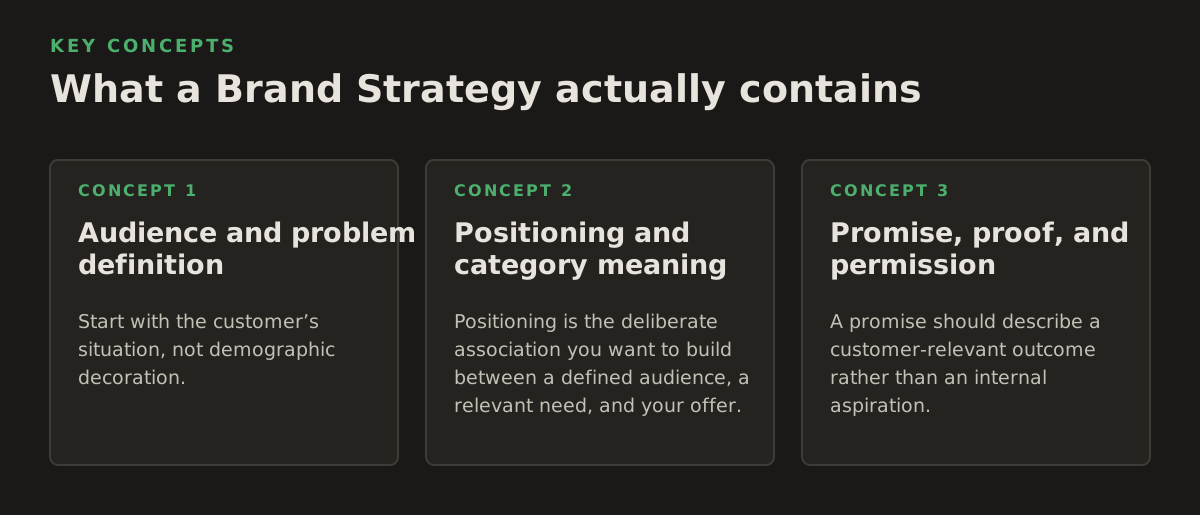
A strategy is strongest when it turns ambiguous marketing questions into explicit choices. “We serve everyone who could use the product” is not a useful target definition. “We are premium” is not a differentiated position. “We care about quality” is not proof. The strategy must narrow the field enough to guide decisions while remaining broad enough to support growth.
Audience and problem definition
Start with the customer’s situation, not demographic decoration. For an ecommerce brand, the useful question may be why a shopper changes from a familiar alternative. For a B2B company, it may be which operational risk creates urgency. For a subscription business, it may be what makes the first month successful enough to justify staying.
Document the customer in terms of:
- The job they are trying to complete.
- The moment or trigger that creates demand.
- The alternatives they consider, including doing nothing.
- The perceived risks of choosing your company.
- The evidence that reduces those risks.
This is more actionable than describing an audience only as “women aged 25–44” or “high-growth companies.” Demographics can help with media planning, but they rarely explain the buying decision by themselves. A useful audience definition should tell a creative team what tension to dramatize and tell a media buyer where qualified demand may be found.
Positioning and category meaning
Positioning is the deliberate association you want to build between a defined audience, a relevant need, and your offer. It should answer four questions:
- Who is the offer for?
- What important outcome does it help create?
- Why is the offer meaningfully different?
- What proof makes that difference credible?
Consider two illustrative positions for a skincare company. “Effective skincare for everyone” is broad but difficult to remember or defend. “A simple routine for people whose sensitive skin makes most product experimentation risky” identifies a situation, a concern, and a reason the brand might matter. The second position does not guarantee success; it gives product, creative, and merchandising teams a sharper set of choices.
Distinctiveness and differentiation are different jobs. Differentiation gives people a reason to prefer you. Distinctiveness helps them recognize you quickly. A brand may differentiate through formulation, service, or distribution while building recognition through consistent color, photography, typography, packaging structure, or verbal cues. Confusing the two leads to either generic messaging or attractive assets with no persuasive substance.
Promise, proof, and permission
A promise should describe a customer-relevant outcome rather than an internal aspiration. “We make commerce better” is an aspiration. “Know which acquisition channels are producing profitable repeat customers” is closer to a useful promise for a marketing partner.
Every promise needs proof. Depending on the business, proof may include:
- Product demonstrations or before-and-after evidence where appropriate.
- Transparent methodology and clearly stated constraints.
- Customer reviews tied to a specific use case.
- Credentials, guarantees, delivery evidence, or operational detail.
- Independent validation or verifiable results.
Permission is the reason a customer should listen now. A relevant trigger, a problem that has become expensive, or a change in circumstances can create that permission. Without it, even a differentiated message may be ignored because it arrives before the customer is ready.
Why strategy changes growth economics
Brand decisions influence performance through several mechanisms. They can improve recognition, reduce uncertainty, increase the relevance of an ad, clarify a product page, and make repeat purchases more likely. None of these effects should be treated as automatic. The strategy has to be expressed consistently and measured against the economics of the business.
It reduces the cost of explaining the offer
Acquisition becomes expensive when every impression must introduce the company, define the problem, explain the product, and overcome distrust. A clear market position gives creative teams a starting point. Repeated associations can allow later ads to spend more time on the customer’s specific situation instead of rebuilding context from zero.
This does not mean repeating one slogan forever. It means preserving the same underlying meaning while changing the execution. A video can show the problem in use, a static ad can state the benefit, and a landing page can provide the proof. The sequence works when the audience can recognize that each asset belongs to the same promise.
It improves the quality of performance signals
Media platforms optimize toward the events and inputs available to them. Google Ads, for example, describes conversion tracking as a way to understand which interactions lead to valuable actions, while its documentation also distinguishes conversion actions and measurement configurations by business objective. See the official Google Ads conversion tracking documentation before selecting an event structure.
A strategy helps define what “valuable” means. If a company optimizes only for cheap leads, it may reward channels and messages that attract poor-fit prospects. If it distinguishes qualified opportunities, first purchases, contribution margin, or repeat orders, the team can judge acquisition against a more meaningful outcome.
For an illustrative ecommerce example, imagine that a brand receives 1,000 first orders at a $40 average order value. If 35% of those customers reorder within the expected period, the acquisition team should not treat a $20 first-order acquisition cost as equivalent to a $20 acquisition cost from customers who never return. The exact acceptable cost depends on margin, fulfillment, refunds, and retention; the point is that the strategic promise should attract the kind of customer the business can serve profitably.
It protects conversion rate from message mismatch
Performance teams often focus on the ad click and treat the landing page as a separate problem. Customers experience them as one claim. If an ad promises a fast, simple solution and the page opens with technical complexity, the gap creates doubt. If the ad implies an affordable entry point but the page reveals mandatory add-ons, the click may have been purchased under a false expectation.
Useful alignment checks include:
- Does the landing page repeat the same customer problem in recognizable language?
- Does the first screen provide the proof implied by the ad?
- Does the offer make the next step as clear as the ad made the problem?
- Are exclusions, shipping conditions, qualification requirements, or contract terms visible early enough?
- Does the post-purchase experience deliver the expectation created before conversion?
Measurement still matters. Google Analytics documentation describes campaign parameters such as source, medium, and campaign name for distinguishing traffic sources; the official campaign URL guidance is a useful reference for consistent tagging. Tags do not fix a weak strategy, but inconsistent tags can make a sound strategy appear unmeasurable.
How to build and operationalize the strategy
Strategy becomes useful when it moves from a presentation into a working system. The process below is intentionally practical: diagnose the current situation, choose a focused position, translate it into behavior, and install feedback loops.
1. Audit the current promise
Collect the language customers encounter before, during, and after purchase. Include ads, search snippets, homepage copy, product pages, sales decks, onboarding emails, packaging, support scripts, and retention campaigns. Do not evaluate these assets only for polish. Look for contradiction.
Build a simple message inventory with columns for audience, problem, promise, proof, call to action, and customer stage. Then mark where the company:
- Makes a claim without evidence.
- Uses different definitions of the primary customer.
- Leads with features before explaining the outcome.
- Sounds interchangeable with category competitors.
- Creates an expectation the product or service does not reliably meet.
Customer research should test assumptions rather than collect flattering quotes. Ask what happened immediately before the purchase, what alternatives were considered, what nearly stopped the decision, and what outcome would make the purchase worthwhile. For lost prospects, ask what felt unclear or risky. For repeat customers, ask what made the product worth buying again.
2. Choose a strategic territory
A strategic territory is a space the brand can credibly occupy over time. It should be relevant to a valuable audience, defensible through capabilities or evidence, and broad enough to generate multiple campaigns.
Score possible territories against four criteria:
- Customer importance: does the territory address a problem that affects the buying decision?
- Credibility: can the company prove it today or build proof realistically?
- Distinctiveness: would the association separate the brand from familiar alternatives?
- Commercial value: does winning this association attract customers with viable economics?
Do not select a territory only because it sounds emotionally appealing. “Freedom,” “confidence,” and “innovation” can support many brands and therefore guide few decisions. A more useful territory contains a specific tension, such as making a complex purchase feel manageable, helping a time-poor buyer avoid waste, or giving an operations leader confidence that growth will not create chaos.
3. Translate strategy into a message architecture
Message architecture prevents every campaign from becoming a fresh debate. It usually contains a central promise, supporting pillars, proof points, objections, and approved language boundaries.
An example for an illustrative analytics service might look like this:
| Layer | Example role | Decision it guides |
|---|---|---|
| Core promise | Make acquisition decisions using revenue-quality signals, not surface-level volume. | What the company should be known for. |
| Pillar one | Connect marketing activity to commercial outcomes. | Which product capabilities to emphasize. |
| Pillar two | Make reporting understandable to non-specialists. | How the benefit should be explained. |
| Pillar three | Expose assumptions and limitations clearly. | How trust should be earned. |
| Proof | Definitions, sample reporting views, methodology, and customer-specific examples. | What evidence belongs near the claim. |
| Objection | “We already have dashboards.” | Which comparison or distinction creative must address. |
The architecture should also define what not to say. If the company cannot promise immediate profitability, do not let a headline imply it. If a service requires customer participation, explain that requirement. Strategic discipline includes declining messages that might produce a cheap click but attract the wrong expectation.
4. Build a creative system, not a single campaign
Creative strategy converts positioning into attention and comprehension. A scalable system has recurring elements that create recognition alongside flexible elements that let the message fit different contexts.
- Recognition cues: recurring visual, verbal, or structural assets.
- Problem frames: different ways to show the customer’s tension.
- Benefit frames: distinct outcomes connected to the same promise.
- Proof formats: demonstrations, comparisons, reviews, data, or process explanations.
- Action formats: trials, product views, consultations, purchases, or educational steps.
A creative testing plan should change one meaningful variable at a time when learning is the priority. If audience, offer, hook, format, landing page, and conversion event all change together, a result may be commercially useful but strategically ambiguous. The team will not know whether the improvement came from stronger positioning, better targeting, or a more compelling offer.
That does not mean every test must be perfectly scientific. Marketing operates under practical constraints. It means the team should label the purpose of each test: diagnose audience resonance, improve clarity, validate proof, or increase action rate. Different purposes require different comparisons.
5. Connect media decisions to the strategy
Media buying should distribute the message to people at different levels of awareness, not merely move budget between platforms. Search may capture existing demand, paid social may create or shape demand, affiliates may borrow trust, and lifecycle channels may increase the value of an acquired customer. The appropriate mix depends on category, buying cycle, creative supply, and measurement quality.
For each channel, specify:
- Which customer problem or intent it is best suited to address.
- Which proof format can credibly work there.
- What action the user should take next.
- Which conversion event will inform optimization.
- What downstream quality signal will validate the acquisition.
Meta’s official documentation describes the Conversions API as a way to create a more direct connection between marketing data and Meta’s systems; review the Meta Conversions API documentation for implementation considerations. The strategic implication is not that a technical connection guarantees better performance. It is that measurement design should reflect the business outcome the strategy is trying to create.
Where Brand Strategy breaks
Most failures are not caused by a lack of strategic vocabulary. They happen when the organization asks strategy to solve a product, offer, measurement, or execution problem it cannot solve alone.
Confusing a visual refresh with a new position
A new identity can improve consistency and recognition, but it does not automatically create demand. If the audience, promise, proof, and customer experience remain unclear, a redesign may simply make the ambiguity more polished.
Before approving a visual refresh, answer:
- What existing association should be preserved?
- What customer misunderstanding should change?
- Which buying context requires stronger recognition or credibility?
- What operational experience must change so the new promise is true?
- How will the team distinguish recognition gains from short-term launch attention?
Trying to own every audience and benefit
Broad reach is not the same as broad relevance. A company may have several customer segments, but one should usually lead the strategic story. Secondary audiences can receive adapted messages without forcing the master brand to mean everything at once.
The trade-off is real: narrowing the position may reduce immediate appeal to some prospects. That can be healthy if it increases relevance and qualification among the customers the business can serve best. The decision should be judged against customer quality and strategic coherence, not only top-line reach.
Using brand language that the product cannot support
Claims create expectations for operations. A “fast” service needs fast delivery. A “simple” product needs a low-friction experience. A “transparent” partner needs understandable reporting, clear scope, and honest explanation of uncertainty. When the experience contradicts the message, paid media may amplify the disappointment.
Legal and platform requirements also constrain claims. Google’s advertising policies, for example, govern the kinds of claims and experiences advertisers can present; consult the Google Ads misrepresentation policy when reviewing guarantees, pricing language, results claims, or omitted conditions. Compliance is not a substitute for credibility, but noncompliant messaging can invalidate otherwise sound creative.
Optimizing for immediate response only
Short-term conversion data is valuable, but it can reward discounts, exaggerated hooks, or narrow audiences that do not support durable growth. A balanced scorecard should include immediate and downstream measures:
- Qualified conversion rate rather than conversion volume alone.
- Contribution margin or revenue quality where reliable data exists.
- Refund, cancellation, or lead rejection rate.
- Repeat purchase or retention behavior.
- Direct or branded demand indicators interpreted carefully.
- Customer feedback about expectation match.
These measures should not be combined into an invented single score unless the business has a defensible weighting method. A dashboard full of metrics can hide the fact that the organization has not decided which outcome matters most.
How practitioners apply it in 2026
In 2026, the practical challenge is not producing more content. It is maintaining strategic coherence while platforms, formats, automation, and customer expectations change. Teams need a repeatable operating rhythm that protects the core position and permits fast execution around it.
Create a one-page decision document
The document should be short enough to use and specific enough to constrain work. Include:
- Primary audience and buying situation.
- Category frame and competitive alternative.
- Core promise in customer language.
- Three supporting reasons to believe.
- Primary objections and approved responses.
- Distinctive assets to preserve.
- Claims or tones the brand should avoid.
- Business outcome the marketing system is designed to improve.
Give every major brief a “strategy connection” field. The team should be able to state which audience tension the asset addresses, which promise it expresses, and what proof it uses. If those answers are absent, the problem is not necessarily the creative team; the strategic system may be too vague.
Separate learning agendas from production agendas
A production agenda asks what assets are needed for the next launch. A learning agenda asks which uncertainty is most expensive. Examples include whether a segment values convenience more than control, whether a proof point overcomes distrust, or whether a product category is understood correctly.
Use a simple prioritization model:
- List the assumption behind the decision.
- Estimate the commercial consequence if it is wrong.
- Identify the cheapest credible way to learn.
- Define the evidence that would change the decision.
- Record what remains uncertain after the test.
An illustrative starting policy might allocate one planning cycle to validate the audience problem, another to validate the promise and proof, and subsequent cycles to scale creative and media execution. This is not a universal timeline; the appropriate cadence depends on traffic, buying cycle, sales capacity, and the cost of being wrong.
Use measurement as a feedback loop
Measurement should answer three different questions:
- Delivery: did the intended audience see the message?
- Response: did the message create the intended action?
- Value: did the action produce a customer or outcome worth acquiring?
Do not use one metric to answer all three. Reach can indicate distribution but not persuasion. Conversion rate can indicate response but not customer quality. Revenue can indicate commercial output but may be delayed, attributed imperfectly, or influenced by factors outside the campaign.
Attribution systems also have limits. Google’s documentation explains that attribution models assign credit across interactions rather than treating every conversion as the result of one isolated touchpoint; see the Google Ads attribution overview when selecting and interpreting a model. In practice, use platform reporting for optimization, analytics for behavior and pathways, and finance or customer systems for economic validation. Disagreement between systems is a reason to investigate definitions, not a reason to select the most flattering number.
Keep the promise stable while the execution evolves
A mature brand does not need every ad to look the same. It needs customers to recognize the same strategic idea across changing contexts. Preserve the core promise, audience relevance, and proof standard; vary the hook, format, spokesperson, demonstration, offer, and level of detail.
For a growth-stage ecommerce company, a sensible sequence might be:
- Use customer and product evidence to define the primary buying tension.
- Write a position that explains why the brand is a credible answer.
- Build several creative routes around that position rather than one hero execution.
- Match each route to an appropriate stage of awareness and landing page.
- Measure first-order response, customer quality, and repeat behavior separately.
- Refresh executions when attention declines without abandoning the association that customers are learning.
The specific recommendation is to treat brand strategy as an operating constraint for growth, not a one-time brand exercise. Before increasing media spend, make the audience, promise, proof, conversion event, and downstream value definition explicit; then use creative and measurement to challenge those choices with evidence. Kimmel Marketing can support that connected work through its digital marketing services, backed by practical marketing expertise across brand, creative, media, and performance decisions. Kimmel Marketing
Authored with NotFair SEO