Brand Strategy Presentation Examples That Turn Positioning Into Growth
Useful brand strategy presentation examples do more than display a logo, color palette, or polished mission statement. They show how a company will become more recognizable, more relevant to a specific customer, and easier to choose—then connect those choices to creative production, media buying, conversion, and revenue. For a growth-stage brand, the best presentation is not a mood board. It is a decision document that helps leadership, creative, sales, and acquisition teams act consistently.
What a brand strategy presentation is supposed to do
A brand strategy presentation is a structured argument about who the brand serves, what it promises, why that promise is credible, and how the business should express it. It turns research and strategic choices into a shared operating model. The audience might include founders approving a repositioning, a marketing leader allocating budget, a creative team developing campaigns, or a performance team trying to improve paid acquisition.
That distinction matters because a presentation can look strategic while avoiding the decisions strategy requires. A collection of competitor screenshots, adjectives, and inspirational imagery does not tell a team which customer to prioritize, which benefit to lead with, or which claims it can defend.
A practical deck usually answers six questions:
- Business direction: What growth problem or commercial opportunity is the brand strategy addressing?
- Audience: Which customer or buying situation matters most now?
- Positioning: What should the brand mean relative to realistic alternatives?
- Proof: Why should a customer believe the claim?
- Expression: How should the strategy appear in language, design, creative concepts, and customer experience?
- Activation: What will change in campaigns, channels, landing pages, and measurement?
The deck should also make clear what is not being claimed. A narrow, credible position is usually more useful than a universal promise such as “the best solution for everyone.” If an ecommerce company wants to move from discount-led acquisition toward higher customer lifetime value, for example, its strategy may prioritize durability, education, and product confidence over constant urgency. That choice affects messaging, offers, creator briefs, landing-page hierarchy, and media objectives.
Strategy is the chain between meaning and behavior
Brand strategy is often treated as a communications exercise, but growth teams need a longer chain:
- Customer tension: What frustration, risk, aspiration, or job is important enough to influence a purchase?
- Strategic choice: What distinctive promise will the brand own?
- Reason to believe: What evidence makes that promise credible?
- Behavioral expression: What should people notice, understand, remember, or do?
- Commercial consequence: Which metric or business outcome should move if the strategy is working?
This chain does not mean every brand impression should be reduced to an immediate conversion. It means the team can explain how a brand choice is expected to contribute to demand, acquisition efficiency, retention, or pricing power. That explanation is especially important when a marketing leader must defend investment beyond last-click revenue.
Why the presentation matters for acquisition and growth
Brand strategy becomes operational when it reduces inconsistency. Without a shared strategic center, campaigns often fragment into channel-specific slogans, audience labels, and visual treatments. Paid social promises one benefit, search ads emphasize another, the landing page introduces a third, and the checkout experience provides no reinforcement. Each asset may be acceptable alone, but the system becomes harder to remember and harder to optimize.
A well-built presentation creates constraints that improve creative decisions. It can tell a team which customer problem deserves emphasis, which proof points are permissible, what tone is appropriate, and which ideas are distinctive enough to repeat. Constraints are not the enemy of creativity; they prevent creative output from becoming disconnected decoration.
The connection to performance marketing
Performance teams need more than a brand tagline. They need a usable translation of strategy into variables that can be observed:
- Message hierarchy: Which promise leads, and which supporting points follow?
- Audience context: How might the same positioning sound to a new prospect, a comparison shopper, or an existing customer?
- Creative territory: What recurring concepts can produce multiple ads without becoming repetitive?
- Conversion expectation: What should the landing page make easier or more credible?
- Measurement role: Is the activity intended to create demand, capture demand, improve conversion, or increase repeat purchase?
For example, a premium skincare company may decide that its position is “effective routines for sensitive skin without unnecessary complexity.” That position can guide a short video explaining ingredient selection, a search ad focused on sensitive-skin concerns, a product page organized around routine simplicity, and a post-purchase email that helps customers use fewer products consistently. The presentation is useful because it connects a strategic idea to a family of actions rather than forcing every channel to repeat one sentence.
Measurement must also match the role of the activity. Google’s official guidance describes conversion tracking as a way to understand actions people take after interacting with ads, but the exact conversion setup depends on the business objective and customer journey (Google Ads conversion tracking documentation). A brand presentation should therefore identify the intended behavior and measurement logic without pretending that one platform metric represents total brand impact.
What makes a deck persuasive to decision-makers
Senior stakeholders rarely need more adjectives. They need to see the trade-offs. A strong presentation explains why the proposed audience is prioritized, why the position is credible, what the business will stop doing, and how the strategy will affect execution. It should expose assumptions that can be challenged before they become expensive production or media decisions.
Use a simple distinction between evidence, interpretation, and decision:
- Evidence: Customers describe the category as confusing, competitors lead with technical specifications, and product returns often involve incorrect product selection.
- Interpretation: The opportunity is not merely to claim superior performance; it is to make confident selection easier.
- Decision: Lead with guidance and fit confidence, then use product performance as supporting proof.
This structure keeps the presentation from presenting an opinion as a fact. It also makes future updates easier: new research can change the evidence without requiring the entire strategic model to be rebuilt.
Five Brand Strategy Presentation Examples and what to adapt
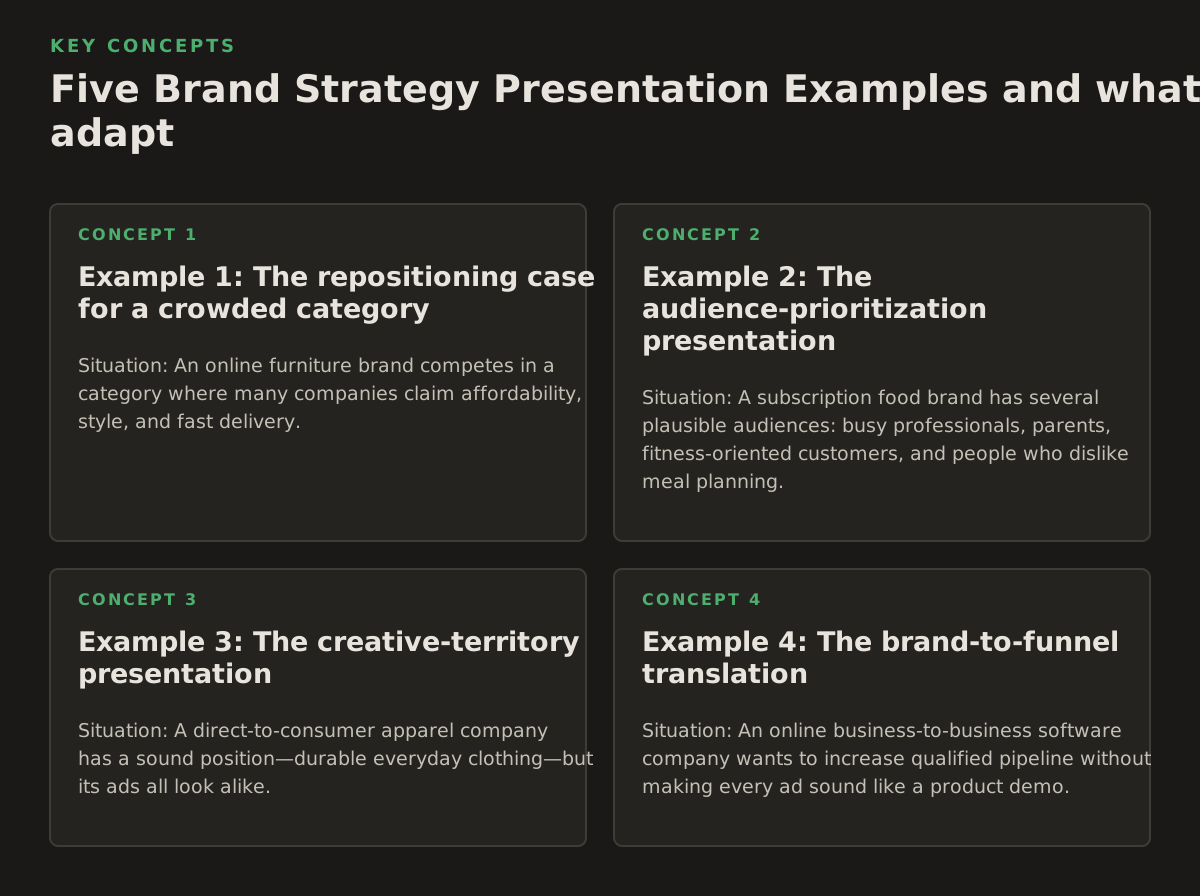
The most useful examples are not famous brand case studies with unavailable internal data. They are reusable presentation patterns showing how a strategic choice becomes an executional system. The following examples use illustrative business situations and numbers. The figures are example inputs, not universal benchmarks; replace them with the company’s own research, economics, and targets.
Example 1: The repositioning case for a crowded category
Situation: An online furniture brand competes in a category where many companies claim affordability, style, and fast delivery. Its presentation opens with a commercial problem: paid acquisition is generating traffic, but shoppers struggle to understand why this brand is different.
Example slide sequence:
- Current perception: “Affordable furniture with modern design,” based on customer interviews and message review.
- Category convention: Most competitors lead with broad style language and frequent promotions.
- Customer tension: Renters and first-home buyers want a coherent room but lack confidence that pieces will work together.
- Position: “The easiest way to build a room that feels considered, one practical piece at a time.”
- Proof: Coordinated collections, room planning guidance, dimensions presented clearly, and delivery expectations stated before checkout.
- Activation: Show complete room combinations in prospecting creative, explain selection logic on landing pages, and use individual products as entry points into a collection.
What it demonstrates: Positioning can create a distinctive buying benefit without inventing a new product category. The promise is not simply “beautiful furniture”; it addresses the confidence gap between browsing a product and assembling a room.
Why it works: It connects customer tension to a concrete experience and gives creative teams a repeatable visual system. It also creates a practical test: do room-based messages produce more engaged product discovery than isolated product claims?
What to adapt: Begin with the customer’s difficult decision, not the company’s preferred adjective. Then show exactly how the brand will make that decision easier.
Example 2: The audience-prioritization presentation
Situation: A subscription food brand has several plausible audiences: busy professionals, parents, fitness-oriented customers, and people who dislike meal planning. Instead of claiming to serve everyone equally, the deck ranks audiences by need, fit, reachability, and economic potential.
| Illustrative audience | Core tension | Strategic role | Example message |
|---|---|---|---|
| Time-poor professionals | They want reliable meals without planning | Primary acquisition audience | “A dependable dinner decision in minutes.” |
| Parents with young children | They need flexibility when plans change | Secondary growth audience | “Flexible meals for unpredictable evenings.” |
| Fitness-oriented customers | They want nutritional control | Proof and product feature audience | “Clear portions and ingredients you can plan around.” |
Illustrative prioritization policy: The team might allocate 60% of new creative development to the primary audience, 25% to the secondary audience, and 15% to exploratory concepts for the third. This is a starting policy, not a benchmark or a recommendation for every company.
What it demonstrates: Segmentation is useful when it changes decisions. A deck that lists personas but gives every segment the same priority has not created a strategy.
Why it works: It prevents creative and media teams from mixing incompatible motivations in one vague message. It also gives performance analysts a clearer way to compare audiences without treating every difference as a new brand position.
What to adapt: Include a prioritization rule and a reason for it. If the business cannot explain why one audience comes first, the segmentation is probably descriptive rather than strategic.
Example 3: The creative-territory presentation
Situation: A direct-to-consumer apparel company has a sound position—durable everyday clothing—but its ads all look alike. The presentation converts the position into three creative territories rather than prescribing one repeated execution.
- Built for repetition: Demonstrate construction, care, and wear over time. This works when durability is credible and visually demonstrable.
- Quiet utility: Show how a small number of dependable pieces simplify daily choices. This works when the audience values reduced friction more than novelty.
- Cost per wear: Explain the economic logic of buying fewer, better-used garments. This can work for comparison shoppers but may fail if the brand cannot substantiate longevity.
Each territory receives a brief with the same strategic guardrails: lead with practical confidence, avoid exaggerated sustainability claims, show the product in ordinary use, and direct the viewer to a page that explains construction and care. The concepts differ in storytelling, but they remain recognizable as one brand.
What it demonstrates: A brand can have creative variety without strategic drift. Territories are especially helpful for growth teams that need enough variation to learn while protecting a consistent position.
Why it works: It separates the enduring strategic idea from the temporary execution. A territory can be refreshed, expanded, or retired without changing the brand’s core promise.
What to adapt: For each territory, document the customer tension, visual behavior, proof requirement, likely funnel role, and failure mode. “Make it emotional” is not a territory; “show the relief of a simpler routine through before-and-after decision moments” is closer to one.
Example 4: The brand-to-funnel translation
Situation: An online business-to-business software company wants to increase qualified pipeline without making every ad sound like a product demo. Its deck maps the same positioning to different stages of decision-making.
| Stage | Customer question | Brand expression | Useful action |
|---|---|---|---|
| Problem recognition | Why is this process becoming costly or risky? | Make the hidden operational problem visible | Read a diagnostic guide or watch an explanation |
| Solution exploration | What approach could solve it? | Show a clearer operating model, not just features | Compare methods or view a workflow |
| Vendor selection | Can this provider deliver safely? | Present proof, implementation expectations, and fit criteria | Request a qualified conversation |
What it demonstrates: The brand promise does not need to be repeated identically at every stage. Its meaning can deepen as the buyer gains context.
Why it works: It stops upper-funnel creative from carrying a low-intent sales message and stops bottom-funnel pages from relying on vague emotional language. The strategy becomes a progression of questions and evidence.
What to adapt: Add a “message job” to every funnel stage. State what the audience should understand or believe before moving forward, and choose the conversion event accordingly.
Example 5: The refresh-without-repositioning presentation
Situation: A profitable ecommerce brand has recognition and repeat customers but inconsistent visual execution across paid social, email, product pages, and retail materials. Leadership does not want to discard the existing position. The presentation separates what is stable from what needs repair.
Keep: The audience, core customer problem, strongest proof point, and established brand association.
Change: Message hierarchy, typography system, product photography rules, promotional language, creator briefing, and landing-page structure.
Test: Whether clearer product education and more consistent creative improve qualified engagement and conversion without relying on deeper discounts. The deck should specify the measurement window and comparison method chosen by the team; it should not promise a lift in advance.
What it demonstrates: A brand refresh can be an operating improvement rather than a symbolic redesign.
Why it works: It reduces unnecessary risk. The company is not asking the market to relearn everything at once, and internal teams can distinguish strategic continuity from executional change.
What to adapt: Include a “do not change” slide. It forces stakeholders to name the equity they are protecting and prevents a refresh from becoming an unbounded preference debate.
Where brand strategy presentations break down
The most common failures happen when the deck is optimized for approval rather than use. Beautiful slides can conceal weak logic, untested assumptions, and missing ownership. A presentation should be judged by what it enables a team to decide six weeks later, not by how impressive it feels in the meeting.
Failure: generic positioning
“High quality,” “customer-focused,” and “innovative” are usually category expectations, not strategic positions. They may belong in supporting language, but they do not tell a prospect why this brand is preferable or tell a creative team what to dramatize.
Repair: Add a competitive contrast and a proof requirement. If the claim could be pasted onto three competitors’ websites without sounding unusual, narrow it or make the customer tension more specific.
Failure: unsupported customer insight
A deck may say “customers feel overwhelmed” because the phrase sounds plausible. Plausibility is not evidence. Label research findings, behavioral observations, hypotheses, and strategic interpretations separately. When the evidence is thin, write “working hypothesis” and specify how the team will challenge it.
Failure: visual identity presented as the strategy
Color, typography, photography, and motion help recognition, but they cannot compensate for an unclear promise. If the presentation reveals the visual system before the audience understands the customer and commercial problem, stakeholders may debate taste instead of strategy.
Failure: no operational translation
“Be more human” does not tell a media buyer which audience to prioritize, a writer which proof point to lead with, or a web team how to restructure a product page. Every strategic principle needs at least one observable implication.
- If the principle is clarity over complexity, reduce competing claims above the fold and explain selection criteria earlier.
- If the principle is earned confidence, show evidence before asking for a high-commitment action.
- If the principle is practical optimism, use specific progress stories rather than exaggerated transformation language.
Failure: confusing platform performance with brand truth
A message can receive cheap clicks without building the intended association, and a brand idea can influence future demand without producing an immediate last-click conversion. Tracking parameters can help distinguish campaign sources in analytics; Google documents how campaign URLs use parameters such as source, medium, and campaign name (Google Analytics campaign URL guidance). But tagging does not solve attribution by itself.
Repair: Define a measurement plan with leading indicators, conversion outcomes, and qualitative checks. For a brand refresh, that might include message comprehension, branded search behavior, direct conversion efficiency, new-customer acquisition cost, and repeat purchase—selected according to the business model rather than copied from a template.
Failure: accessibility and usability treated as finishing touches
Brand expression must work for real people across screens, contexts, and abilities. The Web Content Accessibility Guidelines explain that normal text should meet a minimum contrast ratio of 4.5:1, while large text has a lower minimum of 3:1 under the relevant success criterion (W3C Understanding Success Criterion 1.4.3). Treat such requirements as design inputs, not a final compliance sweep.
Other practical checks include readable type at mobile sizes, captions or transcripts for video, clear focus states, descriptive link text, and forms that explain errors. A strategically distinctive system that customers cannot comfortably read or navigate is not doing its job.
How practitioners turn the deck into an operating plan
After approval, the presentation should become a reference system, not a file that disappears into a shared drive. The next step is to convert strategic decisions into briefs, rules, experiments, and ownership. This is where many brand projects either create leverage or lose momentum.
Build a one-page strategic spine
Condense the approved strategy into a page that a creative or media team can use without reopening the entire deck. Include:
- Priority audience and situation: Who is this for, and when does the need arise?
- Core promise: What valuable outcome should the brand be associated with?
- Proof: Which product, service, process, or customer evidence supports the promise?
- Message hierarchy: What comes first, second, and third?
- Voice rules: What should the brand sound like, and what should it avoid?
- Creative territories: Which recurring ideas can generate varied executions?
- Business role: Is this work intended to create demand, capture demand, improve conversion, or increase retention?
Keep this page stable enough to guide execution, but not so rigid that every campaign becomes identical. The strategic spine should define the boundaries; briefs should make the immediate decisions.
Write better creative and media briefs
A brief should state the strategic problem in behavioral terms. Instead of “increase awareness,” write “help first-time buyers understand why this category is worth considering before they compare prices.” Instead of “make a social campaign,” write “create three concepts that demonstrate the brand’s selection advantage in the first five seconds and route qualified viewers to a guided product page.”
For each brief, specify:
- Audience state: What does the person already know, believe, or misunderstand?
- Single-minded message: What is the one idea the asset must communicate?
- Required proof: What must be shown, demonstrated, or substantiated?
- Executional freedom: What can the team explore without violating the position?
- Destination experience: What should the landing page or product page continue?
- Evaluation method: Which business and user signals will determine whether the work deserves iteration?
For paid search, brand strategy should inform the language and landing-page continuity without replacing search-intent analysis. Google’s documentation on responsive search ads explains that advertisers provide multiple headlines and descriptions that can be assembled into combinations (Google Ads responsive search ads guidance). The strategic implication is not “write more variations” by itself; it is to create variation within a coherent message hierarchy and ensure the destination page supports the promise.
Govern the system with decisions, not taste
Set a regular review in which the team asks whether the strategy is still useful, not whether every asset looks fashionable. Review:
- Consistency: Are audiences encountering the same core meaning across major touchpoints?
- Distinctiveness: Can customers recognize the brand without relying on a logo alone?
- Credibility: Can the business substantiate its prominent claims?
- Efficiency: Are creative and landing-page teams reusing strategic assets rather than rebuilding the argument each time?
- Commercial fit: Is the strategy attracting the type of customer the business can serve profitably?
Do not force every brand question into a short-term experiment. Some decisions are suitable for controlled comparison; others require qualitative research, cohort analysis, or longer observation. The point is to make the reasoning explicit so that the team knows what evidence could change its mind.
For growth-stage companies, this operating discipline is often more valuable than a larger presentation. The deck should help connect brand architecture, creative development, acquisition, conversion optimization, and retention into one accountable system. Teams looking for broader marketing expertise can use that same framework to assess whether their current strategy is being translated consistently across channels.
A practical starting policy for 2026 is to review the strategic spine whenever there is a major audience shift, product change, pricing change, or sustained change in acquisition quality—not merely whenever a campaign underperforms. Campaign performance can reveal an execution problem, a media problem, a conversion problem, or a strategic problem. Diagnose before rewriting the brand.
For companies that need help connecting positioning to creative, acquisition, and measurement, Kimmel Marketing can help translate that chain into a practical operating plan across creative, acquisition, and performance optimization through its Kimmel Marketing.
Authored with NotFair SEO