Brand Strategy Template: Build a Practical Growth Brief
A brand strategy template helps your team make and record the choices that guide how the brand competes, communicates, and grows. Use the worksheet below to define the buyer, market position, proof, brand structure, and creative rules in one brief—then use it to make a specific decision, such as which audience to prioritize or how a new product should fit the portfolio.
For a growth-stage or ecommerce business, the useful test is not whether the document sounds polished. It is whether marketing, creative, and leadership can use it to make consistent trade-offs: what to say, to whom, and what evidence supports the promise. Treat the template as a working decision tool, not a substitute for customer research or a guarantee of commercial results.
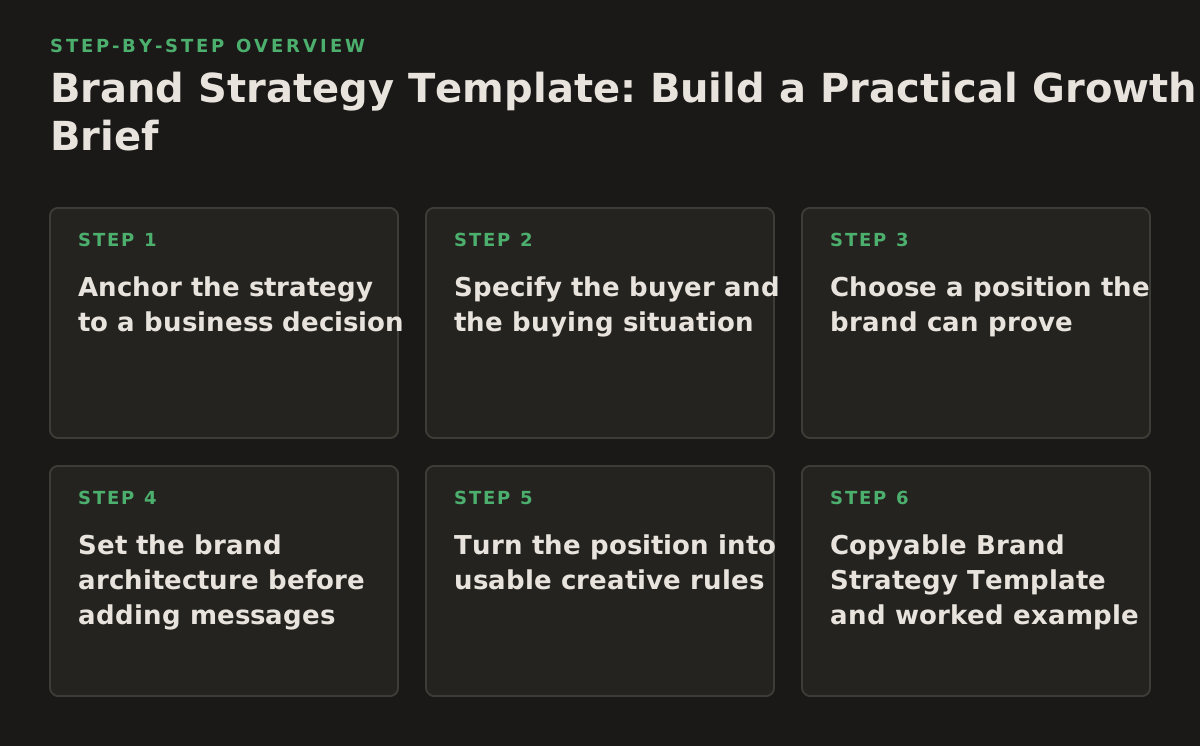
1. Anchor the strategy to a business decision
When it applies: Start here when a brief is being written because the brand feels unclear, acquisition is getting harder, or a launch is approaching. Name the decision the strategy must help with before debating taglines or visual references.
Why it works: A decision gives the work a boundary. “Improve the brand” is too broad to guide a media plan or creative review. “Decide whether our next campaign should prioritize first-time buyers or repeat purchasers” creates a question the research and strategy can actually answer.
Make the decision observable
Record the business objective, the decision-maker, and the evidence that would change the decision. If the goal is more efficient acquisition, for example, identify which customer segment or offer the team is considering—not an unsupported target for lower acquisition cost. A marketing plan can then connect the brand choice to the acquisition work without implying the brand strategy alone will deliver a particular result.
- Objective: what the business needs to improve or protect.
- Decision: what the team will choose after the strategy work.
- Constraint: what cannot change, such as product scope, legal requirements, or available creative resources.
Failure mode: Starting with a desired slogan or campaign look can make research a search for support rather than a way to test assumptions. Example: A subscription business deciding whether to lead with convenience or product quality should identify the launch audience and the evidence needed to choose between those messages before drafting ads.
2. Specify the buyer and the buying situation
When it applies: Use this section when audience labels such as “busy professionals” or “eco-conscious shoppers” are too broad to guide targeting, landing pages, or product messaging.
Why it works: Buyers act in a situation: they have a need, a trigger, alternatives, and a reason to hesitate. Describe those conditions alongside the audience. GOV.UK’s service guidance recommends starting with user needs and researching them rather than assuming them; that is a useful discipline for commercial brand work too (GOV.UK guidance on user needs).
Write a buyer situation, not a persona biography
Capture what the buyer is trying to do, what prompts the search, what they compare, and what makes the choice feel risky. For an ecommerce brand, that might include uncertainty about fit, shipping, ingredients, returns, or whether a product works with what the customer already owns. Keep the statements as hypotheses until supported by interviews, support themes, reviews, search behavior, or other relevant evidence.
- Describe the job or problem in the buyer’s words where possible.
- List the realistic alternatives, including doing nothing or keeping the current solution.
- Separate observed evidence from internal assumptions.
Failure mode: A demographic description can look precise while saying little about the actual purchase. Example: Instead of “urban adults aged 25–40,” write “people replacing a household cleaner who want to avoid buying several products but are unsure whether one formula will work on their surfaces.” Validate whether this need appears in customer evidence before building a major campaign around it.
3. Choose a position the brand can prove
When it applies: Use a positioning statement when customers could plausibly choose several alternatives, or when internal teams describe the brand in noticeably different ways.
Why it works: Positioning connects a chosen audience and need to a relevant difference, then asks what makes that difference credible. The distinction matters: “premium,” “innovative,” and “customer-first” are claims, not proof. The FTC explains that advertising claims must be truthful and supported; its guidance is a reminder to check objective promises before they appear in brand or campaign language (FTC advertising guidance for small businesses).
Use a compact positioning statement
For [priority buyer] who [need or situation], [brand] is the [category or alternative] that [meaningful difference], because [evidence the business can substantiate].
Write the difference from the buyer’s point of view, not as an internal feature list. Then check whether the evidence supports the exact wording. A product feature, documented process, or service policy may support a claim; a hoped-for customer outcome does not prove itself.
Failure mode: A positioning statement that promises every benefit leaves the team with no priority and can create claims risk. Example: A refillable cleaning brand might explore “a simpler way to restock household cleaner” if its refill system genuinely reduces the number of separate purchasing steps. The team should verify that the product experience supports that statement and avoid turning “simpler” into an unsubstantiated environmental or performance claim.
4. Set the brand architecture before adding messages
When it applies: This decision matters when a company has multiple products, sub-brands, audiences, or planned launches—and customers or employees may not know how they relate.
Why it works: A clear structure helps customers understand what carries across the portfolio and what is distinct. It also helps the team decide whether a new offer should strengthen the parent brand, have its own identity, or sit between the two. Choose based on customer understanding and operating needs, not on a preference for more names or more logos.
Map relationships and naming rules
List the parent brand, current offers, planned offers, and any meaningful audience differences. For each, record the role it serves and whether it shares the parent name, visual system, and core promise. If a product is aimed at a distinct need, that alone does not require a separate brand; a separate identity adds communication and maintenance work.
- Keep an offer under the parent brand when the same trust and promise help explain it.
- Consider a distinct sub-brand when the audience, need, or proposition is materially different and customers need that distinction.
- Write a naming rule for future launches so every new product does not reopen the same debate.
Failure mode: Adding a sub-brand to solve a temporary campaign problem can fragment recognition and create ongoing creative work. Example: An ecommerce company adding a larger refill size could first test whether a descriptive product name under the existing brand communicates the difference; it need not assume a separate identity is warranted.
5. Turn the position into usable creative rules
When it applies: Use this section when several people or agencies create ads, product pages, email, or social content and the brand feels different from one touchpoint to another.
Why it works: A useful system sets boundaries while leaving room to adapt a message to its placement. Define what must stay consistent—such as the core promise, proof, and recognizable verbal or visual cues—and what can change, such as the hook, format, or level of detail. Accessibility also belongs in the system: W3C explains that WCAG provides recommendations for making web content more accessible, including content for people with disabilities (W3C overview of WCAG).
Write rules people can apply
Describe voice through contrasts and examples, not a string of adjectives. “Direct, not blunt” is a start; show a sample headline that follows the rule and one that breaks it. Add practical guidance for image selection, product naming, claim review, and legibility. Accessibility details should be checked against the applicable guidance and actual creative—not treated as a promise that a brand document alone ensures compliance.
- Must stay: the audience, positioning, and approved proof.
- Can flex: channel-specific opening lines, formats, and calls to action.
- Check before publishing: claim support, readability, and the destination page’s consistency with the ad.
Failure mode: Rules such as “be bold” or “use beautiful imagery” invite inconsistent interpretation. Example: For a product ad, specify that the opening should name a real use case, the demonstration must show the actual product, and any performance statement needs an approved source. That gives a creator room to write without leaving the brand’s evidence behind.
6. Copyable Brand Strategy Template and worked example
Copy this worksheet into a planning document and answer every prompt. Use short, decision-ready answers; attach research or claim evidence where a reviewer can find it. If an answer is unknown, mark it as an assumption rather than filling the gap with confident language.
Worksheet
| Prompt | Your answer |
|---|---|
| What business decision must this strategy help the team make? | [Decision and owner] |
| Who is the priority buyer, and what situation or trigger makes the need relevant? | [Buyer, need, and context] |
| What alternatives does the buyer consider, including doing nothing? | [Alternatives] |
| What should the buyer understand about this brand that distinguishes it? | [Positioning statement] |
| What evidence supports the difference and any customer-facing claims? | [Proof and evidence location] |
| How do products, sub-brands, or offers relate to the parent brand? | [Architecture and naming rule] |
| What creative elements must stay consistent, and what may vary by channel? | [Brand rules] |
| What evidence or review will show whether the strategy needs revision? | [Validation plan and owner] |
Illustrative filled example
Scenario: A fictional ecommerce brand sells refillable household cleaning products. This example shows how to make the fields specific; it is not a claim about a real product or a proven customer finding.
- Decision: Choose the main message for the next product-page refresh; the ecommerce lead owns the decision.
- Buyer and situation: A shopper replacing a household cleaner wants fewer separate products but is unsure what the refill system includes.
- Alternatives: Buy a familiar single-use product, compare other refill options, or delay replacing the current cleaner.
- Positioning: For shoppers who want a clearer way to restock household cleaner, the brand offers a refill format that explains the steps and contents before purchase.
- Proof: Confirm the actual product contents and instructions on the product page before making those details central to an ad.
- Architecture: Keep the refill size under the parent brand unless customer evidence shows that shoppers need a distinct offer identity.
- Creative rules: Show the real refill steps; vary the opening line by placement; do not make environmental or performance claims without support.
- Validation: Review customer questions and product-page behavior after the refresh, then record what evidence would justify a messaging change.
Adapt the fields: Replace the illustrative buyer and offer with your own evidence. Keep the worksheet concise enough to use in a campaign brief, but link out to the research, approved claims, and customer feedback behind important decisions. Update an answer when new evidence changes the choice—not simply because a stakeholder prefers different wording.
7. Implement the strategy in sequence
When it applies: Use this plan once the team has a draft strategy and needs to put it to work across the website, acquisition creative, and product portfolio. The order prevents teams from scaling language before the core claims and choices are clear.
- Resolve the decision and evidence gaps. Confirm the objective, decision owner, priority buyer, and assumptions that require research. If the buyer need is uncertain, gather evidence before treating the positioning as settled.
- Approve the position and proof. Review the promise against product reality and available evidence. Remove or qualify claims the team cannot substantiate, and record where approved proof lives.
- Set architecture and creative rules. Agree on how offers relate, what must remain consistent, and what can flex. Keep the rules brief enough to use during actual creative reviews.
- Apply the brief to one priority touchpoint. Update a campaign or product page as a practical test of whether the strategy gives the team clear choices. Check that the ad promise, creative, and destination experience align.
- Measure, learn, and revise deliberately. Define the relevant business and customer signals before launch. For campaign attribution, Google Analytics documents the use of campaign URL parameters such as source, medium, and campaign name (Google Analytics guidance on campaign URLs). Use consistent naming so reports can be interpreted; do not treat a tracked result as proof that brand strategy alone caused it.
Failure mode: Rolling the brief out as a static brand document can leave channel teams without a usable application. For paid search, for example, Google Ads responsive search ads use multiple headlines and descriptions that can be combined into ads (Google Ads guidance on responsive search ads). Build message options from the approved position and proof, then review whether each combination remains clear and accurate.
If the work also requires coordinated planning across brand, creative, media buying, and performance optimization, review Kimmel Marketing’s digital marketing services and marketing expertise to understand its stated focus. For a strategy suited to your specific business, you can also learn about Kimmel Marketing.
Authored with NotFair SEO