Brand Strategy Vs Marketing Strategy: What Growth Teams Need to Know
For growth-stage brands, understanding brand strategy vs marketing strategy is not an academic exercise. It determines whether your paid media compounds an advantage or merely buys temporary traffic. Brand strategy defines the meaning, promise, audience, and distinctive position a company wants to own. Marketing strategy turns that foundation into a coordinated plan for reaching customers, creating demand, converting buyers, and increasing lifetime value.
The two disciplines overlap, but they answer different questions. Brand strategy asks, “Why should this business matter, and why should customers choose it?” Marketing strategy asks, “Which customers will we pursue, through which channels, with what offer, and how will we measure profitable growth?” Confusing them creates familiar problems: attractive campaigns with weak conversion, efficient acquisition with poor retention, or a clear brand that never reaches enough qualified buyers.
What brand strategy and marketing strategy actually mean
A useful distinction is that brand strategy is the long-term choice of meaning, while marketing strategy is the operating plan for turning that meaning into commercial outcomes. Brand strategy should make decisions about the market a company wants to shape, the customers it is best equipped to serve, the problem it solves, and the associations it wants to build over time.
Brand strategy sets the direction
Brand strategy is more than a name, logo, color palette, or tone-of-voice document. Those are expressions of strategy. The strategy itself establishes a set of choices that should remain relatively stable even as campaigns, platforms, and promotions change.
- Audience priority: Which customer or buying situation matters most, and which audiences are secondary?
- Category and frame of reference: What kind of solution is the company offering, and against what alternatives will buyers compare it?
- Positioning: What valuable, credible, and distinctive place should the business occupy in the customer’s mind?
- Promise and proof: What outcome does the brand commit to, and what evidence supports that commitment?
- Personality and distinctive assets: What should the brand consistently look, sound, and feel like?
For example, an ecommerce skincare company might decide that it is not simply selling “clean beauty.” Its strategic position could be dermatologist-informed routines for people with sensitive skin who are tired of trial and error. That choice affects product education, packaging, creator partnerships, landing-page structure, customer service, and the claims the company can responsibly make.
Marketing strategy turns direction into choices
Marketing strategy is the system for creating and capturing demand. It connects business goals to customer segments, offers, channels, creative, budgets, sales or ecommerce operations, and measurement. It can include both brand-building work and direct-response activity.
- Business objective: Revenue growth, customer acquisition, contribution margin, retention, or a defined combination.
- Market and customer priorities: Which segments, geographies, products, or use cases receive investment?
- Go-to-market route: Which mix of organic, paid, owned, partner, retail, sales, and lifecycle channels will reach those customers?
- Offer and conversion path: What should a prospect do next, and what friction prevents that action?
- Resource allocation: How will people, creative capacity, media spend, and data support the plan?
- Measurement and learning: Which leading and lagging indicators determine whether to scale, revise, or stop?
Marketing strategy therefore changes more often than brand strategy. A company may retain its positioning while shifting budget from search to video, changing its introductory offer, entering a new market, or redesigning its checkout experience.
| Decision | Brand strategy | Marketing strategy |
|---|---|---|
| Primary question | What should we mean to the right customers? | How will we create and capture demand profitably? |
| Typical horizon | Longer term; durable direction | Annual, quarterly, and campaign planning |
| Core outputs | Positioning, promise, proof, personality, architecture | Segments, channels, offers, campaigns, budget, measurement plan |
| Success signal | Distinctive preference and stronger customer meaning | Quality demand, efficient acquisition, revenue, and retention |
The practical test is simple: if a decision would still matter after the current campaign ends, it may belong in brand strategy. If it concerns how to reach, persuade, convert, or retain a priority audience now, it is probably a marketing strategy decision.
Why the distinction matters for growth and acquisition
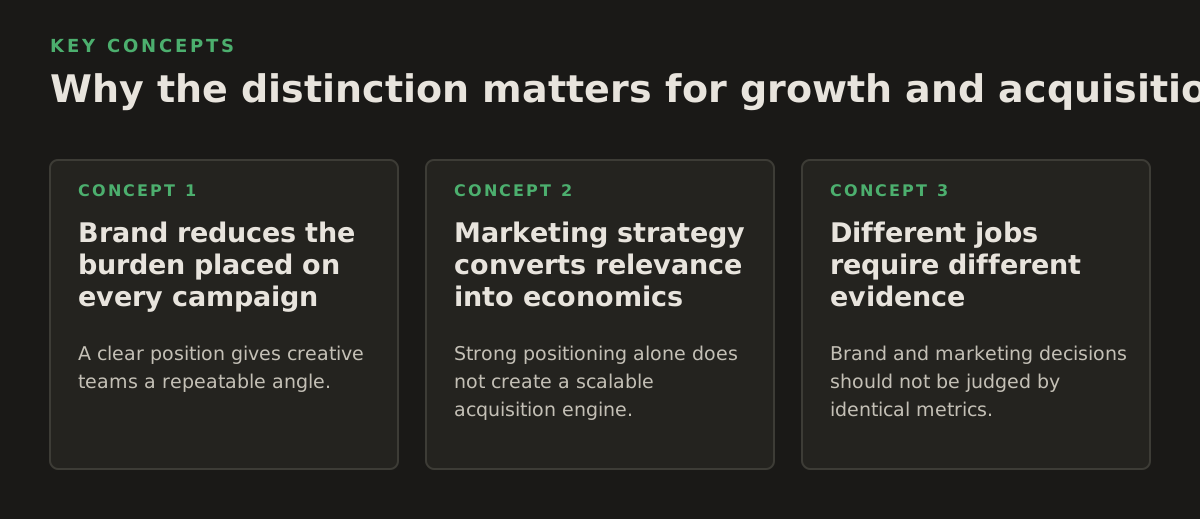
Growth teams often feel the consequences of a weak brand strategy before anyone names the problem. Media costs rise, creative fatigue appears quickly, and campaigns become dependent on discounts. Yet the issue may not be targeting or bidding. It may be that the market has no clear reason to remember or prefer the offer.
Brand reduces the burden placed on every campaign
A clear position gives creative teams a repeatable angle. Instead of producing disconnected ads that all say “high quality” or “shop now,” they can demonstrate a specific customer problem and a recognizable point of view. That consistency helps prospects understand an unfamiliar company faster and gives existing customers a reason to recognize new communications.
Brand strategy does not replace performance marketing. It improves the conditions in which performance marketing operates. A paid social ad can generate a click, but the brand’s positioning influences whether the prospect trusts the landing page, understands the offer, remembers the company, and returns later through another channel.
Marketing strategy converts relevance into economics
Strong positioning alone does not create a scalable acquisition engine. The business still needs a channel plan, a usable offer, sufficient creative volume, landing pages that answer objections, and a measurement model that distinguishes profitable growth from superficial volume.
For an ecommerce company, a campaign can show an acceptable return on ad spend while quietly acquiring customers who rarely purchase again or who require heavy discounting. A better marketing strategy connects channel performance to contribution margin, customer acquisition cost, payback, and lifetime value. The right target may differ by product margin, inventory position, repeat-purchase pattern, and cash constraints.
Measurement also has to respect what each activity can realistically do. Google Ads explains that Ad Rank incorporates factors such as bid, ad quality, the context of the search, and the expected impact of assets; it is not simply a matter of paying the most. That makes creative relevance and landing-page experience part of media performance, not separate branding concerns. Google’s Ad Rank documentation details those auction considerations.
Different jobs require different evidence
Brand and marketing decisions should not be judged by identical metrics. A direct-response campaign may be evaluated against purchases or qualified leads. A brand initiative may initially influence aided awareness, branded search, direct traffic, consideration, or the rate at which later campaigns convert. Those indicators are not interchangeable, and none should be used as a substitute for commercial outcomes indefinitely.
- Brand indicators: Distinctive recall, branded search behavior, direct traffic quality, consideration, and message association.
- Demand indicators: Qualified site visits, product-page engagement, email sign-ups, demo requests, and category searches.
- Acquisition indicators: Conversion rate, new-customer CAC, cost per qualified lead, payback period, and contribution margin.
- Retention indicators: Repeat purchase rate, subscription continuation, cohort revenue, refund rate, and customer service burden.
For a 2026 growth plan, define the relationship between these layers before launch. Otherwise, a brand campaign may be asked to prove immediate revenue, while a conversion campaign is allowed to run without a credible profitability threshold.
How the two strategies work together in practice
The strongest operating model is not “brand first, marketing later.” It is a feedback loop. Brand strategy establishes the strategic constraints and distinctive promise. Marketing strategy places that promise in real buying situations. Performance data then reveals where the proposition is compelling, misunderstood, unsupported, or aimed at the wrong audience.
1. Start with the commercial problem
Begin with the business constraint, not the channel. A founder may say the company needs more traffic, while the actual constraint is low repeat purchase. A media team may request more creative, while the real issue is that the offer has no clear advantage over familiar alternatives.
Write the problem in measurable terms:
- Is the priority acquiring more first-time customers?
- Is the company trying to lower acquisition cost without reducing customer quality?
- Does the business need more demand in a new category or simply better conversion from existing demand?
- Is the growth constraint awareness, consideration, checkout friction, product-market fit, or retention?
- Which financial outcome must improve: revenue, gross profit, contribution margin, or cash payback?
This step prevents a channel plan from becoming a proxy for strategy. “Run paid social” is an execution choice. “Reach high-intent buyers who currently compare us with a cheaper substitute” is a strategic problem statement.
2. Translate positioning into customer-facing reasons to act
Positioning is usually too compressed to serve as ad copy. It must be translated into a message system: the central promise, supporting reasons to believe, objections, proof points, and situations in which the product matters.
Imagine a project-management software company positioned around reducing coordination overhead for distributed product teams. Its marketing strategy could express that position through several routes:
- A comparison page showing how it reduces handoffs between product and engineering.
- A short video demonstrating a weekly planning workflow.
- A customer story focused on fewer status meetings rather than generic productivity claims.
- Search ads aimed at teams looking for a replacement for fragmented tools.
- An onboarding sequence that helps the buyer reach a meaningful first workflow quickly.
Each execution has a different job, but all reinforce the same strategic meaning. This is where message hierarchy and creative consistency matter. Consistency does not mean every ad looks identical; it means the audience can connect different executions to the same valuable idea.
3. Match channel to customer behavior and message maturity
Marketing strategy decides where a message belongs. Search often captures an existing problem or category demand. Social and video can introduce a problem, dramatize a use case, or create memory before a customer is ready to search. Email and onsite experiences develop trust and support conversion. Partnerships and sales may provide proof for higher-consideration purchases.
Do not assume the same creative can perform equally well everywhere. A prospect who searches for “sensitive skin moisturizer” may need reassurance about ingredients and suitability. A prospect encountering a video prospecting ad may first need to recognize their recurring irritation problem. The brand idea can remain constant while the channel role, audience temperature, and call to action change.
Official Google Search guidance describes SEO as helping search engines understand content and helping users decide whether to visit a site. That reinforces a useful division of labor: the page must communicate a relevant answer clearly, while the broader marketing strategy decides how the audience reaches and uses that page. Google Search Central’s SEO Starter Guide covers this relationship between content, search visibility, and users.
4. Build measurement that reflects the journey
Measurement should connect exposure, behavior, and business value without pretending that every customer journey is perfectly observable. Establish an event and naming framework before launch, define the primary conversion, and document which figures are platform-reported, analytics-reported, modeled, or finance-validated.
Google Analytics documentation distinguishes events from key events and explains how businesses can mark important interactions for reporting and analysis. That makes it useful to define actions such as product view, quiz completion, checkout start, purchase, or qualified lead explicitly rather than relying on a vague “engagement” number. Google Analytics’ event documentation provides the official framework for configuring and interpreting these interactions.
An illustrative measurement hierarchy for an ecommerce brand might look like this:
- Business outcome: Increase monthly contribution profit from new customers.
- Acquisition outcome: Generate 800 new customers at an illustrative starting CAC ceiling of $42.
- Behavioral indicators: Improve product-page-to-cart rate from 6% to 8% and checkout completion from 48% to 55%.
- Learning questions: Determine whether the sensitive-skin message, the ingredient proof, or the routine bundle produces the strongest qualified response.
- Guardrails: Monitor refund rate, discount depth, repeat purchase, and inventory availability before increasing spend.
These figures are an illustrative planning example, not universal benchmarks. The important mechanism is the connection between a strategic hypothesis and an observable decision. If the new message produces more clicks but fewer qualified purchases, the team has learned something different from a simple “winner” announcement.
Where the relationship breaks down
Most strategy failures are not caused by choosing brand or performance. They happen when the two are disconnected, when one is asked to do the other’s job, or when internal incentives reward a misleading proxy.
Failure mode: positioning is broad enough to mean nothing
Statements such as “premium quality,” “innovative solutions,” and “customer-first service” may be true, but they rarely provide a useful basis for creative or channel decisions. A position needs a specific customer, context, advantage, and proof. If competitors can repeat it without changing a word, it is probably a value claim rather than a distinctive position.
Failure mode: performance creative becomes a discount machine
Discounts can create a reason to act, but overuse teaches buyers to wait and can obscure the product’s real value. If every winning ad relies on price reduction, investigate whether the brand has failed to communicate a credible non-price advantage or whether the target audience is misaligned with the economics.
Failure mode: brand work is isolated from conversion reality
A polished identity cannot compensate for slow pages, unclear shipping information, weak product proof, or an inconvenient checkout. Google’s documentation on Core Web Vitals identifies loading, interactivity, and visual stability as dimensions of page experience; the details are technical, but the commercial implication is straightforward: creative promise and onsite experience must not contradict each other. The official web.dev Core Web Vitals guidance explains these page-experience measures.
Failure mode: attribution is treated as truth rather than evidence
Last-click reporting can undervalue earlier influence, while platform reporting can make separate channels appear to claim the same conversion. Neither problem is solved by selecting a more impressive dashboard. Use consistent definitions, compare trends over time, and reconcile marketing reporting with orders, revenue, margin, and customer cohorts.
- Red flag: A campaign reports low CAC, but finance cannot reconcile the order count.
- Red flag: Branded search receives more credit after a major awareness push, but no one checks incremental demand.
- Red flag: New-customer volume rises while repeat purchase and contribution margin fall.
- Red flag: Creative is judged only by click-through rate even when the business goal is profitable revenue.
- Red flag: Teams use different definitions for “lead,” “qualified lead,” “new customer,” or “returning customer.”
There is also a strategic timing problem. A brand refresh may be justified, but it should not become an excuse to pause all acquisition learning. Conversely, a company facing weak retention should not increase media spend simply because the dashboard shows more traffic. Strategy is a sequence of choices under constraints, not a permanent permission slip for a preferred discipline.
How practitioners apply both strategies to a growth plan
For a growth-stage brand, the best approach is to make the relationship explicit in planning documents, creative briefs, and weekly decisions. Brand strategy should provide the guardrails. Marketing strategy should provide the route to market. Performance optimization should test whether the route and message are working together.
Use a three-layer planning model
Document three layers separately, then connect them:
- Strategic layer: Priority audience, category frame, positioning, promise, proof, and distinctive assets.
- Market layer: Customer journey, channel roles, offers, budget logic, sales or ecommerce experience, and retention plan.
- Execution layer: Campaigns, ad variations, landing pages, audiences, bids, email flows, tests, and reporting cadence.
When a campaign underperforms, this model helps locate the problem. The strategic layer may be wrong if buyers do not value the promise. The market layer may be wrong if the audience or channel is poorly chosen. The execution layer may be wrong if the landing page is confusing or the creative does not express the proposition. Without these layers, teams often change targeting when the offer is weak or redesign the brand when the campaign setup is the issue.
Write briefs that preserve strategy without limiting creativity
A useful brief should state the decision the work must support. Include:
- The customer situation or tension being addressed.
- The single idea the audience should remember.
- The proof that makes the idea credible.
- The action the audience should take next.
- The channel context and level of awareness.
- The commercial guardrail, such as profitable new-customer acquisition or qualified demand.
- The learning question, such as whether convenience or clinical proof is the stronger reason to choose.
Do not prescribe every visual or line of copy in advance. If the strategic job is clear, creative teams can produce multiple executions while maintaining coherence. The result should be a portfolio of assets: some designed to create recognition, some to explain value, some to overcome objections, and some to close the sale.
Set decision rights and review rhythms
Brand leaders should own the integrity of the position and distinctive assets. Growth and marketing leaders should own channel allocation, offer strategy, funnel performance, and commercial learning. Finance should validate the economics. Creative and media teams should have enough context to explain what an asset is intended to do.
A practical starting policy for 2026 might include:
- A monthly creative review for message consistency, fatigue, and new customer objections.
- A weekly performance review focused on spend, qualified conversions, conversion rate, and delivery issues.
- A quarterly strategy review covering positioning relevance, customer quality, retention, and category changes.
- A documented escalation rule for when a campaign should be paused because of margin, inventory, compliance, or customer-experience risk.
This is a starting policy, not a universal cadence. A seasonal retailer may need daily inventory and promotion decisions, while a complex B2B sale may require longer windows before judging lead quality.
Know when to invest in brand work
Brand investment is especially relevant when the company faces one or more of these conditions:
- Customers cannot clearly explain why the company is different.
- Acquisition depends heavily on discounts or one channel.
- Creative performance declines quickly because every asset uses the same direct-response angle.
- Branded demand is weak despite a useful product and adequate distribution.
- The company is entering a category, audience, or price tier where existing recognition does not transfer.
- Product, website, advertising, and customer experience communicate different promises.
That does not mean launching a large awareness program automatically. Start by clarifying the position, message system, proof, and customer experience. Then select the smallest set of channels capable of creating the needed memory or consideration, and define how you will assess progress alongside acquisition metrics.
Conversely, prioritize marketing strategy and conversion work when the brand is understood but growth is constrained by reach, offer structure, landing-page friction, weak lifecycle journeys, or poor budget allocation. A familiar brand can still have an inefficient funnel.
Make the recommendation specific to the business
For most growth-stage and ecommerce companies, the right answer is not to choose between brand and marketing strategy. Establish a clear brand position first, then build a marketing strategy that assigns each channel a job and ties execution to unit economics. If the brand promise cannot be expressed in a useful ad, landing page, product experience, or retention message, the strategy is not yet operational.
Use brand strategy as the constraint that creates coherence, and use marketing strategy as the resource-allocation system that creates accountable growth. Teams that need help connecting positioning, creative development, media buying, and performance optimization can explore Kimmel Marketing’s Kimmel Marketing, including its digital marketing services and broader marketing expertise.
Authored with NotFair SEO