Campaign Strategy Examples: 6 Patterns Growth Teams Can Adapt
Useful campaign strategy examples connect a specific business goal to an audience, an offer, a channel plan, and a way to judge results. For a growth or ecommerce team, the right example is not the flashiest promotion: it is a repeatable pattern that addresses a real customer decision and can be measured against acquisition cost, revenue, or another agreed outcome. Use the six patterns below to choose a campaign shape, spot common failure modes, and turn the idea into a testable brief.
Each scenario is illustrative, not a claim about a real brand or a guaranteed result. Adapt the mechanism to your own margins, customer journey, tracking quality, and ability to fulfill demand. Before execution, align the plan with the business’s growth objective and define what evidence would justify continuing, changing, or stopping it.
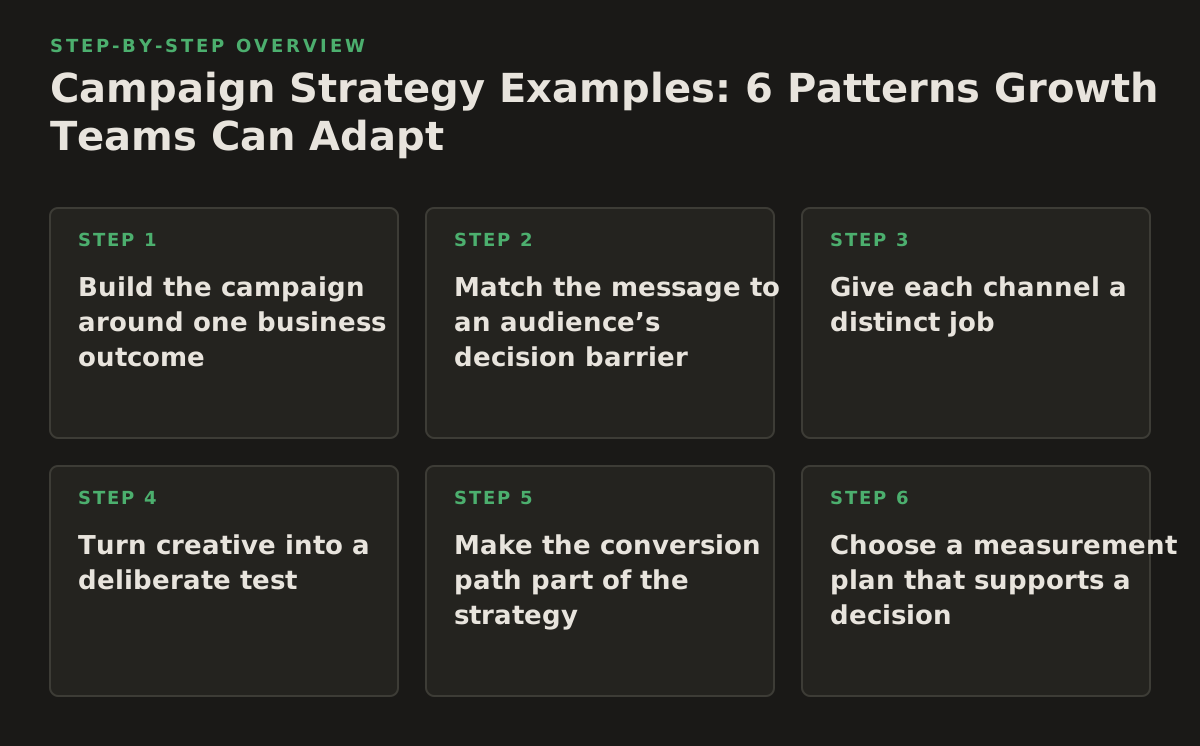
1. Build the campaign around one business outcome
Use this pattern when a team has several competing priorities—such as acquiring new buyers, reactivating lapsed customers, and promoting a product launch—and needs to decide what a campaign is actually for. A campaign can support more than one benefit, but it should have one primary outcome that guides the offer, audience, and measurement.
Example: first-order acquisition for a new product line
Imagine an ecommerce brand introducing a new range of reusable food containers. The campaign’s primary outcome is first orders from customers who have not purchased before. The strategy might use a product demonstration, a starter bundle, and a landing page explaining materials, sizes, and care. Repeat purchase or email sign-ups can be monitored as secondary outcomes, but they should not replace the acquisition decision.
- Why it works: the product story, offer, and conversion path all support the same customer action.
- Failure mode: optimizing for inexpensive clicks or broad engagement while the business needs profitable new customers.
- Adapt it: write the primary outcome in one sentence, then list the one or two supporting signals that help explain it.
Set the target with finance or ecommerce leadership using your actual contribution margin and customer economics. A low acquisition cost is not automatically healthy if it comes from discounting that erodes margin or attracts one-time buyers unlikely to return.
2. Match the message to an audience’s decision barrier
Use this pattern when the audience is known but the reason for hesitation is not. Instead of treating a demographic or customer list as a strategy, identify the barrier preventing the next action: uncertainty about fit, concern about switching, lack of trust, or simply not understanding the product’s value.
Example: reduce uncertainty before asking for a purchase
Suppose a skincare retailer wants to reach shoppers considering a new routine. One message could lead with product ingredients; another could explain how to choose a routine for a stated skin concern and what to expect from each product. The campaign can direct each message to a relevant page rather than sending every audience to the same general storefront.
- Why it works: the message answers a question that exists at that point in the decision process.
- Failure mode: making a sensitive or unsupported personal claim, or assuming an audience trait means every person has the same concern.
- Adapt it: write a short barrier statement—“I’m unsure whether this is right for me”—and make the creative answer it with specific, substantiated information.
Separate audience insight from audience targeting. A customer interview or support question may suggest a useful message, but it does not by itself prove that a particular targeting segment is available, accurate, or appropriate on a given platform. Kimmel Marketing’s marketing expertise can be a starting point for readers considering how strategy and marketing choices fit together.
3. Give each channel a distinct job
Use this pattern when a campaign spans paid social, search, email, retail media, or other channels. A channel plan is stronger when every placement has a defined role in the customer journey, rather than repeating the same ad everywhere and counting each interaction as independent demand.
Example: launch a replenishable household product
An illustrative launch could use short-form video to demonstrate the product in use, non-brand search ads to reach people actively looking for a solution, and an email sequence to explain replenishment after a first purchase. Each channel has a different job: introduce, capture existing intent, or support a subsequent customer action. The sequence should reflect the real buying cycle; it should not assume every prospect sees every message in order.
- Why it works: creative and destination pages can be tailored to the context in which the customer encounters the campaign.
- Failure mode: treating platform-reported conversions as additive, even when channels may claim credit for overlapping customer journeys.
- Adapt it: for each channel, specify its audience, role, message, destination, and decision metric before setting up the campaign.
For paid campaigns, choose an objective that matches the action you intend to optimize. Meta describes its ad objectives in terms of outcomes such as awareness, traffic, engagement, leads, app promotion, and sales; consult its overview of ad objectives when mapping a campaign goal to a platform setup. The platform choice does not replace your own business-level definition of success.
If you want to compare real creative campaign case studies, use them to compare creative campaign case studies and find ideas for planning a marketing campaign—not to copy a surface treatment without understanding its audience, offer, and context.

4. Turn creative into a deliberate test
Use this pattern when a team has several plausible messages and needs to learn which one changes customer behavior. A creative test is not simply a collection of unrelated ads. It isolates a meaningful question, such as whether proof, convenience, or a product demonstration better addresses the audience’s barrier.
Example: test the reason to believe
A subscription coffee brand could compare two otherwise similar concepts: one leads with how the product is sourced, while the other shows how a flexible delivery schedule fits a busy morning routine. Keep the audience, offer, destination, and campaign objective consistent where practical so the test can help distinguish the message’s contribution. If both concepts change at once, the result may not reveal what drove any difference.
- Why it works: a clear hypothesis makes the outcome useful for the next brief, whether the test wins or not.
- Failure mode: changing audience, offer, format, and landing page together, then attributing the result to one creative idea.
- Adapt it: document the hypothesis, the single main variable, the primary measure, and what decision follows each plausible result.
Where an experiment setup is available, Google Ads explains how campaign experiments can compare changes against a base campaign. Its campaign experiments documentation is useful for understanding the structure; it does not mean every creative question should be tested through that specific feature. For broader test design, Nielsen Norman Group’s A/B testing guidance explains why a controlled comparison is more informative than changing multiple elements at once.
5. Make the conversion path part of the strategy
Use this pattern when campaigns attract attention but the next step is unclear, or when paid traffic lands on a generic page that does not continue the ad’s promise. The strategy includes the landing experience, not just the media and creative.
Example: support a considered purchase
Imagine an ecommerce company advertising a high-consideration office chair. A creative focused on adjustability should lead to a page that makes adjustment options easy to understand, answers relevant fit questions, and presents the purchase action clearly. If delivery terms, return conditions, or product dimensions affect the decision, make sure shoppers can find accurate information rather than forcing them to infer it from the ad.
- Why it works: the page resolves the same decision barrier that earned the click.
- Failure mode: a compelling ad promises a benefit that the landing page does not explain or substantiate.
- Adapt it: review the journey from ad to confirmation and note every point where the message, offer, or next action changes.
Track the actions that correspond to the actual business objective. Google Ads’ conversion tracking guidance describes measuring actions after ad interactions. Treat the setup as measurement infrastructure, not proof that a tracked action is incremental or profitable; those questions require business and analytics context.
For teams planning across paid channels and customer journeys, Kimmel Marketing’s digital marketing services page identifies its digital marketing services. Use that page as a point of reference for the agency’s service category, and verify any specific scope or fit directly rather than assuming it from the label.
6. Choose a measurement plan that supports a decision
Use this pattern when a campaign has multiple channels, a long buying journey, or competing definitions of success. Decide in advance what is measured, where it comes from, and what action the result can support. Platform attribution can help with campaign optimization, but it is not automatically the same as the business’s total incremental impact.
Example: distinguish acquisition from repeat demand
A meal-kit company could report first orders from new customers separately from orders by existing customers, then review acquisition cost alongside contribution margin and subsequent purchasing. If a promotion drives more first orders but attracts customers who do not reorder, the acquisition count alone gives an incomplete view. A campaign can still be useful for trial, but the team should know that is the trade-off it is making.
Use consistent campaign naming and tagging so analytics reports can identify source, medium, campaign, and—where useful—creative. Google Analytics documents the use of campaign URL parameters such as utm_source, utm_medium, and utm_campaign in its URL builder and tagging guidance. Apply a naming convention consistently; inconsistent labels can split reporting for what was meant to be one campaign.
| Decision | Question to answer | Example evidence | Warning sign |
|---|---|---|---|
| Objective | What business action should change? | First purchase, qualified lead, or repeat order | Only impressions or clicks are defined |
| Audience | Who has the relevant need or barrier? | New shoppers comparing product options | A broad segment is treated as an insight |
| Offer and message | Why should this audience act now? | A useful demonstration or clear product explanation | The creative makes an unsupported promise |
| Channel role | What job does each placement do? | Introduce, capture intent, or nurture | Every channel is credited with the same outcome |
| Measurement | What evidence changes the next decision? | Business results paired with tagged campaign data | Platform-reported results are treated as total impact |
Use the framework to prioritize the campaign, not to manufacture precision. An illustrative starting policy is to pause a campaign when a material setup or tracking issue makes its results uninterpretable, and to revise the plan when the evidence contradicts its core assumption. Set any numeric threshold using your own economics, historical data, and decision risk; there is no universal cutoff that works across business models.
Put the strategy into execution in sequence
Use this order to move from idea to a decision-ready campaign. It reduces the chance of building media and creative before the team agrees on what success means.
- Write the decision: state the business outcome and the decision the campaign will inform—such as whether a new customer proposition deserves further investment.
- Specify the audience barrier: use customer language or observed behavior to describe what is stopping the desired action. Separate evidence from assumptions.
- Select a pattern: choose one of the examples above based on the job—clarify the outcome, address hesitation, coordinate channels, test a message, repair the conversion path, or improve measurement.
- Draft the brief: define the audience, offer, message, channel roles, destination, primary measure, and material constraints such as inventory or margin.
- Check the journey and tracking: verify the ad-to-page experience, conversion events, campaign tags, and reporting definitions before interpreting results.
- Launch with a learning question: state what result would support, weaken, or leave the hypothesis unresolved. Avoid changing multiple major variables if the goal is to learn which one matters.
- Review and decide: compare campaign evidence with business economics, record what remains uncertain, and choose whether to continue, revise, or stop.
Start with the smallest campaign that can answer the strategic question without obscuring the customer experience or the economics. If you need a partner to help assess a growth plan, Kimmel Marketing describes Kimmel Marketing as a digital marketing agency focused on brand strategy, creative development, media buying, and performance optimization; confirm directly whether its scope fits your particular needs.
Authored with NotFair SEO