Content Strategy Framework for Scalable Growth in 2026
A content strategy framework helps a growth-stage brand decide what to say, who should see it, where it should appear, and how it should contribute to revenue. That matters when an ecommerce team is investing in paid media, a founder is clarifying positioning, or a marketing leader needs to explain why content work deserves budget. This guide gives you a practical system for connecting brand strategy, creative production, acquisition, and conversion decisions without treating content as a disconnected publishing calendar.
The central decision is not “What should we post next?” It is which content investment deserves attention now based on audience demand, commercial importance, distribution potential, and evidence. A useful framework should help you reject attractive but low-impact ideas, brief creatives more clearly, and identify whether a weak result comes from the message, the audience, the offer, the landing experience, or the measurement setup.
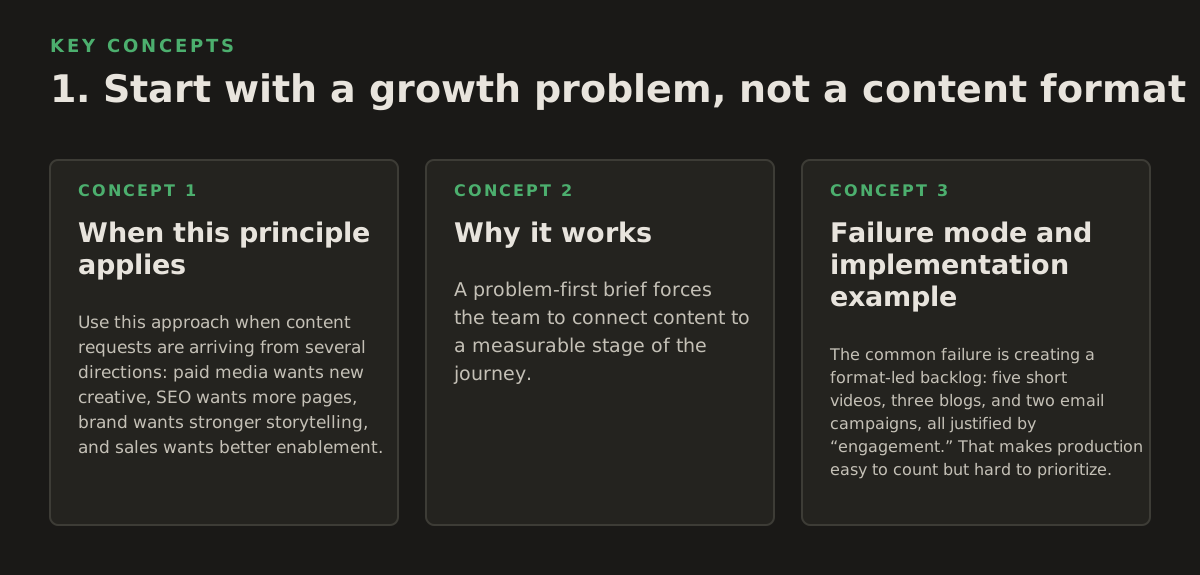
1. Start with a growth problem, not a content format
Content becomes strategically useful when it is assigned a job in the customer acquisition system. “Make more videos” is a production request. “Reduce uncertainty for first-time buyers who understand the category but do not trust our product claims” is a growth problem. The second statement gives a strategist something to solve.
When this principle applies
Use this approach when content requests are arriving from several directions: paid media wants new creative, SEO wants more pages, brand wants stronger storytelling, and sales wants better enablement. It is especially valuable when the business has plenty of output but cannot explain which audience barrier each asset addresses.
Why it works
A problem-first brief forces the team to connect content to a measurable stage of the journey. It also exposes conflicts early. A brand awareness video may be appropriate for a new category, but it is unlikely to solve a checkout objection by itself. A comparison page may support high-intent acquisition, but it should not be judged by the same standard as an introductory educational article.
For acquisition teams, define the desired behavior before selecting the format:
- Discover: the prospect recognizes a problem, category, or relevant use case.
- Evaluate: the prospect compares approaches, products, proof, or trade-offs.
- Convert: the prospect takes a commercial action such as purchasing, requesting a consultation, or starting a qualified conversation.
- Retain: the customer receives value, adopts the product, and has a reason to buy again or recommend it.
Do not assume every asset needs a direct purchase call to action. Instead, assign a primary business job and a secondary progression signal. For example, a product education video may primarily build understanding and secondarily drive a visit to a comparison page.
Failure mode and implementation example
The common failure is creating a format-led backlog: five short videos, three blogs, and two email campaigns, all justified by “engagement.” That makes production easy to count but hard to prioritize. Engagement can also be misleading when the people interacting with content are not potential customers.
Illustrative example: an ecommerce brand selling premium running insoles sees strong traffic from generic “foot pain” content but weak product-page progression. The problem statement becomes: “Help recreational runners understand which symptoms the product can and cannot address, then give them enough evidence to assess fit.” The resulting content set might include:
- A symptom-and-use-case guide for discovery.
- A comparison page explaining materials, fit, and intended activity.
- A short demonstration showing how the product is installed.
- A product-page module answering the three most common fit concerns.
The content is now a sequence, not four unrelated deliverables. That sequence can be connected to the brand’s marketing expertise across strategy, creative, and performance decisions.
2. Define the audience by decision context
Demographic labels are rarely enough to guide strong content. “Women aged 25–44” may support media targeting, but it does not tell a writer what the audience already believes, what risk they perceive, or what proof will change their mind. A useful audience definition describes the decision context surrounding the problem.
Build a decision-context profile
For each priority segment, document the following:
- Trigger: What event makes the problem urgent?
- Current workaround: What are they doing instead, and why is it acceptable for now?
- Desired outcome: What practical or emotional result are they pursuing?
- Perceived risk: What could make the purchase feel wasteful, difficult, or embarrassing?
- Proof requirement: What evidence would make the claim credible?
- Decision authority: Who researches, approves, pays, and uses the product?
This is particularly important for B2B and considered ecommerce purchases. The person who consumes an ad may not be the person who evaluates the product. A founder may want transparent acquisition economics, while a marketing manager needs a workable approval process and a creative team needs a clear visual direction.
Why it works
Content performs a job when it reduces a specific form of uncertainty. A prospect who is unsure whether a product is relevant needs different content from a prospect who believes it is relevant but doubts the price. Mapping the decision context lets you select proof and language instead of defaulting to generic benefits.
Use customer language carefully. Search queries, support tickets, sales-call notes, reviews, onsite search terms, and paid-ad comments can reveal the words people use to describe the problem. Treat those inputs as evidence of questions and anxieties, not as a complete research sample. Validate the most commercially important assumptions before making them the foundation of a campaign.
Failure mode and implementation example
The failure mode is creating one “ideal customer” profile that combines several incompatible situations. A new customer, a repeat customer, and a wholesale buyer may all fit the same demographic description while needing different content.
Illustrative example: a direct-to-consumer skincare brand separates two audiences:
- Routine builders: they need help choosing a manageable regimen and fear irritation or wasted money.
- Ingredient evaluators: they compare concentrations, formulations, and evidence before purchasing.
The first audience receives a routine builder and a “start here” product path. The second receives ingredient education, usage constraints, and comparison content. Both can lead to the same product, but they require different entry points and different proof. The audience profile should therefore be attached to every brief, landing page, and creative test—not stored as a static brand document nobody uses.
3. Turn positioning into repeatable message territories
A framework needs a bridge between brand strategy and individual assets. That bridge is a set of message territories: durable themes that express why the brand matters, who it serves, and how it is meaningfully different.
Choose territories with strategic tension
Strong territories are broad enough to generate multiple executions but specific enough to prevent interchangeable content. For a premium home-fitness brand, possible territories might include:
- Confidence through clarity: remove confusion from choosing and using equipment.
- Progress that fits real life: support consistency without demanding an ideal schedule.
- Designed for the constraint: make limited space, time, or experience part of the solution.
Each territory should answer four questions:
- What belief should the audience take away?
- Which product or service truth supports that belief?
- Which audience problem makes the belief relevant?
- What evidence can the business consistently provide?
Do not confuse a territory with a slogan. A territory is a decision-making tool for copy, visuals, offers, creator briefs, landing pages, and media variations.
Why it works
Repeated strategic themes create coherence across channels while allowing the execution to change. A paid social ad, search landing page, email, and product detail page can express the same territory at different levels of detail. This is more efficient than inventing a new proposition for every placement.
Message territories also make creative analysis more useful. If several executions in one territory underperform, the team can ask whether the audience, proof, offer, or territory itself is the issue. Without that structure, every asset looks like an isolated creative opinion.
Failure mode and implementation example
A frequent failure is building territories from internal adjectives: innovative, premium, trusted, simple, and human. Those words may be desirable, but they do not tell a customer what changes or why the claim is believable.
Illustrative example: a B2B analytics company wants to move beyond “better reporting.” It defines a territory called “decisions without spreadsheet archaeology.” The content system can then produce:
- A founder article showing how delayed reporting creates decision risk.
- A product walkthrough focused on finding a usable answer quickly.
- A paid ad contrasting weekly reporting rituals with more direct decision support.
- A sales enablement page explaining implementation responsibilities and limitations.
The territory is specific enough to guide production and broad enough to support the acquisition funnel. It also prevents the team from claiming an unsupported advantage such as “the fastest” or “the most accurate” without evidence.
4. Map content to intent and the conversion path
Content should meet the audience at an appropriate level of intent. Search, paid social, email, creator placements, and direct traffic each provide different context. A person arriving from a category search may need comparison information, while someone seeing a prospecting ad may first need a clear problem frame.
Use an intent ladder
| Audience state | Content job | Useful formats | Next signal | Priority question |
|---|---|---|---|---|
| Problem is unclear | Name the situation and its cost | Educational article, short video, social concept | Engaged visit or content continuation | Is the problem relevant enough to explore? |
| Approach is being researched | Explain options and trade-offs | Guide, comparison page, webinar, calculator | Product or service page visit | What uncertainty blocks evaluation? |
| Brand is being evaluated | Prove fit and reduce risk | Case evidence, demonstration, FAQ, reviews | Checkout, lead form, or sales action | What would make this choice feel safe? |
| Purchase is near | Remove friction and clarify the offer | Product page, offer page, objection module | Completed conversion | What question remains immediately before action? |
| Customer is active | Increase value and repeat behavior | Onboarding, usage guide, lifecycle email | Activation, repeat order, or referral | What helps the customer achieve the promised outcome? |
For organic search, structure content around the question and the expected next action rather than inserting keywords into every heading. Google’s Search Central documentation describes helpful, reliable, people-first content as content created primarily to benefit users, which supports a needs-led approach rather than a volume-led publishing model (Google Search Central, 2026).
Why it works
The intent ladder prevents a common mismatch: sending low-intent traffic directly to a high-friction offer, or sending high-intent visitors to a vague brand story. It also clarifies how content assists paid media. A prospecting ad can create demand, while a landing page handles evaluation and a product page handles final reassurance.
Use one primary conversion path per asset where possible. Secondary links can support exploration, but too many competing actions make it difficult to tell whether the asset is doing its job.
Failure mode and implementation example
The failure mode is treating all traffic as equally ready to buy. An educational article may have strong reach but low immediate conversion because its audience is still framing the problem. Conversely, a product comparison page may have modest traffic but deserve more attention because visitors are close to a decision.
Illustrative example: an ecommerce furniture company creates a guide for choosing a desk in a small apartment. The article links to a room-size selector, then to two relevant products. The paid campaign does not optimize the article solely for immediate purchases; it evaluates whether the page produces qualified product exploration and later conversion through a properly configured measurement path. Google Ads explains that conversion tracking is used to understand valuable customer actions after interactions with ads, so the team should define those actions before judging the content’s commercial role (Google Ads Help, 2026).
5. Design the measurement system before production
Measurement is part of the content strategy, not a reporting task added after launch. If the team cannot state what behavior would indicate progress, it will default to easy-to-count signals such as impressions, likes, or pageviews.
Separate leading signals from business outcomes
Leading signals indicate that the audience is moving in the intended direction. Business outcomes indicate whether that movement contributes to commercial performance. Examples include:
- Leading signals: qualified landing-page visits, engaged product exploration, video completion, comparison-tool use, email signup, or return visits.
- Commercial outcomes: purchases, qualified leads, approved opportunities, revenue, repeat orders, or contribution after media and fulfillment costs.
- Diagnostic signals: landing-page load issues, broken events, form abandonment, search-query mismatch, or creative fatigue indicators.
Do not use every available metric. Select a small measurement set that matches the content’s assigned job. A prospecting video may be evaluated on qualified visits and downstream assisted behavior, while a product-page module should be closer to add-to-cart, checkout progression, or purchase behavior.
Why it works
Defining measurement early improves both the brief and the post-launch decision. It prompts the team to specify the audience, destination, event, and ownership. It also makes it easier to distinguish between a content problem and a tracking problem.
For websites using Google Analytics, Google’s developer documentation explains that recommended events provide standardized event names and parameters for common interactions; teams should still confirm that the events reflect their own business actions and are implemented consistently (Google Analytics for Developers, 2026). The strategic point is simple: name the action first, then decide how to instrument it.
Failure mode and implementation example
The failure mode is reporting a blended number such as “content influenced revenue” without defining attribution rules, time windows, or the role of the asset. That can create false certainty. A piece of content may assist a purchase without causing it, and platform-reported conversions may not be directly comparable across channels.
Illustrative example: a subscription brand launches a comparison guide. Its measurement plan records:
- Entry source and campaign.
- Scroll or interaction signal that indicates meaningful use of the guide.
- Click into the relevant plan page.
- Trial or purchase event.
- Cancellation or retention outcome where the business can measure it reliably.
The team can then ask better questions: Did the guide attract the right audience? Did readers progress? Did the offer convert? Did new customers retain? The final question matters because acquisition content that produces low-fit customers may look successful in a short reporting window while weakening lifetime value.
6. Build a distribution and creative testing system
Publishing is not distribution. A content asset earns business value when it reaches a relevant audience in a context that supports its job. Distribution planning should therefore happen at the same time as the content brief.
Match the asset to its distribution role
Use a simple distribution map:
- Owned: website, email, customer education, product pages, and lifecycle journeys.
- Paid: prospecting, retargeting, search, shopping, sponsored placements, and creator amplification.
- Earned or shared: customer referrals, organic mentions, partnerships, communities, and public discussion.
Each channel changes the creative requirement. A paid social unit must establish relevance quickly. A search landing page must satisfy the query and support the next action. An email can rely on an existing relationship but still needs a clear reason to click. A product page must make the offer and constraints easy to understand.
Test the decision variable, not random variations
Creative testing becomes informative when each variation isolates a meaningful hypothesis. Useful variables include:
- Problem framing versus outcome framing.
- Demonstration versus testimonial or expert explanation.
- Specific use case versus broad category language.
- Risk-reduction proof versus aspirational benefit.
- Short path to offer versus educational intermediate step.
Meta’s official documentation describes the Conversions API as a way to create a more direct connection between marketing data and Meta systems; implementation details and data governance still need to be handled by the business and its technical partners (Meta for Developers, 2026). For strategy, the implication is that creative decisions and event quality should be considered together. Better creative cannot compensate for an unreliable measurement signal, and better event plumbing cannot rescue an irrelevant message.
Failure mode and implementation example
The failure mode is changing the hook, audience, offer, landing page, and format simultaneously. If performance changes, no one knows why. Another failure is optimizing for the cheapest click when the business actually needs profitable customers or qualified leads.
Illustrative example: an ecommerce team has one product, two high-value use cases, and a limited creative pipeline. It creates three versions of the same core concept:
- A problem-led version for audiences who have not named the need.
- A demonstration-led version for people who have visited a category or guide page.
- A proof-led version for product-page visitors who have not purchased.
The offer, destination, and primary event remain stable during the initial learning period, while the message variable changes by audience context. This does not guarantee a result, but it creates a more defensible basis for deciding what to scale, revise, or stop.
7. Govern the system with priorities, owners, and constraints
A strategy framework fails when it becomes a document rather than an operating system. Growth teams need a way to choose among competing ideas, manage production capacity, and prevent content from drifting away from business priorities.
Use a weighted prioritization policy
Create a score for each proposed initiative using a small number of explicit factors:
- Commercial relevance: how directly the work supports a priority product, audience, or growth constraint.
- Evidence of demand: the strength of customer, search, sales, support, or campaign evidence behind the idea.
- Distribution readiness: whether a realistic audience and channel already exist.
- Reusability: whether the core insight can support multiple assets or funnel stages.
- Execution cost: the people, approvals, production complexity, and technical work required.
Use a simple scale such as low, medium, and high, or an illustrative 1–5 score. The scoring system is a starting policy, not a universal benchmark. Its value comes from making trade-offs visible. A high-effort brand film may be strategically justified, but the team should compare it with a lower-cost product education sequence that addresses an immediate conversion barrier.
Assign ownership at the handoffs
For every initiative, specify who owns:
- The audience and business problem.
- The proposition and proof.
- The creative brief and production.
- The destination experience.
- The tracking and reporting.
- The decision after launch.
Ownership is particularly important when paid media, brand, ecommerce, and creative teams work separately. The person responsible for buying traffic should be able to explain where it goes and what success means. The person responsible for the landing page should understand the promise made in the ad.
Failure mode and implementation example
The failure mode is allowing the loudest stakeholder to determine the calendar. Another is treating every initiative as a campaign, which creates too many launches and too little learning.
Illustrative example: a growth-stage apparel brand has capacity for only four major content initiatives in a quarter. It scores six ideas against commercial relevance, evidence, distribution readiness, reusability, and execution cost. It selects:
- A product-page objection system for the highest-revenue category.
- A sizing education sequence tied to paid search and email.
- A creative territory designed for prospecting audiences.
- A post-purchase guide intended to reduce avoidable support demand and encourage repeat use.
The rejected ideas are not permanently discarded. They remain in a backlog with the evidence needed to reconsider them. This protects the team from replacing strategic priorities with a constant stream of urgent requests.
Implementation plan: put the framework into operation in 2026
Use the following sequence when building or rebuilding your system. The order matters because production before diagnosis usually creates more content without improving the underlying decision.
- Set the commercial constraint. Choose the current growth problem: inefficient acquisition, weak product-page conversion, unclear positioning, low-quality leads, low repeat purchase, or another defined constraint. Record what is outside scope for this cycle.
- Select one to three priority audiences. Describe each by trigger, current workaround, desired outcome, perceived risk, proof requirement, and decision authority. Remove audiences that cannot be reached or served during the planning period.
- Audit the existing system. Group current assets by audience, message territory, intent stage, distribution channel, destination, and measured action. Mark gaps, duplication, stale claims, and pages receiving traffic without a clear next step.
- Write the message territories. Translate positioning into three or four repeatable themes. For each, document the audience belief, product truth, relevant problem, available evidence, and claims the brand must avoid.
- Map the conversion paths. For each territory, specify the entry asset, intermediate experience, commercial destination, primary event, and diagnostic signals. Confirm that links, forms, product pages, and tracking are functional before launch.
- Prioritize the backlog. Apply the weighted policy using commercial relevance, evidence, distribution readiness, reusability, and execution cost. Label every score as an informed planning judgment, not an objective prediction.
- Brief the first production batch. Give each asset one audience, one problem, one message territory, one primary action, one proof requirement, and one distribution context. Add the landing-page owner and measurement owner to the brief.
- Launch controlled learning. Keep enough variables stable to interpret the result. If testing creative, avoid changing the audience, offer, destination, and event at the same time unless the objective is simply to compare complete experiences.
- Review on a decision cadence. Decide whether to scale, revise, repurpose, pause, or investigate measurement. Record the reason, not just the metric. A result is useful when it changes what the team will do next.
- Refresh the framework quarterly or after a major business change. Revisit audiences, product priorities, proof, claims, channel roles, and customer economics. In 2026, do not let an old content map govern a new offer, market, or acquisition model.
The practical recommendation is to treat content as a coordinated growth system: brand strategy sets the meaning, creative strategy turns that meaning into usable assets, media buying finds relevant opportunities, and conversion optimization removes friction after the click. Kimmel Marketing can help connect those decisions through its digital marketing services, with a focus on transparent acquisition economics and measurable growth.
Authored with NotFair SEO