Creative Strategy: A Practical Framework for Scalable Marketing Growth
Creative strategy is the system that connects a brand’s positioning to the messages, formats, audiences, offers, and experiments used to create demand and drive action. It is not a mood board, a campaign slogan, or a list of ad concepts. For a growth-stage brand, it is the operating logic behind what the customer sees, why the message should matter to them, and how the team will decide whether the work is improving acquisition.
That distinction matters because a polished ad can still fail commercially. It may attract the wrong audience, communicate a weak reason to buy, make an unprovable promise, or send qualified traffic to a product page that does not resolve the same concern. A useful creative strategy makes those failure points visible before the media budget magnifies them.
What Creative Strategy actually includes
A practical strategy begins with a commercial problem, not a visual style. “We need more content” is a production request. “We need to increase qualified first purchases without raising the allowable customer acquisition cost” is a strategic problem. The second statement gives the creative team something to solve.
The work translates business and customer evidence into a set of decisions:
- Who to persuade: the audience, situation, need state, and level of awareness that the message addresses.
- What to say: the customer problem, differentiated promise, proof, objection handling, and call to action.
- How to say it: the visual language, voice, demonstrations, testimonials, comparisons, and formats that make the message credible.
- Where to say it: the placements and stages of the journey where the idea has a reasonable chance to be understood.
- How to learn: the hypothesis, success metric, test design, and decision rule used to evaluate the work.
These components should reinforce one another. A premium skincare brand cannot use “clinical evidence” as its central proof, send users to a page dominated by lifestyle imagery, and expect a generic discount banner to complete the argument. The ad, landing page, offer, and follow-up experience are separate assets but one persuasion system.
Strategy is different from execution
Execution is the finished expression: a video, product image, carousel, landing-page hero, email, or creator brief. Strategy is the reasoning that determines which expression deserves production and what job it must perform.
For example, “make a short video featuring the product in use” is executional. A strategic brief would be more precise:
For first-time buyers who believe reusable water bottles are inconvenient to clean, show the lid disassembled in a 12-second demonstration, prove that each part is reachable, and invite the viewer to see the full cleaning process on the product page.
The brief identifies a specific belief, a proof mechanism, a format suited to demonstration, and a next action. It also creates a falsifiable hypothesis: if cleaning anxiety is suppressing conversion, a clear cleaning demonstration should improve qualified engagement or downstream purchase behavior relative to a product-only image.
Strong creative systems also account for the relationship between brand and performance work. Brand consistency does not mean every ad must look identical. It means the audience can recognize the company’s point of view, product logic, and standards while the message adapts to the customer’s context.
For companies reviewing their broader digital marketing services, this is the useful dividing line: production creates more assets; strategy creates a coherent set of reasons for those assets to exist.
Why it matters for acquisition efficiency
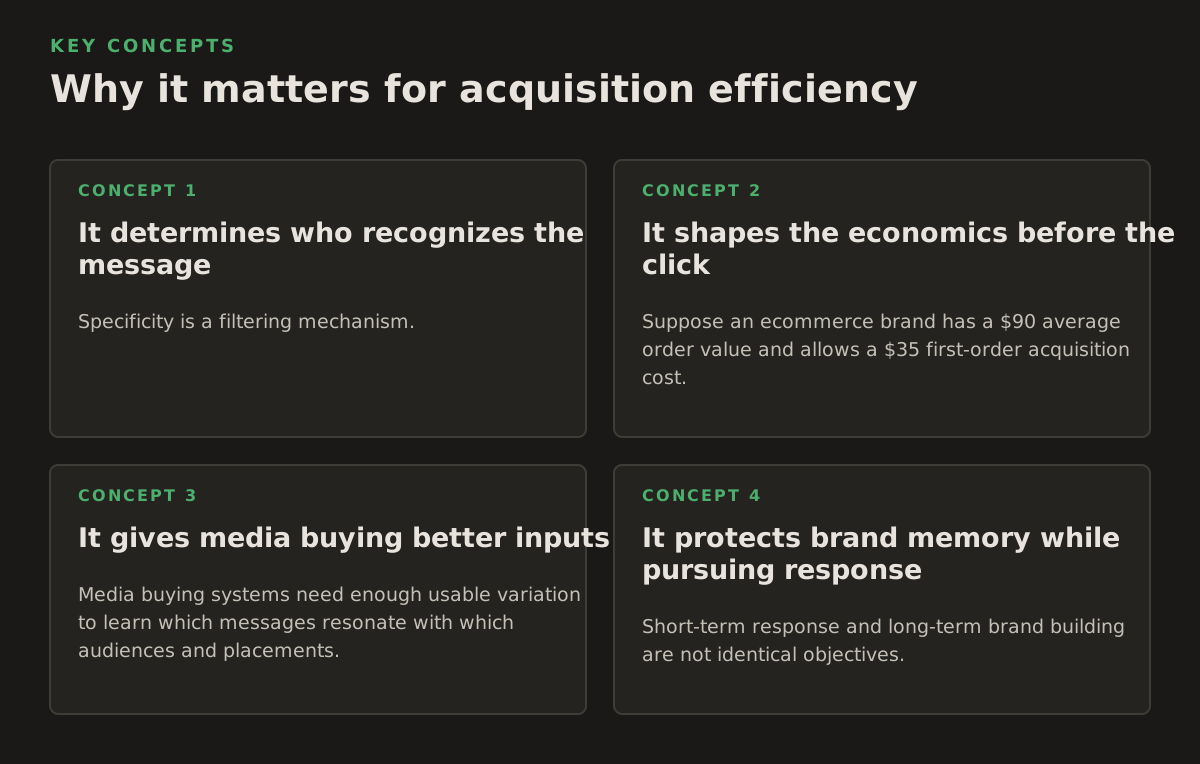
Paid media can buy exposure, but it cannot manufacture relevance. When creative fails, teams often respond by changing targeting, adding channels, or increasing spend. Those moves may hide the problem temporarily, but they do not fix a weak promise or an unconvincing buying argument.
Creative influences performance through several connected mechanisms.
It determines who recognizes the message
Specificity is a filtering mechanism. An ad that says “better tools for modern work” may be broad enough to earn attention but vague enough to attract low-intent clicks. An ad that says “replace the spreadsheet your finance team uses to reconcile subscription revenue” will reach fewer people, yet it may create stronger recognition among the people with the relevant pain.
This is not an argument for making every message narrow. It is an argument for knowing which job the asset performs. A broad brand video can establish category meaning. A retargeting ad can resolve a product objection. A search ad can capture an explicit need. Combining these jobs in one vague asset usually weakens all of them.
It shapes the economics before the click
Suppose an ecommerce brand has a $90 average order value and allows a $35 first-order acquisition cost. An ad that generates inexpensive traffic but attracts people unlikely to purchase may look efficient at the click level while worsening the business outcome. A more qualified message can reduce the volume of clicks and still improve the economics if it raises the proportion of visitors who buy.
The relevant chain is not simply impression to click. It is closer to:
- attention to message comprehension;
- message comprehension to perceived relevance;
- relevance to qualified visit;
- qualified visit to conversion;
- first purchase to repeat value.
Each transition can break. Creative cannot repair a product with no demand, but it can make the product’s value easier to understand and can pre-qualify the audience before the click.
It gives media buying better inputs
Media buying systems need enough usable variation to learn which messages resonate with which audiences and placements. That does not mean generating dozens of cosmetic variations. It means varying meaningful dimensions such as customer problem, proof type, product use case, offer framing, and level of awareness.
Google describes responsive search ads as combining multiple headlines and descriptions to test combinations within an ad, subject to its serving system and policies. The official Google Ads guidance on responsive search ads is useful here because it reinforces a practical point: copy assets need to work both independently and in combination. A creative strategy should therefore provide distinct message assets, not six near-identical headlines.
For a growth-stage brand, the strategic implication is straightforward: creative variation should express different hypotheses, not merely different colors. The media account can distribute and optimize the assets, but the team must decide what each asset is trying to prove.
It protects brand memory while pursuing response
Short-term response and long-term brand building are not identical objectives. A discount-led ad may produce immediate action while teaching customers to wait for promotions. A distinctive demonstration may generate less immediate urgency but strengthen the reason to choose the product later.
The right balance depends on the business model, margin structure, repeat purchase pattern, and stage of demand. A subscription brand may emphasize habit formation and retention value. A luxury brand may need to protect perceived scarcity and avoid training customers to expect price cuts. A new category may need more education before direct-response offers can work efficiently.
That is why acquisition efficiency should be evaluated alongside message quality, customer quality, and downstream value. A low-cost conversion is not automatically a good conversion.
How to build a working Creative Strategy
The process should be structured enough to create useful decisions without pretending that customer behavior is perfectly predictable. Start with evidence, turn evidence into hypotheses, then build a manageable testing system.
1. Define the commercial constraint
Choose one primary constraint for the planning cycle. Examples include insufficient qualified traffic, weak mobile conversion, rising acquisition cost, low repeat purchase, or poor performance in a new audience. Do not give every problem equal priority.
A useful brief states:
- the business outcome to improve;
- the audience or stage of the journey in scope;
- the product or offer being promoted;
- the current constraint or suspected bottleneck;
- the evidence that would support or weaken the hypothesis.
For instance: “Increase qualified first purchases from paid social among visitors who understand the category but have not tried our product. The suspected barrier is uncertainty about setup time. We will compare a setup demonstration against a feature-led product ad and evaluate purchase rate, not only video engagement.”
2. Build an evidence map
Customer research does not need to be elaborate to be useful. Combine what the business already knows with direct observation of customer language and behavior. Review support conversations, product reviews, sales-call notes, search queries, site search terms, post-purchase surveys, and comments on existing ads.
Organize the evidence into four columns:
| Evidence type | Question | Strategic use |
|---|---|---|
| Desired outcome | What result does the buyer actually want? | Shape the promise and end state. |
| Barrier | What makes the buyer hesitate? | Choose objections to address. |
| Proof | What would make the claim believable? | Select demonstrations, data, credentials, or social proof. |
| Trigger | Why act now rather than later? | Develop urgency without relying automatically on discounting. |
Keep evidence separate from assumptions. “Customers want convenience” is an assumption until it is connected to observed language or behavior. “Twenty-three of thirty recent support tickets asked whether the product could be set up without a specialist” is evidence, though it still needs interpretation.
3. Choose the message architecture
A message architecture defines the hierarchy of what the audience should understand. A useful structure is:
- Recognition: identify the problem, situation, or desired outcome.
- Promise: explain the meaningful change the product can provide.
- Mechanism: show how the product creates that change.
- Proof: provide evidence appropriate to the claim.
- Action: make the next step clear and proportionate to the audience’s readiness.
Consider an illustrative example for a meal-planning app. “Eat better” is a category-level promise. A stronger architecture might be: “You buy healthy ingredients but still order takeout on busy evenings. The app creates a five-night plan from your preferences, produces a usable shopping list, and lets you swap recipes when plans change. Start with a free weekly plan.” The mechanism makes the promise more credible because it explains what the product actually does.
Use a message hierarchy rather than forcing every detail into every placement. A six-second asset may establish the problem and visual mechanism. A landing page can explain the workflow. A comparison page can handle switching objections. More information is not automatically more persuasion.
4. Translate the strategy into a testing matrix
Build tests around variables that could change customer behavior. A matrix might include:
- problem-led versus outcome-led opening;
- demonstration versus testimonial proof;
- founder voice versus customer voice;
- premium framing versus savings framing;
- static product visual versus use-case footage;
- direct purchase call to action versus education-first call to action.
Do not change the audience, offer, landing page, format, and message simultaneously if the goal is to learn what caused the result. There are situations where broad iteration is appropriate, especially when an account needs more usable creative, but the learning will be less diagnostic.
Google’s documentation on experiments in Google Ads describes the use of controlled campaign experiments to compare changes. The practical lesson is to define the variable and evaluation method before launch. A test without a pre-agreed decision rule becomes a post hoc explanation exercise.
5. Match measurement to the decision
Use an attention metric when the decision concerns attention, a message metric when it concerns comprehension, and a business metric when it concerns commercial impact. A high view-through rate cannot prove that a product demonstration increased profitable orders.
For an ecommerce test, an illustrative starting policy might be:
- use thumb-stop or three-second viewing behavior to diagnose whether the opening earns attention;
- use outbound click quality and engaged sessions to diagnose whether the promise attracts the right visitor;
- use add-to-cart rate and purchase conversion rate to diagnose product-page and offer alignment;
- use contribution margin, refund rate, and repeat purchase behavior when enough data exists to evaluate customer quality.
These are planning choices, not universal benchmarks. The correct thresholds depend on volume, sales cycle, margin, attribution quality, and the cost of making a decision too early.
Measurement also requires care around attribution. Google’s official Analytics documentation on attribution explains that attribution models assign credit across touchpoints and that different models can produce different interpretations of a conversion path. Teams should not treat platform-reported results as a perfect account of incremental demand. Use them as evidence within a broader measurement system.
Where creative programs break
Most underperforming programs do not fail because the team lacks ideas. They fail because the operating system rewards activity over learning or because the message is disconnected from the customer’s actual decision.
The team optimizes for output
A calendar full of new assets can create the appearance of momentum while leaving the central hypothesis untouched. Recutting the same footage into five aspect ratios is useful production work, but it is not five strategic tests.
Before approving an asset, ask:
- What customer belief is this asset trying to change?
- What evidence supports that belief as a barrier or opportunity?
- What is meaningfully different from the existing control?
- What result would cause us to keep, revise, or stop the idea?
- Where will the next experience continue the argument?
The message is clever but not clear
Creative teams can overvalue novelty. A surprising opening may earn attention while leaving the product, audience, or benefit unclear. This is especially damaging for unfamiliar categories, considered purchases, and products with a non-obvious mechanism.
Clarity does not require boring work. It requires that the audience can answer basic questions quickly: What is this? Is it for someone like me? Why should I care? What should I do next? If a concept cannot survive those questions, visual polish is unlikely to save it.
The claim outruns the proof
“The easiest,” “the best,” and “the only” are strategically expensive claims because they require strong substantiation and invite skepticism. A narrower claim with visible proof may be more persuasive and safer to scale.
For example, replace “the easiest project management platform” with “turn a recurring client brief into assigned tasks in one workspace,” then show the workflow. The second claim is less grand but more testable. It tells the creative team what to demonstrate and the customer what to expect.
The landing page changes the deal
An ad can create a clear expectation that the landing page then breaks. Common examples include:
- an ad promises a product bundle, but the page opens on a single item;
- the ad emphasizes speed, but the page leads with a long brand history;
- the ad targets beginners, but the page uses specialist language;
- the ad presents a demonstration, but the page does not explain the required setup;
- the ad offers a reason to buy now, but the call to action is difficult to find on mobile.
This is a message continuity problem, not merely a copywriting problem. Review the ad and destination together, especially on the device and placement where most qualified traffic arrives.
The team declares winners too quickly
Early performance can be distorted by delivery, audience mix, novelty, seasonality, offer exposure, and tracking limitations. That does not mean teams must wait indefinitely. It means the decision should reflect the cost of being wrong.
If an asset makes a regulated or high-stakes promise, approval may matter more than speed. If the test concerns a low-risk headline variation, a faster iteration policy may be reasonable. Set the review cadence and stopping rule before results create pressure to rationalize them.
Performance can also be limited by technical experience. Google’s web platform documentation defines Core Web Vitals as user-centered measures related to loading, interactivity, and visual stability; the current guidance is available from web.dev’s Core Web Vitals overview. Creative cannot compensate indefinitely for a slow, unstable, or difficult-to-use destination. If an ad increases qualified demand but the page fails to respond, the bottleneck has moved downstream.
How practitioners apply it across the funnel
A mature program does not ask one asset to do every job. It assigns creative roles to stages of customer understanding, then connects those roles through consistent positioning.
Demand creation
At the top of the funnel, the task is often to make a problem or possibility more recognizable. Use distinctive category language, situations the audience will recognize, and a point of view that gives the brand something ownable.
For a direct-to-consumer storage brand, this could mean showing the recurring frustration of seasonal clutter rather than opening with a product pack shot. The product still needs to appear, but the creative first earns relevance by naming the lived problem.
Demand capture
When customers are actively searching or comparing, creative should become more concrete. Emphasize fit, compatibility, price logic, proof, delivery expectations, or the specific difference from common alternatives. Search copy, product pages, comparison content, and retargeting should answer the questions that emerge after initial awareness.
This is where a proof ladder is useful:
- simple demonstration for an easy-to-understand functional claim;
- specific product details for compatibility or performance questions;
- reviews and customer examples for social reassurance;
- documentation, testing, or expert validation for higher-risk claims;
- transparent terms for price, delivery, returns, or ongoing commitment.
Conversion and onboarding
At the decision point, creative should reduce friction rather than add another layer of persuasion. Show what happens after the click, clarify the offer, surface the most important reassurance, and make the first step feel proportionate.
For a software company, that may mean showing the first ten minutes of setup. For a premium ecommerce product, it may mean explaining materials, delivery, returns, and care in a concise sequence. For a service business, it may mean replacing a generic “book a call” with a clear description of who the call is for and what the buyer will leave with.
Retention and expansion
Creative strategy continues after acquisition. Post-purchase education can reduce avoidable disappointment, increase product usage, and create reasons for a second purchase. Retention messages should reflect what the customer has already done rather than treating every person as a new prospect.
Examples include:
- an onboarding sequence that demonstrates the product’s highest-value use case;
- a replenishment reminder tied to actual consumption rather than an arbitrary calendar date;
- a cross-sell based on the customer’s first product and likely next need;
- a referral message that explains the type of friend or colleague who would benefit;
- a win-back message that addresses the reason customers stopped engaging.
Make the operating model explicit
Assign ownership for the decisions that commonly fall between teams. Brand may own positioning, creative may own expression, media may own distribution, analytics may own measurement, and product or ecommerce may own the destination experience. But the customer experiences one connected system.
A useful weekly or biweekly review should cover:
- which hypotheses were launched;
- which audience or journey stage each asset served;
- what changed in the relevant business metric;
- what the result does and does not prove;
- which message should be scaled, revised, retired, or investigated further;
- what new customer evidence should influence the next brief.
Keep a record of decisions, not just results. A failed test can still improve the strategy if it rules out a meaningful explanation. “Customers do not care about this feature” is usually too broad a conclusion. “This feature-led opening did not improve qualified purchase rate for category-aware visitors under this offer and placement” is more useful and more defensible.
For leaders assessing marketing expertise, the key question is whether the partner can connect insight, creative development, media distribution, and measurement without treating them as separate deliverables. The strongest system makes the reasoning visible: what is being tested, why it matters commercially, and what action follows from the evidence.
For 2026 planning, treat creative strategy as an operating discipline rather than a campaign phase. Start with one business constraint, build a small set of differentiated hypotheses, connect every message to a proof mechanism, and judge the work at the level of customer quality and revenue—not just attention or platform-reported clicks.
If your brand needs that system built across positioning, creative development, media buying, and performance optimization, Kimmel Marketing can help turn the strategy into an accountable growth program.
Authored with NotFair SEO