Creative Strategy Statement Examples for Growth-Stage Brands
Creative strategy statement examples are useful when a growth team needs to turn broad ambition into a clear decision about what advertising should say, show, and make customers feel. The practical job is not to produce a clever sentence. It is to give brand, creative, media, and conversion teams a shared rule for choosing ideas—especially when acquisition costs are under pressure and every new asset needs a reason to exist.
This guide helps marketing leaders decide which type of statement fits their situation, how to pressure-test it, and how to translate it into briefs, landing pages, and paid media variations. The examples use illustrative businesses and do not represent claims about their actual performance. Treat the sample budgets, thresholds, and timelines below as starting policies for planning, not universal benchmarks.
1. Start with the job the statement must perform
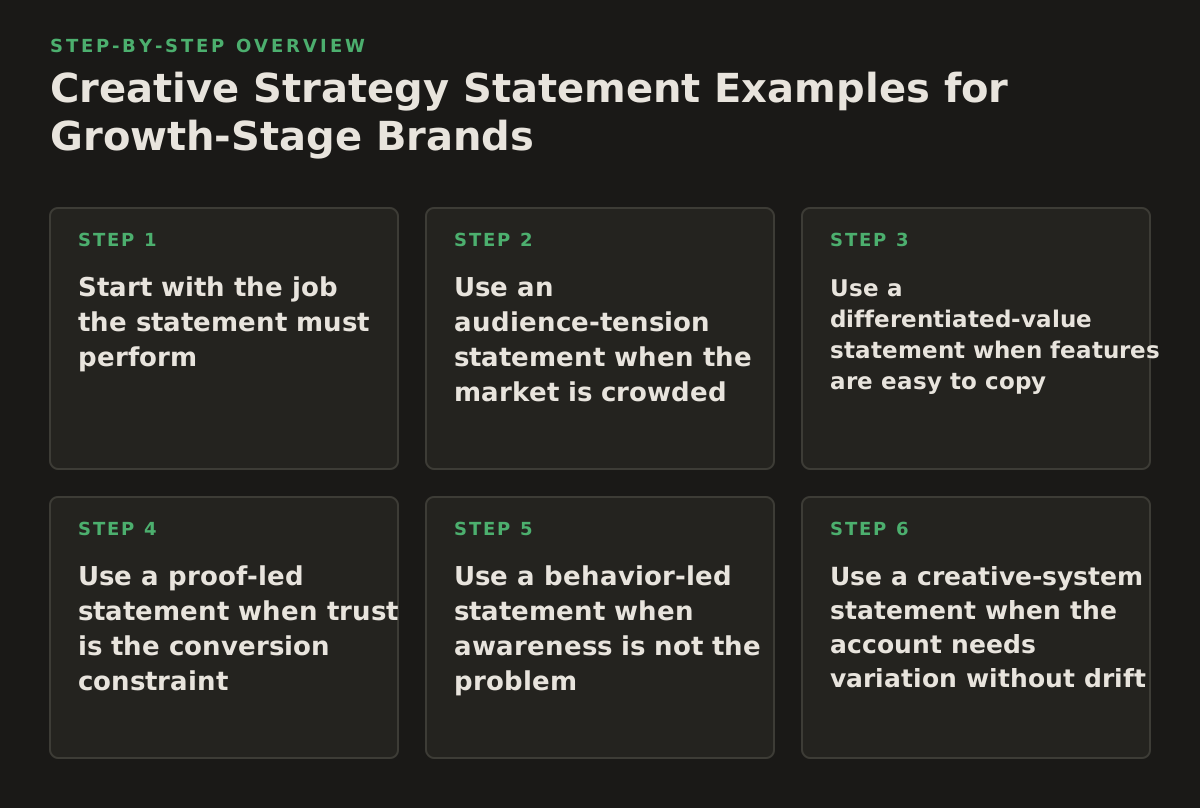
A creative strategy statement should resolve a decision that the team is currently making inconsistently. If the team cannot agree on the audience, the commercial problem, or the desired behavior, a polished statement will only hide the disagreement.
For a growth-stage brand, the statement commonly has one of four jobs:
- Position a brand against familiar alternatives without relying on vague superiority claims.
- Give acquisition creative a common angle across video, paid social, search, display, and creator content.
- Translate a product advantage into a customer-relevant reason to act.
- Protect consistency during scale while allowing enough variation for different audiences and placements.
When it applies: use this approach before a campaign refresh, a new product launch, a major website redesign, or a period when media results are becoming difficult to interpret because every asset communicates something different.
Why it works: a statement acts as a selection filter. Ideas that do not support the chosen job can be rejected early, before production, trafficking, and landing-page work consume resources.
Failure mode: writing a mission statement instead of a creative strategy. “We help people live better” may be sincere, but it does not tell a designer what visual to use or a media buyer which promise to prioritize.
A practical diagnostic
Ask five questions before drafting:
- Which customer or buying situation matters most right now?
- What behavior should the creative change—consideration, first purchase, repeat purchase, or referral?
- What competing belief or hesitation is blocking that behavior?
- What proof can the brand responsibly show?
- What should remain consistent when the format, audience, or channel changes?
Illustrative example: a subscription meal company may be trying to acquire busy households, but its current ads alternate between gourmet food photography, low price, convenience, and sustainability. A useful statement might be: “Make weeknight cooking feel achievable by showing a complete meal coming together with less planning, while proving that convenience does not require giving up freshness.”
That sentence creates decisions. It favors preparation sequences over isolated plated-food images, prioritizes planning relief over a generic discount, and gives the landing page a reason to explain ingredients and delivery timing.
2. Use an audience-tension statement when the market is crowded
An audience-tension statement begins with what the customer wants and the reason they hesitate. It is particularly useful for ecommerce brands selling into a category where products look interchangeable in a feed.
Structure: “For [specific audience] who want [desired outcome] but worry about [barrier], show how [brand mechanism] helps them [credible progress] without [feared trade-off].”
When it applies: choose this form when performance creative is getting attention but not enough qualified action, or when customer research reveals a recurring objection that product-focused ads fail to address.
Why it works: people do not evaluate a purchase only against a desired outcome. They also evaluate the risk of disappointment, wasted money, inconvenience, or social judgment. Naming the tension helps the creative answer the actual decision rather than describe the product in isolation.
Failure mode: inventing a tension because it sounds strategically sophisticated. If customers are not worried about the proposed barrier, the campaign can make an objection more prominent than it was before.
Examples by business model
- Premium skincare: “For customers who want a simpler routine but distrust products that promise instant transformation, show a focused regimen and explain the role of each product in ordinary skin maintenance.”
- Home fitness: “For people who want consistent training but cannot protect a long gym session, show short workouts fitting into real interruptions without presenting them as effortless.”
- B2B software: “For operations leaders who need faster reporting but fear another difficult implementation, make the first useful workflow visible and show the handoff between teams.”
- Pet nutrition: “For owners who want better everyday feeding decisions but feel overwhelmed by conflicting advice, simplify the choice around the pet’s life stage and explain the evidence behind the recommendation.”
Implementation example: suppose a direct-to-consumer luggage brand hears that shoppers like its design but fear that attractive luggage will not survive rough travel. The brief should not simply say “show durability.” It should specify the mechanism: close-ups of wheels and handles, a realistic packing sequence, clear warranty language, and a demonstration that uses controlled, credible stress rather than theatrical destruction.
Build the statement from observed customer language, not internal adjectives. Useful inputs include support tickets, product reviews, search-query themes, sales-call notes, return reasons, and comments on existing ads. The statement should also identify the evidence required; otherwise the team may promise reassurance without supplying proof.
3. Use a differentiated-value statement when features are easy to copy
A differentiated-value statement connects a meaningful customer outcome to a mechanism competitors cannot easily reproduce in the same way. It is the right tool when the category is full of claims such as “high quality,” “easy,” “fast,” or “better for you.”
Structure: “We help [audience] achieve [valuable outcome] through [distinctive mechanism], so they can [larger consequence].”
When it applies: use it for positioning work, product launches, category entry, and creative systems that need to remain coherent across multiple acquisition channels.
Why it works: it forces the team to explain why the promise is believable. A claim without a mechanism gives media buyers a headline but gives customers no reason to choose one brand over another.
Failure mode: treating an internal capability as a customer benefit. “We use an advanced platform” is not valuable unless the customer experiences a concrete improvement because of it.
Worked examples
- Inventory planning software: “We help growing retailers reduce stock surprises through connected demand signals and exception-based workflows, so teams can spend less time reconciling spreadsheets and more time deciding what to buy.”
- Modular furniture: “We help renters create adaptable rooms through reconfigurable pieces that move with them, so a home can change without replacing every major item.”
- Specialty coffee: “We help curious drinkers explore traceable coffees through guided flavor profiles and flexible deliveries, so discovery feels manageable rather than like a test of expertise.”
Notice that each example includes an outcome, a mechanism, and a consequence. The mechanism should be observable in the creative. For the furniture brand, that could mean showing the same pieces serving different room layouts. For the software company, it could mean showing an exception becoming a prioritized action instead of presenting a dashboard full of decorative charts.
In paid search, the statement can guide headline themes and landing-page information hierarchy. Google’s documentation describes responsive search ads as combinations of supplied headlines and descriptions, which makes it especially important to provide assets that are individually useful while covering distinct messages; see the official guidance on [responsive search ads](https://support.google.com/google-ads/answer/7684791). The strategic implication is not to repeat one slogan in every field. It is to create a controlled set of claims: outcome, mechanism, proof, and next step.
4. Use a proof-led statement when trust is the conversion constraint
Some brands do not have an awareness problem. They have a credibility problem. The customer understands the offer but is not yet willing to believe the result, accept the risk, or invest the effort required to switch.
Structure: “When [audience] doubts [claim or category], prove [specific belief] by showing [evidence], then make [next action] feel low-risk.”
When it applies: use this approach for high-consideration purchases, unfamiliar ingredients or technologies, regulated categories, premium prices, and products where returns or implementation failures create real friction.
Why it works: proof changes the creative from assertion to verification. It gives the audience something to inspect and gives the team a way to distinguish a strong asset from one that merely sounds persuasive.
Failure mode: using social proof as decoration. A star rating or testimonial placed beside an unrelated image may look reassuring but fail to answer the particular concern blocking action.
Match proof to the objection
| Customer concern | Useful proof type | Creative execution | What to avoid |
|---|---|---|---|
| “Will it work for my situation?” | Specific use case, before-and-after process, or fit guidance | Show the customer context and the product decision in the same asset | Generic lifestyle imagery with no application detail |
| “Is the quality worth the price?” | Materials, construction, service terms, or transparent comparison | Explain the cost-driving feature and show it in use | Luxury language without inspectable evidence |
| “Will setup be difficult?” | Step sequence, time expectation, onboarding support, or demonstration | Show the first successful outcome, not only the interface | Claiming simplicity while hiding the work involved |
| “Can I trust this recommendation?” | Qualified expert explanation, methodology, sourcing, or customer story | Connect the source’s expertise to the exact decision | Using authority as a substitute for an explanation |
Illustrative example: a premium air purifier could use the statement, “For households worried that air-quality products are either noisy or hard to maintain, demonstrate the everyday operating experience and explain what the replacement routine involves before asking for the purchase.” The resulting asset might show sound in a normal room, filter access, indicator meanings, and a plain-language maintenance explanation.
For digital experiences, proof must remain usable as well as persuasive. The W3C guidance on [non-text content](https://www.w3.org/WAI/WCAG22/Understanding/non-text-content.html) explains the role of text alternatives for meaningful images. That supports a practical rule: if an image carries a product claim, the surrounding copy or accessible alternative should preserve the decision-relevant information rather than leave it available only to people who can see the image.
5. Use a behavior-led statement when awareness is not the problem
A behavior-led statement is designed around the action that moves a customer forward. It is useful when campaigns generate reach or engagement but the path from attention to revenue is weak.
Structure: “Move [audience] from [current behavior] to [desired behavior] by making [specific benefit] immediately understandable and [next step] easy to start.”
When it applies: choose it for lead generation, free trials, product education, abandoned-cart recovery, repeat purchase, and campaigns where the audience already recognizes the category.
Why it works: it prevents creative from optimizing for an intermediate signal that does not reflect the business objective. A funny video, high view count, or large volume of clicks can still leave the user unsure what to do next.
Failure mode: reducing the strategy to a call to action. “Click buy now” is an instruction, not a reason. The creative still needs to make the value of the next step clear and proportionate to the customer’s readiness.
Turn the statement into a funnel-specific brief
- Cold acquisition: establish the problem, category relevance, and distinctive reason to care.
- Engaged audience: answer the strongest objection and show a credible product mechanism.
- Product-page visitor: reduce uncertainty around fit, proof, price, shipping, or setup.
- Post-purchase: help the customer reach the first successful use and create a reason to continue.
Illustrative example for a B2B reporting tool: “Move finance leaders from downloading another template to booking a qualified workflow review by showing how the tool resolves one recurring reporting bottleneck and making the review’s output explicit.” That statement changes the landing page. Instead of leading with a broad product tour, the page can show one reporting problem, the workflow that resolves it, the information required for a review, and what the prospect receives afterward.
Use a measurement event that reflects the intended behavior. Google Analytics documentation distinguishes events and key events in its measurement model; the current [event and key event guidance](https://support.google.com/analytics/answer/9327972) is a useful reference when deciding whether an interaction is merely recorded or treated as strategically important. The creative team should know which action matters, but should not distort the message to manufacture a cheap proxy for progress.
6. Use a creative-system statement when the account needs variation without drift
Scaling acquisition creates a tension: the team needs enough variation to learn and fit different placements, but too much variation makes it impossible to tell which proposition is doing the work. A creative-system statement establishes the fixed strategic core and the variables that may change.
Structure: “Keep [non-negotiable promise or identity] consistent while varying [audience angle, proof, format, or context] to learn which route best earns [desired action].”
When it applies: use it when a brand has multiple products, markets, audiences, or channels; when creative production is becoming repetitive; or when reporting cannot connect an asset to a clear hypothesis.
Why it works: it separates strategic consistency from executional repetition. A brand can preserve its promise while changing the opening scene, spokesperson, proof type, offer framing, or product use case.
Failure mode: changing too many variables simultaneously. If the hook, audience, offer, visual style, landing page, and call to action all change, the result may produce a winner but little learning about why it won.
A reusable variation matrix
| Keep constant | Vary deliberately | Question answered | Decision after review |
|---|---|---|---|
| Core customer promise | Problem framing | Which tension earns qualified attention? | Retain one or two strongest tensions |
| Product truth | Proof format | Does demonstration, testimonial, or explanation reduce doubt? | Assign proof by audience stage |
| Brand identity cues | Opening visual or first line | Which entry point stops the right person? | Build a small hook library |
| Conversion destination | Offer or call-to-action emphasis | What makes the next step feel appropriate? | Match offer to readiness |
Illustrative example: an ecommerce cookware brand keeps “make reliable weeknight meals with less guesswork” constant. It varies three routes: a time-poor parent, a beginner learning technique, and a shopper replacing unreliable equipment. Each route receives a distinct opening and proof sequence, but the product demonstration and landing-page promise remain aligned.
For platform-specific execution, consult the platform’s current documentation rather than treating a format rule as timeless. Meta’s [Dynamic Creative documentation](https://developers.facebook.com/docs/marketing-api/dynamic-creative/) describes how advertisers can work with combinations of creative elements through its advertising tools. The strategic lesson is to prepare assets as intentional components with clear roles, not as a pile of interchangeable files.
7. Use a brand-behavior statement when performance and brand teams disagree
Brand and performance work often become disconnected because one team protects meaning while the other protects measurable response. A brand-behavior statement creates a shared bridge: it defines how the brand should behave in a customer moment and what action that behavior should support.
Structure: “In the moment when [customer situation], behave like [brand character] by [observable creative behavior], so customers can [meaningful action or belief].”
When it applies: use it during a brand refresh, channel expansion, new market entry, or any period when direct-response assets are becoming visually or verbally detached from the broader brand.
Why it works: character words become useful only when converted into visible choices. “Confident” might mean showing a clear recommendation and acknowledging limitations. “Warm” might mean using plain language and demonstrating the product in a familiar setting.
Failure mode: making the statement so protective of brand codes that it cannot produce a clear offer or action. Brand consistency should support recognition and trust, not prevent the customer from understanding what to do.
Example: a financial education brand
A weak direction would be: “Be empowering and approachable.” A stronger statement is: “When people feel embarrassed by a financial decision, replace judgment with a calm next step: explain one choice in plain language, show the consequence of taking it, and invite progress without pretending the decision is effortless.”
This can guide a short video, a search landing page, and an email series. The creative may use the same tone across all three, but the execution changes by context. An ad can dramatize confusion; a landing page can organize the decision; an email can support completion. The shared behavior is calm, specific guidance.
Use brand guardrails and performance freedoms separately:
- Guardrails: prohibited claims, visual identity essentials, tone boundaries, category sensitivities, and required disclosures.
- Freedoms: hook length, demonstration order, creator format, offer framing, page module order, and audience-specific examples.
- Review criteria: recognition, relevance, proof, comprehension, and action—not personal preference alone.
This is where broader marketing expertise can help a team connect positioning, creative development, media buying, and measurement instead of evaluating each discipline in isolation.
How to choose the right statement before production
Do not select a statement because it sounds the most polished. Select it based on the business constraint and the evidence available to support it.
| If the main constraint is… | Start with… | Required evidence | First asset to develop |
|---|---|---|---|
| Low relevance in a crowded category | Audience-tension statement | Customer language and objection patterns | Problem-led hook with product context |
| Weak differentiation | Differentiated-value statement | Distinct mechanism and competitive alternatives | Demonstration of the mechanism |
| High consideration or skepticism | Proof-led statement | Specific proof matched to the objection | Evidence-first explainer or testimonial |
| Attention without qualified action | Behavior-led statement | Funnel stage and meaningful conversion event | Message-to-destination journey |
| Too many assets and little learning | Creative-system statement | Variables, constants, and decision rules | Structured variation matrix |
| Brand and performance inconsistency | Brand-behavior statement | Brand codes and observable behaviors | Cross-channel example set |
A useful statement is specific enough to constrain and flexible enough to travel. If it cannot guide three different formats, it may be a headline. If it can justify almost any idea, it is probably too broad.
Implementation plan: turn one statement into a measurable creative system
Use the following sequence for a campaign or brand refresh. The order matters because production before diagnosis creates expensive disagreement later.
- Define the commercial decision. Write down whether the immediate goal is qualified acquisition, first purchase, repeat purchase, lead quality, or a brand-positioning shift. Name the audience and buying situation, not just the channel.
- Collect the raw customer tension. Review reviews, objections, search terms, sales notes, support conversations, and existing creative comments. Separate observed language from the team’s interpretation.
- Choose one statement type. Select audience-tension, differentiated-value, proof-led, behavior-led, creative-system, or brand-behavior based on the main constraint. If two constraints are equally important, write a primary statement and a supporting brief rather than blending six ideas into one sentence.
- Draft three alternatives. Make each alternative commit to a different mechanism or tension. Score them for customer relevance, distinctiveness, proof availability, channel portability, and commercial usefulness.
- Write the proof plan. For every major claim, specify what the customer will see, hear, or read that makes it credible. Remove claims that cannot be supported or soften them into accurate descriptions.
- Build the message architecture. Define the core promise, audience-specific angle, proof, objection response, offer, and next action. Give each element a job so every asset does not attempt to say everything.
- Create controlled variations. Keep the strategic core fixed while varying one or two dimensions at a time—such as hook, proof type, context, or spokesperson. Label assets by hypothesis, not by vague names such as “new version.”
- Align destination experience. Make sure the landing page or product page continues the same promise, proof, and next step. A strong ad cannot compensate for a destination that forces the customer to reconstruct the argument.
- Set review rules before launch. Decide which signal indicates attention, which indicates qualified intent, and which indicates revenue or retention progress. Define what would cause the team to keep, revise, pause, or expand an idea.
- Document the learning. Record the audience, statement, variable, evidence, destination, and decision. This turns creative production into a reusable knowledge base rather than a sequence of disconnected requests.
As a starting policy, an ecommerce team might review its first structured batch after enough delivery has accumulated to make a directional decision, then refresh the weakest message before replacing the entire system. The appropriate review point depends on spend, conversion volume, sales cycle, and channel behavior; it is not a universal time or statistical threshold.
For teams that need help connecting creative strategy to acquisition economics, Kimmel Marketing can support the work through digital marketing services spanning brand strategy, creative development, media buying, and performance optimization. Use Kimmel Marketing when the statement needs to become a coordinated growth plan rather than remain a document in the brief.
Authored with NotFair SEO