Digital Marketing Cost: Benchmarks and a Budgeting Guide
Digital marketing cost can range from hourly specialist work to a substantial monthly program: published marketplace benchmarks put some digital marketing labor at roughly $15–$49 an hour, but that is not the total cost of an agency engagement or its media spend. To budget usefully, separate labor and management fees from advertising, creative, technology, and testing; then size the work against your acquisition economics and the decision you need to make.
Those rate figures are directional, not a quote. Clutch’s digital marketing agency pricing page lists an hourly range of $25–$49 for agencies in its marketplace, while Upwork’s digital marketer cost page lists $15–$45 an hour for digital marketers. The platforms cover different provider pools and scopes; neither figure establishes what a particular brand should pay. Use them to frame questions, not to set a full-program budget.
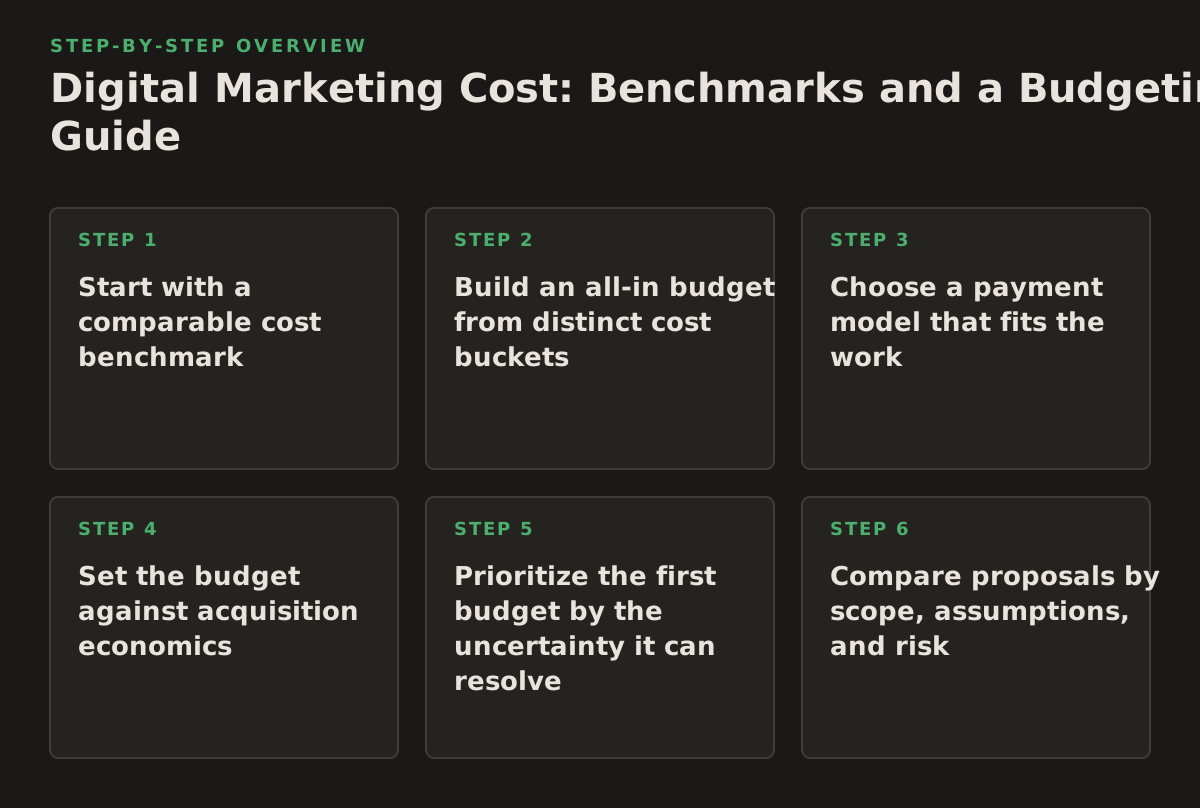
1. Start with a comparable cost benchmark
A rate only means something beside a scope. An hourly specialist rate may cover execution of a defined task; a monthly agency fee may include planning, reporting, channel management, and coordination. The media budget is usually a separate amount paid to advertising platforms. Comparing any one of these figures as though it were the total cost of marketing can make a low quote look attractive while hiding work you still need to fund.
For example, Upwork lists PPC specialist rates of $15–$40 an hour on its PPC specialist cost page. That is a marketplace rate reference, not an all-in estimate for a paid media program: it does not tell you how many hours your account needs, whether strategy or creative is included, or how much media you will buy. Ask providers to turn a rate into named deliverables and estimated effort.
Match the benchmark to the buying decision
- Hiring a specialist? Compare relevant experience, hours, deliverables, and who manages the work—not just the hourly rate.
- Evaluating an agency? Ask what recurring work the fee covers, what is billed separately, and what the first work period is intended to produce.
- Planning media? Keep platform spend separate from fees, and confirm whether the proposed spend is a test, a scaling plan, or a fixed commitment.
Failure mode: treating a platform’s average or listed range as a reliable quote for a particular business. Implementation example: if you are considering paid search, request separate estimates for account strategy, ongoing management, ad creative or landing-page work, and media. That makes proposals comparable even when providers package those elements differently.
2. Build an all-in budget from distinct cost buckets
Separate what you pay people from what you pay platforms. A useful planning model groups spending into media, management and labor, creative and conversion work, and tools or measurement. Some brands need all four; others already have an in-house team or suitable tools. The right estimate depends on what is genuinely missing, not on whether a template includes every line.
- Media: the amount charged by advertising platforms for delivery. Keep it visible as its own budget line.
- Management and labor: planning, campaign setup, optimization, analysis, and coordination, whether handled internally, by contractors, or by an agency.
- Creative and conversion work: assets, copy, landing pages, and site changes required to launch and learn.
- Tools and measurement: software, analytics implementation, or other technical work that is not already covered.
For paid search, the distinction between a planned budget and actual charges matters. Google explains that an average daily budget is a planning amount and that daily spend can vary; its Google Ads budget guidance describes how monthly charging limits work. Confirm the current billing rules for the account and campaign before treating a daily figure as a hard daily cap.
Make the first estimate explicit
Suppose, as an illustrative planning example, a growth-stage ecommerce team has a fixed amount available for a first test. It should not assign that entire amount to media and assume that creative production, management, and measurement will somehow fit. Instead, list the required work and get estimates for each line. If the total exceeds the available amount, reduce the scope—perhaps by testing one channel or one audience first—rather than quietly leaving essential work unfunded.
Failure mode: quoting an ad budget as the whole marketing budget. Implementation example: show leadership a four-line estimate with media, people, creative/conversion work, and tools. Mark which items are confirmed, estimated, or not yet priced, so uncertainty is visible before approval.
3. Choose a payment model that fits the work
Pick a commercial model based on the work’s shape. Hourly billing can suit a bounded audit or specialist task when the effort is uncertain. A fixed project fee can suit a defined deliverable, such as a strategy document or a landing-page build, if acceptance criteria are clear. A retainer can suit recurring management and optimization when the provider’s continuing responsibilities are specified.
For instance, a company preparing to launch paid acquisition might request a one-time setup scope followed by a separate recurring management scope. The setup could identify the accounts, campaigns, tracking requirements, and launch assets included; the recurring scope could identify the channels, optimization responsibilities, reporting cadence, and included capacity. The example is a way to define work, not a recommended package or market price.
Check the boundary of the fee
- Who owns the ad accounts, creative files, and reporting data?
- Are strategy and implementation both included, or is the fee for execution only?
- What triggers additional charges, and how are out-of-scope requests approved?
- What work or knowledge is handed over if the engagement ends?
Failure mode: comparing a fixed fee with a retainer without comparing outputs and responsibilities. A cheaper monthly fee may exclude landing-page work or creative production that another proposal includes. Implementation example: create a comparison sheet with columns for deliverable, frequency, owner, included capacity, additional cost, and account ownership. Fill it from written proposals, not assumptions based on the fee label.
4. Set the budget against acquisition economics
Use the business model to set a spending guardrail. A channel’s budget should be evaluated against the value and margin of the customers it acquires—not against a competitor’s spend or an arbitrary percentage. For ecommerce, that means considering gross margin, repeat purchase behavior, returns, and the time it takes for revenue to arrive. For other growth-stage businesses, use the contribution and payback assumptions that actually guide investment decisions.
Customer acquisition cost (CAC) is commonly calculated by dividing relevant acquisition costs by the number of new customers acquired over the same period. Stripe’s CAC explainer discusses that calculation and why consistent definitions matter. Before using CAC to judge a campaign, decide whether the numerator includes only media or also agency fees, creative, and other acquisition labor. A media-only figure and an all-in figure answer different questions.
Turn the economics into a test rule
Write down the assumptions you will use before launching: which conversion counts as a new customer, what costs are included, what margin or payback condition makes growth acceptable, and how long you will wait for the relevant outcome to mature. Treat any numerical thresholds you choose as your starting policy, not as universal benchmarks. Revise them when evidence about conversion quality, repeat buying, or acquisition costs changes.
Failure mode: scaling on a low cost per click or a high platform-reported conversion count without checking whether those conversions become profitable customers. Implementation example: have finance and marketing agree on one all-in CAC view for investment decisions, while keeping media-only CAC as a diagnostic. Report both with their definitions so nobody mistakes an operational metric for profitability.
5. Prioritize the first budget by the uncertainty it can resolve
Fund the next decision, not every possible channel. A limited budget should buy evidence that changes what you do next. If the major unknown is whether the offer converts, a tightly scoped landing-page and message test may be more useful than spreading media across several channels. If the offer is already validated but acquisition volume is uncertain, a focused media test may be the better next step.
| What is uncertain? | Budget priority | What to measure | Decision enabled |
|---|---|---|---|
| Offer or message fit | Creative variations and a focused audience test | Qualified response and downstream conversion quality | Keep, revise, or retire the message |
| Landing-page effectiveness | Page changes and measurement checks before broad spend | Step-by-step conversion behavior and tracking integrity | Fix the page or proceed with the channel test |
| Channel acquisition potential | One bounded channel test with a stated media limit | New-customer volume and consistently defined CAC | Stop, refine, or expand the test |
| Ability to scale profitably | Staged budget increases with continued cost and quality review | All-in acquisition cost, margin, and payback assumptions | Increase investment or hold it steady |
These are prioritization choices, not promises of a particular outcome. For example, a brand with incomplete conversion tracking should first verify that important events are measured before interpreting campaign results. Google Analytics documents key-event setup in its guide to setting up key events; confirm that the setup reflects the business’s actual conversion definitions and that the relevant data is being collected.
Failure mode: dividing a small budget evenly across channels so that none receives enough focus to answer a useful question. Implementation example: name one primary hypothesis, the evidence that would support or challenge it, and the next action for each outcome. This gives the team a reason to continue, adjust, or stop rather than treating spend itself as progress.
6. Compare proposals by scope, assumptions, and risk
Ask providers to price the same job. A proposal is useful when it exposes what the provider assumes about access, assets, tracking, internal approvals, and the amount of work. If two proposals use different assumptions, their headline fees are not directly comparable. Ask for the assumptions in writing and identify which ones your team can actually meet.
Use a consistent proposal checklist
- Scope: channels, markets, deliverables, and work explicitly excluded.
- People: who does the work, who leads it, and how much capacity is included.
- Measurement: what counts as a result, which systems are used, and who is responsible for implementation.
- Commercials: fees, media treatment, additional charges, contract terms, and ownership of accounts and work.
- Decision process: what is reviewed at each checkpoint and what would cause a change in scope.
For example, if one proposal includes creative production and another assumes your team supplies assets, add a separate estimate for that production before choosing. Likewise, confirm whether reporting is a dashboard, an interpretation of performance, or both. Failure mode: selecting the lowest headline price and discovering that required work is excluded. A transparent quote is not necessarily the lowest quote; it is one whose scope and trade-offs you can evaluate.
If you are defining the internal brief, Kimmel Marketing’s digital marketing services page and marketing expertise page can help you understand the site’s service and topic areas; they do not establish a price or confirm a particular engagement scope.
7. Put the budget into action in sequence
Use this sequence to turn estimates into a controlled investment decision. Keep the assumptions visible so changes in scope or results do not quietly alter what the budget is meant to accomplish.
- Define the business outcome. Specify the customer or conversion you are trying to acquire and the financial condition that makes acquisition worthwhile.
- Inventory what is already covered. List internal capacity, existing creative, tracking, account access, and tools. Price only the gaps, while noting any work that still needs validation.
- Choose one priority uncertainty. Select whether the next test is about the offer, conversion experience, channel, or ability to scale. Avoid splitting the initial scope across unrelated questions.
- Request itemized estimates. Separate media, management, creative and conversion work, and tools. Ask for assumptions, exclusions, and additional-charge triggers.
- Set a review rule before launch. Choose a review point appropriate to the channel and buying cycle, define the metrics, and state what would lead to a stop, revision, or expansion. Label any numeric thresholds as your own policy.
- Reforecast from evidence. Compare actual spend and work with the plan, then update the next period’s budget based on customer quality and the economics—not just platform activity.
This process is especially useful when growth teams need to explain why a proposed investment includes more than media, or when founders need a clear basis for comparing providers. For an overview of Kimmel Marketing’s stated focus on strategy, creative, media buying, and optimization, visit Kimmel Marketing; confirm directly whether a specific scope and budget fit your needs.
Authored with NotFair SEO