Digital Marketing Examples: 6 Patterns Growth Teams Can Adapt
Useful digital marketing examples show how a message, channel, and next step work together—not just what an ad looks like. For a growth-stage or ecommerce team, the six patterns below illustrate ways to capture existing demand, build consideration, improve conversion, and learn what is driving revenue. Adapt the examples to your offer and audience, then prioritize using the selection framework before investing in execution.
These are reusable patterns, not claims about particular brands’ results. The right choice depends on your margin, customer journey, available creative, and ability to measure outcomes. A tactic that produces attention but cannot connect to a meaningful business action may be a poor fit, even if its surface metrics look promising.
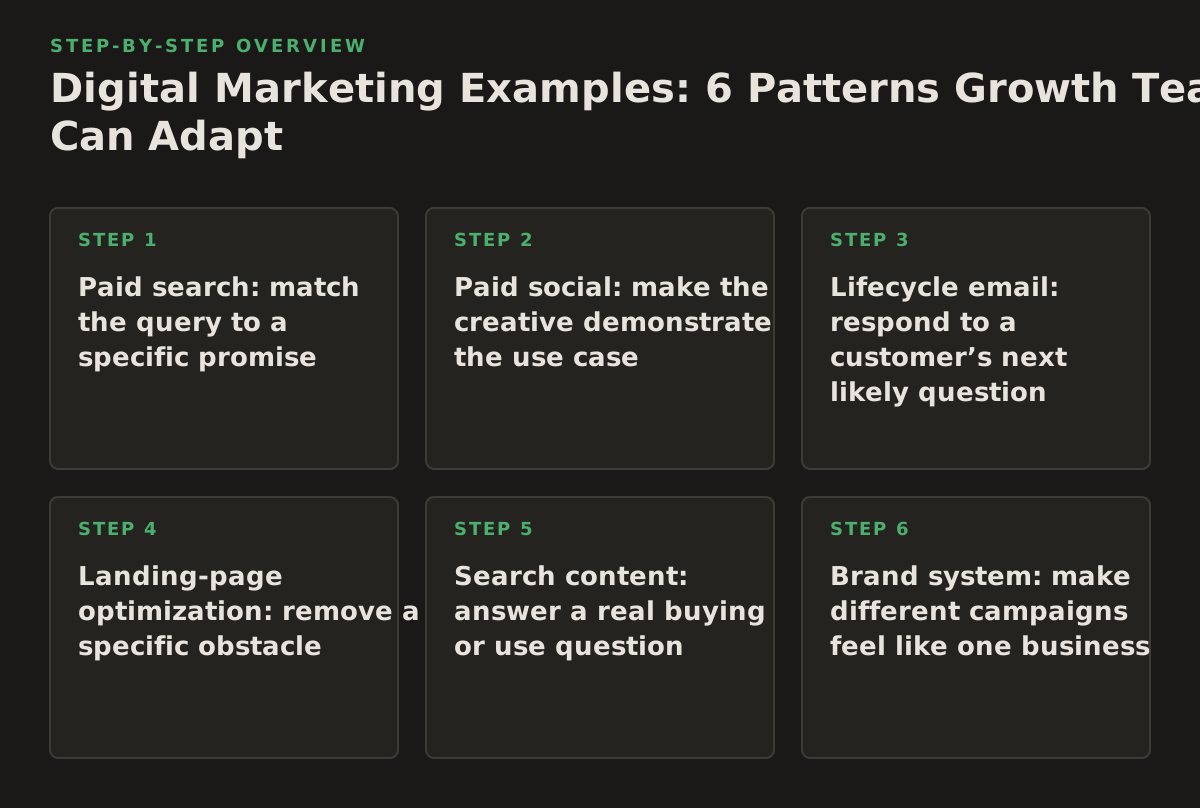
1. Paid search: match the query to a specific promise
Use this when potential customers are already searching for a product, category, or solution. Search can make the connection between intent and offer explicit: the person’s query shapes the ad, and the ad leads to a page that answers the same need. The mechanism is relevance across the whole path, not simply inserting a keyword into a headline.
Illustrative example: a product-category search
An ecommerce store selling insulated bottles might build a search ad around a query such as “insulated bottle for hiking.” The ad could emphasize the relevant use case and send visitors to a hiking-focused category page with product options, capacity details, and shipping information. Google describes responsive search ads as combining supplied headlines and descriptions into ads; its guidance is useful when planning a set of complementary messages rather than repeating one claim (Google Ads guidance on responsive search ads).
- What it demonstrates: connect a specific search intent to a matching promise and destination.
- Why it can work: the visitor does not have to translate a broad brand message into an answer to their immediate need.
- Failure mode: sending every query to the homepage, where the product and relevant details are hard to find.
- Adapt it: group queries by distinct need, write messages for each group, and verify that the landing page fulfills the ad’s promise.
For a high-consideration offer, the same pattern can lead to an explainer or comparison page rather than a checkout page. The decision is not “search or no search”; it is whether the query signals enough intent for the next step you are asking the visitor to take.
2. Paid social: make the creative demonstrate the use case
Use this when your audience may not be actively searching, but can recognize a problem, aspiration, or product use once they see it. Paid social creative has to earn attention and communicate context quickly. A product shot alone may show what you sell, while a demonstration can help explain why it matters.
Illustrative example: show the product solving a real friction
Imagine a meal-prep container brand creating a short video that moves from a crowded work bag to a packed lunch, then shows how the container separates ingredients. The ad’s first moments establish the everyday problem; the rest demonstrates a relevant feature. Meta’s business guidance describes choosing ad objectives to align campaigns with business goals, a useful reminder to define the intended action before choosing the creative treatment (Meta ad objectives).
- What it demonstrates: a visual story can make a product benefit concrete without relying on a long feature list.
- Why it can work: the use case gives viewers a reason to connect the product to their own routine.
- Failure mode: a polished video that delays the product, hides the benefit, or makes a claim the product page cannot substantiate.
- Adapt it: create versions that test different openings—problem, demonstration, or customer question—while keeping the offer and destination consistent enough to interpret.
Do not treat a single creative as a permanent answer. Record the audience, message, format, offer, and landing page for each version. That makes a later comparison more useful than a loose collection of assets with several variables changed at once.
3. Lifecycle email: respond to a customer’s next likely question
Use this when a visitor has opted in, purchased, or otherwise given your business a legitimate reason to continue the conversation. Lifecycle messages can make the next useful action easier: completing a purchase, understanding product care, or considering a relevant replenishment. The sequence should reflect the customer’s state, not just the calendar.
Illustrative example: a post-purchase onboarding sequence
A home coffee equipment store could send a concise order follow-up, then a setup guide, and later a troubleshooting message focused on common first-use questions. The order confirmation serves a different job from the guide, so each email should have one main purpose and a clear next step.
- What it demonstrates: useful communication can continue after conversion instead of treating the sale as the end of the journey.
- Why it can work: relevant guidance helps customers get value from what they bought and gives the brand a meaningful reason to communicate.
- Failure mode: sending generic promotions before the customer has received or understood the product.
- Adapt it: map messages to observable states—new subscriber, first purchase, repeat purchase—and remove messages that do not answer a customer need.
If a message includes an endorsement or testimonial, make sure its presentation does not mislead readers about the endorser’s experience or relationship with the business. The FTC’s endorsement guidance explains disclosure considerations for endorsements and testimonials; review the guidance relevant to your specific use rather than assuming a format is automatically compliant.
4. Landing-page optimization: remove a specific obstacle
Use this when traffic reaches a page but visitors may be missing information they need to act. Conversion optimization is not synonymous with changing button colors. First identify a plausible point of friction—unclear sizing, weak proof, unexpected shipping terms, or an unconvincing offer—and make a focused change that addresses it.
Illustrative example: explain fit before checkout
Suppose a footwear store receives product-page visits but customers may be uncertain about sizing. A test could add a concise fit guide near the size selector, clarifying how to use the guide and where to find product-specific notes. Keep the core offer and traffic source steady while evaluating the change; otherwise, you may not know whether the page edit or a different audience caused the movement.
- What it demonstrates: improve the page around a decision barrier, not a vague desire for a “better” design.
- Why it can work: answering a relevant question at the point of choice can reduce the effort needed to proceed.
- Failure mode: adding more copy, badges, and modules without establishing which uncertainty they address.
- Adapt it: list the questions customers ask before purchase, place the most decision-relevant answer beside the relevant choice, and assess the result using an appropriate conversion measure.
A conversion change is not proven by a handful of visits or a better-looking page. Consider traffic volume, the length of the buying cycle, and other changes during the test. If the evidence is too limited to distinguish signal from noise, treat the result as unresolved rather than declaring a winner.
5. Search content: answer a real buying or use question
Use this when customers research a category, compare approaches, or need instructions before making a decision. A useful search page has a defined reader and job: for example, explaining how to choose a size, comparing material trade-offs, or showing how a product is used. Publishing more pages is not a substitute for answering those questions well.
Illustrative example: a product-selection guide
A cookware store could publish a guide that compares pan materials by heat response, care requirements, and suitable cooking tasks, then link readers to relevant product categories. The guide gives readers a decision framework rather than dressing up a product catalog as an educational article. Google’s guidance on creating helpful, reliable, people-first content is a useful reference for evaluating whether a page serves readers rather than existing mainly to attract search traffic.
- What it demonstrates: educational content can support discovery while helping customers make a more informed choice.
- Why it can work: it connects a genuine research task to relevant products without making the product link the only useful part.
- Failure mode: a generic article that repeats familiar advice but offers no clear criteria, examples, or next step.
- Adapt it: interview sales or support teams about recurring questions, outline the decision criteria, and have someone knowledgeable check the explanations.
Measure the page by its role in the journey, not just its visits. Depending on the goal, useful signals might include relevant product-page visits or assisted conversions. Avoid claiming content caused a purchase simply because a customer viewed it somewhere in the path.
6. Brand system: make different campaigns feel like one business
Use this when several products, audiences, or channels need distinct messages but the brand is becoming inconsistent. A brand system helps teams decide what stays recognizable and what changes by audience or context. It can include positioning, message priorities, visual rules, and examples of how those rules apply—not just a logo file.
Illustrative example: one promise, different proof
A company selling reusable food storage might keep a consistent promise around making food storage easier, while adapting proof for different audiences: a product demonstration for busy households, material details for environmentally motivated shoppers, and a clear size comparison for buyers choosing a set. The core idea remains recognizable, but the evidence changes to fit the question.
- What it demonstrates: consistency does not require every ad to use identical words or imagery.
- Why it can work: shared message priorities help campaigns reinforce the same positioning while allowing relevant audience-specific proof.
- Failure mode: either making every execution interchangeable or letting each team invent a different brand promise.
- Adapt it: write a one-page guide with the audience, need, promise, reasons to believe, and examples of messages that are on or off strategy.
Before expanding a campaign, compare its claims and creative with the product experience and the rest of the customer journey. A strong ad cannot repair a mismatch between the promised benefit and what the landing page or product can actually support. Teams formalizing this kind of work can review Kimmel Marketing’s marketing expertise as a description of its expertise areas.
Choose examples by job, evidence, and constraint
Not every pattern deserves investment at the same time. Use the table below to connect the business problem to a testable action and a meaningful readout. It is a selection framework, not a universal ranking: a channel may be unsuitable if you lack relevant traffic, creative capacity, or reliable measurement.
| Business situation | Pattern to consider | First execution | Useful readout | Watch for |
|---|---|---|---|---|
| People search for the product or problem | Intent-matched paid search | Build a query group and matching destination page | Qualified actions and acquisition cost in context | Broad queries with weak purchase relevance |
| Demand needs to be created or explained | Demonstration-led social creative | Test distinct openings around one use case | Attention and downstream action together | Engagement that does not lead to useful visits |
| Visitors need more confidence to choose | Focused landing-page change | Address one documented objection | Conversion behavior for the affected page | Changing several elements at once |
| Customers need guidance after signup or purchase | Lifecycle email | Write a message for a specific customer state | Relevant clicks, purchases, or support outcomes | Irrelevant frequency or premature promotions |
| Buyers research before choosing | Decision-led search content | Answer one recurring selection question | Qualified discovery and assisted behavior | Traffic without audience or business fit |
| Campaigns feel disconnected | Shared brand message system | Define a promise and adaptable proof points | Consistency across assets and journey | Uniform creative that ignores audience needs |
Set the measurement question before launch. Google Analytics documentation describes attribution settings and reports for assigning credit across interactions; its explanation can help teams distinguish a reporting model from a definitive account of what caused a sale (Google Analytics attribution documentation). Compare like with like, record assumptions, and use the same definition of a conversion when reviewing alternatives.
A simple prioritization score can help teams discuss trade-offs: rate each candidate qualitatively on customer relevance, business value, and ability to learn, then note the main constraint. Treat any numeric scoring scale as an internal organizing device—not an industry benchmark. If a tactic scores well on potential but poorly on measurement, improve the measurement plan or choose a smaller test first.
Implementation plan: move from opportunity to decision
- Define the business job. Write the problem in observable terms: for example, “help visitors choosing a bundle understand which option fits their use,” rather than “improve marketing.” Identify the audience and the action that would count as progress.
- Choose one pattern and one audience. Use the table to select the best-fit example. Avoid launching search, social, email, and page changes simultaneously if the team cannot tell which one is responsible for a change.
- Document the path. Map the message, channel, destination, and next step. Check that the landing page delivers what the campaign promises and that tracking captures the intended action.
- Set a comparison before execution. Record the current approach, the proposed change, the primary readout, and the constraints that could affect interpretation. Set timing and decision rules based on your data volume and sales cycle; any proposed thresholds should be treated as your own starting policy, not a universal standard.
- Review and choose the next move. Decide whether to adopt, revise, or stop the pattern. Preserve what the evidence supports, note what remains uncertain, and apply the learning to the next campaign rather than scaling an unverified assumption.
For teams evaluating outside support, Kimmel Marketing describes its digital marketing services for brands working on growth, creative, media buying, and performance optimization. Use the discussion to clarify the specific business problem, measurement approach, and responsibilities before deciding whether the fit is right; learn more at Kimmel Marketing.
Authored with NotFair SEO