Digital Marketing Google: A Practical Guide to Search, Ads, and Measurement
A practical digital marketing google plan combines organic visibility, paid advertising, and measurement without treating them as one channel. For a growth-stage brand, the useful starting point is to identify whether the immediate constraint is demand, reach, or conversion insight—then use the relevant Google tools to address it and judge results against business outcomes, not clicks alone.
What digital marketing on Google includes
Google is not a single marketing channel. It is an ecosystem of ways to reach people who are searching, ways to buy ad exposure, and tools that help a business understand what happens after a visit. These parts can support one another, but they have different costs, timelines, and degrees of control.
- Organic Search can help relevant pages appear in unpaid search results. It depends on useful content, site accessibility, and how Google understands and ranks pages; a business cannot buy a guaranteed organic position.
- Google Ads lets advertisers participate in paid auctions for eligible ad placements. Campaign settings shape which searches or audiences can trigger ads, while actual delivery and cost depend on the auction and campaign setup.
- Analytics and conversion measurement help teams examine how visitors behave and whether visits lead to outcomes such as purchases or submitted lead forms.
- Shopping-related placements can be relevant to ecommerce brands with product information to promote. Their eligibility and setup depend on the product data and applicable platform requirements.
These distinctions matter because the same business problem can look different in each system. A product page with little organic visibility may call for search-focused content work; a seasonal promotion may need paid reach sooner; a sales team struggling to distinguish inquiries from qualified opportunities needs better measurement and follow-up data.
Google describes Search as a process involving crawling, indexing, and serving results, rather than a direct placement that a site owner can purchase. Its overview of how Google Search works is useful context for setting expectations: SEO can improve a page’s ability to be understood and surfaced, but it does not guarantee a particular ranking or volume of traffic.
Choose the Google channel that fits the constraint
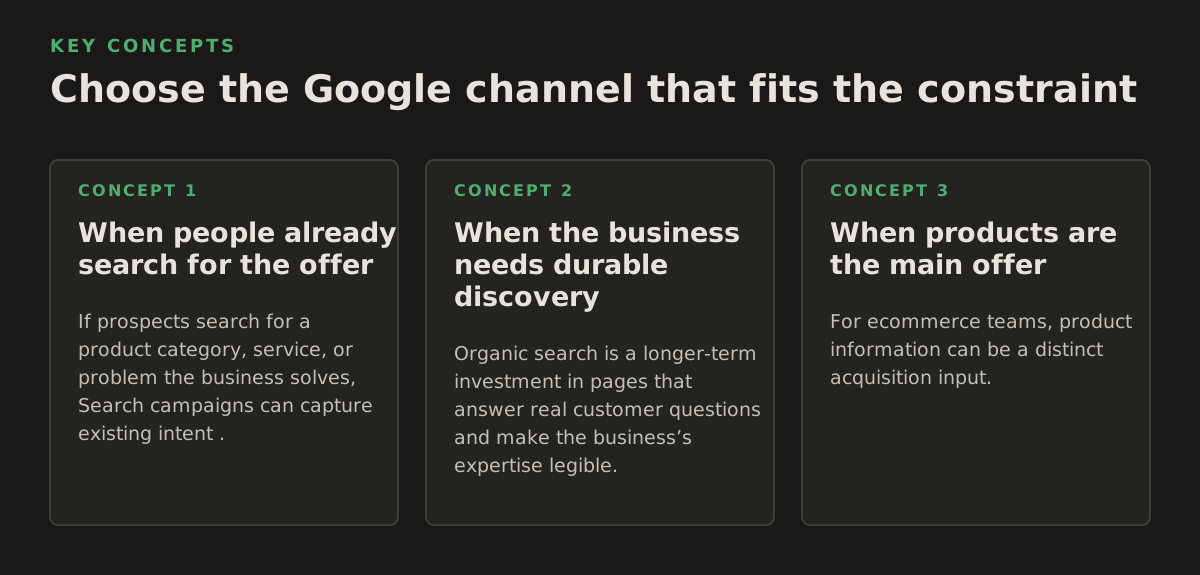
Channel choice should follow the bottleneck in the acquisition system. Starting with a tool because it is familiar can produce activity without resolving the reason growth has stalled. Consider what the team needs to learn or change first, and select the Google channel that can address that job.
When people already search for the offer
If prospects search for a product category, service, or problem the business solves, Search campaigns can capture existing intent. They are most useful when the offer and the search language are clear enough to connect a query with a relevant next step. A brand can use paid Search to test a message or reach eligible queries while organic pages develop, but paid visibility is not a substitute for explaining the offer well.
Google’s documentation describes Search campaigns as a way to show ads to people searching for products and services. Before launching, review the Google Ads Search campaign guidance and decide which searches represent genuine buying or inquiry intent. A broad query can bring volume while still being a poor fit for a specialized product or a high-consideration service.
When the business needs durable discovery
Organic search is a longer-term investment in pages that answer real customer questions and make the business’s expertise legible. It suits brands with a useful perspective, product information, or advice that can serve people before they are ready to buy. For example, an ecommerce company might build category guidance that helps shoppers compare product types; a B2B company might clarify a complex service through detailed problem-solving pages.
Organic content is not simply a cheaper version of paid search. It requires editorial judgment, technical access, and ongoing maintenance, and it may not address an urgent demand target on its own. Use it when the content can remain useful beyond a short campaign and when the business can support the subject with credible detail.
When products are the main offer
For ecommerce teams, product information can be a distinct acquisition input. Product titles, descriptions, and other feed details affect how platforms interpret what is being sold, so weak or inconsistent product data can limit the usefulness of a shopping-focused effort. Google’s Merchant Center guidance on free listings explains that product data is used to show products in relevant experiences; check current eligibility and requirements there rather than assuming every item will appear.
Examples of matching the constraint to a channel include:
- A niche software company with clear category searches tests paid Search for high-intent terms while improving the pages that explain its use cases.
- A retailer with a large catalog first reviews product data quality and category structure before expanding shopping promotion.
- A brand with weak awareness but little evidence about which message resonates may use a controlled paid test to compare propositions, then apply the learning to broader creative and content.
- A lead-generation business with many inquiries but uncertain sales value prioritizes measurement and CRM feedback before increasing media volume.
Connect the click to a useful customer journey
A campaign is a sequence, not just an ad: a person encounters a message, lands on a page, evaluates the offer, and either takes an action or leaves. The strategic question is whether each step gives the visitor enough information to make the next decision. That means designing the destination around the visitor’s intent, not merely sending every campaign to the homepage.
For a product campaign, a relevant destination may need to clarify the product’s use, differences between options, availability information the business can substantiate, and the path to purchase. For a service campaign, it may need to explain the problem addressed, who the service suits, what happens next, and what information an inquiry form requests. These are examples of page jobs, not guarantees that a particular layout will convert.
Campaign structure should make meaningful distinctions visible in reporting. Separate themes when they represent different intent, offers, or landing experiences; avoid creating so many tiny groups that the team cannot interpret results. A useful structure lets a marketer answer questions such as “Which customer problem is generating qualified demand?” rather than only “Which ad received the most clicks?”
Before spending, write down the customer promise in plain language and check that the destination can substantiate it. If an ad says a product solves a specific problem, the page should explain how. If a promotion has conditions, make them clear. This is not just a copywriting preference: a mismatch can attract visitors who expected something the business does not offer, wasting both media spend and the visitor’s time.
Measure outcomes that matter to the business
Measurement should reflect the economics of the business model. An ecommerce team may care about purchases and the value of orders; a lead-generation team may need to distinguish a form submission from a sales-qualified opportunity. A click is an interaction, not proof of commercial value. Define the action that indicates progress before deciding whether a campaign is working.
Separate early signals from business outcomes
Some actions happen before a sale: viewing a key product detail, starting checkout, downloading a guide, or requesting contact. These can help diagnose where a journey is losing people, but they should not automatically count as equivalent to a purchase or qualified lead. Keep the distinction between diagnostic signals and primary outcomes explicit in reports.
Google Analytics documents events as a way to measure interactions on a website or app, and allows events to be marked as key events when they matter to the business. Its key event documentation can help teams understand the distinction. The important planning step is to name events consistently and decide which ones represent meaningful progress, rather than marking every interaction as a success.
Make paid-media reporting decision-useful
For paid campaigns, the team needs to understand which outcomes are passed back into advertising systems and how those outcomes are counted. Google Ads explains that conversion tracking can measure actions after an ad interaction. The specific configuration depends on the site and business, so verify that the recorded action corresponds to the intended outcome and that duplicate or incomplete events are not distorting the count.
For ecommerce, revenue reporting is more informative when order values are accurate and refunds or cancellations are handled appropriately in the business’s analysis. For lead generation, a submitted form is often only an early signal; connecting campaign reporting with later sales outcomes can reveal whether a source produces valuable opportunities or merely more inquiries. If that connection is unavailable, say so in reporting rather than presenting lead volume as revenue evidence.
- Choose one primary outcome for each campaign objective, such as a completed purchase or a qualified inquiry.
- Track intermediate actions only when they help explain a specific point in the journey.
- Record operational definitions: what counts as a purchase, a qualified lead, or a repeat customer.
- Review outcome quality with the people responsible for fulfillment or sales, not only with the media dashboard.
Know where a Google marketing plan can fail
A plan can be technically active yet commercially weak. The reasons are not all the same, so diagnose the failure before changing budgets or switching channels. More impressions will not fix a vague offer; more content will not repair broken purchase tracking; and a better ad cannot compensate indefinitely for a product or sales process that fails to meet customer expectations.
- Demand is overstated. Search volume or click activity can look promising while the addressable audience is small, the query is informational, or the offer is not competitive. Review search terms and customer conversations before treating traffic as proof of market demand.
- The economics do not support acquisition. A campaign may generate customers at a cost the business cannot sustain. Compare acquisition cost with contribution margin, repeat-purchase behavior, and the time it takes to recover acquisition investment; do not rely on revenue alone if fulfillment costs vary materially.
- Measurement hides what happens after the click. Missing events, duplicate submissions, consent choices, or disconnected sales data can make reports incomplete. Treat discrepancies as an instrumentation problem to investigate, not as evidence that a channel has no value.
- Organic work is judged too early or too loosely. Search visibility can change and results are not guaranteed. Assess whether the work improves page usefulness, coverage of relevant topics, and qualified discovery over an appropriate review period, rather than expecting a fixed ranking.
- Too many initiatives dilute execution. Running Search, shopping, content, remarketing, and brand work at once can exceed the team’s capacity to create assets and learn from results. Narrow the active work to the decisions the team can actually support.
Use these failure modes to identify the next diagnostic step—not as a second generic checklist. If demand is uncertain, inspect the language customers use and the relevance of the queries. If economics are weak, examine the offer, margin, and sales progression. If the data is unreliable, audit the event definitions and compare platform records with the business’s source of truth.
Build a focused plan around one business question
A practical plan begins with a business question specific enough to answer. “How do we grow?” is too broad. “Can this product category acquire first-time customers through high-intent search at a sustainable contribution margin?” creates a testable direction. The plan should identify the audience, offer, channel role, destination, outcome, and evidence needed to decide what happens next.
- State the growth constraint. Choose whether the immediate issue is insufficient qualified demand, poor visibility for existing demand, weak conversion, or uncertainty about customer value.
- Select a primary route. Choose the Google channel that can address that constraint, then define any supporting work. For example, paid Search may test demand while the team improves an organic page, but each activity should have a distinct purpose.
- Write the customer journey. Specify the promise, destination, expected action, and what the visitor needs to know before acting. Check that claims and offer conditions are supportable.
- Set the measurement rule. Decide what counts as a meaningful outcome, how it will be recorded, and which source is authoritative if reports disagree.
- Choose a decision, not just a report. Decide in advance what evidence would lead the team to continue, revise the offer, change targeting, or pause the effort. Use a starting policy appropriate to the business rather than treating any threshold as a universal benchmark.
This makes Google marketing an operating system for learning, not a collection of disconnected tactics. Kimmel Marketing’s work spans brand strategy, creative development, media buying, and performance optimization; explore its digital marketing services and marketing expertise to understand the areas it covers. If your team needs help connecting acquisition choices to revenue and customer economics, learn more about Kimmel Marketing.
Authored with NotFair SEO