Digital Marketing Strategy Template: A Practical Growth Worksheet
A digital marketing strategy template is a working plan that connects a business goal to a defined audience, a persuasive offer, selected channels, measurement, and a sequence of tests. Use the worksheet below to make those choices explicit before committing budget or production time; it is designed for growth-stage and ecommerce teams that need acquisition activity to support revenue, customer acquisition cost, and customer value—not just clicks.
The template is useful when a team is planning a launch, revising an underperforming acquisition mix, or aligning brand and performance work. It will not determine the right channel or budget without your own margins, customer data, and operational constraints. Treat its fields as decisions to validate, not as a substitute for them.
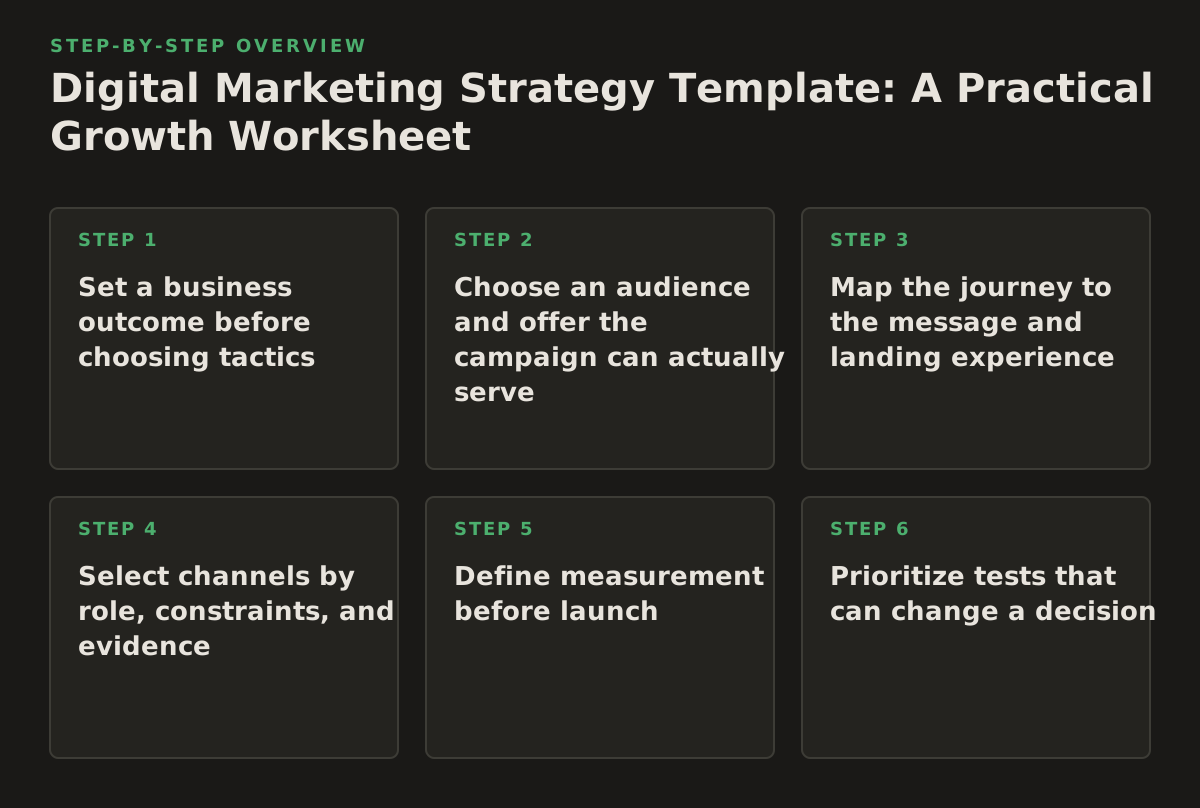
1. Set a business outcome before choosing tactics
Start with the result the business needs, then name the marketing measure that can indicate progress toward it. “Grow awareness” is too broad to guide a media plan unless you define the audience, evidence of awareness, and how it supports a commercial objective. A more useful brief might be: acquire first-time customers for a particular product line while keeping acquisition cost within a limit the finance team considers viable.
This matters because the same campaign metric can mean different things depending on margins, repeat purchases, and the time available to recover acquisition costs. A low cost per lead may be a poor result if those leads rarely become customers. Likewise, optimizing only for immediate revenue can undervalue a long consideration cycle. Agree on the primary outcome and the supporting indicators with the people responsible for revenue and fulfillment.
Write a decision-ready goal
- Business outcome: the change the company needs, such as profitable new-customer growth or demand for a new category.
- Marketing indicator: the observable measure closest to that outcome, such as qualified purchases or sales-accepted leads.
- Guardrails: constraints such as contribution margin, inventory availability, lead quality, or brand requirements.
Failure mode: setting a target from a platform dashboard without checking what counts as a conversion or whether it represents incremental business. For example, a purchase event could include existing customers even when the plan is specifically to acquire new ones. Define the customer and event before evaluating channel performance.
2. Choose an audience and offer the campaign can actually serve
Describe a buying situation, not a demographic stereotype. A useful audience definition says what the person is trying to accomplish, what is getting in the way, and what evidence could change their mind. For an ecommerce brand, this might be shoppers comparing product durability before replacing an item. For a growth-stage company selling to businesses, it might be a marketing leader who needs to explain acquisition efficiency to finance.
The offer must match that situation. It may be a product, a consultation, a comparison guide, or another next step—but it should make the exchange clear. Message-market fit begins with a specific tension: why the buyer is looking now, what they distrust, and what proof is credible. Product claims, delivery terms, and guarantees should be checked against the business’s actual policies before they appear in ads or landing pages.
Turn audience insight into a usable brief
- Identify the trigger that makes the problem urgent.
- List the alternative the buyer uses today, including doing nothing.
- State the benefit in language the buyer would recognize.
- Choose proof the company can substantiate, such as product details or a documented process.
Failure mode: writing one message for every stage and every buyer. Someone unaware of a problem may need explanation; someone comparing options needs differentiation and proof. If the team has limited evidence about objections, label them as hypotheses and gather input from customer conversations, support questions, or sales notes rather than treating assumptions as established facts.
3. Map the journey to the message and landing experience
Before selecting formats, trace the path from first exposure to the action that matters. For each step, ask what the person needs to understand next and what could prevent them from moving forward. A paid social ad might introduce a product use case; a product page must then substantiate the promise with relevant specifications, imagery, and clear purchase information. A lead-generation campaign needs a landing page that explains what happens after submission.
Message continuity reduces avoidable friction. The headline, offer, and proof on the destination page should match the reason someone clicked. If an ad promotes a comparison, sending visitors to a generic homepage forces them to find the promised information themselves. Conversely, a tightly focused page can underperform if it omits a material concern such as compatibility, returns, or how the service works.
Build a small journey map
- First contact: what problem or opportunity earns attention?
- Consideration: what proof or explanation helps the buyer compare?
- Conversion: what action should happen, and what information is required?
- After conversion: what onboarding or follow-up supports retention and future value?
Use the map to identify the weakest handoff, not to create a channel for every stage by default. Google recommends creating helpful, people-first content that serves a clear audience and purpose; its guidance on helpful content is a useful check when planning organic pages or supporting material. Failure mode: producing more content when the real issue is a mismatch between ad promise and landing-page experience.
4. Select channels by role, constraints, and evidence
Choose channels based on the job they can perform for this audience and offer—not on a list of fashionable platforms. Search may capture existing intent; social placements may help introduce a proposition or reach a defined audience; email may support follow-up with people who have already opted in. Those are planning hypotheses, not guaranteed outcomes. Validate them against your own audience access, creative capacity, sales cycle, and measurement quality.
Score each candidate channel against the same criteria. Reach without a credible next step is not a strategy, and a channel that can generate demand may require more education and creative iteration than one aimed at existing intent. A smaller, coherent mix is often easier to evaluate than spreading budget and production across many unproven routes.
| Decision criterion | Question to answer | Planning implication |
|---|---|---|
| Audience access | Can the intended buyer be reached in a relevant context? | Reject channels based only on broad popularity. |
| Intent or education | Does the channel capture existing demand or help create understanding? | Match message depth and landing experience to the job. |
| Economics | Can the likely conversion path fit the business’s margin and sales model? | Model assumptions before scaling spend. |
| Operational fit | Can the team produce, approve, and maintain suitable creative? | Limit the mix if execution capacity is the constraint. |
| Measurement | Can meaningful actions be observed and reconciled with business records? | Resolve tracking gaps before treating reports as comparable. |
Failure mode: allocating evenly across channels to appear diversified. Instead, document each channel’s role, the assumption being tested, and the condition that would cause you to reconsider it. If the business cannot distinguish new-customer orders from returning-customer orders, note that limitation in the plan rather than claiming a channel has proved acquisition impact.
5. Define measurement before launch
Write down the conversion event, its source of truth, and the reporting window before campaigns go live. Separate leading indicators—such as qualified visits or completed forms—from business outcomes such as paid orders or sales-qualified opportunities. That distinction helps diagnose where performance is breaking down without confusing activity with value.
For paid search, Google’s documentation explains how to set up conversion tracking in Google Ads. For analytics implementation, Google documents recommended ecommerce events and their parameters in its GA4 event reference. These sources can help teams define implementation requirements; they do not establish that any particular setup is complete or accurate for your site.
Make a measurement contract
- Name the event and precisely define when it fires.
- Identify who checks implementation and where results are reconciled.
- Record known gaps, such as untracked sales conversations or offline purchases.
- Keep the same definitions when comparing campaigns, unless a change is documented.
For ecommerce teams using Meta advertising, Meta describes the Meta Pixel as a tool for measuring website actions and supporting ad delivery. Verify the current setup, consent requirements, and event behavior for your own site before relying on its reporting. Failure mode: assuming a platform-reported conversion is equivalent to an incremental sale. Compare platform signals with order or CRM records where possible, and state what the comparison can and cannot establish.
6. Prioritize tests that can change a decision
A test is useful when its result could change what the team does next. Instead of testing several unrelated variables at once, identify the main uncertainty: perhaps the audience problem is real but the offer is weak, or the landing page is clear but the creative fails to communicate the differentiator. Write the hypothesis, the evidence to watch, and the decision that follows either result.
Prioritize by impact, uncertainty, and effort. A high-impact assumption that is poorly supported and inexpensive to investigate deserves attention before a low-impact design preference. Keep a record of what changed and when; otherwise, a result becomes difficult to interpret when targeting, creative, and page content all shift together.
Use a compact experiment brief
- Observation: what signal or customer question prompted the test?
- Hypothesis: what change do you expect to affect behavior, and why?
- Measure: which primary outcome and diagnostic measures will you inspect?
- Decision: what will you keep, revise, or stop if the evidence is inconclusive?
Failure mode: treating a short run or a small number of conversions as conclusive. Before launch, agree what evidence would be enough for the decision and what would remain uncertain. If volume is limited, prioritize learning that informs a meaningful next step, and avoid presenting directional observations as proof of causality.
Copyable Digital Marketing Strategy Template
Copy this worksheet into a planning document and complete it with the people responsible for marketing, sales, finance, and fulfillment. Keep assumptions visibly distinct from verified facts.
| Planning field | Prompt / question to answer | Your answer |
|---|---|---|
| Business outcome | What business result should marketing support, and by when? | [Define outcome and planning period] |
| Target buyer | Who is making the decision, what triggers action, and what is their main concern? | [Describe buyer and buying situation] |
| Offer and proof | What are we asking them to do, and what evidence supports the promise? | [State offer and verifiable proof] |
| Journey and destination | What message will they encounter, and where should the click or response lead? | [Map message to landing experience] |
| Channel role | Which channel will perform which job, and what assumption are we testing? | [Name channel, role, and hypothesis] |
| Economics and guardrails | What margin, acquisition-cost, inventory, or lead-quality constraints apply? | [Enter business-approved constraints] |
| Measurement | What event is the primary measure, where is it recorded, and what are the gaps? | [Define event, source, and limitations] |
| Next test | What will we change first, and what decision will the evidence inform? | [Write hypothesis and next action] |
Worked example: illustrative ecommerce plan
Outcome: grow first-time purchases of a selected product line while staying within a contribution-margin limit approved by the business. Buyer: a shopper replacing an item who is comparing durability and fit. Offer and proof: the product, supported by verified specifications and fit information. Journey: an ad introduces the replacement problem and sends shoppers to a product page with those details near the purchase action. Channel role: test a search campaign for existing intent and a social creative concept for problem recognition; treat both as hypotheses. Measurement: define a first-time purchase using available order data, then compare it with platform reporting and document any customer-identification gaps. Next test: test whether clearer fit information improves qualified product-page engagement or purchase behavior, using the measure and decision rule agreed before launch.
Adapt the fields to your sales model: a lead-generation business should specify lead qualification and sales follow-up, while a subscription business should account for retention and cancellation. Use actual company constraints in place of generic targets. If a field cannot yet be answered, assign an owner and a verification task rather than filling the gap with an invented assumption.
Implement the plan in sequence
- Align on the outcome. Confirm the business goal, definition of a valuable customer or lead, and constraints with finance, sales, and operations.
- Validate the buyer and promise. Check audience assumptions against available customer, sales, and support evidence; confirm that every advertised claim is supportable.
- Map the journey. Match each campaign message to a destination that answers the next buyer question and makes the intended action clear.
- Confirm measurement. Test the event definition and reporting path, document blind spots, and identify the business record used for reconciliation.
- Launch a focused mix. Assign each selected channel a role, owner, and explicit assumption; use an illustrative starting sprint, such as a month, only if it fits your sales cycle and available evidence.
- Review and decide. Compare results with the agreed measures, separate known facts from directional signals, then scale, revise, or stop based on the decision rule—not on activity alone.
For teams that need help connecting brand strategy, creative development, media buying, and performance optimization, Kimmel Marketing outlines its digital marketing services and marketing expertise. To discuss whether that support fits your plan, visit Kimmel Marketing.
Authored with NotFair SEO