Digital Strategy Examples: 6 Practical Patterns for Growth
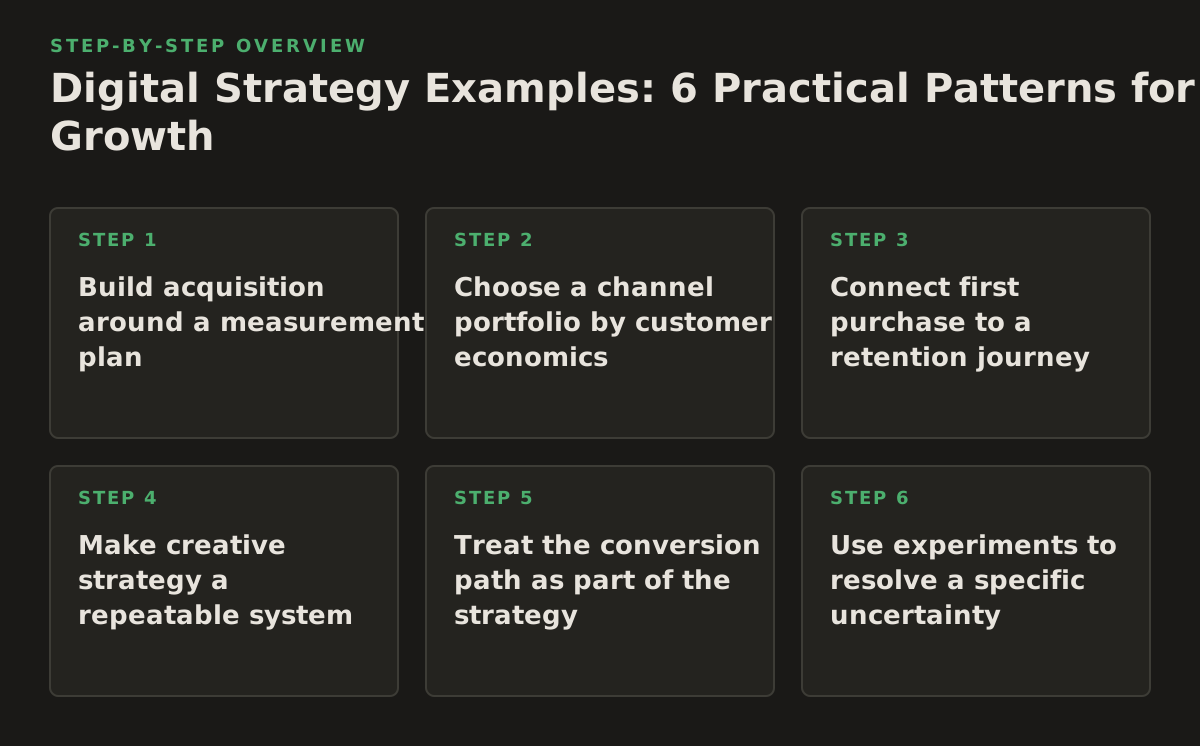
Six useful digital strategy examples are a measurement-led acquisition plan, a channel portfolio built around customer economics, a retention journey, a consistent creative system, a conversion-focused customer path, and a disciplined testing loop. Each connects a business goal to a specific audience, action, and measure. Use the patterns below to decide which one addresses your current constraint—not to copy a tactic without checking whether it fits your margins, customer journey, and ability to measure results.
For a growth-stage or ecommerce team, the decision is usually not “Which channel should we try?” It is “What is preventing profitable, repeatable growth, and what strategy would address that constraint?” A channel plan cannot fix unclear positioning; a new landing page cannot fix unreliable conversion data. Start with the bottleneck, then adapt the example that changes it.
1. Build acquisition around a measurement plan
What it demonstrates: Paid acquisition is more useful when the team defines the business outcome and its measurement before choosing campaign tactics. This pattern applies when marketing reports clicks and platform conversions but finance or leadership needs a clearer view of qualified leads, orders, or revenue.
Why it works: A measurement plan makes the intended action explicit and exposes gaps between what the business values and what a platform records. For example, an illustrative ecommerce plan might define a completed order as the primary conversion, track product-page views and add-to-cart actions as diagnostic steps, and report cancellations separately from initial orders. The point is not to optimize toward every event; it is to distinguish the business result from clues about where the journey stalls.
Turn the goal into an operational brief
- Business outcome: State what must improve, such as profitable new-customer orders or sales-qualified inquiries.
- Primary event: Identify the action that most closely represents that outcome and who owns its definition.
- Diagnostic events: Choose a small number of intermediate actions that help explain movement or friction.
- Decision rule: Record what the team will change if the outcome is weak, strong, or too uncertain to interpret.
Google Analytics documents events as a way to collect interactions on a website or app, while Google Ads explains how conversion tracking can record actions valuable to a business. Those distinctions are useful when aligning event names and conversion definitions across reporting and campaign optimization; they do not, by themselves, guarantee that tracking is complete or that platform-attributed results equal incremental business impact (Google Analytics event documentation; Google Ads conversion tracking).
Failure mode: Counting every measurable interaction as a primary success can teach campaigns to seek low-value activity. Before launch, check that the conversion event reflects the intended customer action, that duplicate events are not inflating totals, and that someone can reconcile reported outcomes with the business’s own records.
2. Choose a channel portfolio by customer economics
What it demonstrates: Channel selection is a portfolio decision, not a popularity contest. It applies when a brand is considering expanding paid media, splitting budget among channels, or reducing dependence on a single source of demand.
Why it works: Channels play different roles. A channel that captures existing intent may produce a different kind of demand from one that introduces a brand to new prospects. Compare them by the customer and business outcome they can plausibly support, alongside their measurement limits and time to learn. For a fictional home-goods store, search campaigns might focus on shoppers already looking for a specific product category, while paid social tests whether a distinct design proposition earns attention among a defined audience. The example is a planning pattern, not a claim that either channel will perform better.
Write a role for each investment
- Specify the audience or intent the channel is meant to reach.
- State its job: capture demand, create consideration, re-engage visitors, or support another defined step.
- Name the outcome and the evidence that would justify keeping, changing, or pausing the activity.
- Account for overlap: multiple channels may influence one customer journey, so platform reports should not automatically be added together as unique incremental sales.
Adaptation: If your business has limited conversion history, make the initial plan a learning portfolio: a small number of clearly differentiated tests, each with a hypothesis and a review date. Any budget allocation or review period should be an illustrative starting policy based on your own cash flow, sales cycle, and risk tolerance—not a universal benchmark.
Failure mode: Spreading investment thinly across many channels can leave every test too ambiguous to guide a decision. Conversely, treating the channel with the most visible attributed conversions as the automatic winner can overlook overlap, delayed effects, or differences in customer quality. Keep a channel only when its role and evidence remain defensible.
3. Connect first purchase to a retention journey
What it demonstrates: Acquisition strategy can include the experience after the first conversion. This example fits ecommerce businesses where repeat purchase, replenishment, onboarding, or customer education could matter to customer value.
Why it works: A customer’s next useful action may depend on what they bought, when they bought it, or what information they still need. A fictional skincare brand, for instance, could map a post-purchase journey around order confirmation, product-use guidance, and a later replenishment reminder only when the product and expected usage make that reminder relevant. The strategy is the timing and relevance logic—not simply sending more messages.
Map the journey before writing the messages
- Choose a customer group or purchase situation with a distinct need.
- Identify the next helpful action, not just the next marketing send.
- Set a trigger and a sensible stopping condition, such as a repeat purchase or an unresolved support issue.
- Decide how to assess the journey, including customer response and any downside such as opt-outs or support contacts.
Adaptation: Start with one journey where the customer context is clear. Document its trigger, audience exclusions, message purpose, and owner. If reliable purchase or consent data are unavailable, do not imply that personalization is already possible; first establish what data can be used and verify the relevant permissions and system behavior.
Failure mode: A retention sequence that fires on a fixed schedule regardless of customer behavior can feel irrelevant, conflict with support needs, or continue after the customer has already acted. Make the journey conditional where the available data allow it, and review whether the messages serve a customer need as well as a commercial one.
4. Make creative strategy a repeatable system
What it demonstrates: Creative strategy turns brand positioning into a set of testable messages and formats. It applies when paid campaigns produce inconsistent assets, a brand refresh needs to reach acquisition creative, or teams are changing visuals without a clear hypothesis.
Why it works: A shared creative system protects the core brand idea while letting teams explore different reasons to care. For a fictional outdoor apparel company, a campaign might test three message angles—weather protection, ease of movement, and repairability—while keeping the product, audience, and offer consistent enough to interpret the comparison. The angles are hypotheses to validate, not proven customer preferences.
Separate the fixed idea from the variables
- Brand anchor: State the promise or distinctive point the creative must preserve.
- Audience tension: Describe the specific need or hesitation the message addresses.
- Creative variable: Name one factor to explore, such as proof, framing, opening line, or product use case.
- Evaluation: Specify the intended audience action and the evidence needed before adapting the message elsewhere.
Search strategy belongs in this system too: a page needs to communicate clearly to people and be understandable to search engines. Google’s SEO Starter Guide recommends making content useful and easy for search engines to understand; it is a guide to search fundamentals, not a promise of rankings. For a brand explaining a product category, that means writing a genuinely helpful page around the customer’s question rather than repeating a campaign slogan across every page (Google Search Central SEO Starter Guide).
Failure mode: Changing the message, audience, landing page, and offer at once makes it hard to learn what affected the result. Another common failure is treating a platform format requirement as the whole creative strategy. Preserve the brand anchor, vary a deliberate element, and adapt execution to the placement without confusing adaptation with a new positioning.
5. Treat the conversion path as part of the strategy
What it demonstrates: The promise in an ad, email, or search result should meet an appropriate next step on the site. This is especially relevant when traffic arrives but customers hesitate, abandon a form, or cannot quickly understand what happens after clicking.
Why it works: Each handoff has a job: confirm relevance, answer the next question, and make the desired action understandable. Imagine a business selling a made-to-order desk. An ad focused on custom dimensions should lead to a page that explains how dimensions are selected and what the shopper needs to do next, rather than a broad homepage that requires the visitor to rediscover the offer.
Diagnose the path before redesigning it
- Write down the exact promise that brings the visitor to the page.
- Check whether the first screen confirms the product, audience, and next action.
- List the information a cautious buyer needs before acting, such as fit, delivery terms, return conditions, or contact options.
- Inspect the path on relevant devices and ask a person unfamiliar with the page to complete the task.
Adaptation: For a lead-generation company, replace the product-detail question with the prospect’s decision: what information they must provide, what response they should expect, and whether the offer is relevant to them. Keep any claims about delivery, availability, or service coverage tied to facts the business has verified. If the details are unknown, make verification part of the work rather than inventing reassuring copy.
Failure mode: A redesign can make a page look more polished while leaving the real uncertainty untouched. Another risk is measuring only form starts or button clicks when the business needs completed, qualified inquiries. Pair usability observations with the outcome defined in the measurement plan; treat intermediate actions as diagnostics, not substitutes for the goal.
6. Use experiments to resolve a specific uncertainty
What it demonstrates: A testing program is a way to make decisions under uncertainty, not a calendar of arbitrary A/B tests. It applies when a team has plausible alternatives and can identify what evidence would change its next action.
Why it works: A well-framed test connects a hypothesis to a meaningful outcome. For example: “If the product page explains the material’s care requirements beside the purchase decision, more shoppers who need that information may complete an order.” The team can compare the existing page with the proposed change, while watching the primary outcome and relevant guardrails. The hypothesis may be wrong; that is useful if the result informs the next decision.
Make the test interpretable
- State the uncertainty and why resolving it matters now.
- Change the smallest meaningful element that can answer the question.
- Choose the outcome and guardrails before reviewing results.
- Record limitations, including low traffic, overlapping campaigns, or changes in the audience mix.
- Decide whether to adopt, revise, or stop—and what new question follows.
Failure mode: Ending a test as soon as one version appears ahead can turn random movement into a false decision, especially when the audience or measurement volume is limited. So can running several overlapping changes and attributing the result to just one. If the evidence is inconclusive, preserve that uncertainty; use qualitative feedback or a narrower follow-up rather than calling a winner without support.
Where campaign measurement uses the Meta Pixel, Meta’s developer documentation describes it as a tool for measuring actions on a website and supporting ad measurement. Confirm implementation and event behavior against the business’s actual setup before using those signals to judge a test; the documentation does not establish that any particular account has working or complete tracking (Meta Pixel documentation).
Use this framework to select the right example
Choose the pattern that addresses the constraint you can observe, not the one with the most appealing tactic. The table is a working selection tool: fill in the final column with your own evidence before committing resources.
| Observed constraint | Example to adapt | First decision | Evidence to inspect |
|---|---|---|---|
| Reports disagree about what counts as success | Measurement-led acquisition | Which event represents the business outcome? | Event definitions, duplicate signals, business records |
| Channel expansion is under consideration | Customer-economics portfolio | What distinct job would the channel perform? | Customer quality, role, overlap, learning limits |
| First-time buyers have no mapped next step | Retention journey | What action would help this customer next? | Purchase context, journey response, opt-outs |
| Creative changes are difficult to interpret | Repeatable creative system | Which message variable should change? | Brand consistency, audience response, action |
| Visitors do not understand the next step | Conversion-path review | What unanswered question blocks action? | Page clarity, task completion, qualified outcomes |
| Teams disagree about a proposed change | Focused experiment | What result would change the decision? | Primary outcome, guardrails, uncertainty |
Implement the strategy in sequence
Use a short, explicit sequence to move from example to operating plan. The order matters: channel and creative decisions are difficult to interpret if the goal, measurement, or customer path is still undefined.
- Name the business constraint. Describe the specific growth problem in observable terms: unreliable conversion reporting, weak product-page clarity, no defined retention journey, or uncertainty about a channel’s role. Avoid starting with a preferred platform or redesign.
- Choose one strategy pattern. Select the example that directly addresses the constraint. Write down what it is intended to change and what it cannot solve. If the problem spans several patterns, choose the prerequisite rather than attempting a full overhaul at once.
- Check readiness and evidence. Confirm that the needed audience information, measurement, ownership, and customer-facing facts are available. Mark unknowns explicitly. For example, an acquisition test cannot be judged confidently if the outcome event is unclear; a personalized journey cannot be responsibly planned without verified data and permissions.
- Write the working brief. Include the audience, customer need, proposed action, primary outcome, guardrails, owner, and review conditions. Label any budget or timing as an internal starting assumption, then adapt it to the business’s economics and operating capacity.
- Run, review, and record the next decision. Keep the test narrow enough to interpret. At review, document what the evidence supports, what remains unknown, and whether to scale, revise, pause, or collect better information. Carry that learning into the next cycle rather than treating a single result as a permanent channel rule.
For teams evaluating outside support, Kimmel Marketing describes its work around brand strategy, creative development, media buying, and performance optimization; the relevant scope should be confirmed against your specific needs. Explore the agency’s digital marketing services and marketing expertise, then use Kimmel Marketing to discuss whether that scope fits the decision you need to make.
Authored with NotFair SEO