Digital Strategy Framework for Scalable Growth
A digital strategy framework helps a growth-stage brand decide what to prioritize when acquisition costs rise, creative performance becomes inconsistent, or the website cannot convert the demand media is generating. The useful question is not “Which channel should we add?” It is “Which connected set of decisions can produce profitable growth, and what evidence would make us change course?” This guide gives ecommerce leaders, founders, and marketing owners a practical way to make that decision without treating brand, media, measurement, and conversion as separate projects.
The framework is designed for a business that needs more than an activity list. It connects commercial objectives to customer economics, audience insight, positioning, channel roles, measurement, experimentation, and operating cadence. Use it to choose where to invest next, identify the constraint limiting growth, and brief an internal team or a partner providing digital marketing services.
1. Start with the commercial constraint, not the channel plan
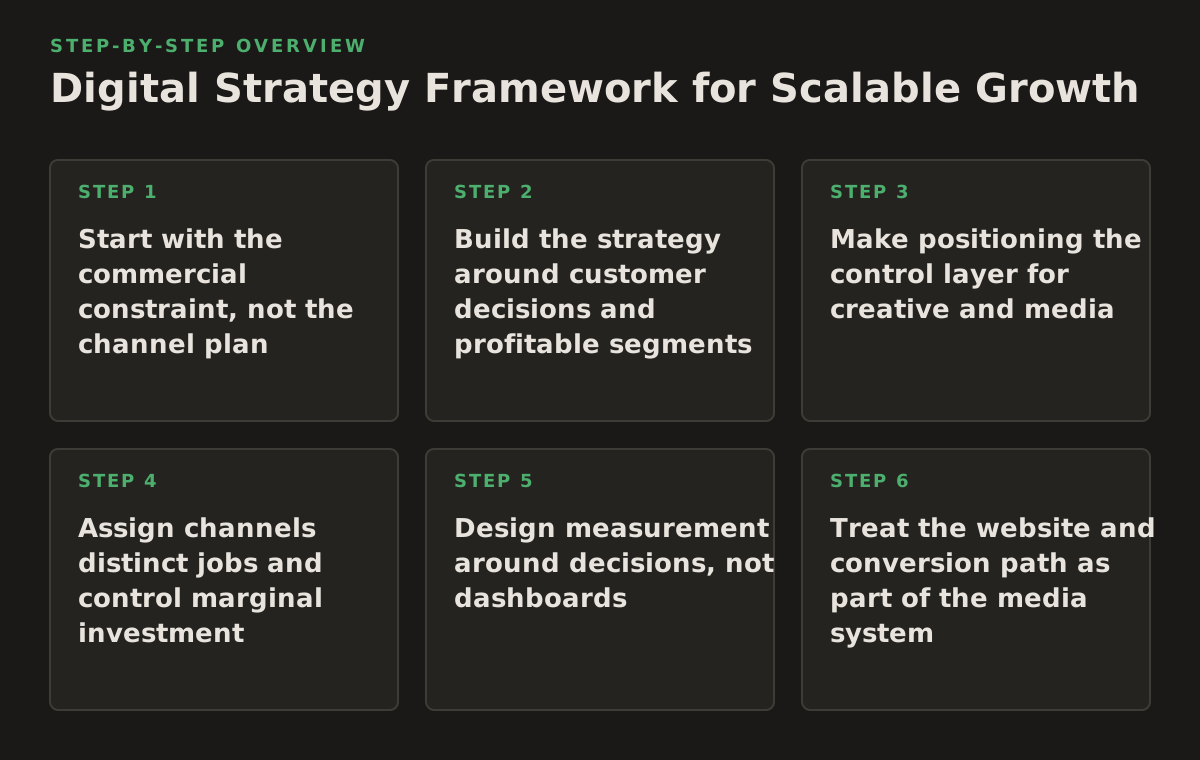
The first principle applies when a company has several plausible growth opportunities but limited money, attention, or creative capacity. A channel-first plan usually creates motion without resolving the business problem. A commercial constraint forces the team to distinguish between more demand, better conversion, and more valuable customers.
For example, an ecommerce company may report that paid social revenue is below plan. That observation does not identify the constraint. The underlying issue could be weak new-customer demand, a rising cost to reach qualified prospects, poor landing-page relevance, low checkout completion, weak repeat purchase, or unreliable attribution. Each diagnosis requires a different intervention.
Translate the growth goal into an operating equation
Use a simple model before discussing platforms:
- Revenue = qualified traffic × conversion rate × average order value.
- Contribution profit = revenue − product cost − fulfillment cost − discounts − variable marketing cost.
- Customer value = first-order contribution plus expected future contribution, adjusted for retention uncertainty.
These are management models, not accounting replacements. Their purpose is to expose the lever and its cost. If the company needs first-order profitability, an acquisition plan should not quietly depend on future orders. If the real objective is customer growth, a strict first-order return target may suppress useful investment. State the rule before evaluating campaigns.
A useful diagnostic brief answers:
- What must improve: revenue, contribution, new customers, repeat rate, or payback?
- Which customer or product segment matters most to that objective?
- What is the current bottleneck, and what evidence supports that diagnosis?
- What constraint is fixed for the next planning cycle: budget, inventory, margin, creative supply, or operational capacity?
- What result would prove the diagnosis wrong?
Failure mode: setting a blended return-on-ad-spend target without separating margin, customer type, and time horizon. A high-value returning customer and a discounted first order can look identical in a blended view while creating very different economic outcomes.
Implementation example: suppose a skincare brand has adequate traffic but a weak mobile product-page conversion rate. Its first 2026 priority should not be expanding into another prospecting channel. It should isolate whether the page fails because of unclear product fit, insufficient proof, slow load time, or price friction. The channel plan can remain stable while the team resolves the higher-leverage constraint.
2. Build the strategy around customer decisions and profitable segments
This principle applies when audience definitions are overly broad, creative is generic, or media reports describe people only by age, interest, or device. A stronger framework maps customer jobs-to-be-done to buying situations and economics. The goal is not to create fictional personas. It is to understand why a person enters the category, what risk they perceive, and what evidence moves them forward.
For a growth-stage brand, segmenting only by demographics often hides the most useful differences. Two customers can share an age range and location while having different urgency, product knowledge, budget, and likelihood to reorder. Those differences should affect the message, landing experience, offer, and measurement window.
Use a segment scorecard
For each meaningful segment, document:
- Trigger: what problem or event starts the search?
- Desired outcome: what does success look like to the customer?
- Barrier: what makes the purchase feel risky, expensive, or confusing?
- Proof: which demonstration, review, comparison, or guarantee reduces that risk?
- Economics: expected margin, reorder behavior, service cost, and acquisition tolerance.
- Reachability: where can the company reliably encounter this segment?
Prioritize segments using a score that reflects the business objective, not just market size. An illustrative starting policy is to rate each segment from 1 to 5 for need intensity, margin quality, repeat potential, reachable demand, and message clarity. Multiply or weight the factors only if the team can explain why. A large segment with weak economics may deserve less investment than a smaller segment with strong retention and clear creative angles.
Failure mode: treating a segment as a permanent audience setting. Segment strategy should guide propositions and creative hypotheses; it does not mean every platform must support or receive the same audience definition. Platform signals, privacy controls, and available data can change how precisely a segment can be activated.
Implementation example: a premium home office brand might separate “first serious desk setup” from “replacement for an inadequate setup.” The first group needs compatibility guidance and a complete configuration. The second needs proof of durability, dimensions, and a reason to switch. Both may search the same category, but their landing-page hierarchy and creative promise should differ.
3. Make positioning the control layer for creative and media
Use this principle when campaigns produce a stream of new ads but no coherent learning. Creative volume cannot compensate for an unclear reason to choose the brand. Positioning gives every campaign a consistent answer to three questions: who is this for, what valuable change does it create, and why should the customer believe it?
A positioning system should be specific enough to exclude some buyers. “High quality” and “great service” are usually category expectations. A stronger proposition identifies a meaningful trade-off or point of view, such as speed over customization, guided selection over overwhelming choice, or durable materials over low initial price.
Turn positioning into a message architecture
Document the following hierarchy:
- Core promise: the primary customer outcome in plain language.
- Reason to believe: product attributes, process, expertise, proof, or policy that supports the promise.
- Objection answers: the two or three reasons a qualified customer may hesitate.
- Message angles: different ways to make the promise relevant to different triggers.
- Evidence format: demonstration, comparison, expert explanation, review, visual proof, or user-generated content.
Then create a creative brief that connects message to funnel role. A prospecting video may establish the problem and category distinction. A product-page module may explain fit and proof. A retargeting asset may remove a specific objection. The same claim can appear in all three places, but the job changes.
Failure mode: optimizing ads against cheap engagement while the message attracts people who do not have the commercial problem. Strong hooks can inflate attention and weaken qualified conversion if the promise is broad or sensational.
Implementation example: a subscription coffee brand could position around “fresh coffee without decision fatigue.” Its creative system might show a simple selection quiz, explain roast recommendations, and answer concerns about cancellation and delivery frequency. The media team can test different triggers—busy mornings, gifting, or inconsistent supermarket quality—without abandoning the central promise.
Creative learning should be recorded as a decision log, not a gallery. For each asset, capture the audience situation, promise, proof, format, placement, spend context, conversion event, and next hypothesis. Avoid declaring a message “the winner” when several variables changed at once.
4. Assign channels distinct jobs and control marginal investment
This principle applies when a plan lists channels but cannot explain what each one contributes. Channel selection is not a popularity contest. It is a portfolio decision based on customer behavior, available creative, measurement quality, operational capacity, and the role each channel can perform.
Separate channels into jobs such as:
- Demand capture: intercepting people already expressing relevant intent.
- Demand creation: making a problem, category, or brand salient before active intent exists.
- Proof and education: helping customers understand fit, quality, use, or risk.
- Retention: increasing repeat purchase, replenishment, adoption, or referral.
- Measurement support: producing first-party signals and learning that improves decisions elsewhere.
One channel may perform several jobs, but the team should not assume that one reported metric proves all of them. A prospecting placement can generate future branded search, while a search campaign can harvest demand created by other activity. The correct question is whether the portfolio produces incremental profitable growth, not whether each channel claims the same sale.
Use a marginal-investment rule
Before increasing spend, ask:
- What customer demand is the next unit of spend intended to reach?
- What evidence suggests that demand is not already being captured elsewhere?
- How will marginal cost change as spend expands?
- What creative, landing-page, or inventory constraint could make the increase unproductive?
- What stop or review condition applies?
An illustrative starting policy for a 2026 planning cycle is to release budget in stages rather than approve a full expansion at once. For instance, a team might authorize a controlled increment, review qualified conversion and contribution after a defined learning period, then either scale, revise, or stop. The amount and review period should reflect spend volume, sales cycle, inventory, and data reliability; they are not universal benchmarks.
Failure mode: reallocating budget based on platform-reported return without asking whether the conversions are incremental. This can reward channels closest to the purchase while starving the activities that create future demand.
Implementation example: an outdoor apparel retailer can assign search to active category demand, paid social to problem-led discovery and creative learning, email to retention, and its product content to proof. If search volume grows after a brand campaign, the team should inspect the relationship rather than crediting search alone or assuming the relationship proves causality.
For paid media operations, keep the account structure simple enough that budget, creative, audience, and landing-page decisions can be interpreted. Excessive fragmentation creates small samples, duplicated auctions, and reporting noise. Consolidation is not always right, but every split should have a stated decision it enables.
5. Design measurement around decisions, not dashboards
Use this principle when teams have many numbers but cannot agree on what happened. Measurement should connect a business question to an event, a data owner, a reporting view, and an action. It must also state where the data is incomplete.
Google Analytics documents events as interactions that can be collected and analyzed, while recommended ecommerce events provide a shared vocabulary for actions such as viewing an item, adding to cart, and purchasing. See the official GA4 event reference for the current event definitions. That vocabulary is useful only when the site sends consistent parameters and the team agrees what each event means.
For advertising measurement, Google Ads explains that conversion tracking records actions valuable to the business after an ad interaction; its official conversion tracking overview also distinguishes conversion actions and measurement setup. Treat the conversion definition as a commercial choice, not merely a tag implementation. A purchase, qualified lead, subscription start, and margin-adjusted order may all be valid—but they answer different questions.
Create a measurement contract
For each important outcome, specify:
- Business meaning: why this event matters.
- Event name and parameters: what is sent and in what format.
- Source of truth: analytics, commerce platform, CRM, or finance.
- Latency: when the event becomes reliable enough to evaluate.
- Allowed use: optimization, reporting, diagnosis, or audience creation.
- Known gaps: consent, browser restrictions, offline sales, cancellations, returns, or deduplication risk.
Use a funnel model that reflects the business rather than forcing every company into the same stages. For an ecommerce brand, it may include qualified product view, add to cart, checkout start, purchase, delivered order, repeat purchase, and contribution after returns. For a B2B company, it may include qualified inquiry, accepted opportunity, proposal, closed revenue, and retained account.
Failure mode: treating a tracking platform as a complete accounting system. Analytics and ad platforms help with directional optimization, but they can differ from finance because of attribution rules, time zones, refunds, consent, modeled data, and reporting windows.
Implementation example: a fashion retailer can report purchase conversion for daily campaign optimization, then reconcile net revenue and returns in a weekly commercial report. The media buyer uses timely signals; the leadership team uses the reconciled view for investment decisions. Neither report is mislabeled as the other.
When using Meta advertising, consult the official Meta Pixel documentation for implementation concepts and event setup. Do not assume that installing a pixel resolves attribution or consent issues; event quality, deduplication, permissions, and business rules still require ownership.
6. Treat the website and conversion path as part of the media system
This principle applies when acquisition metrics look acceptable but profitable outcomes lag, or when media teams keep changing targeting to compensate for a weak experience. The landing page is where the promise made in an ad meets the customer’s uncertainty. A page can lose demand through mismatch, ambiguity, friction, lack of proof, or poor technical performance.
Start with message continuity:
- Does the headline answer the same customer problem as the ad?
- Can the visitor understand the product or offer without hunting?
- Is the most important proof visible before a high-effort decision?
- Are price, shipping, returns, availability, and eligibility clear?
- Does the mobile experience support comparison, selection, and checkout?
Use behavior data to form hypotheses, not to invent certainty. A high exit rate may indicate mismatch, but it can also reflect successful information gathering, a slow page, an external checkout, or a measurement defect. Pair analytics with usability observation, customer service themes, search queries, and session-level investigation where permitted.
Prioritize tests by mechanism
Rank a conversion opportunity by:
- Expected effect on a valuable step, such as qualified purchase or lead completion.
- Confidence that the identified friction is real.
- Effort and implementation risk.
- Speed of learning.
- Ability to apply the learning to other pages or segments.
Failure mode: testing cosmetic changes while the fundamental offer is unclear. Button color or minor layout changes cannot repair missing product fit, weak proof, broken variant selection, or an uncompetitive proposition.
Implementation example: a furniture retailer notices paid traffic reaching a product page with a strong image but no clear delivery estimate. Instead of sending more traffic, it can test a prominent delivery and returns explanation, add dimensions beside the purchase controls, and distinguish made-to-order timing from in-stock timing. The hypothesis is that uncertainty—not awareness—is blocking the next step.
Technical performance is also a strategic concern. Google’s Search documentation describes Core Web Vitals as user-focused measurements related to loading, interactivity, and visual stability; the official Core Web Vitals guidance provides the current framework. Use it as one input to experience work, not as a promise that a score alone will improve revenue. Business outcomes still depend on relevance, offer, trust, and usability.
7. Operate the framework through explicit experiments and governance
A framework becomes useful when it changes what the team does every week. This principle applies when experiments are launched without a hypothesis, results are interpreted opportunistically, or no one knows who can change budget, creative, tracking, or the website.
Each experiment should contain:
- Decision: what will change if the result is positive or negative?
- Hypothesis: the mechanism expected to cause the outcome.
- Population: which customer, product, channel, or page is included.
- Primary metric: the outcome closest to the commercial objective.
- Guardrails: quality, margin, refund, complaint, or operational measures that cannot deteriorate materially.
- Evaluation rule: how long or how much evidence is needed before action.
Do not call every campaign adjustment an experiment. Changing audience, budget, creative, landing page, and offer together may be sensible optimization, but it is not a clean test. Label it honestly as a bundled intervention and use directional evidence. Where a controlled test is practical, preserve a comparison group or a credible before-and-after design, while acknowledging seasonality and concurrent changes.
Failure mode: stopping at the first attractive result. Early results are especially vulnerable to noise, uneven audience mix, delayed conversions, and promotional effects. A result should survive a predefined quality check before becoming a new rule.
Implementation example: a nutrition brand tests whether education-led landing pages improve qualified subscription starts compared with product-led pages. The team keeps the offer, product, and traffic source stable where possible; defines subscription start as the primary outcome; monitors refund and cancellation signals as guardrails; and records whether the result applies to first-time visitors, returning visitors, or both.
Governance should be lightweight but visible. Assign owners for commercial strategy, media, creative, web, analytics, and finance. Hold a weekly operating review for active decisions and a monthly strategic review for segment, positioning, economics, and channel roles. A short decision log is more valuable than a long meeting deck if it records the evidence, choice, owner, and next review date.
Reusable Digital Strategy Framework: select the next move
Use the table below when several recommendations compete for the same budget or team capacity. Score each opportunity with the evidence available; do not manufacture precision. “High” and “low” are decision labels, not claims about a universal benchmark.
| Opportunity | Use it when | Evidence to require | Primary risk | First action |
|---|---|---|---|---|
| Clarify positioning | Creative attracts attention but qualified conversion is weak | Customer objections, competitor alternatives, message-to-page mismatch | Producing a broad claim with no proof | Write promise, proof, objections, and three message angles |
| Fix measurement | Platform, analytics, and finance numbers disagree materially | Event audit, source-of-truth map, refund and consent review | Optimizing toward an unreliable event | Define the measurement contract and reconcile one journey |
| Improve conversion path | Traffic is qualified but key page or checkout steps leak | Funnel rates, usability evidence, support themes, technical checks | Testing cosmetic changes before offer clarity | Identify the highest-value friction and form one mechanism-led test |
| Expand media reach | Existing demand is captured and economics remain acceptable | Marginal efficiency, audience overlap, creative supply, inventory capacity | Paying more for the same demand | Release a controlled budget increment with a stop rule |
| Invest in retention | Acquisition is viable but repeat value is underdeveloped | Repeat timing, cohort contribution, service and product experience | Counting messages as retention impact | Map post-purchase jobs and one behavior-based lifecycle intervention |
| Increase creative production | Learning is limited by too few credible message or format variations | Creative fatigue signals, audience coverage, test backlog, production capacity | Creating volume without a hypothesis | Build a brief matrix linking segment, trigger, promise, proof, and format |
The table should produce a sequence, not a shopping list. Choose the opportunity that addresses the binding constraint and has a measurable next decision. If measurement is unreliable, repair it enough to support the next decision rather than delaying all marketing indefinitely. If the offer is weak, do not hide behind more sophisticated targeting.
Implementation plan for a 2026 growth cycle
Follow this sequence when building or rebuilding the framework for a growth-stage brand. The durations below are an illustrative planning sequence, not a universal timeline.
- Define the commercial outcome. Write the target outcome, margin or payback logic, priority customer, product constraints, and decision horizon. Specify whether the business is optimizing for immediate contribution, customer acquisition, revenue, or future value.
- Audit the evidence. Reconcile one customer journey from ad or referral through purchase and, where relevant, repeat behavior. List tracking gaps, data delays, returns, consent limitations, and discrepancies between platform reporting and finance.
- Identify the constraint. Use funnel evidence, customer research, creative review, and operational context to decide whether the primary issue is demand, reach, message, conversion, economics, retention, or capacity.
- Prioritize segments and jobs. Score the commercially relevant segments, document triggers and barriers, and select the group for the next cycle. Keep the segment choice connected to product availability and service capability.
- Build the message system. Establish the core promise, reasons to believe, objections, proof formats, and channel-specific jobs. Turn these into creative and landing-page briefs that can be evaluated against the same strategy.
- Assign channel roles. Decide which channels capture demand, create demand, educate, retain, or generate useful signals. Set marginal-investment rules and identify what would justify expansion, revision, or a stop.
- Repair the critical experience. Fix the highest-value landing or checkout friction before scaling traffic. Use one clear hypothesis at a time when possible, and protect essential operational and customer-quality guardrails.
- Launch a learning backlog. Rank experiments by commercial value, confidence, effort, and reusability. Every item needs an owner, primary metric, guardrails, evaluation rule, and decision that follows the result.
- Run the operating cadence. Review active performance and decisions weekly; review segment economics, positioning, channel roles, and customer value monthly. Record what changed and why so the next cycle starts with accumulated learning.
For leaders who need an external partner, the right evaluation criterion is not a large list of tactics. Look for clear links between business economics, creative decisions, media investment, and measurement limitations. Kimmel Marketing brings together brand strategy, creative development, media buying, and performance optimization; its marketing expertise can be relevant when those disciplines need to operate as one growth system. Kimmel Marketing
Authored with NotFair SEO