Goals Form The Basis Of Any Marketing Strategy: A Practical Guide
Goals form the basis of any marketing strategy because they determine what the business is trying to change, which customers to prioritize, what marketing should measure, and how teams should allocate resources. For a growth-stage brand, that means translating a business outcome—such as profitable customer acquisition—into a measurable target, a defined audience, a coordinated plan, and clear rules for adjusting spend. Without that chain, channel activity can look productive while contributing little to revenue or customer value.
What it means for goals to form a marketing strategy
A marketing goal is a specific business outcome marketing can influence, stated with a measure and a time horizon. A strategy is the set of choices that explains how marketing will pursue that outcome: which customers matter, what value proposition to communicate, which channels to use, and what evidence will guide investment. Goals are the starting point for those choices, not a substitute for them.
For example, “grow the brand” expresses an ambition, but it does not tell a team what to do. “Increase first-time purchases among high-intent shoppers while keeping acquisition cost below our allowable level” is more actionable. It identifies the customer and the commercial outcome, while leaving room for the team to decide which audience, offer, creative, and channel are most likely to work.
A useful goal connects four elements:
- Business outcome: revenue, contribution margin, qualified pipeline, retention, or another result that matters to the company.
- Marketing contribution: the customer behavior marketing is expected to influence, such as a first purchase or qualified lead.
- Measure and time frame: how progress will be assessed and when the team will review it.
- Operating constraint: a condition such as allowable acquisition cost, inventory availability, or sales capacity.
The distinction matters: an outcome is the destination; strategy is the route; campaigns and assets are the execution. If a brand’s goal is profitable growth, a high click-through rate is not automatically success. It is a signal only if it helps explain progress toward profitable customers.
Why a clear goal changes the quality of marketing decisions
Teams with an agreed goal can make trade-offs explicitly. A channel may produce more orders but attract customers who rarely return. A promotion may lift immediate conversion while eroding margin or training customers to wait for discounts. A brand campaign may influence demand that appears later in search or direct traffic. A goal tied to the business outcome helps the team ask whether these effects support the intended growth, rather than judging each activity in isolation.
It also makes collaboration more concrete. Finance can clarify margin assumptions, ecommerce can flag inventory limits, and sales can define what makes a lead usable. Marketing can then set a plan against shared constraints instead of optimizing to a metric that another team does not value. For a company preparing a brand refresh, goals can help distinguish a desired perception shift from the commercial behavior expected to follow it.
Measurement definitions are part of that agreement. Google Ads’ conversion tracking documentation explains how advertisers can track actions such as purchases and leads; the specific actions chosen should reflect the outcome the strategy is meant to produce. A purchase, a qualified lead, and a newsletter signup are not interchangeable simply because all can be counted.
A goal is especially useful when it rules something out. If a team has limited stock, a plan to maximize order volume may conflict with availability. If customer support cannot handle a surge in inquiries, lead volume alone may be a poor target. Naming the constraint early gives media buyers and creative teams a basis for deciding what not to scale.
How to translate a business goal into campaign choices
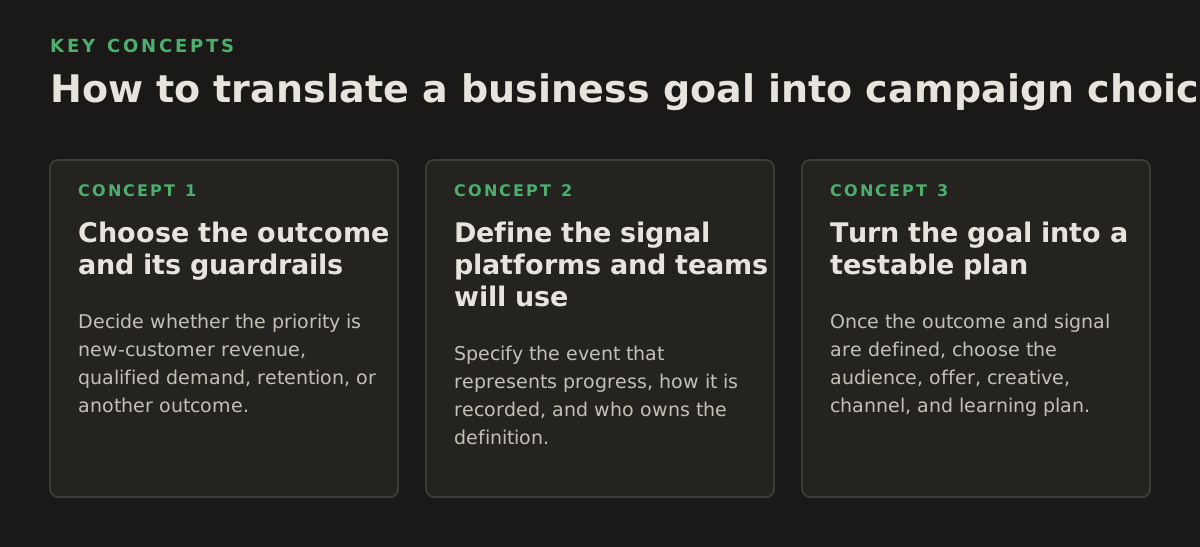
Start with the business result, then work backward to the behavior marketing can influence. Make each link in the chain visible: otherwise, a campaign can be well optimized against an outcome that does not contribute to the company’s actual priority.
Choose the outcome and its guardrails
Decide whether the priority is new-customer revenue, qualified demand, retention, or another outcome. Then document the limits that make growth worthwhile. For ecommerce, those may include contribution margin, allowable acquisition cost, inventory, and the share of orders from first-time buyers. For a lead-generation business, they may include qualification criteria, follow-up capacity, and the rate at which leads become customers.
Keep the goal narrow enough to guide action, but do not pretend that one metric explains the whole business. A revenue target without a margin guardrail can reward unprofitable orders; a cost-per-lead target without a quality measure can reward low-intent inquiries. Pair the primary outcome with a small number of guardrail measures that reveal when the apparent progress is costly or low quality.
Define the signal platforms and teams will use
Specify the event that represents progress, how it is recorded, and who owns the definition. In Google Analytics, an event can be marked as a key event when it represents an important interaction; its key events documentation describes that distinction. Choose events that represent meaningful customer actions, and confirm that reporting systems use compatible definitions before comparing results.
Then decide how campaigns will optimize. Google describes Smart Bidding as a set of automated bidding strategies that use auction-time signals to optimize for conversions or conversion value. Automation still depends on the conversion goal and inputs being appropriate: if the tracked event is a weak proxy for business value, automated optimization can efficiently pursue the wrong thing.
Turn the goal into a testable plan
Once the outcome and signal are defined, choose the audience, offer, creative, channel, and learning plan. A campaign should have a reason for each choice. For example, an offer might reduce friction for first-time buyers; a retention campaign might focus on a replenishment window; a lead campaign might qualify prospects before sales follow-up. The strategy should also state what evidence would cause the team to continue, revise, or stop an approach.
For paid social, campaign structure should likewise reflect the intended result rather than a convenient label. Meta’s ad objectives overview describes objectives in relation to the action an advertiser wants people to take. That makes the objective a strategic choice: a campaign optimized for one kind of action may not be the right setup for a different business outcome.
Worked example: make the goal measurable without mistaking the example for a benchmark
The following numbers are an illustrative planning example, not a recommended industry target. Imagine an ecommerce company planning a 12-week campaign in 2026. Its business priority is to acquire first-time customers without exceeding an internally approved acquisition-cost limit. The team has enough inventory to support growth, but wants to avoid treating returning-customer revenue as proof that acquisition is working.
- Business goal: increase first-time-customer revenue during the 12-week planning period, subject to the company’s approved margin and acquisition-cost limits.
- Marketing outcome: generate first purchases from customers who have not ordered before, with new-customer status recorded consistently.
- Primary measure: first-time purchases and their revenue, reviewed alongside the internally calculated acquisition cost.
- Guardrails: contribution margin, stock availability, cancellation rate, and the share of purchases that meet the new-customer definition.
- Execution: use prospecting creative that explains the product’s value, test a lower-friction landing page, and separate acquisition reporting from retention activity.
- Decision rule: if reported purchase volume rises but the new-customer share falls or the margin guardrail is breached, investigate audience mix, attribution, offer economics, and inventory before increasing spend.
The value of this plan is not its numerical target; it is the traceable connection between goal and action. A buyer can see what the campaign is meant to acquire. An analyst can verify whether reported purchases represent first-time customers. A finance partner can check the economics. A creative strategist can develop messages that make the intended offer clear.
The same logic applies when the goal is qualified pipeline rather than ecommerce orders. Define a qualified lead with sales, record the transition from inquiry to accepted opportunity, and inspect both lead cost and downstream quality. Do not optimize toward a form submission merely because it arrives sooner if the actual goal is revenue from qualified prospects.
Where goal-led strategies break down
Writing a goal does not guarantee a useful strategy. The system breaks when the goal is vague, the measurement is disconnected from value, or teams are rewarded for activity that conflicts with the intended outcome.
- Vanity metrics replace outcomes. Reach, clicks, or engagement may explain how an ad is behaving, but they do not prove profitable acquisition. Use them as diagnostics unless they are directly linked to the business goal.
- Conflicting goals compete for the same budget. “Maximize revenue,” “protect margin,” and “grow new customers” can point toward different choices. Establish a priority and explicit guardrails rather than implying that every metric can rise at once.
- Measurement gaps create false confidence. Missing purchase values, inconsistent lead stages, duplicate events, or weak customer-status data make platform reporting less useful. Audit the event definition and reporting path before interpreting a trend as strategy performance.
- Targets ignore operational constraints. Media can generate demand faster than inventory, fulfillment, or sales follow-up can absorb it. Coordinate campaign plans with the teams responsible for delivering the customer experience.
- Short-term reporting erases delayed effects. A campaign judged only by immediate conversions may undervalue activity that supports later demand. Agree on review windows and use complementary evidence where the sales cycle or purchase journey is longer.
One further failure is changing the goal whenever a campaign underperforms. That makes learning impossible: teams cannot tell whether the strategy was wrong, the execution was weak, or the measurement was broken. Keep the business outcome stable long enough to evaluate the approach, while allowing the team to change its audience, creative, channel mix, or offer when evidence supports a change.
Apply the framework in your next planning cycle
For a practical planning session, bring marketing, finance, and the teams closest to fulfillment or sales together. The aim is not to create a long scorecard. It is to agree on one priority, identify the evidence that would show progress, and decide how the team will respond when results diverge from expectations.
- Write the business outcome in one sentence, including the customer or revenue behavior that matters.
- List the economic and operational guardrails that make the outcome sustainable.
- Define the conversion event, customer or lead qualification rules, reporting owner, and known measurement gaps.
- Choose the audience, value proposition, channel roles, and creative hypotheses that connect to the goal.
- Set a review cadence and document what would trigger a change in spend, targeting, offer, or measurement.
Before launch, ask whether each campaign has a clear job and whether the reporting can distinguish that job from adjacent activity. If a tactic cannot be connected to the goal or justified as a learning test, reconsider its place in the plan. For teams that need support connecting brand choices, creative development, media buying, and measurement, Kimmel Marketing’s digital marketing services and marketing expertise can help turn the framework into an operating plan. Explore Kimmel Marketing when you are ready to align acquisition decisions with revenue, customer acquisition cost, and lifetime value.
Authored with NotFair SEO