How a Media Buying Agency Builds Scalable Customer Acquisition
Choosing a media buying agency is not simply a decision about who will place ads in Google, Meta, TikTok, retail media, or other channels. It is a decision about who will allocate acquisition capital, translate business goals into campaigns, diagnose measurement problems, and make trade-offs between growth, margin, and brand demand. For a growth-stage brand or ecommerce company, the right partner should make paid media more explainable and more controllable—not merely more active.
What a Media Buying Agency actually does
A media buying agency plans, purchases, manages, and evaluates paid advertising inventory on behalf of a business. The work can include search ads, paid social, shopping campaigns, display, video, retail media, connected TV, and programmatic placements. The important distinction is that media buying is an operating system for paid demand, not just the act of launching advertisements.
A capable team connects four layers:
- Commercial strategy: which products, audiences, markets, and offers deserve investment?
- Media strategy: which channels and buying methods can reach those audiences at an acceptable level of efficiency?
- Campaign execution: how should accounts, audiences, bids, budgets, creative, feeds, and landing pages be configured?
- Measurement and optimization: how will the business decide whether additional spending creates profitable growth?
The service category a company needs depends on its internal capability and its immediate constraint. A founder with no paid media operator may need end-to-end management. An ecommerce team with an experienced channel manager may need specialized creative testing, feed management, or measurement support. A larger marketing department may need an external strategist to audit its structure without taking over daily execution.
Common service models and the buyer situation for each
- Full-service paid media management: suited to companies that need channel planning, account administration, campaign execution, reporting, and ongoing optimization from one partner.
- Channel-specialist management: suited to a business with a clear opportunity in one channel, such as paid search, paid social, shopping, or retail media.
- Audit and recovery engagement: suited to a company experiencing unexplained performance decline, wasted spend, tracking discrepancies, or a disorganized account.
- Launch or expansion support: suited to a brand entering a new market, introducing a product line, or testing a channel it cannot yet staff internally.
- Strategic advisory and enablement: suited to an in-house team that wants operating standards, measurement design, experimentation plans, and senior review while retaining execution.
These models have different implementation burdens. Full-service work requires access to ad accounts, analytics, product feeds, creative files, customer and margin information, and people who can approve changes quickly. Advisory work may require less day-to-day access but more internal labor because your team must implement the recommendations. A low-touch engagement is not automatically easier; it may simply transfer more execution back to the buyer.
When evaluating providers, ask for a precise definition of scope. “Performance marketing” may include campaign management but exclude creative production, landing page changes, feed fixes, analytics implementation, attribution analysis, or CRM integration. The phrase “media buying” may also exclude the commercial decisions that determine whether an ad can be profitable.
Why paid media management matters to growth-stage brands
Paid media converts budget into market exposure, but the conversion is not linear. More spend can buy more customers, or it can purchase increasingly expensive impressions, less qualified traffic, and discounts that damage contribution margin. The central job is therefore capital allocation under imperfect information.
For an ecommerce company, a platform-reported return on ad spend may look healthy while the business loses money after product cost, shipping, returns, payment fees, discounts, and agency or technology costs. For a subscription business, the first purchase may be unprofitable but acceptable if retention and payback justify the acquisition cost. For a brand with a long sales cycle, last-click reporting may undervalue ads that create demand before a lead converts through sales activity.
A useful agency should help establish a hierarchy of metrics rather than report every available platform number. That hierarchy might look like this:
- Business outcome: contribution profit, qualified pipeline, new-customer revenue, or another agreed commercial result.
- Unit economics: allowable acquisition cost, payback period, gross margin, repeat purchase rate, or lead-to-revenue conversion.
- Channel efficiency: blended acquisition cost, incremental revenue, return on ad spend, or qualified lead cost.
- Diagnostic signals: click-through rate, conversion rate, frequency, impression share, creative fatigue, and landing-page engagement.
The lower levels explain movement in the higher levels; they do not replace them. A falling click-through rate matters because it can reduce qualified traffic, not because the percentage itself is a business objective.
Worked example: separating platform efficiency from business efficiency
The following is an illustrative example, not a universal benchmark. Suppose a retailer spends $20,000 in a month and records $60,000 in platform-attributed revenue. The reported return on ad spend is 3.0. If $60,000 includes $12,000 from existing customers, $8,000 in discounts, and products with a 45% gross margin, the commercial picture is very different from the headline ratio.
- Reported platform revenue: $60,000
- Illustrative new-customer revenue: $48,000
- Illustrative gross profit before fulfillment and overhead: $21,600
- Media spend: $20,000
- Illustrative gross profit after media, before other costs: $1,600
The calculation does not prove the campaign is good or bad. It shows why a buying partner needs access to margin, customer status, promotions, and repeat-purchase data. The agency should help define what counts as success before it recommends scaling.
Measurement also needs technical discipline. Google Ads describes conversion tracking as a way to measure actions such as purchases, sign-ups, and calls after ad interactions; implementation details affect what can be optimized and reported, as documented in its official conversion tracking guidance: Google Ads conversion tracking. If purchase events are duplicated, revenue values are missing, or consent and browser limitations are ignored, optimization decisions can be systematically wrong.
How a media buying program works in practice
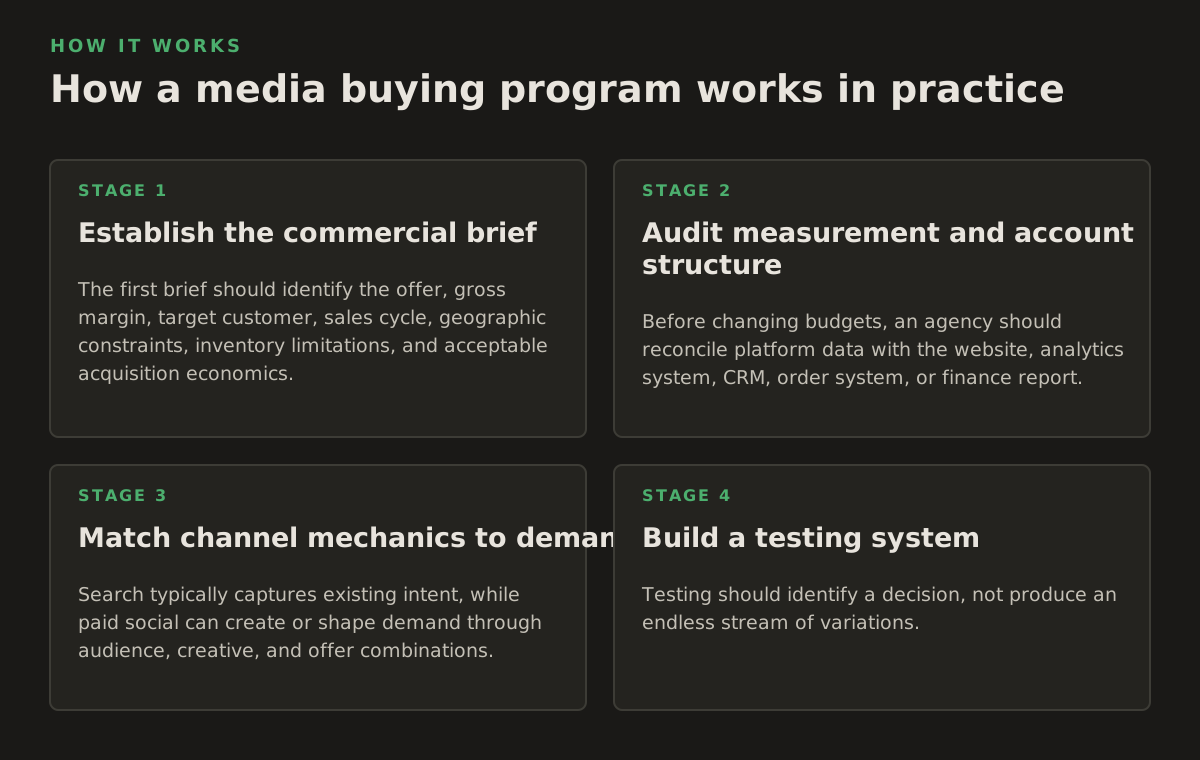
Effective buying follows a sequence. The exact tools differ by channel, but skipping a stage usually creates a downstream problem that looks like a bidding or targeting problem.
1. Establish the commercial brief
The first brief should identify the offer, gross margin, target customer, sales cycle, geographic constraints, inventory limitations, and acceptable acquisition economics. A brand that wants profitable first orders should not be managed to the same target as a brand investing deliberately in lifetime value.
Useful questions include:
- Are we optimizing for new customers, total revenue, qualified leads, or contribution profit?
- Which products can absorb demand without stock or fulfillment problems?
- What is the difference between a first-order target and a blended customer-value target?
- Which audiences or geographies should be excluded because serviceability or margin is poor?
- What must remain consistent with the brand architecture and creative strategy?
2. Audit measurement and account structure
Before changing budgets, an agency should reconcile platform data with the website, analytics system, CRM, order system, or finance report. The audit should inspect event firing, purchase values, duplicate conversions, attribution windows, UTM conventions, offline conversion imports, product feeds, and account permissions.
Google Analytics documentation explains that events and recommended events are the basis for collecting user interactions in GA4, while ecommerce implementations need to send relevant commerce details rather than assuming the platform can infer them: Google’s GA4 event documentation. The practical implication is simple: an agency cannot responsibly optimize what the business cannot define and observe.
Account structure should support decisions. Campaigns may need separation by geography, product economics, objective, funnel stage, or brand versus non-brand demand. Excessive fragmentation can prevent algorithms from receiving enough signal; excessive consolidation can hide which products or audiences are actually driving results.
3. Match channel mechanics to demand
Search typically captures existing intent, while paid social can create or shape demand through audience, creative, and offer combinations. Shopping and catalog campaigns depend heavily on product data quality. Video and connected television may support reach and consideration, but their role should be evaluated with a method appropriate to the buying cycle rather than forced into last-click economics.
Ad auctions are not simply won by submitting the highest bid. Google explains that ad position and eligibility are influenced by factors including bid, ad quality, context, and the expected impact of assets in its overview of the Google Ads auction. That makes landing-page relevance, creative quality, offer clarity, and account structure part of media performance—not separate concerns.
4. Build a testing system
Testing should identify a decision, not produce an endless stream of variations. A useful test states the hypothesis, the audience or placement affected, the primary metric, the guardrail metric, and the action that follows each result.
For example, a retailer might test whether a product-specific demonstration produces more profitable new-customer orders than a discount-led static ad. The primary metric could be new-customer contribution after a defined observation period. Guardrails could include refund rate, average order value, frequency, and blended acquisition cost. The result should inform the next creative brief, not merely earn a label of “winner.”
5. Allocate and pace budget
Budget management includes daily pacing, marginal efficiency, seasonality, inventory, promotions, and the time needed for conversions to mature. A channel can meet its reported target while absorbing budget that would have produced more incremental demand elsewhere.
A sensible operator distinguishes:
- Base spend: budget required to maintain proven demand capture.
- Growth spend: budget allocated to new audiences, creative concepts, markets, or products.
- Learning spend: deliberately limited investment used to reduce uncertainty about a channel or proposition.
The third category should have a defined stopping rule. “We are still learning” is not a sufficient explanation for continuing an experiment that repeatedly misses the business’s allowable economics.
6. Report decisions, not activity
A monthly report that lists impressions, clicks, and campaigns may be accurate and still be operationally useless. Strong reporting explains what changed, why it changed, what the team did, what remains uncertain, and what decision is recommended next.
For ecommerce, reporting may need to distinguish new from returning customers, gross from net revenue, and attributed from blended performance. For lead generation, it may need to connect ad leads to qualified opportunities and closed revenue. For a brand campaign, it may require reach and attention measures alongside later demand indicators. The reporting model should follow the commercial objective.
Where media buying programs break
Many underperforming accounts do not have a single “bad channel.” They have a chain of weak assumptions. Diagnosing the chain is more productive than replacing platforms at random.
Measurement breaks first
Common failures include double-counted purchases, missing checkout events, inconsistent revenue values, incorrect currency, unattributed offline sales, and a mismatch between platform and finance reporting. A buying team may then optimize toward cheap but low-value conversions.
Shopify’s Web Pixels documentation describes a standardized way to capture customer events in a Shopify storefront, but the presence of an event system does not by itself validate business logic, deduplication, or downstream reporting: Shopify Web Pixels API documentation. The buyer should ask who owns the implementation and how changes will be tested after theme, checkout, consent, or analytics updates.
Creative becomes a bottleneck
Media buyers can adjust bids and audiences, but they cannot manufacture a convincing proposition from an unclear brief. When every ad uses the same product image, claim, hook, and format, frequency rises and learning stalls. Conversely, a large volume of creative variants without a test plan creates noise and approval burden.
Creative production should be connected to buying signals. If search data shows a repeated concern about shipping time, creative might address delivery confidence. If prospecting traffic engages but does not purchase, the issue may be offer clarity, proof, price framing, or landing-page friction rather than audience quality.
Targeting and attribution receive too much credit
A narrow audience can appear efficient because it contains people already close to purchase. A broad audience can appear weak during the learning period while creating future demand. Neither observation is enough to establish incrementality.
Use controlled comparisons where practical, compare blended business outcomes, and document the limits of attribution. Do not promise that a platform report can identify every sale caused by an ad. Do not reject a channel solely because last-click reporting undervalues its role. The correct method depends on sales cycle, purchase frequency, traffic volume, and the quality of available first-party data.
Operational friction prevents useful optimization
Slow creative approvals, unavailable product feeds, unplanned promotions, stockouts, and unclear budget authority can make a competent agency look ineffective. Before signing, define who supplies assets, who approves claims, who controls the website, who handles tracking changes, and how quickly urgent commercial decisions can be made.
Red flags during evaluation
- Guaranteed results without assumptions: no responsible partner can guarantee an outcome while ignoring price, margin, creative, inventory, competition, and tracking conditions.
- Reports dominated by impressions and clicks with no connection to profit, qualified pipeline, or customer acquisition cost.
- Recommendations to increase spend before measurement, offer, and landing-page issues are documented.
- Vague ownership of ad accounts, pixels, audiences, data, creative files, and historical reporting.
- A fixed channel list presented as a strategy, regardless of your customer journey or economics.
- Claims that one attribution view is the complete truth.
- No explanation of what would cause the team to pause, restructure, or reduce investment.
How to compare agency service types and trade-offs
There is no universally best service model. The right choice depends on urgency, internal expertise, change capacity, data quality, and the cost of making a wrong decision. Use the table as a starting framework, then adapt it to your operating context.
| Buyer need | Service type | Implementation burden | Main trade-off |
|---|---|---|---|
| No internal paid media owner and multiple active channels | Full-service paid media management | High initial access and coordination; lower daily execution burden for the client | Broader accountability, but the client must share commercial and creative inputs |
| One channel has a clear performance or expansion problem | Channel-specialist management | Moderate; internal teams still manage other channels and shared measurement | Depth in one channel can leave cross-channel and brand interactions less coordinated |
| Sudden decline, tracking discrepancy, or inefficient account | Audit and recovery engagement | Moderate to high during diagnosis; implementation may remain with the client | Fast clarity is possible, but an audit alone does not create ongoing operating capacity |
| New market, product, or acquisition channel | Launch or expansion support | High around research, creative, feed, localization, and measurement setup | Useful for reducing setup errors, but early results may be uncertain by design |
| Experienced in-house team needing senior direction | Advisory and enablement | Lower agency execution burden; higher client implementation burden | More control for the client, with less external ownership of day-to-day outcomes |
| Creative is limiting media performance | Creative strategy and production paired with buying | High approval and asset-planning burden | Can address the message-market fit problem, but requires clear testing and production governance |
Pricing and budget questions to ask
Agencies commonly structure commercial terms around a retainer, a percentage of media spend, project fees, performance-related components, or a hybrid. The point is not to identify a universally superior model. The point is to understand what behavior each model may encourage and which services are actually included.
- Is the fee based on planned spend, actual spend, managed channels, deliverables, or a combination?
- Are strategy, creative development, landing-page recommendations, feed work, analytics, and reporting included or separate?
- Are there minimum commitments, setup fees, cancellation terms, or pass-through technology costs?
- Who pays the advertising platforms, and who owns the payment relationship?
- Does the commercial model reward increased spending even when marginal efficiency declines?
- What happens if the client pauses spend because of inventory, cash flow, or performance concerns?
- Which budget is reserved for testing, and who decides when a test graduates into core spend?
Do not ask only, “What is the monthly fee?” Ask what level of client labor the fee assumes. A lower agency fee may be inappropriate if your team must write briefs, build campaigns, QA tracking, produce reports, and implement every recommendation. Conversely, a broad scope may be wasteful if you already have strong channel operators.
Define measurable success before engagement
Success criteria should be written in terms that both parties can inspect. Depending on the business model, they may include:
- New-customer acquisition cost after a defined attribution and reporting treatment.
- Contribution margin after media and promotional costs.
- Qualified pipeline value and lead-to-opportunity conversion.
- Payback period or first-order profitability.
- Blended revenue efficiency alongside channel-reported efficiency.
- Data quality requirements, such as deduplicated purchases and reconciled revenue.
- Operating deliverables, including testing cadence, budget pacing, and decision logs.
Targets should include definitions and time windows. “Improve ROAS” is incomplete unless the parties specify whether the metric includes existing customers, how returns are treated, which attribution view is used, and whether the target applies during a launch, promotion, or normal trading period.
How practitioners should choose and manage a partner
Start with a business diagnosis, not a vendor shortlist. Write down the constraint that is most expensive today: insufficient demand, high acquisition cost, weak conversion rate, poor creative throughput, unreliable tracking, limited internal capacity, or an inability to scale without harming margin. Then ask each agency to explain how its service addresses that constraint and what it cannot solve.
Vendor interview checklist
- How would you define our primary success metric and the guardrails around it?
- What information would you need before recommending a channel, budget change, or campaign restructure?
- How would you reconcile platform reporting with our analytics, order, CRM, or finance data?
- Which work is performed by senior strategists, channel operators, analysts, creatives, and subcontractors?
- What is included in the proposed scope, and what triggers an additional fee?
- How do you distinguish new-customer performance from repeat-customer performance?
- How do you decide whether a creative, audience, placement, or channel test has produced a useful result?
- What conditions would lead you to reduce spend or recommend pausing a campaign?
- What access, approvals, assets, technical changes, and meeting time will you require from our team?
- Who owns the accounts, audiences, tracking configuration, creative files, and historical data if the relationship ends?
- How will you document decisions, assumptions, tests, and unresolved measurement limitations?
- What would you investigate first if performance dropped while platform-reported conversion volume remained stable?
Request a sample reporting structure using your actual business questions, not a generic dashboard. Ask the agency to show how it would explain an ambiguous month: revenue is up, new customers are flat, acquisition cost is rising, and a major promotion changed the conversion rate. The quality of that explanation often reveals more than a polished presentation.
Set the first operating period correctly
The opening phase should not be judged only by immediate efficiency if the account requires foundational work. Establish a starting policy, explicitly labeled as an illustrative example rather than a universal benchmark:
- Weeks 1–2: confirm economics, access, tracking, account structure, feed quality, and reporting definitions.
- Weeks 3–6: prioritize a limited set of restructuring and creative tests with documented hypotheses.
- Weeks 7–8: evaluate signal quality, eliminate failing tests, and decide where incremental budget is justified.
The exact timetable will vary by buying cycle, spend level, seasonality, and implementation complexity. The principle is to separate foundational delivery from performance claims. A tracking repair is valuable even before it produces a visible lift, but it should be reported as a measurement improvement rather than disguised as revenue growth.
Use a weekly or biweekly decision rhythm for active accounts. The meeting should cover pacing, business results, creative learning, technical issues, risks, and approved actions. Avoid changing several major variables at once unless the account is in recovery; otherwise, the team may not know which intervention caused the result.
When to use broader digital marketing support
Paid media cannot compensate indefinitely for a weak offer, unclear positioning, slow website, poor product detail pages, or inconsistent brand promise. If the diagnosis points beyond campaign execution, the right engagement may combine buying with conversion optimization, creative strategy, analytics, or broader digital marketing services rather than adding more campaigns to the same bottleneck.
That broader work should still be prioritized economically. A landing-page change deserves attention when it has a plausible path to improving qualified conversion, average order value, or lead quality. A brand architecture project deserves a clear connection to how products, audiences, messages, and creative systems will become easier to scale. Good marketing expertise is not a reason to expand scope indiscriminately; it is a way to identify which adjacent constraint deserves investment.
For most growth-stage brands, the practical recommendation is to choose the smallest service model that can own the current constraint, establish reliable measurement, and produce decisions your team can act on. Expand the relationship only when evidence shows that the next bottleneck requires additional capability. Kimmel Marketing supports brands through brand strategy, creative development, media buying, and performance optimization; explore Kimmel Marketing when you need a partner that connects acquisition activity to revenue, customer acquisition cost, and lifetime value.
Authored with NotFair SEO