How Does Digital Marketing Work? A Practical Guide for Growth-Stage Brands
When a founder asks how does digital marketing work, the useful answer is not “by posting on social media” or “by running ads.” Digital marketing is a connected system for turning a business objective into measurable customer actions: define the audience and offer, create a reason to respond, place that message in reachable channels, measure what happens, and improve the economics over time. For a growth-stage brand, the output is not traffic alone. It is profitable demand, clearer customer insight, and a repeatable path from first impression to revenue.
What digital marketing is—and what it is supposed to produce
Digital marketing is the use of internet-based channels, data, creative assets, and conversion experiences to influence a customer’s journey from awareness to purchase and retention. The channels can include paid search, paid social, organic search, email, content, affiliate partnerships, marketplaces, websites, and customer relationship programs.
The precise unit of work is not a channel. It is a customer journey connected to a business outcome. A paid search campaign, landing page, checkout flow, and post-purchase email may be managed by different people, but the customer experiences one system. If the ad promises “next-day delivery” while the product page hides shipping times, the problem is not isolated to media buying. The entire path loses credibility.
A useful digital marketing system has five layers:
- Business strategy: the revenue, margin, retention, and growth objectives the marketing program must support.
- Audience and positioning: the customers most likely to value the offer and the reason they should choose it.
- Demand creation and capture: channels that introduce the brand and channels that reach people already showing intent.
- Conversion infrastructure: the website, product detail pages, forms, checkout, tracking, and customer follow-up.
- Measurement and optimization: a decision system that connects spend and effort to qualified demand, contribution margin, and lifetime value.
These layers answer different questions. Brand strategy asks, “Why should this company matter?” Creative strategy asks, “What message and proof will make that matter to this audience?” Media buying asks, “Where can we reach likely buyers efficiently?” Conversion optimization asks, “What prevents an interested visitor from acting?” Analytics asks, “What happened, and how confidently can we attribute it?”
That distinction matters because marketing activity is not the same as marketing progress. Impressions, clicks, video views, and rankings can be useful leading indicators, but they are not automatically business results. A campaign can generate inexpensive traffic and still fail because the audience is wrong, the offer is weak, or the checkout experience creates friction.
For example, an ecommerce company may define success as new-customer contribution margin rather than revenue alone. A B2B company may care about sales-accepted opportunities rather than form fills. A subscription brand may permit a higher initial acquisition cost if retention and payback support it. The correct metric follows the business model.
In 2026, privacy changes, platform automation, fragmented customer journeys, and longer consideration cycles make this systems view more important. It does not eliminate channel metrics; it places them in context. A rising cost per click deserves attention, but the decision depends on conversion rate, average order value, gross margin, repeat purchase, and the quality of the customers those clicks produce.
Why the system matters to growth and acquisition efficiency
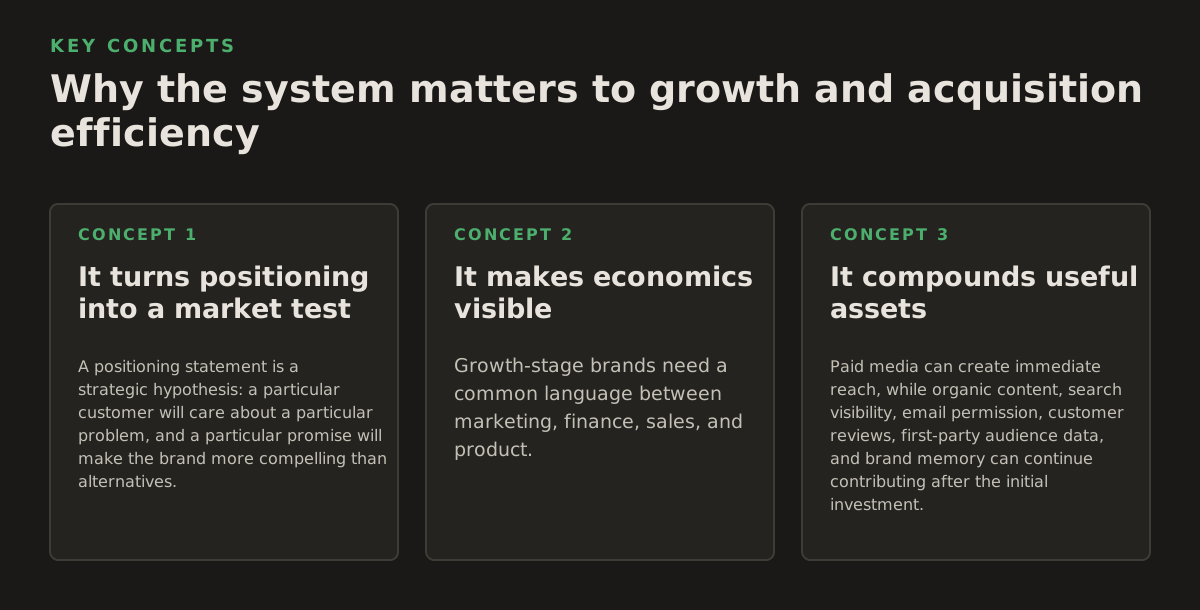
Digital marketing matters because it gives a company several ways to create and capture demand while making decisions with more feedback than many offline channels provide. That feedback is only valuable when the organization knows what it is trying to learn and which financial outcome matters.
It turns positioning into a market test
A positioning statement is a strategic hypothesis: a particular customer will care about a particular problem, and a particular promise will make the brand more compelling than alternatives. Creative assets and landing pages put that hypothesis in front of a real audience. Response patterns can reveal whether the issue is the audience, the message, the offer, or the experience.
This is not a license to change everything whenever a campaign misses its target. A weak result may come from limited delivery, poor tracking, low brand familiarity, a confusing page, or a price objection. The point is to separate those explanations rather than label every outcome “creative performance.”
It makes economics visible
Growth-stage brands need a common language between marketing, finance, sales, and product. Useful measures include:
- Customer acquisition cost (CAC): eligible acquisition spend divided by the number of customers acquired in the chosen period.
- Conversion rate: completed target actions divided by the relevant visitor, click, or session population.
- Return on ad spend (ROAS): attributed revenue divided by ad spend; useful, but incomplete when margin and retention vary.
- Contribution margin: revenue minus the variable costs that scale with the order or customer.
- Payback period: the time required for contribution profit from acquired customers to recover acquisition investment.
- Lifetime value (LTV): a model of the economic value a customer is expected to generate over the relationship, not a guaranteed future result.
These measures can point in different directions. A prospecting campaign may show lower short-term ROAS than a branded search campaign because it reaches people earlier in the journey. That does not make it ineffective; it means the comparison needs a consistent attribution window and a business-level view.
Marginal efficiency is the scaling question. A channel’s blended average may look healthy while its next dollar performs poorly. Conversely, a new channel may look weak while it is still learning or while conversion assists are not captured. The practical question is: if the company adds the next unit of spend, creative capacity, or sales follow-up, what incremental value is likely to result?
It compounds useful assets
Paid media can create immediate reach, while organic content, search visibility, email permission, customer reviews, first-party audience data, and brand memory can continue contributing after the initial investment. The mix depends on the category and buying cycle.
Search optimization is especially useful when customers actively research a problem. Google’s official SEO guidance emphasizes making content understandable to search engines and useful to people, rather than treating SEO as a collection of tricks. Review the Google Search Central SEO Starter Guide when evaluating content structure, crawlability, and search intent. If the company lacks internal capacity, professional SEO services can help a marketing leader evaluate professional SEO services for improving organic search visibility and compare whether the proposed work addresses technical foundations, useful content, and measurable acquisition goals.

The trade-off is speed versus durability. Paid campaigns can be launched quickly but stop generating paid reach when spend stops. Organic authority and customer retention can compound, but they require consistent investment and do not guarantee a particular ranking or traffic volume.
How digital marketing works from strategy to measurement
The operating process is a sequence of decisions. Each step narrows uncertainty for the next one. Skipping a step does not remove it; it simply forces the platform, sales team, or customer to resolve the ambiguity in a less controlled way.
1. Start with the commercial objective
Translate a broad objective such as “grow online sales” into a decision-ready target. Define the customer type, product or service, time period, acceptable economics, and constraints. For an ecommerce brand, that may mean acquiring first-time buyers while protecting contribution margin. For a lead-generation business, it may mean producing sales-qualified opportunities in a specific market.
Then specify what counts as a conversion and what happens after it. A form submission is not necessarily a qualified lead. A first purchase is not necessarily a profitable customer. The organization needs a conversion hierarchy that distinguishes primary outcomes from diagnostic events.
Illustrative starting policy, not a universal benchmark:
- Primary outcome: completed first purchase with a valid transaction value.
- Secondary outcome: product-view, add-to-cart, checkout-start, and email-signup events.
- Quality check: new-customer rate, refund rate, gross margin, and repeat purchase behavior.
- Decision rule: do not scale solely because a secondary event becomes cheaper.
2. Define the audience, problem, and offer
Audience targeting is more than demographic selection. It includes the customer’s situation, urgency, alternatives, objections, buying authority, and expected value. A useful brief should explain why this person is in-market now and what evidence would reduce perceived risk.
The offer is the practical reason to act. It might be a product, consultation, trial, comparison guide, bundle, or service engagement. Strong offers reduce uncertainty by clarifying the outcome, process, proof, price logic, and next step. Discounting is one option, not a substitute for relevance or trust.
Creative strategy converts that understanding into messages and assets. A disciplined creative system usually includes:
- A central promise tied to a recognizable customer problem.
- Proof such as demonstrations, specifications, reviews, case evidence, or transparent process detail.
- Objection-handling for price, risk, complexity, switching cost, or timing.
- Distinct executions for awareness, consideration, conversion, and retention.
- A testing map that changes one meaningful variable at a time when the learning objective requires isolation.
3. Match channels to intent and role
Channels should be assigned a job. Paid search can capture existing demand for a known category or problem. Paid social can create demand through audience, creative, and recommendation systems. Organic search can answer recurring questions and capture relevant intent. Email and lifecycle programs can help convert and retain people who have given permission to hear from the brand.
Do not force every channel to carry the same KPI. A prospecting campaign may be evaluated on qualified new-customer growth and assisted behavior; a branded search campaign may be evaluated on incremental demand rather than all attributed conversions; an email program may be evaluated on revenue per recipient, deliverability, and unsubscribes.
For paid platforms, automation works from the signals and constraints supplied to it. Google Ads describes conversion tracking as a way to measure actions after interactions with ads, such as purchases, sign-ups, or calls; the specific setup and conversion definitions should be reviewed in its official conversion tracking documentation. The practical implication is straightforward: bad inputs can produce efficient-looking bad decisions. If only cheap micro-actions are tracked, an automated system may optimize toward those actions instead of profitable customers.
4. Build the conversion experience
Traffic becomes value only when the destination makes the next action clear and credible. The landing page should continue the promise made in the ad or search result. It should answer the visitor’s immediate questions without making them hunt through navigation.
Review the page across these mechanisms:
- Message match: the headline and proof reflect the specific expectation created before the click.
- Friction: forms, checkout steps, account requirements, delivery details, and payment options do not create unnecessary work.
- Trust: policies, reviews, guarantees, security cues, contact options, and product detail appear where doubt arises.
- Decision support: comparisons, specifications, use cases, FAQs, and availability information address the questions that block action.
- Technical performance: the page functions correctly across relevant devices, browsers, and traffic sources.
An illustrative funnel shows why diagnosis matters. Suppose 10,000 paid visits produce 300 add-to-carts, 120 checkout starts, and 60 purchases. If the brand improves the product page so add-to-carts rise to 400 but checkout completion remains weak, the next constraint is probably later in the journey. The numbers are illustrative, not a benchmark. They show why “increase conversion rate” is too broad to guide work.
5. Instrument the journey
Measurement should document meaningful events and their relationships, not collect every possible interaction without a decision attached. A basic ecommerce measurement plan may include product views, cart additions, checkout starts, purchases, refunds, new-versus-returning status, and customer value fields where the data and permissions support them.
Google Analytics documents an event-based data model in which interactions are collected as events with associated parameters. Its GA4 events documentation is a useful reference when deciding how to name and structure actions. Tracking should also be reconciled against backend orders or CRM records, because analytics platforms and ad platforms may use different attribution rules, time zones, identity signals, and data processing methods.
Use a measurement table before launch:
| Business question | Event or source | Decision it supports |
|---|---|---|
| Did a new customer buy? | Order record with customer status | Assess acquisition and new-customer economics |
| Where does product intent weaken? | Product view, add-to-cart, checkout start | Prioritize page, offer, or checkout diagnosis |
| Which leads become valuable? | CRM stage and revenue outcome | Improve audience and bidding signals |
| Do customers return? | Repeat orders or subscription status | Model retention and payback |
6. Launch, learn, and reallocate
Launches should have a stated learning agenda. One campaign may test whether a problem-led message beats a product-feature message. Another may test whether a shorter form increases qualified lead volume. A third may test whether a new landing page improves checkout completion for high-intent traffic.
After launch, separate three questions:
- Is delivery occurring as intended?
- Is the audience responding to the message and offer?
- Are the resulting actions economically valuable?
Do not make a major conclusion from a single day of volatile data or from a metric disconnected from the objective. At the same time, do not leave obvious tracking failures running while waiting for more data. A broken purchase event, incorrect revenue value, or unapproved landing page should be corrected immediately.
digital marketing services is relevant when a company needs coordinated support across campaign execution, search, website development, and performance optimization rather than isolated channel activity. The useful evaluation question is whether the service connects those disciplines to revenue, acquisition cost, and customer value.
Where digital marketing breaks—and how to diagnose it
Most underperforming programs do not fail because one channel is inherently useless. They fail at the handoffs between strategy, creative, media, technology, and finance. Diagnosis starts by locating the stage where expected behavior diverges from actual behavior.
The offer is not competitive or clear
If impressions and clicks are healthy but qualified actions are weak, the problem may be the promise, price logic, product-market fit, or proof. More targeting will not repair an offer that does not resolve a meaningful customer problem.
Look for:
- High engagement with low progression to product or pricing pages.
- Repeated objections in sales calls, reviews, chats, or customer support.
- Strong interest in an educational topic but weak response to the commercial offer.
- Competitors communicating a simpler outcome or lower perceived risk.
The response may be a clearer value proposition, a better bundle, stronger proof, improved merchandising, or a narrower audience—not simply a higher budget.
The message and audience do not match
Creative can attract attention from people who will never buy. A broad promise may produce cheap clicks because it is interesting, while a specific promise produces fewer clicks but better downstream quality. Compare audiences using qualified actions and customer economics, not engagement rate alone.
Creative fatigue is another failure mode. A message can lose effectiveness because the audience has seen it repeatedly, because competitors have copied the category language, or because the customer’s objection has changed. A creative refresh should preserve the strategic learning while changing the execution intentionally.
The conversion path leaks demand
Common leaks include slow or unstable pages, unclear shipping or pricing, weak mobile layouts, forced account creation, confusing forms, limited payment options, and a call to action that does not match the visitor’s readiness. These are often invisible in platform reports because the ad platform can record the click but not the reason the visitor abandoned the experience.
Use a funnel view and qualitative evidence together. Analytics can show where exits cluster. Session recordings, support transcripts, customer interviews, and usability reviews can suggest why. Avoid treating any one tool as a complete explanation.
The measurement system rewards the wrong behavior
Attribution is a model, not a neutral camera. Different platforms may claim the same conversion, and direct or organic traffic can receive credit depending on the reporting setup. Tracking gaps can also make a channel appear weaker or stronger than it is.
Warning signs include:
- Platform-reported revenue does not reconcile to the order system.
- Lead volume rises while sales acceptance or close rate falls.
- Campaigns optimize toward page views, cheap leads, or other proxy events.
- Brand and non-brand activity are mixed, obscuring incremental demand.
- Refunds, cancellations, repeat purchases, or margin are absent from the growth view.
The remedy is not to search for one perfect attribution model. Use a consistent reporting framework, document definitions, reconcile important outcomes, and make decisions with multiple forms of evidence. For larger changes, controlled experiments or geographic holdouts may provide stronger evidence than platform attribution alone when they are feasible and properly designed.
The economics are too weak to scale
A campaign can be operationally excellent and still not support growth. If contribution profit per customer cannot recover acquisition investment under realistic retention assumptions, scaling merely increases the speed of loss.
Build scenarios rather than relying on a single LTV estimate. An illustrative model might show a $90 first order, $45 in variable costs, and $20 in acquisition cost before overhead. If repeat purchase assumptions change, the acceptable acquisition cost changes too. Those figures are examples only; each business must use its own margin, returns, fulfillment, retention, and cash-flow data.
Cash flow is a constraint, not a footnote. A subscription or repeat-purchase business may tolerate a longer payback than a low-retention business, but only if the company can fund the period between acquisition spend and recovered contribution. Finance should be involved before a channel is labeled scalable.
How practitioners apply the system in real operating decisions
Application means turning the framework into routines, ownership, and explicit trade-offs. The strongest programs do not optimize every metric every day. They decide which constraint matters now and assign the appropriate team and evidence to it.
Use a strategy-to-execution brief
Before significant media or creative production, document:
- The business outcome and the customer segment responsible for it.
- The problem, desired outcome, and reason to believe.
- The offer, price or qualification logic, and key objections.
- The channel role and expected customer intent.
- The destination experience and primary conversion.
- The measurement owner, data source, and reporting cadence.
- The stop, continue, and investigate rules.
This brief prevents a common failure: media teams optimizing delivery while brand, creative, web, and sales teams operate from different assumptions. It also makes disagreements productive. Teams can challenge the audience, offer, or metric directly instead of debating whether a channel “feels good.”
Separate exploration from exploitation
Exploration allocates resources to learn: new audiences, messages, offers, formats, or channels. Exploitation allocates resources to what already meets the current decision rule. Both are necessary.
An illustrative starting policy, not a universal benchmark, might reserve a defined portion of creative production capacity for new concepts while protecting the strongest existing assets. The proportion should reflect cash constraints, business maturity, and how quickly the market changes. A company with one reliable acquisition path may need diversification; a company with no validated offer may need concentrated learning before expansion.
Make creative a performance variable
Creative is not decoration placed on top of targeting. It influences who stops, who understands the value, who trusts the claim, and who remembers the brand. Develop variations around different customer tensions:
- Problem recognition: “This is the issue your current approach creates.”
- Outcome: “This is what improves when the issue is solved.”
- Proof: “This is why the claim is credible.”
- Process: “This is what working with or buying from us involves.”
- Objection: “This is how we address the risk you are considering.”
Do not declare a creative winner from click-through rate alone. A curiosity-driven execution may win attention but lose on qualified conversion. Judge the asset at the stage it is intended to influence, then follow customers through the rest of the journey.
Use SEO and paid media together without confusing their roles
Paid search can reveal the language customers use when they are ready to act. Search content can answer recurring questions and build a useful information architecture. Paid campaigns can also test commercial messages quickly, while organic work creates pages that may continue attracting relevant demand.
That does not mean every paid keyword should become a page or every ranking should be treated as a sales opportunity. Map topics to intent:
- Informational: the customer is learning about a problem or category.
- Commercial investigation: the customer is comparing approaches, providers, or products.
- Transactional: the customer is ready to buy, book, or request a proposal.
- Retention or support: the customer needs help using or continuing with the product.
Each intent needs an appropriate page, call to action, and success measure. A technical guide should not be judged like a product page, and a product page should not bury its buying path under generic education.
Review performance at the right altitude
A weekly operating review can focus on delivery, conversion quality, creative learning, and technical integrity. A monthly or quarterly review can focus on incrementality, budget allocation, positioning, retention, and the relationship between acquisition and contribution margin.
Use a short decision log:
- What changed?
- What evidence supports the change?
- Which explanation is most plausible?
- What will be changed, held constant, or investigated?
- When will the decision be revisited?
This prevents post hoc storytelling. It also protects teams from constant reactive changes that make learning impossible.
Choose partners by operating discipline
When evaluating an outside partner, ask for the reasoning chain rather than a channel menu. The partner should be able to explain how brand strategy, creative development, media buying, measurement, and conversion optimization connect to the company’s economics.
Look for evidence of:
- Clear definitions for conversions, qualified leads, customers, and revenue.
- Transparent separation of platform reporting and business reporting.
- A documented testing and learning process.
- Attention to landing pages, offer quality, and customer retention—not only ad settings.
- Honest limits around attribution, data quality, market demand, and scale.
marketing expertise gives leadership a way to review the strategic disciplines behind execution, including the difference between a short-term acquisition tactic and a durable brand or growth system. Use that review to identify the capability gap before selecting a scope of work.
What to do next: build one measurable growth loop
Do not begin by trying to master every channel. Start with one commercially important customer journey and make its logic visible: a defined audience, a credible offer, a message, a destination, a primary conversion, a quality check, and an economic decision rule.
For a growth-stage ecommerce brand, that might be one category, one customer segment, and one acquisition path. For a lead-generation company, it might be one service line and a closed-loop connection between campaigns, CRM stages, and revenue. Once the loop is measurable, improve its largest constraint before adding complexity.
The specific recommendation is to prioritize measurement integrity and conversion clarity before aggressive scaling. If the business cannot distinguish a qualified customer from a cheap action, more spend will create more ambiguity, not reliable growth.
Kimmel Marketing helps connect brand strategy, creative development, media buying, and performance optimization into that kind of accountable growth system. If you need a partner to map the journey and decide what to improve first, start with Kimmel Marketing.
Authored with NotFair SEO