How to Build a Marketing Strategy Brief That Drives Growth
A strong marketing strategy brief gives a growth-stage brand a shared decision system—not another presentation that gets approved and forgotten. The job is to connect revenue goals, customer economics, positioning, creative, media, website experience, and measurement well enough that a team can decide what to do next and why.
This guide is for ecommerce leaders, founders, and marketing teams deciding whether to scale acquisition, refresh a brand, appoint a transparent partner, or fix underperforming paid media. It will help you choose what belongs in the brief, identify the assumptions that need evidence, and turn the finished document into a practical operating plan. The best briefs do not promise certainty; they make uncertainty visible and assign a way to reduce it.
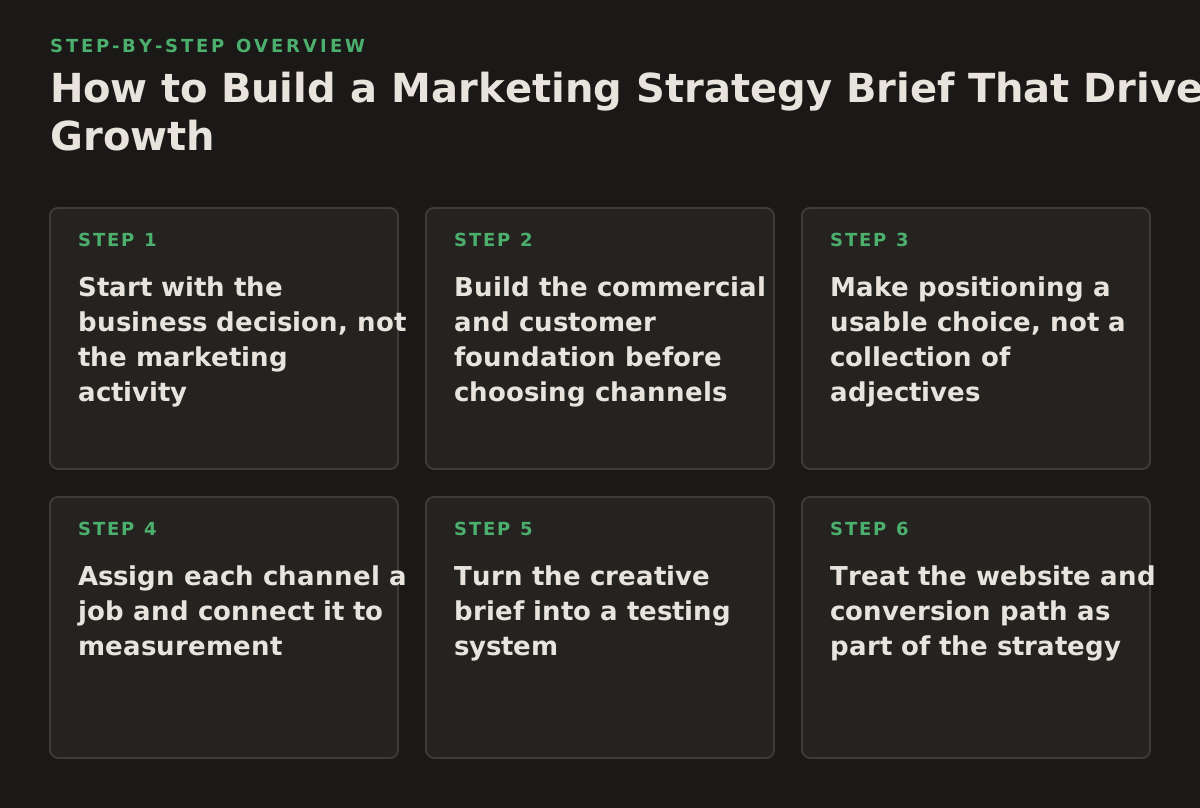
1. Start with the business decision, not the marketing activity
When it applies: Use this principle whenever several initiatives compete for attention: a new paid channel, a site redesign, a brand refresh, a product launch, or a push to improve repeat purchase. If the brief begins with “run more ads” or “make the brand feel premium,” it is already too vague to guide investment.
Why it works: Marketing activity only has meaning in relation to a business constraint. A company with healthy conversion but weak contribution margin needs a different plan from one with strong demand but poor landing-page performance. Defining the decision first prevents the team from optimizing a metric that is easy to report but irrelevant to the business.
Write the decision in one sentence
Use a sentence that includes the decision owner, the commercial outcome, the time horizon, and the constraint. For example:
“By the end of the 2026 planning cycle, the growth team must decide whether to increase paid acquisition for the core product line while protecting contribution margin and preserving the brand’s premium positioning.”
That statement is more useful than “increase awareness” because it creates questions the brief must answer:
- What level of demand is required?
- What acquisition cost can the business tolerate?
- Which products have enough margin or lifetime value to support scaling?
- What evidence would justify more spend?
- Which brand signals must remain consistent as volume increases?
Separate outcomes, indicators, and activities
Put these into three different fields. Business outcomes are revenue, qualified pipeline, contribution margin, or profitable new customers. Leading indicators are product-page engagement, qualified sessions, add-to-cart rate, or first-purchase conversion. Activities are producing video, launching a search campaign, improving checkout, or testing an offer.
Failure mode: A team may call “launch six new ad variations” a goal. That creates output without a definition of success. If the ads generate cheaper clicks but attract low-value customers, the activity succeeded while the business decision failed.
Implementation example: An ecommerce brand selling premium kitchen equipment might set the outcome as profitable first orders from new customers. Its indicators could include qualified product-page visits, checkout completion, and predicted repeat-purchase value. Its activities might include a comparison landing page, creator demonstrations, and a controlled paid-search expansion. The brief should state that the activities are hypotheses—not commitments to spend regardless of results.
2. Build the commercial and customer foundation before choosing channels
When it applies: This section matters when acquisition costs are rising, product lines have different economics, or internal teams disagree about the “right” audience. It is especially important for ecommerce website owners whose blended revenue hides large differences between first orders, repeat orders, discounts, and returns.
Why it works: Media cannot compensate for an unattractive offer, weak retention, or unclear relevance. A strategy becomes more defensible when it shows which customers create value, what problem the brand solves, and why the offer deserves attention now.
Document customer economics explicitly
Include the inputs that determine how much acquisition investment is rational. Use actual business data where available and label assumptions where it is not.
- Average order value and gross margin by major product or service line.
- Discounting, shipping, refunds, cancellations, and payment costs.
- New-customer revenue versus returning-customer revenue.
- Expected repeat purchase behavior and the period used to evaluate it.
- Maximum acceptable acquisition cost under a conservative scenario.
- Cash-flow or inventory constraints that limit how quickly demand can scale.
Do not present lifetime value as a single magical number. Show the method. A simple starting policy might compare first-order contribution with a separately modeled repeat-purchase scenario. That is an illustrative planning approach, not a universal benchmark. If the business cannot yet estimate repeat behavior reliably, the brief should say so and prioritize better cohort measurement.
Turn audience descriptions into buying situations
“Women aged 25–44” is a media targeting input, not a strategy. Add the context that changes the buying decision:
- What triggered the need?
- What alternatives are being considered?
- What risk makes the buyer hesitate?
- What proof would make the offer credible?
- What job must the product perform after purchase?
For a premium skincare brand, one buying situation may be a customer replacing a routine after irritation. Another may be a gift buyer who needs confidence that the product feels considered and arrives reliably. These customers may share demographics but require different messages, proof, and landing-page paths.
Failure mode: Segmenting by platform availability rather than commercial relevance. A brand might define its audience as “people who watch short-form video” because that is easy to target. The brief should instead explain the need state and then identify which channels can reach it.
Implementation example: A subscription coffee business could prioritize “home workers seeking a dependable morning ritual” over a broad lifestyle audience. The brief would connect that situation to a starter bundle, a freshness explanation, a simple subscription pause policy, and creative showing the product in the actual morning routine. This gives media, creative, and conversion teams one customer problem to solve.
3. Make positioning a usable choice, not a collection of adjectives
When it applies: Use this principle when a brand is entering a crowded category, refreshing its architecture, launching a new product, or producing inconsistent creative across channels. It also applies when performance ads convert sporadically because the promise changes from one execution to the next.
Why it works: Positioning reduces the number of messages a team must invent and helps the right customer recognize relevance quickly. It should tell the organization what to emphasize and what to refuse, not merely describe the brand as innovative, trusted, or customer-centric.
Use a message hierarchy
A practical hierarchy has four levels:
- Category role: What does the brand help customers accomplish?
- Distinctive promise: What meaningful result or experience does it offer?
- Reasons to believe: What evidence supports that promise?
- Action: What should the customer do next?
For example, a B2B analytics platform might define its category role as helping ecommerce teams make faster revenue decisions. Its promise could be clearer allocation of acquisition investment. Reasons to believe might include the workflow, data visibility, or service model—only where the business can substantiate them. The action could be requesting an assessment rather than starting a free trial if the sale requires consultation.
Define boundaries and proof requirements
Add a “do not say” list to the brief. It might prohibit unsupported superiority claims, vague sustainability language, or a discount-led message that conflicts with premium positioning. Also specify the proof required for each major claim:
- Customer evidence, if a testimonial or review is used.
- Product or operational evidence for speed, durability, or availability claims.
- Commercial terms for guarantees, returns, subscriptions, or promotions.
- Legal or regulatory review where the category requires it.
Failure mode: Treating the positioning statement as final copy. A positioning line can be strategically correct but too abstract for an ad or product page. The brief should translate it into message territories, objections, proof points, and examples of plain-language execution.
Implementation example: A sustainable apparel company might choose “fewer, better pieces for repeat wear” as a strategic territory. Creative can then demonstrate outfit versatility, construction details, and care guidance. The team avoids making every ad a generic environmental claim and gives conversion pages specific evidence to carry the promise.
4. Assign each channel a job and connect it to measurement
When it applies: This is essential when a company is adding media channels, shifting budget between prospecting and retention, or receiving conflicting reports from ad platforms and analytics tools. It is also useful when a founder asks which channel is “best” without defining the role the channel must perform.
Why it works: Channels are not interchangeable containers for the same message. Search can capture existing intent; social can create or shape demand; email and lifecycle programs can develop known customers; content and organic discovery can answer questions over a longer period. Assigning a job clarifies what success should look like and prevents every channel from being judged by the same immediate metric.
Build a channel-role map
| Business need | Possible channel role | Primary signal | Required caution |
|---|---|---|---|
| Capture existing demand | High-intent search, branded demand, comparison content | Qualified conversion rate and contribution | Do not assume captured demand was created by the channel |
| Create consideration | Video, social, creators, educational content | Engaged visits, qualified searches, assisted progression | Cheap reach is not proof of commercial relevance |
| Convert active shoppers | Product feeds, retargeting, landing pages, email | Incremental conversion and order economics | Frequency and audience overlap can inflate apparent efficiency |
| Increase customer value | Lifecycle email, SMS where appropriate, loyalty, cross-sell | Repeat contribution and retention behavior | Discounts can train customers to wait for promotions |
Design the measurement contract
Write down the source of truth for each decision. Google’s documentation describes conversion tracking as a way to measure actions valuable to a business, such as purchases or leads; that makes conversion definitions a strategic input rather than a reporting afterthought (Google Ads Help, 2026). Define the event, owner, platform, reporting window, and quality check for each important action.
Use consistent campaign naming and tracking parameters across paid media, partnerships, and owned campaigns. Google’s Analytics documentation explains how campaign parameters help identify the source, medium, and campaign associated with incoming traffic (Google Analytics Help, 2026). This does not solve attribution by itself, but it makes the data more interpretable.
Failure mode: Reporting platform-reported conversions as if they were additive. A customer can be exposed to several channels, and different systems may credit the same order differently. The brief should identify the reporting view used for optimization and a separate finance view used for profitability.
Implementation example: A direct-to-consumer brand could assign paid search the job of capturing high-intent demand, paid social the job of developing new consideration, and email the job of recovering and retaining known customers. The brief would require all channels to report new versus returning customers and contribution after discounts, while allowing each channel its own leading indicators.
5. Turn the creative brief into a testing system
When it applies: Use this principle when ads are being produced in isolation, creative fatigue is suspected, or a team keeps requesting “more variations” without learning from the results. It is particularly relevant for ecommerce brands scaling paid social and for companies translating a new brand strategy into performance creative.
Why it works: Creative is not just a visual wrapper around targeting. It determines who recognizes the problem, how the offer is understood, and whether the customer believes the proof. A creative system lets the team vary a meaningful hypothesis—problem, promise, proof, format, or objection—rather than changing colors and headlines at random.
Use a creative hypothesis grid
For each concept, specify:
- Audience situation: What is happening in the customer’s life or buying process?
- Core tension: What concern or unmet need creates attention?
- Promise: What useful outcome should the customer expect?
- Proof: What makes the promise credible?
- Format: Demonstration, comparison, testimonial, founder explanation, or another execution type.
- Next step: The action that matches the customer’s level of intent.
One concept for a meal-kit brand might focus on “weekday decision fatigue,” show the preparation sequence, prove convenience through the actual recipe steps, and lead to a first-box explanation. Another might focus on dietary confidence and require a different proof structure. Both can support the same commercial objective without being superficial variants.
Protect the learning agenda
Prioritize tests that can change a decision. A starting policy for an illustrative example might be to test one major message variable before introducing several new formats. The exact pace depends on traffic, spend, sales cycle, and the cost of making a wrong decision.
Failure mode: Changing audience, offer, landing page, and creative at the same time, then declaring a winner. That may produce an outcome but not a usable explanation. If the brief cannot state what the team is trying to learn, it is not ready for production.
Implementation example: A high-consideration software brand could test “reduce reporting time” against “make budget decisions with more confidence,” holding the audience, destination, and call to action stable for the initial comparison. If one message attracts more qualified conversations, the next brief can test proof type rather than immediately changing the entire campaign.
6. Treat the website and conversion path as part of the strategy
When it applies: This principle applies when paid traffic is increasing but conversion is weak, when mobile users struggle to act, or when ads promise something the destination page does not immediately confirm. It is a priority for ecommerce website owners because small points of friction can affect every acquisition channel at once.
Why it works: Acquisition creates an opportunity; the website decides whether the opportunity becomes a sale, lead, or qualified conversation. Conversion optimization is therefore not a final design polish. It is the process of matching intent, information, reassurance, and action at each step.
Map the promise to the page
For every major campaign, record the path from ad or referral to action:
- What promise brought the visitor in?
- Where does the page confirm that promise?
- What question is likely to arise next?
- What proof answers that question?
- What friction blocks action?
- What happens after the click or purchase?
A comparison ad should lead to a page that makes comparison easy. A product demonstration should not land on a generic category page if the customer expects the demonstrated product. A founder-led ad may require a page that preserves the founder’s explanation and adds concrete proof.
Prioritize friction by consequence
Do not prioritize experiments only by visual prominence. Rank them by likely commercial consequence and confidence in the diagnosis. Examples include:
- Unclear shipping, delivery, returns, or subscription terms.
- Product information that arrives after the purchase decision is expected.
- Forms that request information unrelated to the next step.
- Mobile layouts that hide price, availability, or the primary action.
- Slow or confusing paths from a high-intent ad to the relevant offer.
The W3C’s forms guidance recommends associating labels with controls so users can understand what information is required; this is a concrete usability requirement worth including in a conversion review (W3C Web Accessibility Initiative, 2026). General usability guidance also emphasizes making system status, language, and error recovery understandable to users (Nielsen Norman Group, 2026).
Failure mode: Optimizing for a higher form-completion rate while reducing lead quality, or increasing checkout starts through a stronger discount that damages margin. Every conversion test in the brief should include a quality guardrail such as contribution, qualified rate, refund behavior, or repeat purchase.
Implementation example: An ecommerce brand with strong ad engagement but weak product-page conversion might first align the headline with the ad promise, surface delivery and return information near the purchase action, and add a concise comparison module. It would monitor completed orders and margin—not only button clicks.
7. Establish governance so the brief survives contact with the market
When it applies: Use this principle when marketing is shared across founders, internal teams, agencies, freelancers, and sales or merchandising leaders. It is also important when performance changes quickly and stakeholders are tempted to override the strategy after a few days of noisy data.
Why it works: A brief becomes valuable when it controls decisions after launch. Governance defines who can change the audience, offer, budget, creative direction, or measurement method—and what evidence is required. This creates transparency without pretending that every choice can be planned in advance.
Add decision rights and escalation rules
Include a simple responsibility map:
- Who owns the commercial target?
- Who approves positioning and claims?
- Who controls channel execution and budget movement?
- Who validates tracking and data quality?
- Who decides whether a test is paused, extended, or replaced?
- Who communicates a material change to the wider team?
Set a review cadence appropriate to the sales cycle. A short-cycle ecommerce program may use frequent operational checks, while a considered B2B purchase may need more time before judging lead quality. These are planning choices, not universal timing rules.
Keep an assumption and learning register
Every major assumption should have an owner, evidence status, and next action. A useful register might include:
| Assumption | Why it matters | Evidence status | Next decision |
|---|---|---|---|
| Customers will accept the premium bundle | Determines offer and margin strategy | Directional survey and existing order data | Test bundle framing against single-product framing |
| Video explains the product better than static imagery | Determines production priority | Creative hypothesis, not yet validated | Run a controlled message and format comparison |
| Repeat purchase supports a higher first-order cost | Determines allowable acquisition investment | Needs cohort analysis | Report first-order and repeat contribution separately |
Failure mode: Treating the brief as a fixed contract that cannot change. Markets, inventory, product quality, and customer response can invalidate assumptions. The answer is not to abandon the strategy; it is to document what changed, why, and which downstream decisions must be revisited.
Implementation example: A founder and agency might agree that budget can move within an approved channel role when tracking is healthy, but a change in offer, audience definition, or brand promise requires a documented review. That boundary gives the operator speed while protecting strategic consistency.
Implementation plan: turn the brief into a 2026 operating sequence
Build the document in the order decisions depend on one another. Do not begin with channel tactics while the commercial constraint is unresolved.
- Confirm the decision and constraint. Write the one-sentence business decision, identify the owner, and define the period being planned. State whether the immediate priority is profitable acquisition, demand creation, retention, repositioning, or a combination with an explicit order of priority.
- Assemble the commercial baseline. Gather product economics, customer segments, existing funnel performance, inventory or capacity limits, and current measurement definitions. Mark each input as verified, directional, or unknown.
- Choose the highest-value customer situations. Select the buying situations where the brand has a credible advantage and the business can serve demand. Write the trigger, objection, desired outcome, and proof needed for each.
- Approve the positioning boundaries. Create the message hierarchy, proof requirements, prohibited claims, and examples of how the strategy should sound in ads, landing pages, product pages, and lifecycle communication.
- Assign channel jobs. Decide which channels capture demand, create consideration, convert intent, or increase customer value. Define a primary signal and a guardrail for each rather than forcing every channel into one attribution model.
- Create the first learning backlog. Rank creative, media, offer, and website hypotheses by potential business consequence, evidence quality, and implementation effort. Start with tests that can change the next investment decision.
- Validate the measurement path before scaling. Check event definitions, campaign parameters, order or lead quality, and the relationship between platform reporting and finance reporting. If data is incomplete, make that limitation visible in the brief and avoid false precision.
- Run a structured review. At each review, record what changed, what was learned, which assumptions remain unresolved, and what decision follows. Retire activities that no longer support the business outcome, even if they are familiar.
The brief should become the connective tissue across brand strategy, creative development, media buying, and performance optimization. Kimmel Marketing can support teams that need digital marketing services or deeper marketing expertise to turn these decisions into an accountable growth system. If your current plan has activity but no clear decision logic, use the brief as the starting point for a more transparent marketing partnership through Kimmel Marketing.
Authored with NotFair SEO