How to Choose an Ecommerce Marketing Agency for Profitable Growth
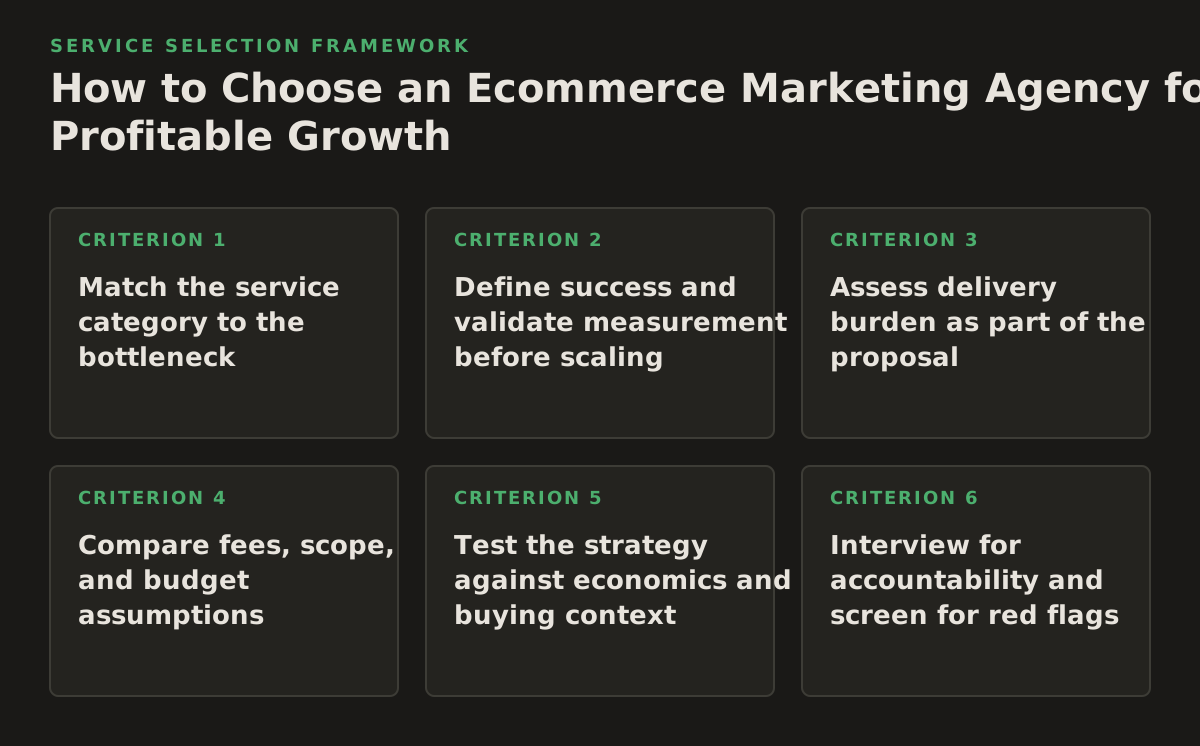
Choose an ecommerce marketing agency by matching its services to the constraint limiting your store, then check whether it can deliver the work, measure the agreed outcome, and coordinate with your team. A paid-media specialist, SEO provider, conversion partner, or broader growth agency may each fit—but the right choice depends on whether your challenge is acquisition, discoverability, the buying experience, or coordination. Use the framework below to compare scope, implementation demands, pricing, and accountability before committing.
1. Match the service category to the bottleneck
This decision matters when a proposal leads with channels before clarifying the business problem. Start with one lead constraint: identify what is preventing better commercial results, and choose a service model that can address it. Agencies may combine disciplines, so ask which work they will own rather than relying on a label such as “full service.”
| Buyer need | Service type to assess | Trade-off to check |
|---|---|---|
| Paid traffic is active, but acquisition efficiency or revenue quality is unclear | Paid-media management or performance marketing | Campaign data can inform decisions, but interpretation depends on sound measurement, suitable creative, and viable unit economics. |
| Product pages are difficult to discover through search | Ecommerce SEO | Can address organic visibility, but recommendations may need sustained content or technical implementation. |
| Visitors arrive but struggle to find products or complete purchases | Conversion optimization or ecommerce UX | Analysis only helps if design, development, and testing capacity exist to act on it. |
| The offer or creative is not clearly differentiated | Brand and creative strategy | Can clarify positioning and campaign inputs, but does not replace channel execution or storefront fixes. |
| Store architecture or technical limits block marketing work | Ecommerce development | May enable needed changes, while adding build coordination and technical ownership requirements. |
| Several constraints interact and no one coordinates the work | Growth or multi-discipline agency | May consolidate planning, but requires clear specialist accountability and handoffs. |
Separate the diagnosis from the proposed service. A store with unreliable tracking and one with reliable tracking but weak campaign efficiency do not have the same first task. A provider should explain why its proposed work addresses the constraint, what evidence would change that view, and which adjacent work is outside its scope.
Failure mode: hiring a partner to “own growth” while leaving inventory, margins, approvals, and site changes unassigned. For example, an agency might own campaign tests while an internal owner supplies stock and margin information and a developer handles approved storefront changes. If the growth plan also needs Shopify or WooCommerce development, e-commerce and web development services helps you assess those development requirements alongside marketing.

2. Define success and validate measurement before scaling
Use this principle when platform dashboards and store records disagree, or when stakeholders have different definitions of a successful campaign. Agree on a decision-grade scorecard before increasing activity: distinguish business outcomes from channel indicators, and document the data source and assumptions behind each measure.
Choose measures that answer a decision
- Business outcome: for example, net revenue, gross margin, or contribution from new customers, selected to fit the commercial question.
- Efficiency guardrail: the acquisition cost or return the business can support given its own margins and operating needs.
- Diagnostic indicators: product views, add-to-cart activity, checkout starts, or other events that help locate a problem.
- Context: returns, discounting, stock availability, and new-versus-returning customer mix when they affect interpretation.
For stores using GA4, Google documents ecommerce events including view_item, add_to_cart, and purchase in its ecommerce measurement guide. Google Ads separately documents how conversion tracking is set up and used in its conversion tracking guide. These documents can help define an event plan; they do not establish that a particular store’s events are implemented or recorded accurately.
Why it works: the team can distinguish a change in traffic from a change in orders or efficiency. For example, if spend rises while orders stay flat, check event accuracy, product-page engagement, and checkout progression before deciding whether to change the campaign or the storefront.
Failure mode: treating one advertising platform’s attributed revenue as the sole business result. Reporting systems may use different attribution settings and overlap in the credit they assign. Ask the agency to state its attribution assumptions and reconciliation process, then compare channel reporting with store order records. If numbers still differ, document the gap rather than forcing a false match.
3. Assess delivery burden as part of the proposal
This matters when a recommendation depends on changes your team may not have capacity or permission to make. A deliverable is not the same as implementation: an audit, test plan, or campaign brief creates work for someone, and the proposal should identify who will do it.
Map responsibilities before kickoff
- Who owns campaign setup, strategy, creative briefs, production, and approvals?
- Who can publish storefront changes, validate tracking, and resolve technical issues?
- Who supplies product margins, stock status, promotion rules, and approved product claims?
- What is the review cadence, and who can approve time-sensitive changes?
For example, a landing-page test may require the agency to write a test brief, your team to approve the offer and provide product imagery, and a developer to publish the variation. Listing those responsibilities makes the test schedulable and reveals whether it depends on resources you do not have.
When organic discovery is the constraint, separate search recommendations from the work required to implement them. Google’s SEO Starter Guide outlines foundational search practices; use it as a reference point when asking a provider which changes it will make, which your team must handle, and how progress will be assessed. For a provider to help improve organic traffic and sales, SEO services gives you a starting point for evaluating SEO services against those ecommerce goals.

Failure mode: commissioning an audit without assigning implementation capacity. If engineering time is constrained, ask the provider to prioritize a short list of changes, name an owner for each, and define how completion will be checked. That is more actionable than an unranked backlog.
4. Compare fees, scope, and budget assumptions
Apply this test when proposals use different fee formats or appear difficult to compare. Common structures include retainers, project fees, spend-linked fees, performance components, or combinations; the format alone does not show value. Compare the work included, the capacity reserved, and the provider’s control over the outcome.
Ask each agency to separate its service fee from media spend, creative production, software, and pass-through costs. Clarify what triggers extra charges, how scope changes are approved, and whether a fee varies with advertising spend or attributed sales. For performance-linked terms, define the outcome, baseline, data source, exclusions, and treatment of refunds or repeat customers.
Set a budget policy from your own constraints, not an unsupported industry benchmark. As an illustrative starting policy, decide what the business can sustain through an agreed learning period while protecting cash and inventory needs. Ask providers to show how the work plan changes at different investment levels, and identify the evidence that would justify expanding or reducing activity.
Failure mode: choosing the lowest service fee before checking exclusions. For example, request a written scope that lists campaign management, creative production, analytics support, landing-page work, meeting cadence, and out-of-scope rates separately. If one proposal excludes creative or development and another includes it, their headline fees are not directly comparable.
5. Test the strategy against economics and buying context
This principle applies when a provider recommends a familiar channel mix before learning about the product, purchase cycle, margins, or customer. Channel choices should follow the buying context. A short decision cycle and a considered purchase may call for different creative, measurement, and testing priorities.
Ask how customer insight will inform the offer, creative, audience, and destination page. A useful test proposal states what will change, why that variable matters, what evidence will be collected, and what decision follows. For product listings, ask whether accurate feed information is within scope: Google’s Merchant Center product data specification describes product attributes used for listings, so confirm who is responsible for the data needed by the planned placements.
If paid social depends on website events, ask how the provider will validate the signals it uses. Meta describes the Pixel as a website measurement tool in its Pixel documentation; a proposal should also explain how event quality will be checked and how limitations in observed data will be handled. For Shopify stores, Shopify’s customer events and pixels documentation can help clarify the store-side setup to discuss with the provider.
Failure mode: changing the audience, message, offer, and landing page at once, then claiming to know what caused a result. As an illustrative test, keep the offer and landing page stable while comparing two distinct creative messages. Use the result to inform a next test, not as proof that the same message will work across every audience or product.
6. Interview for accountability and screen for red flags
Use interviews to assess how a provider reasons under uncertainty, not just how confidently it presents a plan. Ask for decision logic, not promises: a credible answer explains the information needed, the assumptions being made, and what would cause a change in direction.
Vendor interview checklist
- What business information do you need before recommending services or spend?
- How will you set a baseline and account for margin and customer mix?
- Which work is done by your team, and which depends on our staff or another vendor?
- How do you validate tracking and investigate differences between platform and store reporting?
- How are creative tests selected, approved, and used to shape the next iteration?
- What decisions should each report help us make, and how often will we review them?
- Who controls advertising accounts, analytics, creative files, and data if the relationship ends?
- What evidence would make you recommend pausing or changing the plan?
Red flags include guaranteed outcomes without stated assumptions, a channel plan presented before the agency understands the economics, and unclear ownership of accounts or implementation. Also watch for success measures that can be redefined after the work begins. Put the measure, reporting source, scope, and exit process in writing.
For example, if a provider recommends increasing campaign investment, ask it to identify the current signal supporting that move, the risk it expects, the condition that would reverse it, and who approves it. Transparent decision rules make a proposed test easier to distinguish from an open-ended spend increase.
7. Move from diagnosis to a bounded first work cycle
After shortlisting providers, use a sequence that confirms fit and readiness before scaling activity. Start with a bounded plan so both sides can test their working assumptions and make a clear next decision.
- Write a one-page problem statement. Name the business constraint, target customer, relevant margin or efficiency guardrail, and decision the partner should help you make. Include known data gaps.
- Request comparable proposals. Give each provider the same brief. Ask for scope, deliverables, exclusions, dependencies, fee structure, and success criteria so you can compare assumptions as well as cost.
- Confirm responsibilities and access. Identify who controls accounts, analytics, storefront changes, creative files, and approvals. Record the minimum access required and who can revoke it.
- Check the measurement path. Validate that the agreed events or business records capture the actions used in reporting. Note limitations and agree how discrepancies will be investigated.
- Run a focused first cycle. Select a small number of priorities, assign owners, specify evidence to collect, and define whether to continue, change, or stop. Avoid changing unrelated inputs at the same time.
- Review before expanding. Compare results with the agreed baseline and business guardrails. Expand only the work supported by evidence, and revisit the plan if margins, stock, customer mix, or site capacity change.
Kimmel Marketing describes its work as helping brands build and scale growth through brand strategy, creative development, media buying, and performance optimization. Review its digital marketing services and marketing expertise pages to understand the agency’s stated service and expertise categories, then confirm scope and fit against your requirements. If those areas match the problem you are solving, Kimmel Marketing is a practical way to begin a conversation.
Authored with NotFair SEO