Intercept Strategy Marketing Examples: 6 Ways to Win High-Intent Demand
Intercept strategy marketing examples show how to meet a potential customer at a decision point before they choose another option: bid on relevant comparison searches, clarify your advantage on a landing page, help a product-page visitor choose, or follow up when a shopper leaves checkout. For growth-stage brands, the decision is not whether to “interrupt” more people; it is which signal shows genuine intent and what useful next step your brand can offer.
Interception is strongest when it removes friction from an active decision. It is weaker when it relies on misleading claims, follows people with irrelevant ads, or treats every competitor search as a good prospect. Use the examples below to choose a moment, match the message to it, and decide how to judge the result.
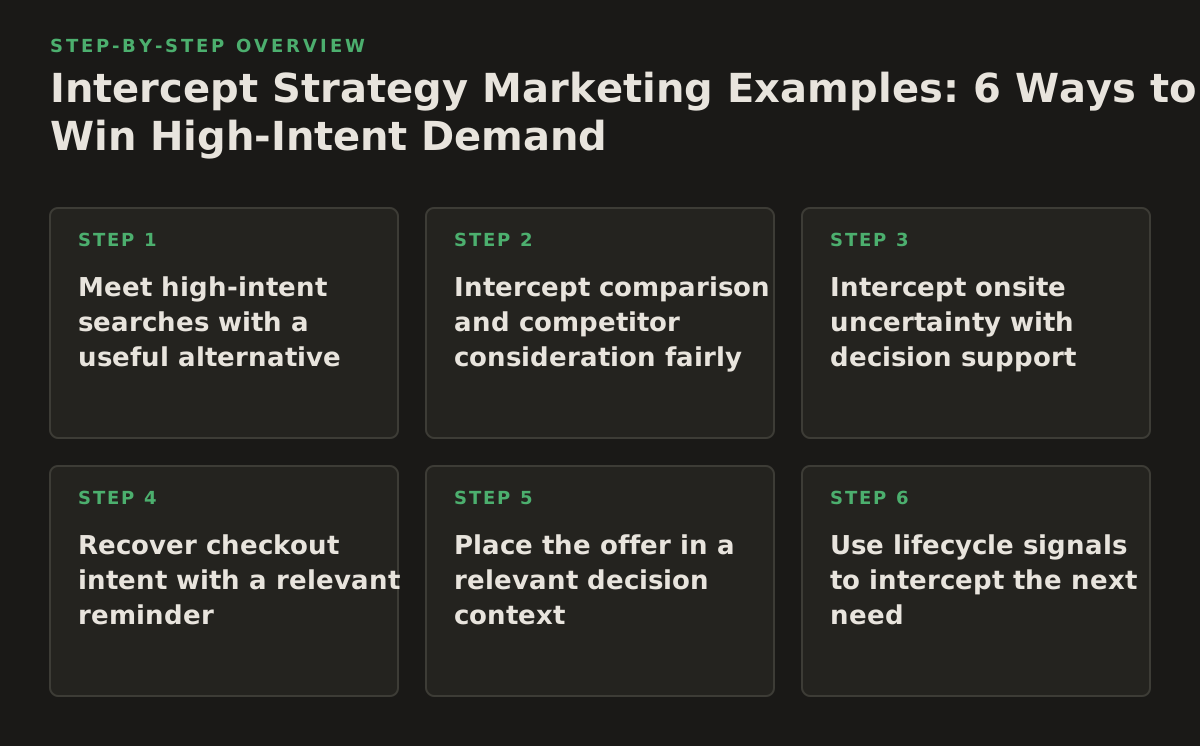
1. Meet high-intent searches with a useful alternative
When it applies: Your audience searches for a product category, a solution to a defined problem, or a comparison before buying. This is often a practical starting point for ecommerce brands and services with clear search demand.
Why it works: The search itself offers a clue about the job a prospect is trying to complete. An ad and landing page that answer that job can help your brand enter the consideration set. Google Ads search campaigns can show ads in response to relevant searches, while keyword match types determine how closely a query must relate to a keyword; the details are in Google’s search campaign guidance and keyword matching documentation.
Example: the category challenger
A meal-kit brand wants to reach shoppers searching for “family meal kits” and “easy dinners delivered.” Instead of sending every click to its homepage, it creates a landing page that explains who the plan suits, what a first order includes, and how delivery works. The ad promises a clear evaluation—not an unsupported claim that the brand is the cheapest or best.
- Adapt it: Group searches by decision need, such as delivery, ingredients, price, or use case.
- Put the answer to that need above the fold; link to relevant product or plan details.
- Review search terms and exclude queries that signal a different need, such as recipes when the business sells subscriptions.
Failure mode: Broad targeting can buy clicks from people who are researching the category but cannot or will not buy your offer. Treat search-term relevance and conversion quality—not click volume alone—as the test. If the landing page cannot substantiate the ad’s promise, fix the page before expanding reach.
2. Intercept comparison and competitor consideration fairly
When it applies: Buyers already know the category and are weighing alternatives. This can suit brands with a verifiable point of difference, such as a specialized assortment, a distinct service model, or a feature that matters to a particular segment.
Why it works: A comparison gives the buyer a decision structure. For example, a project-management brand could explain which team size or workflow its product fits, then show the relevant capabilities and limitations. The aim is to earn consideration with specific, supportable differentiation, not to imply that a competitor is inferior without evidence.
Example: the alternative page
A skincare company sees searches for its category alongside searches that include other brands’ names. It creates a page for shoppers comparing routines, with a side-by-side explanation of ingredients, skin-type suitability, and product format. Where it names another product, it uses accurate, current information and states the basis of the comparison.
The Federal Trade Commission’s policy says comparative advertising is acceptable when comparisons are truthful and non-deceptive. That is a useful standard for competitor messaging, but it is not a substitute for checking the rules and substantiation requirements that apply to your claims; see the FTC’s statement on comparative advertising.
- Compare factors buyers can verify, such as included services, materials, or stated product specifications.
- Make the page useful even if the shopper does not switch: explain fit, trade-offs, and who should choose another option.
Failure mode: A page that merely repeats a competitor’s name can attract low-quality traffic and create legal or reputational risk. If your advantage cannot be shown with evidence, target the underlying category need instead of making a direct comparison.
3. Intercept onsite uncertainty with decision support
When it applies: A visitor has reached a product, category, or pricing page but may not have enough information to take the next step. Use this approach when customer questions recur or when analytics show a particular page attracts visits without the expected product exploration or add-to-cart behavior.
Why it works: The visitor is already in your environment, so useful guidance can reduce uncertainty without paying to reacquire the same person. The intervention should answer a likely question at the point it arises—not cover the page with a generic discount or pop-up.
Example: the fit-and-selection guide
A footwear store finds that shoppers browse running shoes across several categories. On those pages, it offers a fit guide organized around running surface and intended use, with clear links to suitable products. The guide does not claim to diagnose injuries; it helps shoppers narrow the catalog using information the brand can support.
- Use customer service questions, onsite search terms, and product-page behavior to identify the friction.
- Place the guide near the relevant choice, and make it easy to dismiss or revisit.
- Compare the behavior of visitors exposed to the guide with a suitable control or pre-defined baseline; track assisted product exploration as well as immediate purchases.
Failure mode: A helpful-looking prompt can still interrupt a shopper who has already made a decision. Avoid stacking prompts, hiding product details behind a quiz, or assuming that every exit means the offer needs a discount.
4. Recover checkout intent with a relevant reminder
When it applies: A shopper has started checkout or otherwise shown clear purchase intent, but the order is not complete. This is a different signal from a casual product-page visit and deserves a more focused follow-up.
Why it works: The reminder can return the shopper to the specific decision they paused, while making it easier to resolve a practical concern such as delivery, returns, or product details. Shopify documents abandoned-checkout recovery options for eligible stores in its checkout recovery guidance; confirm the available settings for your store rather than assuming every setup behaves the same way.
Example: the useful checkout follow-up
A home-goods retailer sends a permitted follow-up that links back to the saved cart and answers a common question about delivery or returns. The message uses the items the shopper selected, avoids inventing urgency, and does not automatically offer a discount. If the shopper already purchased, the campaign suppresses further cart reminders.
- Separate checkout starters from product viewers so the message reflects the strength of the signal.
- State the next step clearly and link directly to the relevant cart or checkout where supported.
- Measure completed orders, cancellations, and discount use together; a recovered order is not automatically incremental revenue.
Failure mode: Repeated reminders can damage trust, and a blanket discount can train customers to delay checkout. Set frequency and suppression rules, and check applicable consent and messaging requirements before sending.
5. Place the offer in a relevant decision context
When it applies: Your buyer learns by reading reviews, watching demonstrations, or researching a specific use case, and search alone does not reach that moment efficiently. This approach can help products that need explanation, but it requires close attention to context and placement quality.
Why it works: A message placed beside relevant information can make the next step easier to discover. For example, a cookware brand could sponsor a recipe demonstration focused on the technique its product is designed for, then link to a page that explains the product’s fit for that use. The example works because the content and offer share a clear task.
Example: the use-case placement
A storage brand places a demonstration beside content about organizing a small apartment. The creative shows a specific storage problem and directs interested viewers to a landing page with dimensions, compatible spaces, and product options. It does not pretend to be an independent review or imply an endorsement the publisher has not made.
- Choose placements by audience need and content relevance, not just by a large reach estimate.
- Give each placement a matching landing page and a trackable path to product discovery.
- Review placement-level engagement and downstream quality; pause contexts that bring mismatched traffic.
Failure mode: A broad placement can generate attention without purchase intent, while an unclear sponsorship can erode trust. Treat this as a learning channel: start with a narrow hypothesis, document the context, and expand only when qualified behavior supports it.
6. Use lifecycle signals to intercept the next need
When it applies: A customer or known prospect has shown a meaningful prior interest, and a later message can be relevant to that behavior. Examples include replenishment, a complementary product, or a return to a category the person previously explored.
Why it works: A signal-based audience can focus follow-up on people who have taken a relevant action rather than treating all visitors alike. Google Analytics documents how audiences can be created from user attributes and behavior for analysis and activation; its audience documentation explains the concept. Google Ads also documents data segments used for reaching past site visitors, subject to eligibility and setup requirements, in its remarketing guidance.
Example: replenish, don’t retarget everyone
A pet-supplies retailer identifies customers who purchased a consumable product and sends a relevant replenishment reminder when the expected need is approaching. It excludes customers who have already reordered and does not use the same message for someone who only browsed the product once. The timing should be based on the product and available evidence, not an assumed universal replenishment cycle.
Failure mode: Broad retargeting can repeatedly show an irrelevant product to someone who bought it, returned it, or has moved on. Define audience entry, exit, and suppression rules before launch, and ensure data use and consent practices match the applicable requirements.
Choose the intercept by signal, value, and friction
Use this framework to prioritize opportunities before adding channels or campaigns. The ratings are an illustrative internal rubric, not industry benchmarks: score each factor as low, medium, or high, then prioritize the opportunities with a strong intent signal, a credible response, and a measurable next step.
| Opportunity | Intent signal | Useful response | Key risk to check | First measure |
|---|---|---|---|---|
| Category search | Search for a product or solution | Offer and landing page matched to the query | Irrelevant queries | Qualified conversions by query group |
| Comparison search | Explicit evaluation of alternatives | Evidence-based comparison or fit guide | Unsupported claims | Qualified visits and assisted conversions |
| Onsite hesitation | Repeated exploration or page friction | Selection guide or clear product information | Interruptive prompts | Product exploration and conversion behavior |
| Checkout pause | Checkout started, order incomplete | Relevant cart reminder and answer to a barrier | Over-messaging or unnecessary discounts | Recovered orders and incremental value |
| Prior customer behavior | Purchase or meaningful category interest | Relevant replenishment or complementary offer | Stale signals and poor suppression | Repeat purchase quality and opt-outs |
Before committing spend, ask three questions: Is the signal specific enough? Can the brand respond with a useful, provable message? Can the team separate a real business outcome from activity that would have happened anyway? If the answer to any is no, improve the signal, offer, or measurement before scaling.
Implement in sequence: start narrow, prove relevance, then scale
- Choose one decision moment. Select a single signal—such as a category search, checkout pause, or replenishment need—and state what the person is trying to decide.
- Write the useful response first. Specify the offer, evidence, landing-page content, and next step. If the message depends on a claim you cannot support, revise it before buying traffic.
- Define exclusions and guardrails. Decide who should not see the campaign, how existing customers are treated, and what frequency or follow-up limits protect the experience.
- Set a measurement plan before launch. Track the intended business outcome alongside leading indicators, and define how you will account for repeat purchases, discounts, and other channels’ influence. Treat any initial spend or observation period as a starting policy informed by your economics and volume—not a universal benchmark.
- Review quality before increasing reach. Check query relevance, placement context, landing-page behavior, and customer feedback. If clicks rise but qualified actions do not, revise the match between signal and response instead of automatically raising spend.
- Expand one variable at a time. Once the first use case is credible, test another audience, message, or placement separately so the team can identify what changed.
For brands that need to connect these decisions across positioning, creative, media, and measurement, Kimmel Marketing’s digital marketing services and marketing expertise can support a coordinated approach. If the next step is to map an intercept opportunity to your acquisition economics, explore Kimmel Marketing.
Authored with NotFair SEO