Market Disruption Strategy: How to Change the Competitive Game
A market disruption strategy deliberately changes the value, cost, or buying experience a market offers—so customers have a compelling reason to choose a different kind of solution and competitors must respond. It may start with an underserved segment, a simpler offer, or a new way to deliver and charge for value; it is not simply reacting to trends or improving ad performance. The distinction matters: disruptive innovation often begins in low-end or new-market footholds, rather than as a better version of the incumbent’s premium offer, as the Christensen Institute explains and Harvard Business Review clarifies.
What a Market Disruption Strategy changes
A market disruption strategy changes the basis of competition: what customers consider valuable, what they must do to get it, and what the provider must spend to deliver it. The strategic move could be a product designed for a customer incumbents overlook, a lower-friction buying journey, or a business model that makes an expensive or inconvenient category accessible in a different way.
That is distinct from a market-response strategy. If a rival launches a discount and your brand matches it, you have responded to competition. If you redesign your offer so customers can buy only the service level they need, and the simpler delivery model supports a different price and experience, you may be changing the competitive equation. The test is not whether the campaign looks novel. It is whether the offer changes customer choice and the economics of serving that choice.
Nor is every innovation disruptive. An improved product can win share among existing high-value customers without opening a foothold that changes the market over time. The Christensen Institute’s framework distinguishes new-market and low-end footholds from sustaining improvements; use that distinction to avoid calling routine feature launches “disruption.” Blue ocean strategy is related but not identical: it focuses on creating uncontested market space through value innovation, as described in the Blue Ocean Strategy overview.
- Customer: Which group is underserved, excluded, or paying for more than it needs?
- Trade-off: What does that group value more—simplicity, access, speed, guidance, customization, or price?
- Delivery: What must change in the product, service, channel, or operating model to serve it?
- Economics: Can the business deliver the new value sustainably rather than subsidizing an unprofitable promise?
Why it matters to growth-stage brands
Growth-stage brands often compete in a crowded auction for familiar audiences with familiar claims. More media spend may increase reach, but it does not necessarily create a reason to choose the brand. A disruption strategy looks upstream of channel tactics: it asks whether the business has an acquisition-worthy difference that can be expressed in the offer, experience, and proof—not just in the ad creative.
For an ecommerce company, this can be a more useful question than “How do we lower customer acquisition cost?” A lower CAC is valuable only if customer quality and contribution economics hold. The broader question is whether a redesigned offer can attract a customer group the current proposition misses, or make a purchase easier enough to change the path from consideration to conversion. That may involve a focused assortment, a guided selection process, a flexible replenishment option, or service that removes a category-specific barrier.
Disruption also creates a brand-strategy challenge. If a new offer has different economics or serves a different audience, the brand architecture must make the relationship clear. A sub-brand, endorsed offer, or extension can help customers understand what is new; each choice also carries costs in attention, operational complexity, and potential confusion. The offer should lead the architecture decision, not the other way around.
Before committing, map the consequences across the business:
- Demand: Is the unmet need large and identifiable enough to reach through available channels?
- Margin: Does the offer leave room for fulfillment, support, returns, and acquisition costs?
- Retention: Is there a credible reason for customers to return, renew, or recommend?
- Brand: Does the new promise strengthen the main brand, or require clearer separation?
These questions connect strategic ambition to acquisition reality. Kimmel Marketing’s marketing expertise covers the brand, creative, and performance considerations that help teams assess whether a distinct proposition can be communicated and scaled.
How the strategy works: change the value equation
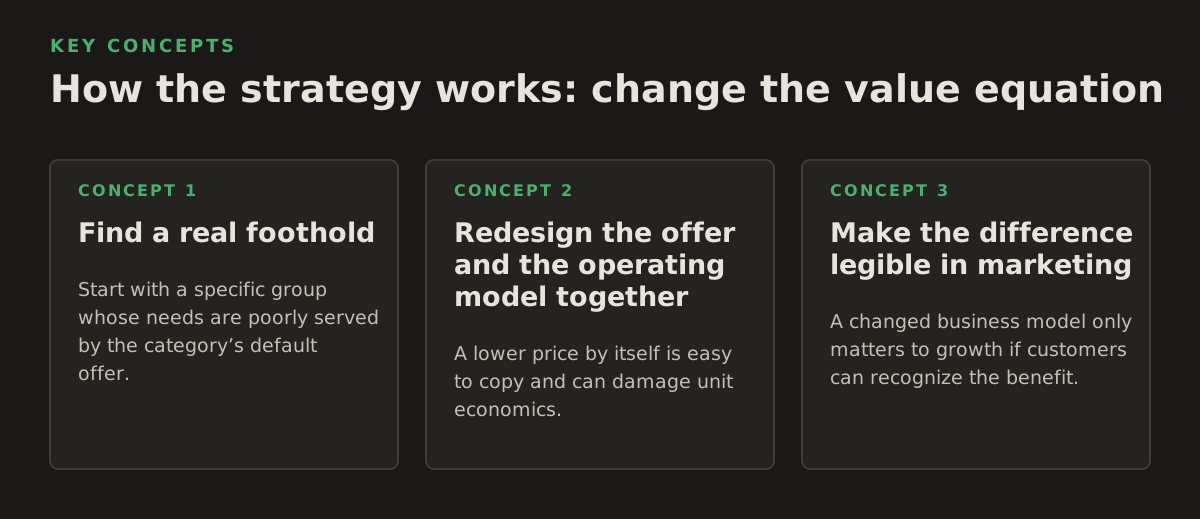
A workable strategy joins three choices: who is underserved, what trade-off changes, and how the business delivers it. If any one is missing, the idea is incomplete. A customer segment without a distinct offer is just targeting; a novel offer without a viable delivery model is an expensive experiment; a lean operating model without customer value is internal optimization.
Find a real foothold
Start with a specific group whose needs are poorly served by the category’s default offer. That group might be first-time buyers overwhelmed by choice, customers who need a smaller commitment, or people who want expert help without a high-touch sales process. Do not define the segment only by demographics or platform interests. Describe the job they are trying to complete, the workaround they use now, and why the existing options fail.
Redesign the offer and the operating model together
A lower price by itself is easy to copy and can damage unit economics. Instead, decide which attributes to reduce or remove, which to elevate, and what to add. The strategic choices have to connect: a simpler product may support a lower-cost service model; a guided experience may justify a premium; a replenishment offer may change purchasing frequency but also add cancellation and fulfillment demands. The Blue Ocean Strategy framework provides an eliminate-reduce-raise-create lens for examining those choices; use it as a prompt, not proof that a market has been disrupted.
For example, an illustrative ecommerce brand selling a large range of skincare products might test a three-step routine for customers who find the category confusing. The strategic change is not merely “bundle more.” It is a narrower decision, supported by product guidance and a fulfillment plan that can deliver the routine consistently. The team should examine whether the simplified choice improves customer fit and whether the savings from a focused range offset the added cost of guidance.
Make the difference legible in marketing
A changed business model only matters to growth if customers can recognize the benefit. Translate the strategy into a specific customer promise, a reason to believe it, and a low-friction next step. Then align the landing page, product detail, creative, and media audience with the same proposition. If the ad promises personal guidance but the page presents an undifferentiated catalog, the experience breaks before the strategy gets a fair test.
For practitioners, useful questions include:
- Can a customer explain what is different after seeing the offer once?
- Does the landing page show the trade-off plainly, including what the customer does not get?
- Does the creative demonstrate the new experience rather than rely on a broad claim?
- Can operations fulfill the promise when a campaign drives more demand?
Test the strategic bet before scaling it
Testing a disruption strategy is not the same as A/B testing a headline. The first experiment should challenge a business hypothesis: that a defined customer group wants the changed offer and that the business can serve it with viable economics. Use the smallest test that can distinguish between meaningful explanations. A landing-page concept test may help assess message comprehension; a limited assortment or pilot service may reveal operational friction; a controlled paid-media test may indicate whether the proposition attracts qualified demand.
Set the decision rules before the test. Choose measures that reflect both customer response and business quality: qualified conversion, average order value where relevant, gross margin after variable costs, refund or cancellation behavior, and repeat purchase over an appropriate period. A click-through rate can help diagnose creative, but it cannot establish that a new business model works. Likewise, early conversion does not prove retention.
When using Google Ads campaign experiments, the platform’s documentation explains how experiments compare a proposed change with an original campaign under a defined setup; consult the Google Ads experiments guide for the current process. Treat such a test as evidence about the campaign change and measured outcomes—not as standalone proof of durable market disruption.
Measurement quality matters when the strategy depends on downstream value. Google’s conversion tracking documentation describes how advertisers can measure actions after ad interactions. For a strategic test, confirm that the chosen conversion represents a meaningful customer action, and use first-party order or customer data to evaluate margin and repeat behavior where available. Platform-attributed conversions alone may not answer whether the offer is economically sound.
Consider this illustrative pilot for a brand testing a guided starter kit against its standard product page. These figures are example test settings, not benchmarks:
- Run the pilot for 4 weeks with a defined audience and a capped spend of $8,000, provided that cap is affordable for the business.
- Compare the guided offer with the existing experience, keeping major audience and campaign conditions as consistent as practical.
- Review qualified purchases, contribution margin after variable costs, refunds, and early repeat orders—not just clicks or initial conversion.
- Decide in advance to scale, revise, or stop based on the economics and evidence quality; extend observation if repeat behavior cannot yet be judged.
The numbers are there to make the decision concrete, not to prescribe a universal budget or timeline. A team with long purchase cycles, low traffic, or high order values will need a different design and may need qualitative customer research alongside quantitative results.
Where market disruption strategies break
Ambitious ideas usually fail at the joins between customer promise, operating model, and acquisition—not because the concept lacks a catchy name. A practical review should look for these failure modes before the company commits a large budget or reorganizes around the idea.
- Novelty mistaken for demand: People may notice an unusual offer without wanting to buy it. Test a meaningful behavior, not just reactions or clicks.
- Growth mistaken for viable economics: A lower entry price or more generous service may lift initial sales while increasing variable costs. Model gross margin, returns, servicing, and repeat behavior together.
- A new segment that is hard to reach: The underserved group may be real but expensive to identify or too small for the intended model. Estimate reachable demand before treating a niche as a scalable market.
- Marketing that overpromises: A distinctive claim can create demand that fulfillment cannot meet. Set operational capacity and customer support expectations before scaling spend.
- Incumbent imitation: Competitors may copy visible features. Build around hard-to-reproduce capabilities—such as a sharper customer understanding or a coherent delivery model—rather than assuming the first campaign owns the idea.
There is also a timing risk: early revenue can look promising before customers have had enough time to renew, reorder, or return. Separate leading indicators (such as qualified interest) from durability indicators (such as repeat purchase and sustained margin). If the latter are not yet observable, label the conclusion provisional and keep the test narrow.
Finally, do not force a disruption thesis onto a business that needs a more focused growth improvement. If the customer proposition is already strong but acquisition is inefficient, improving creative, measurement, landing pages, or channel mix may be the better near-term decision. Strategy should clarify where to invest—not turn every optimization project into a category-reinvention claim.
How growth teams should apply it
For a growth-stage brand, the useful output is not a declaration that the company will “disrupt” a category. It is a set of testable decisions connecting customer need to business economics. Start by writing a one-sentence hypothesis: “For [specific customer], we will change [part of the value or buying experience] by [distinct offer or delivery model], because [evidence of unmet need]; we will judge viability by [customer and economic measures].” If the sentence depends on vague words such as “innovative” or “premium,” sharpen it before buying media.
Then assign ownership across functions. Brand and product teams define the promise and boundaries; creative translates the difference into recognizable proof; media buying finds a controlled route to the intended audience; analytics and finance define how success is measured; operations confirm the experience can be delivered. This is where digital marketing services can support the acquisition and measurement work, while the business retains responsibility for product, fulfillment, and commercial decisions.
A useful starting sequence is:
- Diagnose: Identify a customer group, unmet job, and current workaround using customer conversations, support themes, search behavior, or purchase data.
- Design: Specify what changes in the offer and delivery model, then model contribution economics under cautious assumptions.
- Prove: Run a bounded test with a clear comparison, meaningful customer outcomes, and a pre-agreed decision rule.
- Scale selectively: Expand only the audience, spend, or operational capacity supported by evidence; keep monitoring retention and service quality.
The recommendation is to treat disruption as a business-model hypothesis with a marketing expression, not a media tactic. If your team needs to turn a distinct proposition into a measurable acquisition plan, Kimmel Marketing can help connect brand strategy, creative, media buying, and performance optimization.
Authored with NotFair SEO