Market Penetration Strategy Examples: 6 Practical Growth Plays
Market penetration strategy examples include winning customers from competitors, increasing repeat purchases, improving conversion rates, expanding distribution, and using sharper offers for an existing market. The right approach grows revenue from a market you already understand without assuming that entering a new category or geography is the answer. For a growth-stage brand, the practical test is whether the strategy can increase qualified demand while protecting contribution margin, customer acquisition cost (CAC), and lifetime value (LTV).
What a market penetration strategy actually means
Market penetration is a growth strategy focused on selling more of an existing product to an existing market. The market may be defined by geography, customer segment, use case, or channel. A direct-to-consumer skincare brand selling moisturizers to customers in the United States is pursuing penetration when it improves its paid acquisition, converts more site visitors, or gets existing buyers to reorder. It is not pursuing pure penetration when it launches a supplement line or begins selling in a new country.
The distinction matters because the risk profile changes. Penetration usually builds on existing product knowledge, customer data, creative assets, and distribution. Diversification asks the business to learn a new product and a new market at the same time. A useful operating definition is:
Market penetration = increasing share, frequency, or revenue within a known market using an existing core offer.
That does not mean every penetration tactic is low risk. Aggressive discounting can train customers to wait for sales. Paid media expansion can raise marginal CAC. Retargeting can take credit for demand that would have converted anyway. The strategy is only healthy when the incremental revenue is worth the incremental cost.
Penetration versus adjacent growth
Teams often mix four different growth decisions:
- Market penetration: sell more of the current offer to the current audience.
- Product development: sell a new offer to the current audience.
- Market development: sell the current offer to a new audience, region, or use case.
- Diversification: sell a new offer to a new market.
Some tactics sit on the boundary. A new bundle made entirely from existing products can be penetration if it targets current buyers. A new wholesale channel may be market development if the brand has only sold direct to consumers. Classifying the move correctly helps leadership set realistic measurement expectations and avoid calling every revenue initiative “penetration.”
Why penetration matters for revenue and acquisition efficiency
Penetration is attractive because it can improve the economics of assets the company has already paid to create: brand awareness, product education, creative, email lists, landing pages, and customer relationships. It also gives marketing leaders more levers than simply increasing media spend.
Consider an illustrative ecommerce example. A brand has 100,000 monthly sessions, a 2% purchase conversion rate, and a $75 average order value. That produces 2,000 orders and $150,000 in revenue before returns and variable costs. A penetration plan could combine a conversion improvement to 2.3%, a reorder program, and a more efficient paid-media mix. None requires a new category. The business still needs to validate margin and incrementality, but the growth path is more controlled than buying an entirely different audience.
The most useful scorecard connects the tactic to incremental revenue and contribution margin, not just top-line sales. Track:
- New-customer CAC by channel, audience, and creative angle.
- Conversion rate by landing page, device, offer, and traffic source.
- Gross margin after discounts, shipping, refunds, and payment costs.
- Repeat purchase rate and time to second order.
- Blended revenue efficiency, such as contribution profit divided by total marketing spend.
- Incremental lift compared with a holdout, matched market, or pre-defined baseline.
Attribution platforms can report which touchpoint received credit, but credit is not the same as causation. Google describes conversion tracking as a way to understand actions after an ad interaction, while its measurement guidance also distinguishes observed conversions from broader lift questions; see the official Google Ads conversion tracking documentation. Use platform reporting for optimization, then use experiments or controlled comparisons when a large budget decision depends on true incrementality.
The economic ceiling of penetration
Every market has a practical ceiling. The easiest customers may already know the brand, competitors may respond with lower prices, and the next audience segment may cost more to persuade. A plan should therefore specify how much efficient demand remains, rather than assume that reach can expand indefinitely.
Useful warning signals include rising frequency without rising conversion, more branded search but no increase in total category demand, and new customers with poor second-order behavior. These patterns suggest that the brand is harvesting existing intent rather than creating durable growth.
Six Market Penetration Strategy Examples you can adapt
The examples below are reusable patterns rather than universal prescriptions. Each one shows the mechanism, the condition that makes it work, and the failure mode to watch.
- Improve conversion on existing demand. An apparel store receives 50,000 qualified monthly sessions and converts 1.8% of them, producing 900 orders. An illustrative starting policy is to test clearer sizing information, stronger product proof, faster mobile checkout, and a more specific landing-page promise. If conversion reaches 2.2% at the same traffic level, orders rise to 1,100. This demonstrates that conversion optimization can penetrate a market without buying more traffic. It works when traffic quality is already adequate; it fails when the real problem is weak product-market fit or misleading acquisition. Adapt it by isolating one funnel constraint at a time and measuring profit per session, not only conversion rate.
- Take share from a named competitor. A project-management software company creates comparison pages and search campaigns for teams evaluating a known alternative. The message focuses on a specific switching reason—such as simpler migration or better approval workflows—rather than vague “better software” language. This demonstrates competitive displacement. It works when the product has a credible, provable advantage and a migration path. It fails when the campaign attracts comparison shoppers who do not fit the ideal customer profile. Adapt it by matching the promise to a real product capability and tracking qualified pipeline or activated accounts.
- Increase purchase frequency through replenishment. A coffee subscription brand identifies that many first-time buyers reorder only when they remember. It introduces a reorder reminder, a subscription option, and a two-bag bundle using the existing product line. This demonstrates frequency-based penetration. It works when consumption is predictable and the customer experience supports repeat use. It fails if reminders create fatigue, subscriptions are difficult to pause, or the offer reduces margin more than it increases retention. Adapt it by segmenting reminders around actual consumption intervals rather than sending every customer the same schedule.
- Use packaging and bundles to increase basket size. A skincare brand sells a cleanser and moisturizer separately, then creates a routine bundle with clear savings and education about the order of use. This demonstrates share-of-wallet growth inside the existing customer base. It works when the products solve connected problems and the bundle reduces decision friction. It fails when customers perceive forced bundling or when the discount hides an unprofitable order. Adapt it by showing the standalone price, bundle price, expected use case, and margin impact before launch.
- Expand distribution within the same customer market. A premium snack brand that sells only through its website adds a small set of specialty retail accounts where its target customers already shop. This demonstrates channel penetration, not necessarily geographic expansion. It works when the new channel adds availability and discovery without damaging pricing or brand positioning. It fails when wholesale terms, retailer promotion, and operational complexity consume the contribution profit. Adapt it by defining channel-specific economics and keeping direct customer data collection compliant and useful.
- Refresh creative around an existing positioning. A home fitness company keeps the same core product but develops creative for distinct barriers: lack of time, uncertainty about setup, and desire for guided progress. This demonstrates message-market penetration. It works when the audience exists but the current communication speaks to only one motivation. It fails when the brand changes its promise so often that recognition and trust decline. Adapt it by preserving the strategic positioning while varying proof, use cases, hooks, and customer objections.
Paid media can support each pattern, but it is not the strategy by itself. Google Ads explains that automated bidding can optimize toward conversion goals and, in some cases, conversion value; the relevant Google Ads bidding documentation is useful when deciding whether the account has enough reliable value signals. Do not ask an algorithm to optimize for revenue if revenue data omits refunds, margin differences, or offline outcomes that determine business value.
How to build and measure a penetration plan
Start with a constrained growth hypothesis
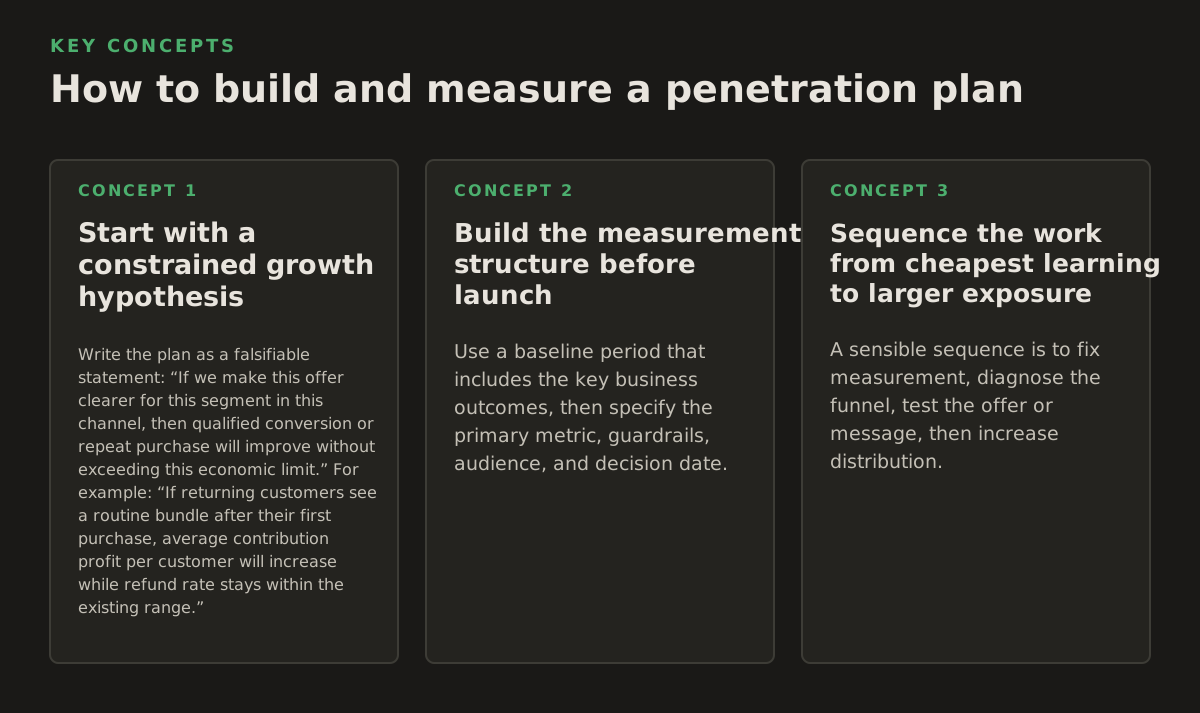
Write the plan as a falsifiable statement: “If we make this offer clearer for this segment in this channel, then qualified conversion or repeat purchase will improve without exceeding this economic limit.” For example: “If returning customers see a routine bundle after their first purchase, average contribution profit per customer will increase while refund rate stays within the existing range.”
Then define the unit of analysis. A first-order offer should be judged at order level; a subscription intervention should be judged over a retention window; an acquisition campaign should be judged with new-customer CAC and later value. Mixing all revenue into one blended number can make a poor tactic appear successful because repeat customers subsidize expensive acquisition.
Build the measurement structure before launch
Use a baseline period that includes the key business outcomes, then specify the primary metric, guardrails, audience, and decision date. A practical measurement brief includes:
- Primary outcome: incremental contribution profit, qualified leads, activated accounts, or repeat orders.
- Leading indicators: click-through rate, product-page engagement, checkout starts, or trial activation.
- Guardrails: CAC, discount rate, refund rate, gross margin, and customer support contacts.
- Comparison method: randomized holdout, geographic split, audience split, or a pre-registered before-and-after analysis.
- Decision rule: scale, revise, or stop based on economics rather than an attractive but incomplete metric.
For ecommerce, connect media cost to orders and customer status in a consistent reporting layer. Google Analytics documentation explains how event and ecommerce data can be collected for analysis in GA4; see the official GA4 event documentation. The implementation detail matters: if add-to-cart events fire twice or refunds never enter the dataset, the apparent penetration result can be wrong.
Sequence the work from cheapest learning to larger exposure
A sensible sequence is to fix measurement, diagnose the funnel, test the offer or message, then increase distribution. For example:
- Audit the current customer, product, and channel economics.
- Identify the largest constraint: demand, conversion, frequency, or distribution.
- Run a focused test with a clear control or baseline.
- Review customer quality and margin, not only immediate sales.
- Scale the winning combination gradually across audiences and placements.
Audience expansion should follow evidence. Google Ads describes audience signals and targeting controls in its official Google Ads audience targeting guide. Use those controls to organize a test, but do not treat an audience label as proof that the segment will be profitable. The business outcome still depends on offer, creative, landing page, and post-purchase experience.
Where market penetration strategies break
The most common failure is confusing captured demand with incremental demand. A retargeting campaign may look efficient because it reaches people who were already close to buying. That can be useful for conversion, but it does not prove the campaign created the purchase.
Other failure modes are operational rather than media-related:
- Discount dependence: sales rise only while the offer is unusually generous.
- Audience saturation: reach increases but frequency, complaints, or declining response rise faster.
- Weak retention: acquisition looks acceptable until second-order behavior is included.
- Channel conflict: new retail or marketplace distribution undermines direct pricing and customer relationships.
- Creative inconsistency: every test changes the brand promise, making learning impossible.
- Measurement leakage: returns, cancellations, offline sales, or gross-margin differences are excluded.
Platform-reported results require especially careful interpretation. Meta’s official guidance on ad campaign measurement describes measurement as a way to assess campaign performance, but reported attribution windows and modeled results are not interchangeable with a controlled incrementality study. Align the platform metric with the business question: optimization can use fast signals, while budget allocation needs a more defensible view of incremental value.
There is also a strategic limit: if the core offer is not competitive, penetration tactics can amplify the problem. More traffic exposes poor delivery times, unclear pricing, weak onboarding, or inadequate support. Before increasing spend, confirm that the product experience can handle the customers the campaign is intended to win.
How practitioners apply penetration across the growth system
Strong execution treats penetration as a coordinated system rather than a single campaign. Brand strategy determines the durable promise. Creative strategy turns that promise into different reasons to believe. Media buying finds qualified opportunities. Conversion optimization removes friction. Lifecycle marketing increases the value of customers already acquired.
For an ecommerce leadership team, the monthly operating review can ask:
- Which customer segment has the clearest unmet reason to choose us?
- Which existing product or message can serve that need without a new category?
- Where is the current funnel losing profitable demand?
- Which result is incremental, and which result is merely attributed?
- What happens to CAC, margin, and LTV if the tactic is scaled?
Use the answers to assign one owner and one economic target to each initiative. A media manager may own acquisition efficiency, a creative lead may own message testing, and a lifecycle owner may own repeat purchase. Leadership should still evaluate the combined result because a cheaper first order is not a win if retention falls or customer support costs rise.
For brands preparing a broader repositioning, penetration work can also reveal which claims and use cases deserve a stronger role in the brand architecture. Customer objections, search themes, sales conversations, and post-purchase feedback can inform the strategy without turning every short-term performance signal into a permanent brand promise. This is where disciplined marketing expertise connects immediate acquisition work with longer-term brand clarity.
The practical recommendation is to choose one penetration constraint—conversion, competitive switching, purchase frequency, basket size, distribution, or message relevance—then build a measured test around it before adding budget. Kimmel Marketing helps brands connect brand strategy, creative development, media buying, and performance optimization through Kimmel Marketing, so growth decisions stay tied to revenue, CAC, and LTV.
Authored with NotFair SEO