Market Positioning Strategy Definition: How to Build a Growth-Ready Position
Market positioning strategy definition: it is the deliberate choice of which customer a brand is for, what valuable problem it solves, how it is meaningfully different, and why that customer should believe it. A useful positioning strategy connects an audience, category, value promise, competitive contrast, and proof into one decision-making framework. For a growth-stage brand, it is not a slogan; it is a system for deciding which customers to acquire, what to say in creative, where to buy attention, and how to judge profitable growth.
That distinction matters because many brands describe their product without establishing a reason to choose it. “High quality,” “easy to use,” and “customer-focused” may be true, but they rarely tell a prospect why this offer is better for their situation. Effective positioning turns internal capabilities into a customer-relevant reason to act.
What a market positioning strategy actually contains
Positioning is the space a brand aims to occupy in a customer’s mind relative to alternatives. A positioning strategy is the set of choices used to claim and reinforce that space. It sits between broad brand strategy and channel-level execution: brand strategy defines the larger identity and ambition, while positioning gives acquisition and conversion teams a sharper commercial direction.
A complete positioning statement should answer five questions:
- Who is the priority customer? Define the situation, need, buying trigger, and constraints—not only demographics.
- What category or alternative is the customer comparing? The relevant alternative may be a competitor, an internal process, a cheaper substitute, or doing nothing.
- What outcome does the brand promise? State the customer result rather than listing features.
- Why is this offer distinct? Identify a difference that matters to the selected audience and can be defended.
- What proof reduces perceived risk? Use evidence such as demonstrations, transparent policies, expert validation, customer results, or product experience.
A practical template is: For [specific customer in a specific situation], [brand] is the [category or solution] that delivers [valuable outcome] because [distinctive mechanism or proof], unlike [relevant alternative]. The template is not customer-facing copy. It is an internal decision rule that should make some audiences, messages, products, or channels less important.
Positioning is not the same as a target market
A target market describes who may buy. Positioning explains why that audience should choose you. An ecommerce company may target women aged 25–44, but that does not tell a creative team whether to emphasize ingredient transparency, speed, status, affordability, or a specialized use case.
For example, a skincare brand could target people with sensitive skin. Its positioning might be “the routine for people who want active ingredients without trial-and-error irritation,” supported by ingredient education and a routine-building tool. That is more actionable than “premium skincare for sensitive skin” because it identifies the tension being resolved and the proof the brand must provide.
Positioning is not a campaign message
A campaign message changes by audience, offer, season, and channel. Positioning should remain more stable. “Free shipping this week” is an offer. “A replenishment-first household essentials brand that reduces the work of remembering staples” is positioning. The offer can support the position, but it cannot substitute for one.
This is why a brand can have attractive ads and still lack strategic clarity. Creative may produce attention without establishing a durable association. Media may deliver traffic without creating preference. Positioning supplies the consistent meaning that makes those activities compound.
Why positioning affects acquisition economics
Positioning influences growth through a chain of customer decisions: whether someone notices an ad, understands its relevance, believes the claim, considers the product, converts, and returns. It does not guarantee lower acquisition cost, but it changes the conditions under which media and conversion work.
Relevance reduces wasted attention. A narrow, situation-based promise helps a qualified prospect recognize themselves quickly. This can improve the quality of traffic even when total reach becomes smaller. More reach is not automatically better if it brings people who have no reason to buy or cannot be served profitably.
Differentiation protects against substitution. When every brand claims similar benefits, customers often compare on price, convenience, or familiarity. A distinctive position gives the buyer another criterion. For a subscription business, that might be operational simplicity; for a B2B software company, it might be faster implementation for a specific team; for ecommerce, it might be a product architecture designed around a narrow use case.
Proof lowers perceived risk. The stronger the customer’s uncertainty, the more the brand must demonstrate. A high-consideration purchase may need comparison content, product walkthroughs, guarantees, case evidence, or expert explanation. A low-friction purchase may need only clear product detail, reviews, and delivery information. The correct proof depends on the objection implied by the position.
Paid media makes these consequences visible. Google explains that its ad auction considers factors including bid, ad quality, context, and the expected impact of assets—not just the highest bid; its quality guidance also connects relevance and landing-page experience to ad quality. See Google’s overview of the Google Ads auction and Quality Score documentation. Positioning cannot override weak economics or poor execution, but it helps teams build more relevant messages and destinations.
On social platforms, the same principle appears in a different auction environment. Meta describes ad delivery as an auction that weighs factors such as bid, estimated action rate, and ad quality. Its ad auction guidance makes clear that buying more impressions is not the sole route to delivery. A clear position gives creative a stronger basis for communicating relevance and expected action.
How to build a positioning strategy from evidence
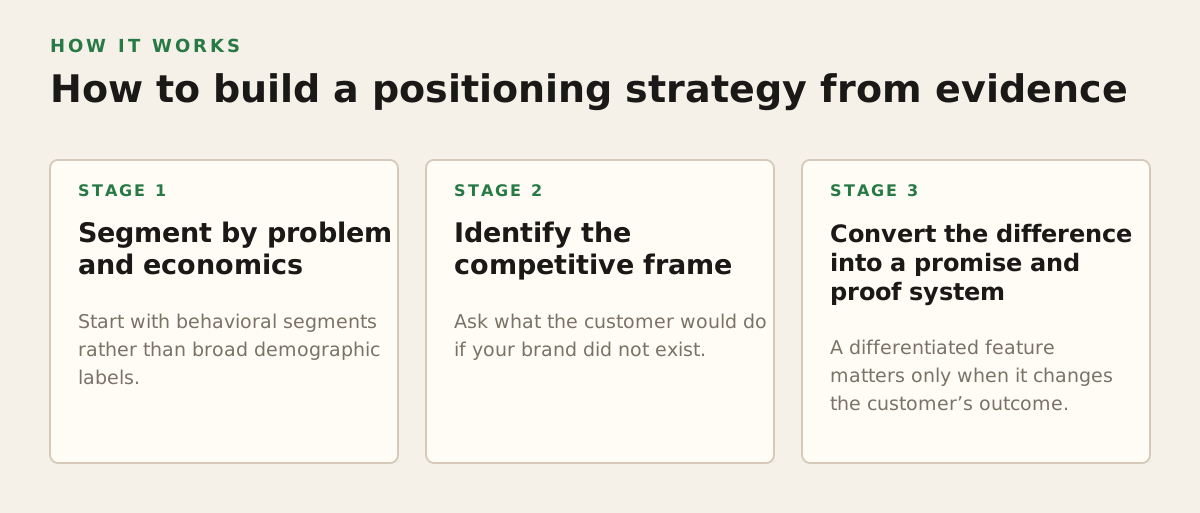
Do not begin with a brand workshop that asks for favorite adjectives. Begin with the commercial problem: which customers, products, and buying situations should produce profitable growth, and what prevents those customers from choosing the brand now?
1. Segment by problem and economics
Start with behavioral segments rather than broad demographic labels. Useful variables include the trigger that creates demand, current workaround, urgency, acceptable price, purchase frequency, switching cost, and expected lifetime value.
Use existing evidence wherever possible:
- Search terms and on-site queries reveal the language customers use to describe the problem.
- Sales calls, support tickets, reviews, and returns reveal objections and unmet expectations.
- First-order and repeat-purchase data reveal whether a segment is merely easy to convert or genuinely valuable.
- Competitor reviews reveal where alternatives disappoint, but those complaints still need validation with your own customers.
- Ad and landing-page results show which claims earn attention or action, although performance data alone cannot explain why.
A segment is strategically attractive when it has a meaningful problem, enough reachable demand, a plausible path to profitable acquisition, and a reason to prefer your solution. A large audience with weak urgency can be less useful than a smaller audience with strong fit and repeat demand.
2. Identify the competitive frame
Ask what the customer would do if your brand did not exist. The answer may be “buy from another brand,” but it could also be “use a spreadsheet,” “visit a store,” “hire an agency,” “combine several products,” or “wait.” Positioning against the actual alternative produces more useful differentiation than listing competitor features.
Map alternatives across four dimensions:
- Outcome: What does each alternative help the customer accomplish?
- Friction: What effort, delay, uncertainty, or inconvenience does it create?
- Economics: What does the customer pay in money, time, and switching cost?
- Trust: Why does the customer believe the alternative will work?
Then choose one or two dimensions where your brand can credibly win. A brand cannot own every benefit. If it claims to be the cheapest, fastest, most premium, most sustainable, and most personalized option, prospects may interpret the message as undisciplined rather than comprehensive.
3. Convert the difference into a promise and proof system
A differentiated feature matters only when it changes the customer’s outcome. “Our platform has automated reporting” is a feature. “Marketing leaders can see spend, pipeline, and acquisition efficiency in one operating view” is an outcome-oriented promise. The latter still needs proof: a usable demonstration, clear methodology, sample reporting, or credible customer evidence.
For each proposed claim, record:
- The customer tension it resolves.
- The mechanism that makes the outcome possible.
- The evidence available today.
- The objection a skeptical buyer will raise.
- The behavior the claim should influence, such as a product view, lead submission, or repeat purchase.
This prevents a common failure: selecting a position because it sounds distinctive, then discovering that the business cannot consistently deliver or substantiate it.
How to apply positioning across media, creative, and conversion
Positioning becomes valuable when it changes execution. Treat it as a translation layer between strategy and the customer journey. The same core position can produce different expressions depending on awareness, intent, placement, and stage of consideration.
Build a message hierarchy
Create a hierarchy with four levels:
- Core meaning: the one-sentence position the brand wants to own.
- Priority promise: the customer outcome most likely to create preference.
- Reasons to believe: mechanisms, evidence, demonstrations, policies, and experience.
- Activation messages: hooks, headlines, offers, objections, and calls to action adapted to each channel.
For example, an ecommerce brand positioned around “simpler replenishment for busy households” might use a convenience-led paid social hook, a comparison page explaining subscription flexibility, product pages showing usage duration, and an email flow focused on reorder timing. These are different executions of one idea, not disconnected campaigns.
Match the promise to intent
High-intent search traffic usually needs immediate clarity: product, use case, differentiator, price context, and next step. Prospecting creative can earn attention by dramatizing the problem or showing a new way to solve it. Retention communications should reinforce the reason the customer chose the brand and make the promised outcome easier to realize.
Do not use the same landing page for every audience simply because the URL converts well in aggregate. A customer arriving from a problem-specific ad should see that problem reflected above the fold, followed by the relevant proof. Message continuity reduces the cognitive work required to decide whether the click was worthwhile.
For measurement, separate positioning signals from business outcomes. Immediate signals can include qualified click-through rate, engaged sessions, product-page progression, lead quality, and search behavior. Commercial measures include contribution margin, customer acquisition cost, payback period, repeat purchase, and lifetime value. Attribution reports are directional rather than perfect representations of causality; Google’s Google Analytics attribution documentation describes how different attribution models assign credit across touchpoints.
An illustrative starting policy—not a universal benchmark—is to require every major campaign brief to specify one audience, one positioning promise, two reasons to believe, one primary conversion event, and one downstream quality measure. If a campaign cannot identify those elements, it is probably testing a creative variation without testing a strategic hypothesis.
Use controlled tests without reducing strategy to click-through rate
Testing can compare positioning hypotheses, but the test must preserve the distinction between attention and value. A bold claim may win clicks while attracting poor-fit prospects. A quieter message may generate fewer clicks but more qualified purchases or better retention.
An illustrative numerical example:
- Message A generates 10,000 impressions, 300 clicks, and 9 purchases: a 3% click-through rate and a 3% click-to-purchase rate.
- Message B generates 10,000 impressions, 220 clicks, and 11 purchases: a 2.2% click-through rate and a 5% click-to-purchase rate.
- If Message B also produces higher-margin orders or stronger repeat purchase, optimizing only to clicks would select the weaker commercial position.
The numbers above are illustrative, not a benchmark. The decision should follow the business model: for a lead-generation company, inspect qualified opportunities and close rate; for ecommerce, inspect contribution margin and repeat behavior; for subscription products, inspect activation and retention alongside initial conversion.
Where positioning strategies break
They target everyone
“For anyone who wants better results” is not positioning. Broad relevance often creates weak relevance because no customer sees a specific situation, tension, or advantage. Start with a priority segment and expand only when the brand has evidence that the same advantage transfers to adjacent audiences.
They confuse internal capability with customer value
Proprietary technology, a large team, or a sophisticated process may support the offer, but customers buy the consequence. Translate each capability into a measurable or observable benefit. Then check whether the benefit matters enough to change selection behavior.
They promise what operations cannot deliver
A premium, fast, or highly personalized position creates operational obligations. If delivery is inconsistent, customer support is slow, or inventory frequently fails, the gap between promise and experience becomes a source of negative reviews and rising acquisition costs. Positioning must be approved by the teams responsible for fulfilling it.
They change before the market can learn them
Refreshing the message every few weeks prevents useful learning. Creative should evolve, but the strategic meaning needs enough consistency to become recognizable. Change the position when the target segment, competitive frame, offer, or customer evidence changes—not merely because one ad underperformed.
They treat performance data as a complete explanation
Conversion data tells you what happened under specific targeting, creative, offer, and timing conditions. It does not automatically tell you what customers believe about the brand. Pair behavioral data with qualitative evidence, customer interviews, review analysis, and sales feedback. Otherwise, teams may optimize a temporary promotion and mistake it for durable differentiation.
How practitioners operationalize positioning for growth
Turn the strategy into a short operating document that media, creative, web, sales, and customer experience teams can actually use. It should be specific enough to reject off-position work and flexible enough to support multiple channels.
Include:
- Priority audience: the customer and situation with the strongest strategic fit.
- Competitive frame: the alternative being replaced or reconsidered.
- Core promise: the outcome the brand wants associated with its name.
- Distinctive mechanism: why the brand can deliver that outcome.
- Proof library: evidence approved for ads, landing pages, sales material, and retention.
- Disqualifiers: customers, use cases, or claims the brand will not pursue.
- Measurement plan: leading signals and downstream financial outcomes.
Review the document whenever there is a major change in product, pricing, audience economics, competitive behavior, or customer expectation. A quarterly review can be a useful starting policy for a growth-stage team, but the correct cadence depends on how quickly the market and offer change.
For brands buying media, connect the positioning document directly to briefs and experiments. Every new concept should state which audience tension it addresses, what proof it uses, and what would falsify the hypothesis. For ecommerce teams, connect it to merchandising, product detail pages, bundles, retention flows, and customer service language—not just advertising.
The practical recommendation is to choose a position that is specific enough to be recognizable, valuable enough to affect choice, distinct enough to avoid commodity comparison, and credible enough to deliver repeatedly. Then measure whether it improves the quality and economics of growth, not merely the volume of traffic. Kimmel Marketing can help turn that position into coordinated digital marketing services, creative, media, and performance decisions through its broader marketing expertise. Kimmel Marketing
Authored with NotFair SEO