Marketing Campaign Template: A Revenue-Focused Planning Worksheet
A marketing campaign template gives your team one place to define the customer, commercial goal, offer, channels, budget, and measurement before launch. Use the worksheet below to decide whether a campaign is ready to fund, what it needs to prove, and how you’ll respond if results miss the plan—not just to collect ideas in a brief.
For a growth-stage or ecommerce brand, the useful distinction is between a campaign that can generate activity and one that can inform a business decision. A campaign plan should connect the customer-facing promise to a measurable outcome, with clear ownership and a practical next step if the evidence changes your assumptions.
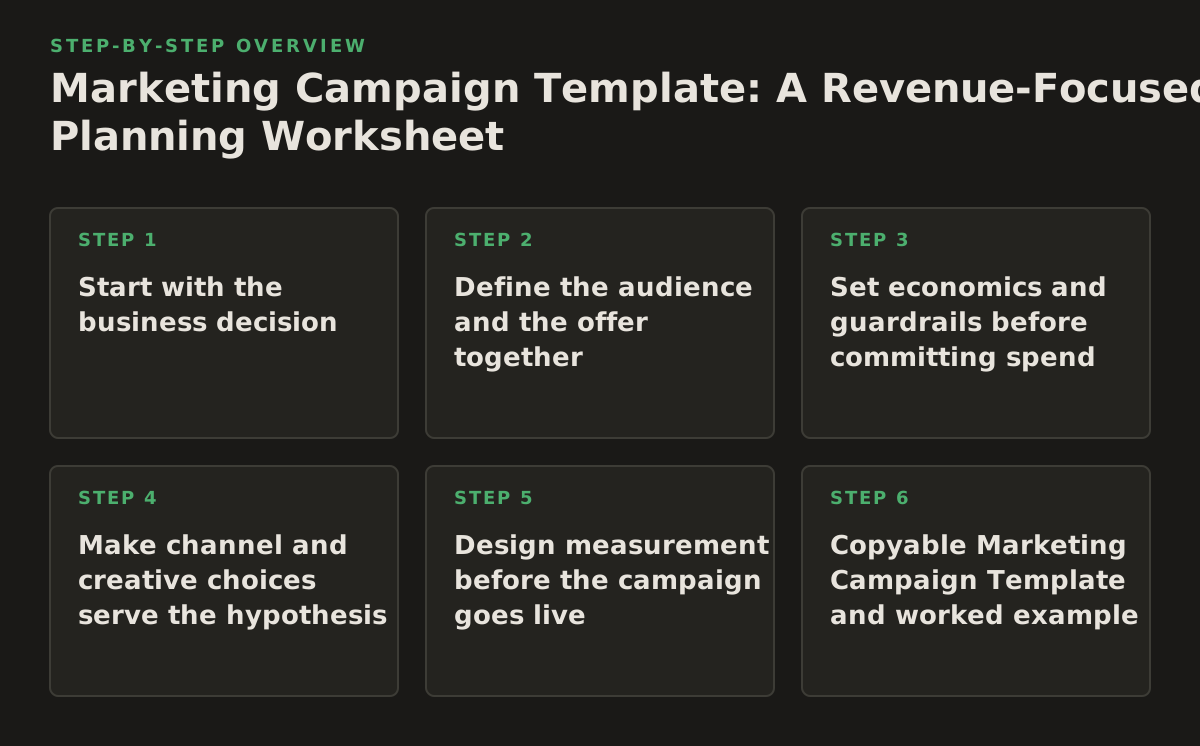
1. Start with the business decision
When it applies: Use this section whenever a campaign has a meaningful spend, revenue, or positioning decision attached. It is especially important when several teams are asking marketing to solve different problems at once.
Why it works: A campaign objective is useful only when it points to a decision. “Increase awareness” may be an appropriate aim, but it does not tell the media buyer whether to optimize for reach, traffic, or a downstream action. Meta’s documentation describes campaign objectives in relation to the business outcome an advertiser wants, so select an objective that reflects the intended result rather than the format of the ad (Meta’s overview of ad objectives).
Write a decision statement before a channel plan
Finish this sentence: “If this campaign shows [evidence], we will [decision].” That wording forces the team to say what the campaign is meant to teach or change. It also exposes a mismatch early: if the desired decision concerns profitable acquisition but the only planned measure is impressions, the measurement plan needs work.
- Business outcome: What should change—qualified pipeline, first purchases, repeat purchases, or another defined result?
- Decision owner: Who can approve more spend, a creative change, or a stop?
- Decision window: What operating period will you review, based on your sales cycle and available data?
Failure mode: Treating a broad aspiration as a target. “Grow the brand” does not specify what evidence matters. Implementation example: An ecommerce team could write, “If the campaign brings in first-time buyers at or below our approved acquisition-cost ceiling, we will expand the audience test; otherwise, we will review offer and landing-page friction before increasing spend.”
2. Define the audience and the offer together
When it applies: Use this principle when the product serves multiple customer types, or when a campaign is underperforming despite adequate reach. The audience and offer should be planned as a pair, not as independent fields in a brief.
Why it works: A message becomes more specific when it connects a buyer’s situation to a relevant reason to act. A useful audience description names a need, trigger, or objection that can guide both the creative and the landing page. It does not need to be an elaborate persona.
Turn customer knowledge into a testable message
Describe the person in terms the campaign can act on: what they are trying to do, what is blocking them, and what proof or reassurance might matter. Then state the offer and the next action in plain language. Keep distinctions that change the message; avoid demographic detail that does not affect targeting, creative, or the destination experience.
- Write one audience hypothesis: “This campaign is for buyers who ___ and are held back by ___.”
- Choose one primary promise and one supporting proof point.
- Check that the landing page repeats the same promise and makes the next step clear.
Failure mode: Targeting a broad audience with a generic discount when the real barrier is uncertainty about fit, delivery, or product quality. For example, a home-goods brand might test a “fits small apartments” message against a general product-benefit message, with each ad leading to a page that supports its claim. Claims in advertising should be truthful and supported by a reasonable basis; the FTC’s guidance for businesses explains this obligation (FTC advertising guidance for small businesses).
3. Set economics and guardrails before committing spend
When it applies: Use this section for acquisition campaigns where revenue alone can disguise poor economics. A high sales total is not enough if discounts, fulfillment costs, or low repeat purchase rates make the acquisition unviable.
Why it works: A financial guardrail turns “scale what works” into an operating rule. Start with the metric that reflects the decision—such as allowable acquisition cost, contribution after variable costs, or qualified pipeline cost—and note what assumptions it depends on. If those assumptions change, the guardrail should be revisited rather than treated as permanent.
Separate the target from the assumptions
For an ecommerce campaign, the team might define a maximum acceptable cost per first order based on expected contribution, then separately record its assumptions about margin, discounts, returns, and repeat purchases. For a lead-generation campaign, it might define a qualified-lead cost and document how sales qualification is determined. Do not use a revenue target as a substitute for either calculation.
- Record the campaign’s approved spend cap and who can change it.
- State the economic measure and whether it uses first-order or longer-term value.
- List constraints that can change the result, such as stock availability or discount eligibility.
Failure mode: Using lifetime value as a reason to accept any acquisition cost without evidence that the acquired cohort will repeat. Implementation example: A subscription brand can track first-purchase acquisition cost separately from repeat behavior, then keep the initial spend limit tied to a conservative assumption until cohort evidence supports changing it. Any sample budget or threshold in a draft plan should be labeled an illustrative starting policy, not an industry benchmark.
4. Make channel and creative choices serve the hypothesis
When it applies: Use this section when deciding where to place spend, how many creative ideas to develop, or whether to split a campaign into separate audiences or messages.
Why it works: A channel earns a place in the plan when it can reach the intended audience and help answer the campaign question. Creative should make the hypothesis visible: if you are testing a different customer motivation, the ad should express that difference clearly enough to interpret the response.
Keep the test interpretable
Before launch, write down what is changing and what is held steady. If the team changes audience, offer, creative, and landing page at the same time, a result may be difficult to explain. That does not mean every campaign needs a controlled experiment; it means the plan should acknowledge which comparisons will and will not support a conclusion.
- Choose channels based on audience access, objective, and measurement feasibility.
- Give each creative route a distinct message or proof point.
- Specify the destination and any channel-specific adaptation needed.
Failure mode: Launching many assets that differ in several ways, then declaring a winner based on a platform-reported result without checking the business outcome. Implementation example: A retailer testing convenience against product durability could keep the offer and landing-page structure consistent while making the two creative routes distinct. If the business also changes its promotion during the test, record that change so the result is not misread.
5. Design measurement before the campaign goes live
When it applies: Use this section whenever performance will be reviewed across ad platforms, web analytics, and internal sales or order data. It matters most when a team may otherwise find inconsistent campaign names or missing conversion events after launch.
Why it works: A measurement plan names the source of truth, the events that count, and how traffic will be identified. Google Ads’ conversion tracking guidance explains that conversion measurement requires setting up conversion actions and tags or other supported measurement methods; decide which actions matter and verify their setup before relying on reported results (Google Ads conversion tracking setup).
Use consistent campaign naming and URL tags so reporting can identify the campaign and its source. Google Analytics documents the use of URL parameters such as utm_source, utm_medium, and utm_campaign for identifying campaign traffic; use a shared naming convention rather than letting each buyer invent one (Google Analytics campaign URL guidance).
Specify what counts and where it is checked
Choose one primary outcome and supporting diagnostics. A purchase may be the outcome; landing-page engagement or add-to-cart activity may help explain it but should not quietly replace it. Document the platform report, analytics view, or internal system the team will use to evaluate each measure, and reconcile definitions before comparing results.
Failure mode: Treating platform-attributed conversions and analytics sessions as interchangeable when their definitions or attribution settings differ. Implementation example: An ecommerce team can agree to review orders in its commerce system for the business outcome, use platform reporting to manage delivery, and use tagged analytics traffic to inspect on-site behavior. Record the differences instead of forcing one system to answer every question.
6. Copyable Marketing Campaign Template and worked example
Copy this worksheet into your campaign brief. Fill in the prompts before launch; use “not applicable” only when the reason is clear. Keep the completed version as the reference for approvals and post-campaign review.
| Field | Question to answer |
|---|---|
| Business decision | What decision will this campaign inform, and who owns it? |
| Outcome and audience | What business result matters, and which buyers or customers are we trying to reach? |
| Customer tension | What need, trigger, or objection should the campaign address? |
| Offer and message | What is the primary promise, proof point, and call to action? |
| Economics and guardrails | What is the approved spend limit and success measure? Which assumptions support them? |
| Channels and creative | Where will the campaign run, and what message or asset variation is being tested? |
| Destination | Where does the audience land, and does that experience support the ad’s promise? |
| Measurement | What counts as the primary outcome, where is it verified, and how is traffic tagged? |
| Owners and response | Who approves launch, monitors delivery, and decides to adjust, continue, or stop? |
Worked example: illustrative ecommerce launch
Business decision: Decide whether to expand a paid campaign for a fictional reusable lunch container. Outcome and audience: Acquire first-time customers who pack meals for work or school. Customer tension: Buyers may doubt whether the container is practical for daily use. Offer and message: Demonstrate the product’s compartments and make the next step a product-page visit. The offer is the standard product listing, with no assumed discount.
Economics and guardrails: Use an approved, illustrative test cap and a maximum first-order acquisition cost calculated from the brand’s own contribution assumptions; do not treat either as a market benchmark. Channels and creative: Use paid social as a proposed test channel, comparing a practical-use demonstration with a product-detail message. Destination: Send both routes to the relevant product page and check that it answers questions raised by the ads. Measurement: Verify purchase measurement, apply the agreed campaign tags, and reconcile orders against the commerce system. Owners and response: Name the media owner and the person authorized to adjust the cap.
How to adapt it: Replace the fictional product with your actual offer and use your own margin, sales-cycle, and repeat-purchase evidence. If a field cannot be answered yet, make it a pre-launch task with an owner; do not fill the gap with an untested assumption.
7. Use a sequenced launch plan
When it applies: Use this sequence when a brief is moving from strategy into production and media buying. It helps teams find blockers before a campaign is live, when changes can be more disruptive.
- Approve the decision and economics. Confirm the business outcome, decision owner, spend limit, and assumptions behind the target.
- Lock the audience, offer, and message. Check that the promise is relevant to the intended customer and supported by the destination page.
- Build assets and trafficking details. Confirm creative variations, landing-page links, naming, and URL tags. Google Ads and analytics setup should be checked against the measurement plan before launch.
- Verify the measurement path. Test the intended conversion action and confirm where the business outcome will be checked. Record any known differences between platform and internal reporting.
- Launch with an owner and review rule. Assign who monitors delivery, what would trigger a review, and who can change spend or creative. Make the review rule fit the sales cycle and the amount of evidence available; avoid inventing a universal threshold.
- Document the decision after review. Record what changed, what evidence informed the decision, and what the next test should isolate.
A campaign is ready when the team can explain what it is trying to prove, how it will recognize the result, and what action follows. If you need support connecting planning to creative, media buying, and performance optimization, explore Kimmel Marketing’s digital marketing services and marketing expertise. For a campaign that needs a coordinated growth plan, Kimmel Marketing is a practical next step.
Authored with NotFair SEO