Marketing Plan Template: Build a Revenue-Focused Growth Plan
A marketing plan template helps a growth-stage brand turn a revenue goal into a set of choices: which customers to pursue, what to say, where to invest, and how to judge progress. Use the worksheet below to record those decisions, then adapt it to your business model, margins, and measurement limits before committing budget.
The useful plan is not the longest one. It is the one that makes trade-offs visible: what the team will prioritize, what it will defer, and what evidence would change the plan. For an ecommerce team, that may mean balancing new-customer acquisition against repeat purchases; for a brand preparing a refresh, it may mean defining how new positioning should shape campaigns and landing pages.
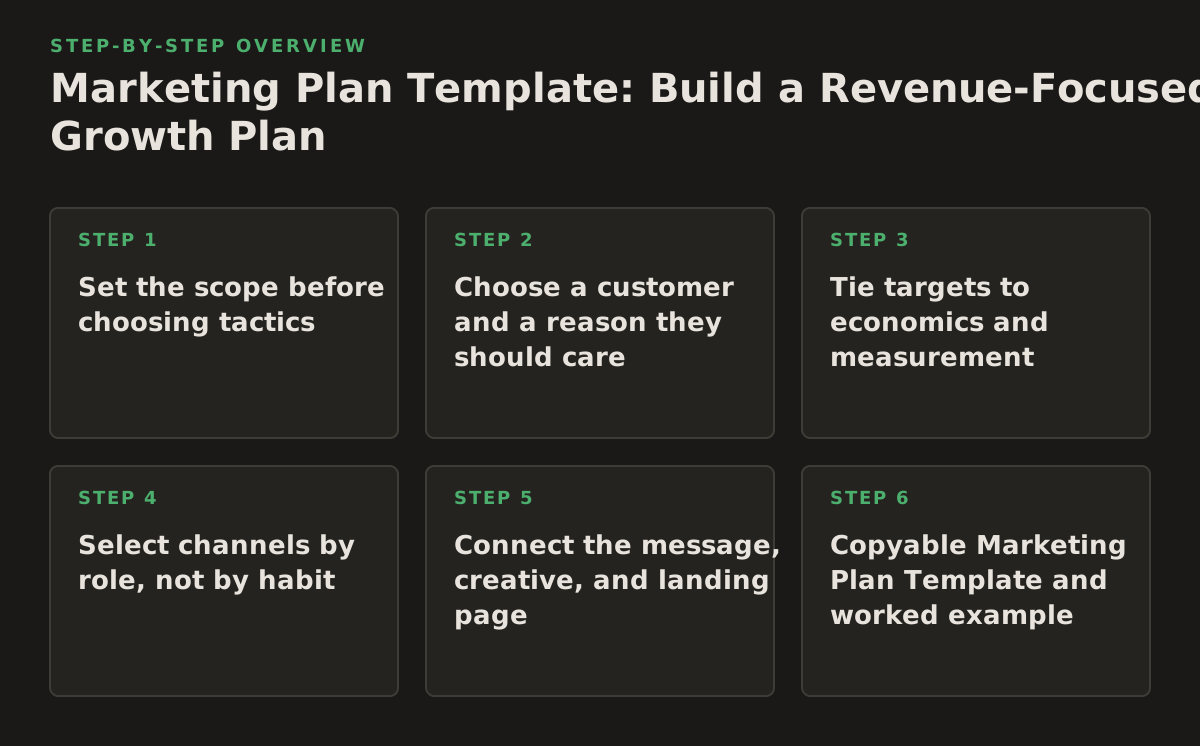
1. Set the scope before choosing tactics
When it applies: Start here when several teams or channels are competing for attention, or when leadership has requested a plan without clarifying the decision it must support. Define the time horizon and the business outcome first. A plan for a seasonal launch needs different assumptions from one intended to guide ongoing acquisition.
Why it works: Scope prevents a channel list from masquerading as strategy. A marketing objective should connect a business priority to an audience and a measurable result. For example, “grow revenue” is too broad to guide spending; “acquire first-time customers for the core product while keeping acquisition cost within a contribution-margin limit” gives the team a direction and a constraint.
Write the decision in one sentence
State what this plan is meant to help the team decide. Then record the period it covers, the product or market in scope, and any constraints that could change the recommendation. Mark uncertain inputs as assumptions rather than presenting them as facts.
- Decision: What must the plan prioritize or resolve?
- Scope: Which products, markets, audiences, or business units are included?
- Constraints: What limits the plan—such as creative capacity, inventory, margin, or tracking quality?
- Known unknowns: Which assumptions need validation before they guide investment?
Failure mode: A plan can become a catch-all for every growth idea. If a tactic does not support the stated decision, move it to a backlog instead of letting it dilute the plan. Implementation example: An ecommerce team planning a new product launch could define the scope as acquisition for that product, excluding retention campaigns and unrelated catalog activity. That makes budget and results easier to interpret.
2. Choose a customer and a reason they should care
When it applies: Use this step when acquisition costs are rising, your brand is broadening its audience, or campaign messages sound interchangeable with competitors’. Specify the customer by need and buying context, not just by a demographic label. A useful description says what the person is trying to accomplish, what is getting in the way, and what makes them consider a change.
Why it works: A defined buyer problem gives channel, creative, and landing-page decisions a shared reference point. It also exposes where the brand lacks evidence. The U.S. Small Business Administration’s guidance on market research and competitive analysis points businesses toward examining demand, customer characteristics, and alternatives; those are practical inputs to a plan, not a substitute for deciding which audience matters most.
Turn customer knowledge into a usable brief
Separate observed evidence from interpretation. Evidence might include customer interviews, search terms, support questions, product reviews, or analytics. An interpretation might be that a specific objection is preventing a purchase. Keep both, but label them differently so a hypothesis does not quietly become a “customer truth.”
- Describe the buyer’s situation and the job they are trying to get done.
- Record the barrier, competing alternative, or reason to delay.
- State the brand’s relevant proof or advantage without stretching beyond what it can substantiate.
- Identify the next evidence-gathering step if the audience or message is uncertain.
Failure mode: “Everyone who shops online” is not a useful segment, and a persona filled with unsupported details is not useful either. Implementation example: A hypothetical skincare brand might focus on shoppers who want a simpler routine but hesitate because they cannot tell which product fits their needs. That hypothesis suggests testing clearer product-selection guidance; it does not prove that the concern is widespread. Trade-off: A narrower audience can make creative more relevant, but it may also limit reach. Treat segment size and response as questions to validate.
3. Tie targets to economics and measurement
When it applies: Use this step when leadership needs to know whether growth is economically sustainable, especially when revenue, customer acquisition cost (CAC), and lifetime value (LTV) point in different directions. Choose a primary outcome and a guardrail. A guardrail helps the team avoid celebrating a result that damages margin, customer quality, or future demand.
Why it works: A metric is useful only if the team can define how it is calculated and what decision it informs. For a direct-response campaign, a team might monitor first-order contribution after variable costs alongside new-customer volume. For a longer buying journey, the plan may need intermediate indicators, while keeping the eventual business outcome visible.
Write the metric before the target
Record the event definition, data source, reporting window, and owner before setting a target. Google’s documentation explains how conversion tracking in Google Ads can measure actions such as purchases or leads. That makes it important to confirm that the tracked action matches the business outcome the plan intends to optimize—not merely an easy-to-count page view.
For cross-channel analysis, define what crediting method the team will use and avoid treating one attribution view as a complete account of causality. Google Analytics describes its attribution models as ways of assigning credit across touchpoints; use the selected model consistently for its stated purpose, and compare it with other evidence when making larger investment decisions.
- Primary metric: The outcome that best represents the plan’s goal.
- Guardrail: A measure that signals an unacceptable trade-off.
- Diagnostic metrics: Signals that help explain movement in the primary metric.
- Measurement owner: The person responsible for checking definitions and data quality.
Failure mode: Optimizing to a proxy because it moves faster can shift spend toward low-quality outcomes. Implementation example: If a campaign is intended to acquire customers, the team could treat qualified first purchases as the primary outcome, monitor contribution after variable costs as a guardrail, and use landing-page conversion rate as a diagnostic. These are example choices, not universal targets. Confirm event tracking and order-quality rules before comparing results.
4. Select channels by role, not by habit
When it applies: Use this section when deciding whether to add a channel, shift spend, or reduce a crowded media mix. Give each channel a job in the customer journey: capture existing demand, introduce the brand, support consideration, or encourage repeat purchase. Then ask whether the audience, message, and measurement approach fit that job.
Why it works: Channel selection is a portfolio decision. A channel that captures intent may depend on demand created elsewhere; a prospecting campaign may reach potential customers who are not ready to buy immediately. Comparing every channel on the same short-term metric can hide those differences. Meta’s guidance on ad objectives describes objectives in relation to the outcomes advertisers want from campaigns. The practical lesson is to align the campaign objective with the intended action before interpreting results.
Use a simple selection screen
Score options using evidence the team actually has. A high score does not guarantee performance; it helps make the decision and its assumptions explicit. If evidence is weak, identify the smallest useful test rather than pretending the uncertainty is settled.
| Selection question | What to assess | Decision signal |
|---|---|---|
| Audience fit | Can this channel reach the chosen buyer in a relevant context? | Proceed, test, or defer |
| Channel role | What job does it perform in the plan? | Write one distinct role |
| Creative readiness | Can the team produce a message suited to the placement and audience? | Confirm assets or identify the gap |
| Measurement quality | Can the intended action be tracked and interpreted? | Validate before scaling |
| Economic fit | Can the channel plausibly operate within the plan’s guardrails? | Set a test limit or rule out |
Failure mode: Adding a channel because it is popular or because a competitor appears to use it. That does not establish that it fits your audience, creative capacity, or economics. Implementation example: A growth-stage brand could compare paid search, paid social, and lifecycle email by role rather than ranking them as interchangeable sources of revenue. If paid social has an audience-fit hypothesis but weak creative readiness, the next action may be to develop and review a small set of concepts before committing a larger budget.
5. Connect the message, creative, and landing page
When it applies: Use this principle when campaigns attract attention but the subsequent experience does not resolve the buyer’s question, or when a brand refresh needs to show up consistently across acquisition touchpoints. The plan should define the claim, proof, and next step—not just the campaign theme.
Why it works: A customer experiences the ad, landing page, product information, and checkout as one path. If the creative promises a benefit that the landing page does not explain or support, added media reach can amplify confusion rather than improve conversion. A brief that links the audience’s need to a substantiated message gives creative and performance teams a common standard.
Specify the handoff from impression to action
For each priority campaign, capture:
- Message: What relevant promise or problem does the creative lead with?
- Proof: What product detail, demonstration, or evidence supports it?
- Next step: What should the visitor do, and is that action clear?
- Landing-page match: Does the destination repeat the offer and provide the information needed to act?
- Test question: What change would distinguish one message hypothesis from another?
Failure mode: Testing several changes at once—audience, offer, creative, and page—then attributing the result to one factor. Implementation example: A brand could hold the product offer and landing page constant while testing two different customer-problem openings in its creative. If it changes the page too, record that as a separate test or accept that the result will not isolate the message effect. The best test is not necessarily the most elaborate; it is one whose result can change a decision.
6. Copyable Marketing Plan Template and worked example
Copy the worksheet below into a planning document. The prompts are designed to make assumptions, owners, and decisions visible—not to produce polished copy. Replace bracketed text with your own information, and use “unknown” where the team needs evidence instead of filling gaps with guesses.
| Plan field | Prompt to answer | Your answer |
|---|---|---|
| Decision and scope | What decision will this plan support, and what product, market, and period does it cover? | [Describe the decision and scope] |
| Business outcome | What business result matters most, and what trade-off must the plan protect against? | [Name the outcome and guardrail] |
| Priority buyer | Who is the priority customer, what are they trying to do, and what blocks action? | [Describe the buyer and need] |
| Evidence and assumptions | What supports the buyer and message choice, and what still needs validation? | [List evidence and open questions] |
| Positioning and proof | What relevant promise can the brand make, and what substantiates it? | [Write the message and proof] |
| Channel roles | Which channels will perform which jobs, and why do they fit this audience? | [List channels and roles] |
| Economics and budget rule | What economics constrain investment, and what rule governs a test or scale decision? | [State assumptions and decision rule] |
| Measurement | What is the primary metric, guardrail, event definition, and data owner? | [Define metrics and ownership] |
| Creative and destination | What message will be tested, and what must the landing page make clear? | [Describe asset and page requirements] |
| Next actions | What happens first, who owns it, and what evidence will trigger the next decision? | [Name action, owner, and trigger] |
Filled example: illustrative ecommerce plan
Decision and scope: Decide how to test acquisition for one core product over the next planning cycle. Outcome: Increase qualified first purchases while protecting contribution after variable costs. Buyer: Shoppers who want to solve a specific product-related problem but need clearer guidance before choosing. Evidence: Customer questions and product-page feedback suggest confusion; validate how common it is before treating it as a broad audience insight. Message: Explain how to choose the product and support the claim with accurate product information. Channels: Use intent capture where relevant searches exist and test prospecting creative only after the message and destination are ready. Measurement: Track first purchases, monitor contribution, and verify event definitions before reading results. Next action: Review customer questions, revise the product page, then launch a bounded creative test. This is a planning illustration, not a forecast or performance promise.
Adapt the worksheet by adding fields your decision requires—such as inventory constraints, brand architecture, or retention objectives—and removing fields that do not apply. If you cannot provide a credible answer, record the owner and method for resolving the unknown. If your team needs support connecting these decisions across digital marketing services or clarifying a strategic question through marketing expertise, confirm the relevant scope directly with Kimmel Marketing; the available site evidence does not establish specific deliverables or terms.
7. Put the plan into motion in sequence
A plan becomes useful when it governs what happens next. Follow this sequence so the team validates foundations before increasing complexity or investment.
- Align on scope and economics. Get agreement on the business outcome, guardrail, product or market in scope, and assumptions that could invalidate the plan.
- Check the customer and message evidence. Review existing research and customer signals. Assign someone to investigate the most consequential unknown rather than hiding it in a planning note.
- Validate measurement. Confirm that the intended actions are tracked, definitions are shared, and the reporting view matches the decision. Repair measurement gaps before treating channel comparisons as decisive.
- Choose a small set of channel roles and tests. Identify what each channel is expected to do, what creative it needs, and what evidence would lead the team to continue, revise, or stop.
- Set a review cadence and decision owner. Decide when results will be reviewed, who can change the plan, and which factors should trigger a change. Avoid setting universal thresholds without considering margin, sales cycle, and data quality.
- Update the plan when evidence changes. Keep a short decision log: what changed, what evidence prompted it, and what the team will do differently. This makes the plan an operating tool rather than a document that becomes obsolete after approval.
Recommended next move: Fill the worksheet with the team’s current evidence, then mark the two assumptions most likely to change channel or budget decisions. Kimmel Marketing describes its focus as brand strategy, creative development, media buying, and performance optimization; you can review Kimmel Marketing and confirm directly whether its current scope fits your needs.
Authored with NotFair SEO