Marketing Strategy Marketing Plan Template: A Practical Growth Worksheet
A marketing strategy marketing plan template helps a growth-stage brand turn a commercial goal into audience choices, channel priorities, measurement, and an executable schedule. Use the worksheet below to connect what the business needs to achieve with what marketing will do, how success will be measured, and what the team will change if results miss the mark.
The useful distinction is simple: strategy makes the choices—which customers to serve, what value to offer, and where to compete—while the plan assigns those choices to owners, actions, and dates. A plan that lists campaigns without making the strategic choices can be busy and still fail to improve acquisition efficiency.
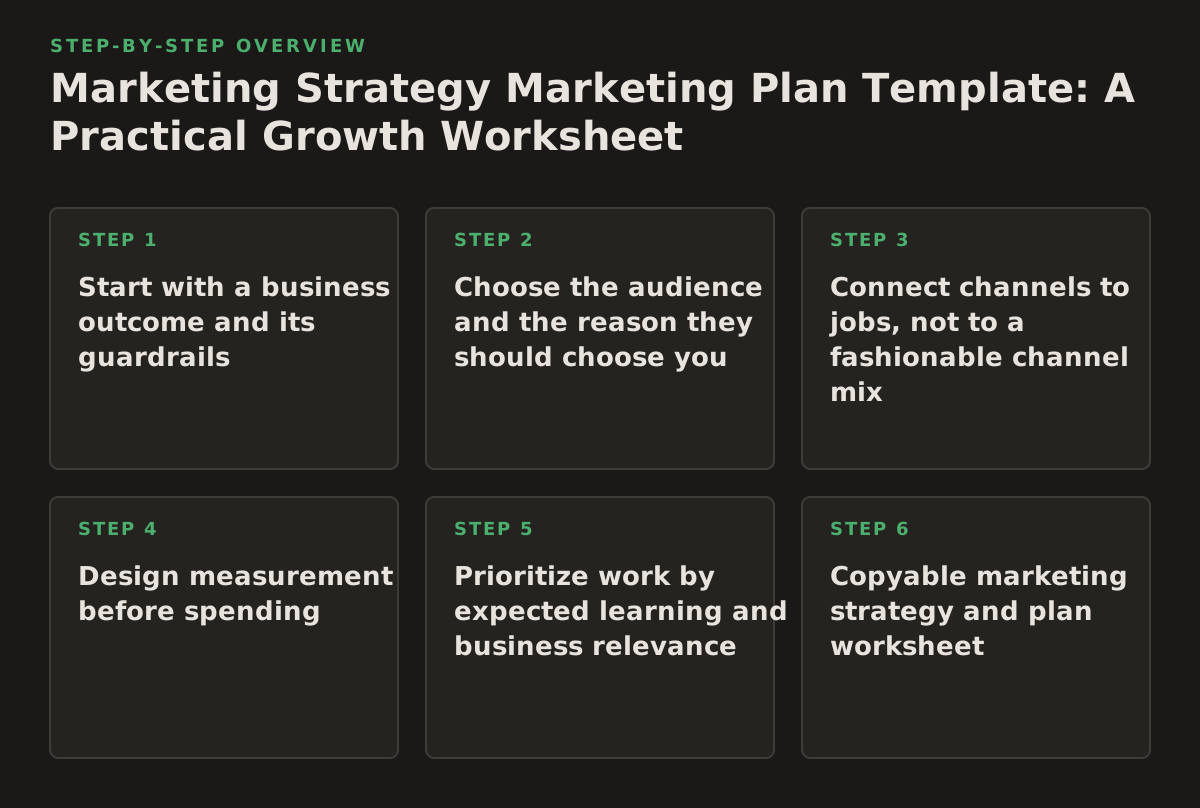
1. Start with a business outcome and its guardrails
When it applies: Start here when a founder or finance lead asks marketing to “grow,” but the team has not agreed on which growth matters. Revenue, first-time customers, contribution margin, and customer lifetime value can point to different tactics.
Why it works: A defined outcome gives channel and creative decisions a common test. Pair the goal with a constraint, such as allowable customer acquisition cost (CAC), margin, or payback period. A lower-funnel campaign may produce more immediate orders, for example, but be a poor choice if discounts erase contribution margin.
Make the goal specific enough that someone can tell whether it happened. Record the baseline, target, time period, and measurement source. If the business cannot calculate a dependable baseline yet, make establishing the baseline an explicit first task rather than presenting an invented target as fact.
Separate the outcome from the activity
“Launch a creator campaign” is an activity. “Acquire first-time customers while keeping CAC within the approved limit” is an outcome with a guardrail. The activity can change; the commercial requirement should not change without a reason.
- Choose one primary business outcome for the planning period.
- Name one or two guardrails, such as margin, payback, or brand requirements.
- Write down the source of truth and the person responsible for reporting it.
Failure mode: Setting a revenue target without accounting for returns, discounts, or repeat purchase can reward unprofitable acquisition. Example: An ecommerce team might define its objective as growing new-customer revenue while keeping first-order contribution above a finance-approved floor, then review repeat purchase separately rather than using it to excuse weak first-order economics.
2. Choose the audience and the reason they should choose you
When it applies: This decision matters when paid campaigns attract traffic but not qualified buyers, or when the brand’s messaging sounds interchangeable with competitors. It is also essential before expanding into a new product category or customer segment.
Why it works: A channel can distribute a message; it cannot repair a vague value proposition. Define the buyer by the need, buying context, and decision barrier—not only by broad demographic labels. Then state the benefit your brand can credibly deliver and the evidence that makes it believable.
Make the positioning usable in creative
Translate audience insight into a brief that a media buyer, copywriter, and designer can all use. For a premium home-goods brand, “people who like interiors” gives little direction. “Renters furnishing a small space who need durable storage that does not look temporary” suggests a product benefit, a visual context, and a likely objection.
- Buyer: Who has the need and the ability to buy?
- Job or trigger: What changed or became difficult enough to prompt a purchase?
- Alternative: What do they do now, including doing nothing?
- Proof: What product detail, demonstration, or substantiated claim addresses doubt?
Failure mode: Treating an unverified assumption as customer truth. Label assumptions, then assign a way to validate them through interviews, search behavior, sales conversations, or a controlled creative test. Example: If the team assumes delivery speed is the main barrier, test a delivery-focused message against one focused on product durability before making it the brand’s central promise.
3. Connect channels to jobs, not to a fashionable channel mix
When it applies: Use this step when the business is deciding whether to add a channel, shift investment, or ask an agency to take over media buying. The question is not “Which channels should every brand use?” It is “Which customer behavior and business need should each channel serve?”
Why it works: Channels have different roles and constraints. Search can capture existing demand; prospecting media can introduce a proposition to people who may not be shopping yet; email or SMS can support retention when the brand has permission and a relevant reason to communicate. The mix should follow the audience and economics, not a template percentage.
For each proposed channel, write down its role, intended audience, core message, landing destination, and decision rule. Check whether the team can create enough relevant assets and measure the desired action before increasing complexity. The U.S. Small Business Administration’s marketing guidance likewise treats target market, competitive advantage, sales strategy, goals, and budget as connected parts of a plan, rather than isolated campaign choices (SBA marketing and sales guidance).
- Keep: the channel has a clear job and usable measurement.
- Test: the role is plausible, but a key assumption remains unproven.
- Defer: the team lacks the creative, operational capacity, or tracking to learn from it.
Failure mode: Launching too many channels at once can spread creative and analytical effort so thin that no result is interpretable. Example: A growing skincare brand might first test paid search against high-intent product queries and paid social around a specific product demonstration, while deferring a new channel until it can produce distinct creative and track resulting orders.
4. Design measurement before spending
When it applies: Measurement design is a prerequisite when a plan depends on paid acquisition, multiple landing pages, or a decision to reallocate spend. It is especially important when ad-platform reporting and the company’s order or CRM data do not agree.
Why it works: A plan is only actionable if the team can distinguish delivery from business impact. Define the event that counts as success, the system that records it, and the reporting view used for decisions. Google Ads documentation describes conversion tracking as a way to measure actions after an ad interaction; the action being counted should match the business outcome the plan actually values (Google Ads conversion tracking guidance).
For web campaigns, standardize campaign tags so traffic sources can be identified consistently in analytics. Google Analytics documents campaign URL parameters such as source, medium, and campaign name; agree on a naming convention before launches, because inconsistent labels can split reporting into separate rows (Google Analytics campaign URL guidance).
Write down what the report can and cannot say
Choose a primary reporting source for the commercial outcome, then use platform reports as diagnostic views of delivery and campaign activity. Do not imply that attributed conversions prove a channel caused every sale. Note any known gaps—such as delayed purchase data, offline sales, or incomplete tagging—so leaders can interpret results with appropriate caution.
- Specify the primary conversion and any supporting funnel events.
- Assign an owner to check tracking and naming before launch.
- Record the reporting source, review cadence, and known limitations.
Failure mode: Optimizing to an easy-to-count action, such as a click, when the business needs qualified leads or profitable orders. Example: A subscription brand can report trial starts as a diagnostic, but keep paid subscriptions and downstream cancellation or revenue data visible when evaluating acquisition quality.
5. Prioritize work by expected learning and business relevance
When it applies: Use a prioritization rule when the team has more campaign ideas than it can fund, create, or analyze. It is useful before quarterly planning and whenever a new request threatens to displace an existing initiative.
Why it works: A small set of explicit criteria makes trade-offs visible. Score ideas against the business goal, evidence, measurement readiness, and effort. The score is a discussion aid, not a forecast: a high rating does not guarantee performance.
| Decision check | What to ask | What to do with the answer |
|---|---|---|
| Business fit | Does this address the primary outcome or a named guardrail? | Deprioritize work with no clear connection. |
| Evidence | What customer signal or prior observation supports the idea? | Label weak evidence as a test, not a committed growth driver. |
| Readiness | Are the audience, creative, landing experience, and tracking ready? | Fix the largest blocker before launch. |
| Learning value | What decision will the result help us make? | Prefer tests that resolve a meaningful uncertainty. |
| Effort and risk | What team time, budget, or brand risk does execution require? | Compare the opportunity cost with the expected learning. |
Failure mode: Treating a numerical score as objective when the inputs are guesses. Example: If a landing-page redesign scores well but engineering capacity is uncertain, make confirming scope the next action; do not schedule media around an assumed launch date.
6. Copyable marketing strategy and plan worksheet
Copy this worksheet into your planning document and complete it with the people who own revenue, marketing, and measurement. Keep entries short enough to guide action; link to detailed briefs or dashboards separately. Replace every bracketed prompt, and mark assumptions that still need validation.
| Planning field | Your answer |
|---|---|
| Business outcome and period | [What business result must change, by when, and what is the baseline?] |
| Guardrails and source of truth | [What margin, CAC, payback, or brand constraints apply? Which system reports the result?] |
| Priority buyer and trigger | [Who is the buyer, what prompts action, and what alternative do they consider?] |
| Positioning and proof | [What relevant benefit do we offer, and what evidence supports the claim?] |
| Channel roles | [Which channels serve which job, audience, message, and destination?] |
| Measurement and limitations | [What event counts, how is it tracked, and what will reporting not capture?] |
| Initiatives, owners, and dates | [What will be done, by whom, and what must happen first?] |
| Review and decision rule | [When will results be reviewed, and what evidence means continue, revise, or stop?] |
Filled example: a hypothetical home-goods ecommerce brand
Outcome: Increase first-time orders during the next planning period; establish the current baseline before setting a numeric target. Guardrail: Maintain the contribution floor approved by finance. Buyer: Renters furnishing compact homes who need storage that feels durable and considered. Positioning: Space-conscious storage designed for daily use; support the claim with product specifications and clear product photography. Channel roles: Search captures active category demand; paid social tests demonstrations against a style-led message. Measurement: Orders and first-time customer status from the commerce source of truth; platform conversions used for campaign diagnostics. First initiative: Validate tracking and prepare two message variants before launch. Review rule: Continue only if tracking is usable and the campaign’s customer and margin indicators meet the team’s agreed decision criteria.
Adapt the fields to your operating model. A lead-generation company may replace “first-time orders” with sales-accepted leads and include lead quality or sales-cycle stages. A brand with a long purchase cycle may track qualified intent as an interim indicator, but should identify which later business outcome will validate it. Avoid copying the example’s audience, channels, or guardrail; they are illustrative, not a benchmark.
7. Turn the worksheet into a working plan
When it applies: Use this sequence when the strategy is approved but execution is not yet coordinated. It is also a practical reset when the team has a document but campaigns keep launching with unclear ownership or incomplete measurement.
Why it works: Sequencing exposes dependencies early. Tracking, landing-page readiness, and creative production often determine when a campaign can responsibly begin. A schedule that puts launch first can create avoidable rework.
- Align: Confirm the business outcome, baseline, guardrails, and source of truth with the relevant owners.
- Validate: Check the buyer insight and positioning; label assumptions and decide how to test the most consequential ones.
- Choose: Assign each channel a job, then defer initiatives that lack a clear audience, measurement path, or execution owner.
- Prepare: Build creative and landing experiences, apply campaign naming, and verify that the intended events are recorded.
- Launch and review: Set a review date before launch. Compare results with the chosen outcome and guardrails, document uncertainty, and make a specific continue, revise, or stop decision.
Failure mode: Treating the plan as fixed after launch. Market response, stock availability, creative fatigue, and operational constraints can change the best next move. Keep the commercial objective stable while revising tactics when evidence or constraints change. For teams that need support connecting brand, creative, media buying, and performance decisions, Kimmel Marketing’s digital marketing services can be considered alongside internal ownership. If you want an outside partner to help shape the strategy and operating plan, explore Kimmel Marketing.
Authored with NotFair SEO