Marketing Strategy Sample For Business Plan: A Complete Paid Growth Example
A useful marketing strategy sample for business plan should show how one business will acquire customers profitably—not just list social media channels. This worked example gives an illustrative ecommerce plan with a defined objective, target segment, positioning, channel mix, budget, forecast assumptions, KPIs, timeline, and responsibilities. Adapt the figures to your margins, sales cycle, capacity, and available evidence before using the plan with investors or an internal finance team.
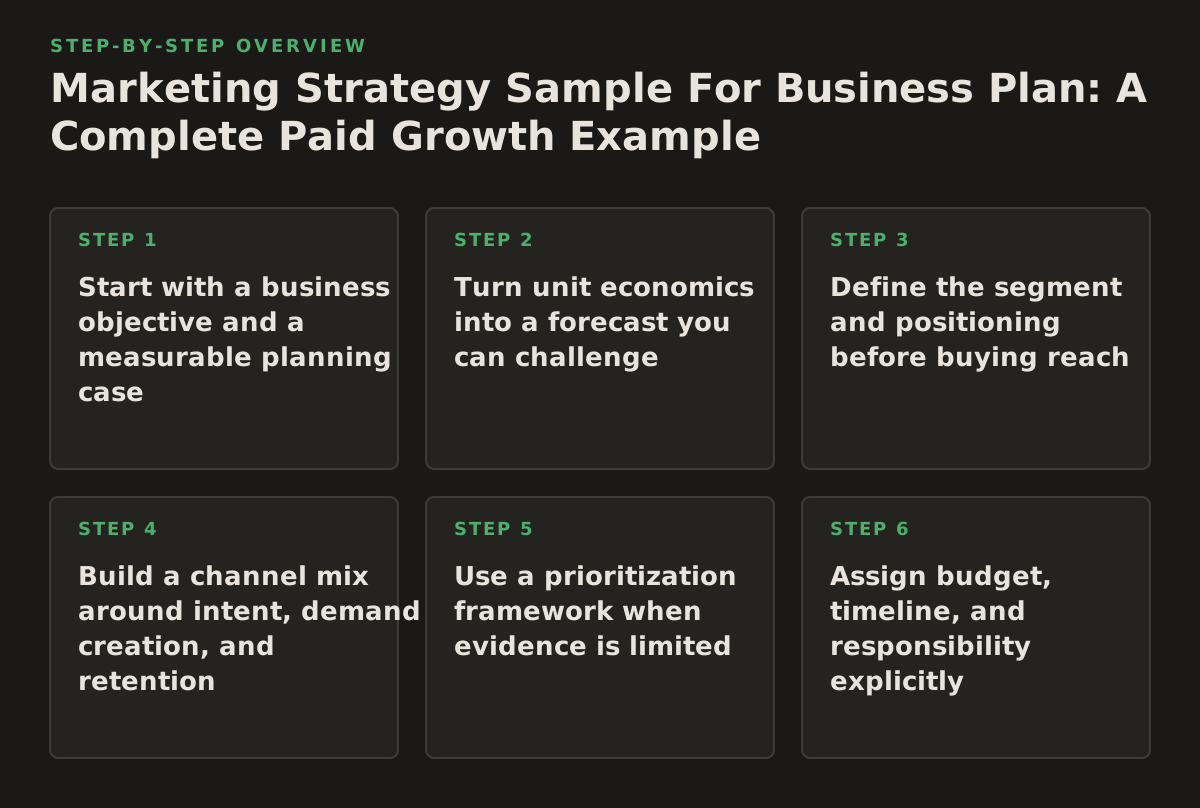
1. Start with a business objective and a measurable planning case
This approach applies when a founder or marketing leader needs to connect marketing activity to revenue, contribution margin, and cash requirements. It works because the plan begins with a business decision—whether to fund a controlled acquisition program—instead of beginning with a list of platforms.
The following is an illustrative sample business, not a universal forecast:
- Business: Northstar Pantry, a direct-to-consumer ecommerce brand selling shelf-stable meal kits.
- Planning period: April through September 2026.
- Primary objective: Generate 600 first-time orders in six months while learning whether paid acquisition can scale within a target customer acquisition cost.
- Commercial constraint: The business has limited inventory and one founder handling operations, so the plan must create demand without exceeding fulfillment capacity.
- Decision at the end of the period: Increase, maintain, or pause paid acquisition based on profitable demand, not traffic volume alone.
For a formal business plan, this marketing section should connect to the broader sales and operating plan. The U.S. Small Business Administration describes marketing and sales as components of a business plan, including how a company attracts and retains customers; its guidance is a useful structural reference for separating strategy from execution. See the SBA business-plan guidance.
The one-paragraph strategy statement
Northstar Pantry will acquire health-conscious professionals who want convenient weekday meals through search, paid social, creator-style product demonstrations, email, and referral offers. It will position its meal kits as a practical alternative to repetitive takeout: easy to store, simple to prepare, and suitable for planned weekday lunches. The company will prioritize first-order contribution margin and repeat purchase signals over reach, and will expand spend only when tracking quality, inventory, and acquisition efficiency support the decision.
Failure mode: Writing “increase brand awareness and sales” as the objective. That wording cannot determine whether a channel, creative concept, or budget deserves more investment.
Implementation example: Put the objective, period, owner, and decision rule at the top of the plan. Every later recommendation should answer one of four questions: who is being acquired, why they should choose the brand, how they will be reached, and what evidence will justify more spend.
2. Turn unit economics into a forecast you can challenge
This principle applies before selecting channels or setting a media budget. It works by translating the customer economics into a ceiling for acquisition cost. The ceiling is not a benchmark copied from another company; it is a starting policy derived from the sample business’s assumptions.
Illustrative Northstar Pantry assumptions
- Average first order value: $58.
- Product and packaging cost per first order: $23.
- Payment, fulfillment, and variable service cost per first order: $10.
- First-order contribution before marketing: $25 ($58 − $23 − $10).
- Target first-order acquisition cost for the test period: $20 or less.
- Illustrative six-month media and testing budget: $12,000.
- Illustrative non-media marketing costs: $3,000 for creative production, landing-page work, and email setup.
Under these assumptions, a $20 acquisition cost leaves $5 of first-order contribution after media. That is a deliberately modest result: the plan is relying on repeat purchases to improve customer lifetime value, but it does not assume future revenue in order to disguise an unprofitable first order.
The illustrative forecast is:
- $12,000 in media divided by a $20 target acquisition cost = 600 first-time orders.
- 600 orders multiplied by a $58 average order value = $34,800 in first-order revenue.
- 600 orders multiplied by $25 contribution before marketing = $15,000 contribution before marketing spend.
- $15,000 minus $12,000 media spend = $3,000 contribution after media, before the separate $3,000 production and setup budget.
This is a planning model, not a promise. Actual results may differ because conversion rate, average order value, refund rate, inventory availability, and repeat purchase behavior can all change. Include a low, base, and high case rather than presenting one precise outcome:
| Case | Illustrative acquisition cost | Orders from $12,000 media | First-order revenue at $58 AOV | Use in the decision |
|---|---|---|---|---|
| Low | $30 | 400 | $23,200 | Reduce spend and fix offer, creative, or conversion friction |
| Base | $20 | 600 | $34,800 | Continue controlled testing |
| High | $15 | 800 | $46,400 | Assess capacity before increasing spend |
Failure mode: Treating an industry acquisition-cost average as Northstar’s allowable cost. A business with different margins, repeat rates, or fulfillment costs can lose money while appearing to meet a borrowed benchmark.
Implementation example: Create a spreadsheet with editable cells for average order value, variable cost, media spend, conversion rate, and acquisition cost. Add a “pause” condition if actual contribution after media is negative for two consecutive weekly reviews, unless the team has documented a specific test and a fixed end date.
3. Define the segment and positioning before buying reach
This principle applies when a brand is tempted to target everyone who could theoretically use the product. It works because a specific customer problem gives the media team a sharper audience hypothesis and gives creative a reason to exist.
Northstar’s initial segment
Primary segment: Urban professionals aged approximately 28–45 who work hybrid schedules, buy lunch or dinner away from home several times a week, and value convenience but dislike highly processed ready meals. This is an illustrative planning segment, not a claim that demographic targeting alone identifies the best customers.
Job to be done: “Help me prepare a dependable weekday meal without a large shopping trip or a complicated recipe.”
Positioning: “Northstar Pantry is the shelf-stable meal-kit option for organized but time-constrained professionals who want a practical weekday meal plan without relying on takeout.”
Reason to believe: Demonstrate the storage format, preparation steps, portion, ingredient list, and real use occasion. Avoid unsupported claims about health, sustainability, or superior taste unless the business can substantiate them.
The message hierarchy should move from the customer’s situation to the product’s proof:
- Situation: weekday meals become repetitive or inconvenient.
- Promise: make a planned meal with less shopping and preparation friction.
- Proof: show what arrives, how it is stored, and how long the preparation takes according to verified product information.
- Action: try a starter bundle with a clear price and delivery expectation.
Failure mode: Using “busy people who want healthy food” as both audience and positioning. It is too broad to guide a landing page, a search ad, or a creative brief, and “healthy” can create substantiation obligations the business may not be prepared to meet.
Implementation example: Produce three creative angles for the same segment: a weekday planning demonstration, a comparison with an unplanned takeout decision, and a storage-and-preparation walkthrough. Keep the offer and landing page consistent enough to identify whether the angle—not a different price or product—is driving the response.
4. Build a channel mix around intent, demand creation, and retention
This principle applies when a business needs both immediate acquisition and a way to build future efficiency. It works because different channels perform different jobs: search can capture existing demand, paid social can introduce the problem and product, and owned channels can encourage a second purchase without paying to reacquire the same customer.
Northstar’s illustrative channel plan
- Paid search: Capture high-intent queries related to meal kits, weekday meal planning, and convenient pantry meals. Start with tightly grouped themes and send each group to a relevant page.
- Paid social: Test short product demonstrations and problem-led creative against the defined segment. Use the channel primarily to create qualified demand and learn which message earns attention.
- Creator-style assets: Commission or produce demonstrations that show the product in use. This is a creative format decision, not a promise to use a particular platform or influencer.
- Email: Recover abandoned carts, explain the first-order experience, and prompt replenishment or a second bundle after the expected consumption period.
- Referral: Offer an incentive only after modeling its impact on contribution margin and ensuring the terms are clear.
An illustrative allocation of the $12,000 media budget is $4,800 to paid search, $5,400 to paid social, $1,200 to creator-style asset testing, and $600 to retargeting. Email production and referral incentives sit outside this media allocation and must be tracked separately.
Measurement needs to be designed before launch. Google Ads documents conversion tracking as a way to measure actions such as purchases and use those conversions in campaign management; the exact setup should match the business’s checkout and analytics architecture. Review Google’s conversion-tracking documentation. For campaign links, Google Analytics guidance explains how UTM parameters help identify campaign source, medium, and related dimensions in reports. Review Google’s campaign URL guidance.
For paid social, document the event definitions, consent approach, attribution window, and reconciliation process before interpreting platform reports. Meta’s official developer documentation provides the reference point for its Pixel implementation and event setup. See the Meta Pixel documentation.
Failure mode: Calling every click a conversion and comparing platform-reported purchases without a consistent order source. This can inflate apparent performance and lead the team to move budget toward the channel with the most permissive reporting rather than the strongest economics.
Implementation example: Define one primary conversion—completed first order—and secondary events such as product view, checkout start, and email signup. Reconcile platform purchases to the ecommerce order system weekly, then use the same order count and revenue definition in the business-plan forecast.
5. Use a prioritization framework when evidence is limited
This principle applies to growth-stage brands that cannot fund every channel, audience, creative concept, or landing-page idea at once. It works by ranking initiatives according to business impact and learning value rather than internal enthusiasm.
| Initiative | Primary job | Evidence required | Starting priority | Stop or change when |
|---|---|---|---|---|
| Search campaign for high-intent terms | Capture existing demand | Search relevance, purchase tracking, margin by order | High | Queries are irrelevant or acquisition cost exceeds the approved ceiling |
| Three paid-social demonstrations | Create demand and test messages | Qualified visits, add-to-cart rate, completed orders | High | Creative fails to generate downstream action after a defined test budget |
| Landing-page offer test | Improve conversion efficiency | Same audience, product, and traffic mix | High | Test is changed before enough comparable observations exist |
| Referral offer | Encourage lower-cost acquisition | Referred orders, incentive cost, repeat behavior | Medium | Discount cost removes contribution or attracts low-quality orders |
| Broad awareness campaign | Reach a wider audience | Incremental demand or assisted business outcome | Low initially | No credible link to qualified demand or future pipeline |
Failure mode: Scaling the channel with the lowest reported cost per click. Cheap traffic is not necessarily valuable traffic; the business outcome is a completed order that meets the economic policy.
Implementation example: Require each proposed initiative to include a hypothesis, owner, budget cap, primary KPI, secondary diagnostic, test duration, and decision date. If a proposal cannot state what result would disprove it, it is not ready for the plan.
6. Assign budget, timeline, and responsibility explicitly
This principle applies when strategy documents are approved but execution stalls. It works because named ownership exposes dependencies between creative, media, website, analytics, inventory, and customer service.
Illustrative six-month schedule
- Weeks 1–2, foundation: Confirm economics, inventory limits, offer terms, analytics events, UTM naming, landing-page requirements, and baseline conversion reporting.
- Weeks 3–4, launch preparation: Produce three paid-social concepts, build search campaigns, QA checkout tracking, and prepare email recovery and post-purchase flows.
- Month 2, controlled launch: Release the initial channel mix with spend caps. Review search terms, creative diagnostics, checkout completion, and order reconciliation weekly.
- Months 3–4, optimization: Shift budget only after identifying whether the constraint is traffic quality, message fit, landing-page conversion, checkout friction, or fulfillment capacity.
- Months 5–6, scale decision: Model the next budget using observed acquisition cost, contribution, repeat purchase signals, and operational capacity. Document what should be stopped, retained, or expanded.
Illustrative responsibility map
- Founder or general manager: Owns objective, offer approval, inventory, cash limits, and the final scale decision.
- Marketing lead: Owns channel plan, weekly performance review, budget pacing, and experiment backlog.
- Creative owner: Owns briefs, demonstrations, copy variations, approvals, and asset version control.
- Web or conversion owner: Owns landing pages, checkout issues, page QA, and conversion-test documentation.
- Finance or operations owner: Owns contribution assumptions, order reconciliation, refunds, fulfillment capacity, and margin reporting.
Track a small KPI set: first-time orders, blended acquisition cost, first-order contribution after media, conversion rate, average order value, repeat purchase rate, and budget pacing. Use channel metrics such as click-through rate and cost per click as diagnostics, not as the business objective.
Failure mode: Assigning “marketing” responsibility to a department while leaving product data, inventory, analytics, and approvals unowned. The result is often a campaign that launches on time but cannot produce a trusted business reading.
Implementation example: Hold a 30-minute weekly review with one page of reporting: planned versus actual spend, orders, acquisition cost, contribution, operational exceptions, tests completed, and next decisions. Record the decision owner and due date beside every action.
7. Put the sample into your business plan and execute in sequence
Use this sequence when converting a draft into an approvable operating plan:
- Write the commercial objective: State the customer outcome, revenue or order goal, period, and capacity constraint.
- Validate the economics: Calculate contribution before marketing, an illustrative acquisition-cost ceiling, and low/base/high forecast cases.
- Choose the first segment: Describe the job to be done, buying context, exclusions, and evidence that would indicate message fit.
- Write the positioning: Connect the customer problem, product promise, proof, and offer without relying on claims the business cannot substantiate.
- Select the channel jobs: Assign each channel a role—capture demand, create demand, retain customers, or generate referrals—and set a budget cap.
- Instrument measurement: Define the primary conversion, supporting events, UTM structure, order reconciliation, attribution caveats, and reporting owner before launch.
- Launch a controlled test: Keep the first test narrow enough to identify the cause of an outcome. Avoid changing audience, offer, creative, and landing page simultaneously unless the objective is simply a go/no-go validation.
- Review against decision rules: Increase, maintain, revise, or pause based on acquisition cost, contribution, order quality, repeat signals, and operational capacity.
The practical standard is not a polished forecast with many channels. It is a plan that makes its assumptions visible and tells the team what evidence will change the next decision. If you need help translating that operating model into coordinated digital marketing services or want a second view on positioning, measurement, and channel priorities, Kimmel Marketing’s marketing expertise can support the planning process.
Authored with NotFair SEO