Media Buy Explained: How to Plan, Measure, and Improve Paid Acquisition
A media buy is a planned purchase of advertising inventory designed to reach a defined audience at an agreed cost, in a selected channel, during a particular period. For a growth-stage brand, a media buy is not simply “running ads”; it is the connection between a commercial goal, a creative message, an audience, a bid, and a measurement system. The quality of that connection determines whether paid acquisition creates profitable demand or merely produces attractive platform metrics.
That distinction matters for ecommerce companies and marketing leaders. A campaign can generate clicks while increasing customer acquisition cost, produce conversions that do not reconcile with orders, or scale spend into audiences with weak lifetime value. A disciplined media buying process makes those trade-offs visible before budget is committed.
What a Media Buy Actually Includes
In practical terms, a media buy specifies what inventory is purchased, who should see the message, how much the advertiser is willing to pay, and what business result defines success. Inventory can include paid search placements, social feeds, video, display, retail media, connected television, sponsorships, or other environments where an audience can be reached.
The phrase can describe a single campaign or a coordinated plan across several channels. A paid search campaign buying clicks for high-intent product queries is a media buy. So is a paid social campaign using an automated auction to find likely purchasers. A television placement bought against a defined audience and schedule also qualifies, although its measurement and buying mechanics differ.
The five decisions inside the purchase
- Objective: acquire a first order, generate qualified leads, increase repeat purchases, or create demand that will be captured later.
- Audience: define the people, accounts, contexts, search behaviors, or customer lists the campaign can reach.
- Inventory: choose the ad placements and formats that can carry the message, such as search results, short-form video, display, or retail product pages.
- Economics: set a budget, bidding approach, and acceptable cost in relation to margin, average order value, and customer lifetime value.
- Evidence: decide which events will be recorded and how those events will be connected to revenue.
These decisions are interdependent. A brand selling a $60 product with a 45% contribution margin cannot evaluate a $35 acquisition cost in the same way as a subscription business expecting multiple years of retention. Likewise, a campaign optimized for lead volume may be harmful if sales rejects most of those leads.
Media buy versus media plan
A media plan is the broader allocation strategy. It may define the role of each channel, the audience journey, creative requirements, measurement rules, and investment sequence. The media buy is the executional commitment within that plan: the budget and inventory purchased to deliver the intended exposure or action.
The distinction helps when a channel is underperforming. If paid social is producing low-quality customers, the issue may be the buy, such as weak audience controls or poor bid logic. It may instead be the plan, such as assigning social a bottom-funnel sales role when the product needs education. Changing placements will not repair a flawed strategic role.
Why Media Buying Matters to Growth-Stage Brands
Paid media is often the fastest way to create a measurable acquisition loop, but speed can expose weak assumptions. A brand can increase spend before it understands its real margin, can optimize toward an event that does not represent revenue, or can mistake platform-reported conversions for incremental customers.
The job is therefore not to maximize delivery. It is to buy enough qualified demand to support growth while preserving the economics required to keep buying tomorrow.
Connect spend to contribution, not vanity metrics
Clicks, impressions, video views, and click-through rate are useful diagnostic signals. They are not the final business case. For an ecommerce advertiser, the more useful chain is usually:
- Spend creates impressions and visits.
- Visits create product views, add-to-carts, and checkout starts.
- Checkouts create orders and net revenue.
- Orders create contribution after product cost, shipping, discounts, payment fees, returns, and media spend.
- New customers may create additional future value through repeat purchases.
If the business has a clear allowable acquisition cost, the buying team can make decisions before the month closes. An illustrative policy might allow a $28 first-order acquisition cost for a product with adequate contribution margin, while permitting a higher initial cost for a customer segment with verified repeat purchases. That is a starting policy for discussion, not a universal benchmark.
Revenue quality also matters. A $100 order with a 20% discount and a high return rate is not equivalent to a $100 order at full price with low support costs. Media reporting should therefore separate gross revenue, net revenue, and contribution after media whenever the data is available.
Make channel roles explicit
Different channels solve different problems. Search can capture existing demand, while social and video may create or shape demand. Retargeting can remind previous visitors, but it cannot prove that every exposed customer needed the reminder. Retail media can reach shoppers near a purchase decision, while connected television may help establish memory at a larger scale.
A useful channel brief answers four questions:
- What customer problem or buying moment does this channel reach?
- What evidence should the channel produce at its stage of the journey?
- What creative format is native to the placement?
- What would cause the team to reduce, expand, or pause spend?
These roles should not be treated as permanent. A search campaign may begin as a demand-capture tool and later reveal new query themes that inform brand messaging. A prospecting campaign may initially be judged on qualified visits and later on purchases once tracking volume is sufficient.
Kimmel Marketing’s marketing expertise approach is relevant here because a media decision often exposes a brand, creative, funnel, or measurement problem rather than a bidding problem alone.
How a Media Buy Works From Brief to Optimization
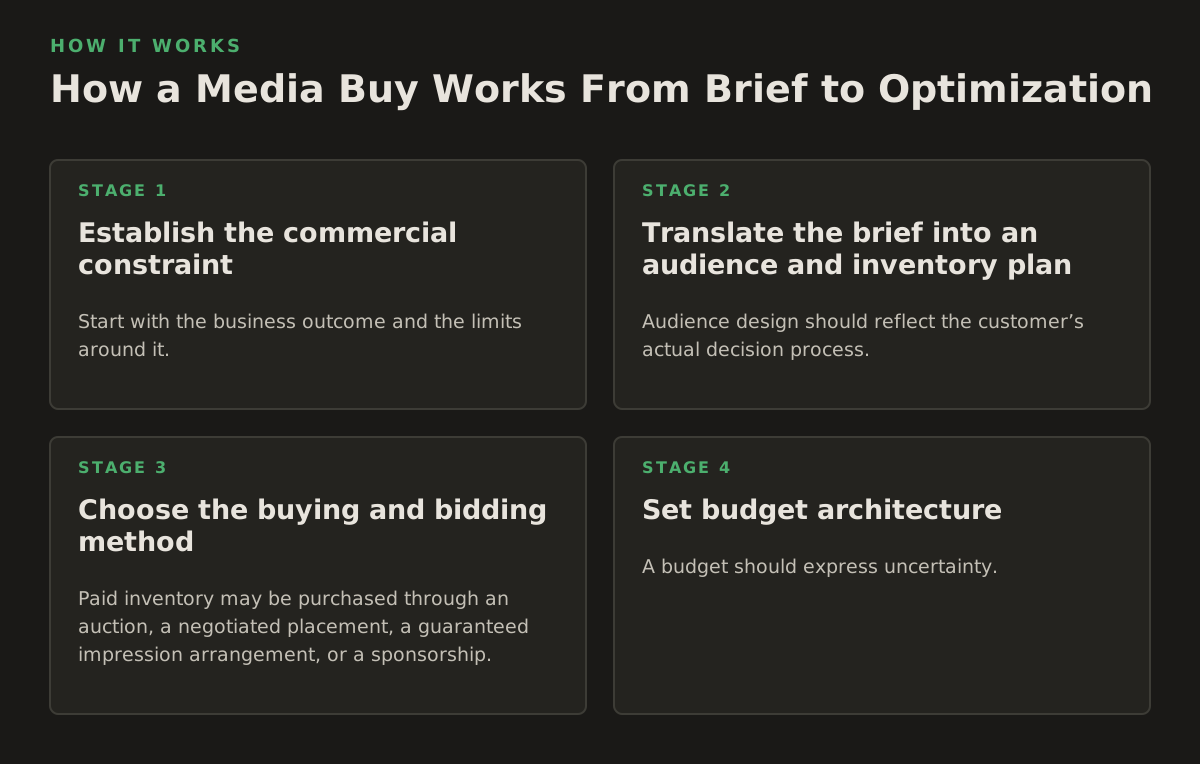
A reliable buying process moves from economics to execution, not from an available platform feature to a budget. The sequence below is deliberately operational: each step creates an input for the next one.
1. Establish the commercial constraint
Start with the business outcome and the limits around it. Define the product or offer, eligible markets, gross margin, fulfillment constraints, sales capacity, and the customer value horizon. For lead generation, define what makes a lead acceptable and how quickly sales can contact it.
Then set a measurement hierarchy:
- Primary outcome: the event that represents the business result, such as a completed order or qualified opportunity.
- Secondary outcomes: events that indicate progress, such as checkout initiation, product configuration, or booked consultation.
- Diagnostic signals: delivery, reach, click quality, landing-page engagement, and creative retention.
- Guardrails: cost, margin, frequency, refund rate, lead quality, or inventory availability.
Do not treat every available event as a conversion. If an ecommerce site fires a purchase event when a payment fails, the platform may learn from a distorted signal. Google’s documentation explains that conversion tracking is used to measure actions after ad interaction, but the advertiser remains responsible for defining and implementing the actions accurately: Google Ads conversion tracking.
2. Translate the brief into an audience and inventory plan
Audience design should reflect the customer’s actual decision process. Separate prospects from existing customers, high-value customers from one-time buyers, and category demand from brand demand when the data supports those distinctions.
For each audience, specify:
- the customer problem or intent being addressed;
- the exclusion rules, including recent purchasers or irrelevant geographies;
- the message and proof required to earn attention;
- the landing experience that continues the promise;
- the expected buying time and acceptable amount of follow-up.
Inventory selection follows the audience’s behavior. High-intent searches may justify a direct product or service offer. A new category may require demonstrations, comparisons, testimonials, or educational content before a conversion request. The mistake is asking every placement to close the sale with the same asset.
3. Choose the buying and bidding method
Paid inventory may be purchased through an auction, a negotiated placement, a guaranteed impression arrangement, or a sponsorship. Auction buying gives an algorithm discretion over eligible opportunities. Negotiated or guaranteed buying can provide more predictable placement or reach but may offer less immediate conversion feedback.
Within auction platforms, a bidding strategy should match the quality and volume of the signal. Google describes Smart Bidding as automated bid strategies that use auction-time signals to optimize for conversions or conversion value; its documentation also distinguishes target CPA and target ROAS approaches: Google Ads Smart Bidding documentation.
That does not mean automation removes judgment. It means the team must decide:
- which conversion event is trustworthy enough to optimize toward;
- whether the account has sufficient signal for the chosen strategy;
- how much value differences between customers should influence bidding;
- what changes are safe while the system is recalibrating;
- when a manual control is preferable because the data is sparse or unstable.
An illustrative starting policy might hold a new campaign to a defined daily budget for two weeks while validating event quality, then adjust the bid strategy only after checking order reconciliation and lead quality. That timeline is a planning example, not a platform rule.
4. Set budget architecture
A budget should express uncertainty. Instead of allocating every dollar to the channel with the lowest reported cost, reserve money for learning, proven demand, creative production, and controlled expansion.
One illustrative allocation might be:
- 60% to established acquisition campaigns;
- 20% to creative or audience experiments;
- 10% to retargeting or customer reactivation;
- 10% held as a reallocation reserve.
The percentages are not a benchmark. The useful principle is to distinguish base spend from learning spend. Without that distinction, every experiment is judged as though it must immediately match a mature campaign, and the team either kills useful ideas too early or protects weak campaigns because they once performed well.
Daily budget is also not the same as guaranteed daily spend in every buying environment. Google explains that campaign budgets and delivery can be affected by its serving systems and billing rules, so budget planning should be checked against the current platform documentation rather than assumed from a spreadsheet: Google Ads budget documentation.
5. Build the measurement path before launch
Map the journey from impression to business outcome. Confirm that the ad destination loads, the offer is visible, the tracking event fires once, transaction values are passed correctly, and orders can be reconciled against the commerce or CRM system.
A practical pre-launch checklist includes:
- test events on mobile and desktop;
- verify currency, revenue, order ID, and lead fields;
- check that cancelled or refunded transactions are handled in reporting;
- confirm UTMs and naming conventions;
- document attribution windows and reporting time zones;
- create a fallback report outside the ad platform.
For server-side event transmission, Facebook’s official Conversions API documentation describes a method for sending marketing events from a server or other direct connection rather than relying only on browser-based signals: Meta Conversions API documentation. The implementation does not automatically make data accurate; deduplication, consent, event quality, and business definitions still require attention.
Where Media Buys Break
Most underperforming buys do not fail because one person chose the wrong button in an ad platform. They fail at the boundary between strategy, data, creative, and operations. Identifying the failure mode prevents an expensive reaction such as changing bids when the landing page is the real constraint.
Bad inputs produce efficient waste
An algorithm can optimize effectively toward the wrong event. If a lead form submits successfully but the resulting lead has no budget or buying authority, a falling cost per lead is not progress. If an ecommerce event includes test orders, duplicate purchases, or inflated values, automated bidding can pursue false efficiency.
Audit the signal when you see:
- large differences between platform conversions and backend orders;
- sharp changes in reported value without a corresponding business change;
- high lead volume paired with low sales acceptance;
- conversion spikes that align with tracking releases rather than customer behavior;
- strong reported return on ad spend but weak cash contribution.
Attribution overstates the role of the buy
Attribution assigns credit according to a rule. It does not prove that the ad caused the sale. A retargeting campaign may receive credit for a customer who was already returning to buy. A branded search campaign may capture demand created by a different channel. A long sales cycle may place the conversion outside the reporting window.
Use platform reporting for optimization within the platform, then compare it with independent business reporting. Useful checks include geo-based holdouts where feasible, pre/post analysis around controlled changes, new-customer rate, branded versus non-branded demand, and post-purchase quality. None is perfect in isolation, but disagreement between methods is a reason to investigate rather than choose the most flattering number.
Creative fatigue is a system problem
Creative fatigue is more than an ad’s frequency increasing. It can appear when the audience has exhausted the promise, when the opening frame no longer earns attention, or when the offer has become less competitive. Replacing a headline while preserving the same idea may not create meaningful variation.
Build creative testing around distinct hypotheses:
- The customer has a different underlying problem than the current ad assumes.
- A demonstration will be more persuasive than a claim.
- Proof from a specific customer type will reduce perceived risk.
- A different offer structure will improve conversion without damaging margin.
- A landing page that answers objections earlier will improve qualified conversion.
Keep the audience, budget, and evaluation window sufficiently stable to interpret the result. If the team changes the creative, landing page, bid strategy, and audience at once, the outcome may move but the cause will remain unknown.
Scale exposes operational constraints
A successful buy can create problems outside the ad account. Inventory may run short, fulfillment times may lengthen, sales representatives may fail to follow up, or customer support may receive complaints that reduce repeat purchase. The right response may be to cap spend even when reported acquisition cost remains acceptable.
Before scaling, connect media decisions to:
- stock availability and margin by product;
- sales capacity and response time;
- customer service volume;
- return, refund, and cancellation rates;
- repeat purchase or renewal behavior.
How Practitioners Apply a Media Buy
Application depends on the business model, buying cycle, and quality of available data. The following examples show how the same buying principle changes when the commercial constraint changes.
Ecommerce: optimize for profitable orders
Imagine an apparel brand with several products, different margins, and a meaningful return rate. The team should not evaluate every ad set against the same revenue target without accounting for product mix. A campaign selling a high-margin accessory may tolerate a different acquisition cost from one selling a discounted outerwear item.
An illustrative decision table could look like this:
| Scenario | Reported result | Decision to investigate |
|---|---|---|
| Prospecting campaign | $42 acquisition cost, 35% new-customer rate | Check contribution margin and repeat purchase before scaling |
| Retargeting campaign | $18 acquisition cost, 8% new-customer rate | Test incrementality; much of the audience may already be high intent |
| Product campaign | $75 average order value, 25% return rate | Evaluate net revenue rather than reported order revenue |
| Creative test | Higher click-through rate, lower checkout rate | Inspect message-to-landing-page consistency and traffic quality |
The goal is not to reject cheap conversions. It is to identify whether the campaign is creating profitable new demand or harvesting demand that would have converted anyway.
Lead generation: qualify the conversion
For a B2B or higher-consideration service, the first conversion may be a form completion, booked meeting, or content download. The media buy should be judged progressively: cost per lead, lead acceptance, meeting rate, opportunity rate, and closed revenue.
Use a feedback loop that sends meaningful downstream stages back into planning where the systems and permissions support it. A lead source producing fewer submissions but more sales-qualified opportunities may deserve more budget than one producing inexpensive form fills.
Messaging should also pre-qualify. Naming the company size, geography, minimum project scope, or problem complexity can reduce raw volume while improving sales efficiency. That is often a better trade than making the sales team filter out unsuitable demand manually.
Brand and performance: use one system, not two silos
Brand strategy affects performance because it influences recognition, trust, click behavior, conversion confidence, and the cost of explaining an offer. Performance data can also improve brand strategy by showing which problems, proof points, and category terms attract valuable customers.
A coordinated plan might use broad-reach video or creator-led content to establish a distinctive problem frame, then use search and retargeting to capture active demand. The measurement question changes by stage. Reach and completed views may be useful diagnostics for the awareness layer, while qualified conversions and contribution matter more for the capture layer.
Do not force every brand placement to report last-click revenue, and do not excuse every weak performance campaign as “brand building.” Assign each activity a role, a falsifiable expectation, and a review method.
Budget reviews: make reallocation rules explicit
A weekly or twice-weekly review should separate signal from noise. The exact cadence depends on spend, conversion volume, sales cycle, and the cost of making a premature change. A review agenda can include:
- delivery against plan and any pacing problem;
- tracking health and reconciliation with backend results;
- marginal acquisition cost from the latest spend;
- new-customer mix and downstream quality;
- creative fatigue and landing-page behavior;
- inventory, sales, and customer-service constraints;
- the next action, owner, and condition for reversing it.
Write the rule before the result arrives. For example, an illustrative policy might move a limited portion of experimental budget toward a campaign only if net contribution remains positive across two review periods and lead or order quality does not deteriorate. This is more defensible than moving all budget after one unusually strong day.
For teams evaluating outside support, a transparent partner should be able to show how digital marketing services connect channel execution with creative, measurement, and commercial outcomes—not only provide screenshots of platform dashboards.
A Specific Recommendation for Planning Your Next Buy
Before increasing spend in 2026, document the buy on one page: commercial target, customer definition, inventory, creative hypothesis, landing experience, conversion event, allowable cost, budget reserve, and stop or scale rules. Then reconcile platform-reported outcomes with orders, qualified opportunities, margin, and customer quality.
If the numbers disagree, pause scaling long enough to identify whether the issue is tracking, attribution, creative, offer, audience, or operations. If the numbers agree and the economics hold, increase investment in controlled steps while preserving a separate learning budget. This approach is slower than chasing the cheapest reported conversion, but it gives growth-stage brands a buying system that can survive changing platforms and rising acquisition costs.
Kimmel Marketing can help connect brand strategy, creative development, media buying, and performance optimization into that operating system; explore Kimmel Marketing when you need a transparent partner focused on revenue, acquisition cost, and lifetime value.
Authored with NotFair SEO