Messaging Strategy Examples: 6 Patterns to Adapt
Useful messaging strategy examples show how a brand connects a specific audience problem to a credible reason to choose it. Below are six adaptable patterns for growth-stage and ecommerce teams, with sample copy, the decision each pattern supports, and a way to put it to work across ads and landing pages. Treat every sample as a starting hypothesis: replace its illustrative claims with evidence your business can substantiate.
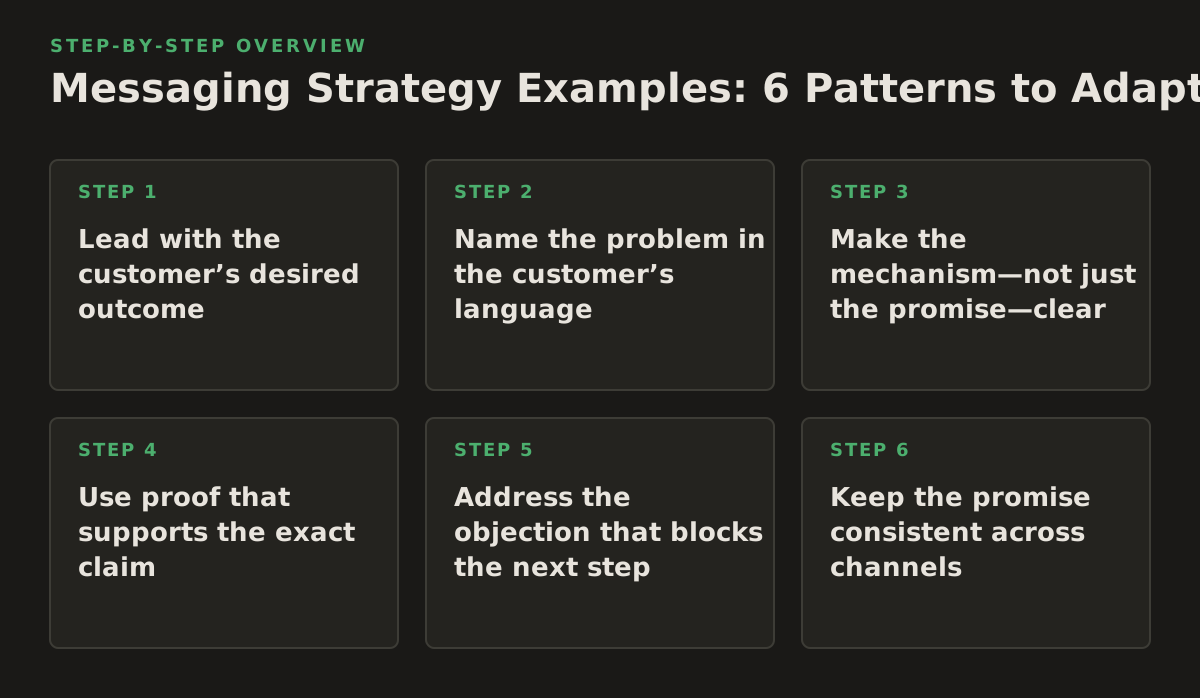
1. Lead with the customer’s desired outcome
Use this pattern when people understand the category but do not immediately see why your offer matters to their work or life. It is especially useful for paid acquisition: a clear outcome gives a prospect a reason to pay attention before you introduce features. A value proposition should make the offer’s relevance and benefit understandable; Nielsen Norman Group discusses these elements in its guidance on value propositions.
Example: turn a feature into a job
Illustrative software example: “See which orders need attention before your team starts packing.”
This line demonstrates an outcome-first message. It does not lead with “real-time dashboard” or another feature label; it describes a useful decision the customer may be trying to make. The mechanism works only if the product actually helps users identify those orders before packing begins. If it does not, the promise creates a mismatch between expectation and experience.
Adapt the pattern by completing this sentence: “When [situation], [audience] can [useful outcome] without [meaningful friction].” For example, an ecommerce brand might test “Choose a desk lamp that fits your space before it arrives” if its product information genuinely helps shoppers assess fit. Avoid promises such as “find the perfect lamp” unless you can define what “perfect” means and support the claim.
- When it fits: The audience knows the category but needs a reason to care.
- Failure mode: The stated outcome is vague, inflated, or disconnected from the product experience.
- Adapt: Name the customer’s next useful decision, then check whether the offer enables it.
2. Name the problem in the customer’s language
Use this approach when internal product language is clearer to your team than to a first-time buyer. It can be effective for a new category, a considered purchase, or a service whose value is hidden behind process terminology. The message first makes the friction recognizable; the next line explains what changes.
Example: state the friction, then the change
Illustrative ecommerce example: “Not sure which size to order? Compare garment measurements before you choose.”
The question identifies a concrete purchase hesitation, and the answer points to a specific aid. It works if the size information is accessible and useful. If the measurements are missing, hard to interpret, or inconsistent, the copy may make the shopper more aware of the problem without helping solve it.
Build this message from customer evidence rather than a brainstorming-room guess. Review support questions, search queries, product reviews, sales-call notes, or on-site search terms. Look for the customer’s words, then separate the visible symptom from the underlying concern. “I can’t tell whether it will fit” is a symptom; the concern may be having to manage a return. You can address either, but do not imply a return outcome or policy that the business has not verified.
Plain language makes the problem easier to recognize. GOV.UK’s content design guidance recommends writing for users’ needs and using words they understand. Apply that discipline to marketing copy: use the phrase customers use, not the internal name of a workflow.
- Collect repeated questions from a defined audience or journey stage.
- Draft one sentence that describes the friction without blaming the customer.
- Pair it with a next step the product or service demonstrably supports.
3. Make the mechanism—not just the promise—clear
Use a mechanism message when competing offers make similar claims. “Save time,” “grow faster,” and “shop smarter” may sound appealing, but they do not explain how this offer produces the result. A concrete mechanism helps a buyer judge whether the approach fits their situation.
Example: connect an action to a benefit
Illustrative marketing service example: “Group campaigns by customer intent so budget decisions reflect what each audience is trying to do.”
This example shows a how-it-works message: a defined action, followed by the decision it is meant to improve. It does not claim a particular lift or guarantee better results. It works when the approach is genuinely part of the service and the intended benefit is framed as a reasoned use, not a promised outcome. It fails if the method is merely a slogan or if the audience cannot see why it matters.
For a product, the mechanism might be a material, process, or design choice. For a service, it may be a sequence of work or a decision framework. Keep the explanation short enough for an ad, then provide detail on the landing page. A useful drafting structure is:
- Action: What does the offer do differently?
- Connection: Why should that action matter to this audience?
- Boundary: What does the mechanism not establish or guarantee?
For instance, “We review product-page questions before drafting new ad angles” describes an action. “That helps keep the ad promise connected to information shoppers need” explains its relevance. The wording should still reflect what the business actually does; do not present this illustrative process as a verified capability of a particular provider.
4. Use proof that supports the exact claim
Use proof-led messaging when a buyer has a reason to doubt a claim: the benefit sounds unusually strong, the purchase carries risk, or the company is unfamiliar. Proof might be a documented product specification, a clearly explained process, a relevant customer quotation used with permission, or a result that is accurately defined and substantiated. The format is secondary to the match between evidence and claim.
Example: make the evidence legible
Illustrative product example: “Made with a removable, washable cover. Check the care instructions before ordering.”
This sample uses a verifiable product attribute and points the reader to a practical detail. It works only if the cover is removable and the care instructions support the statement. If the instructions say otherwise, the message is inaccurate even if the product is generally easy to clean. The U.S. Federal Trade Commission explains that advertising claims must be truthful and evidence-based in its Advertising and Marketing on the Internet guidance.
For performance claims, define the metric and context before writing the headline. “Reduced acquisition cost” needs a clear basis: which cost, over what period, compared with what, and for which audience or campaign? A case study can be persuasive without implying that every customer should expect the same result. If the evidence is not available or does not support the proposed wording, narrow the claim rather than dressing it up with a qualifier that readers may miss.
- Match each specific claim to a source the team can check.
- Keep important conditions close to the claim, not buried elsewhere.
- Use product facts for product messages and defined evidence for outcome messages.
5. Address the objection that blocks the next step
Use objection-focused messaging when prospects show interest but hesitate at a specific point in the journey. The right objection may be uncertainty about fit, setup effort, decision risk, or whether an offer suits a particular use case. Do not try to answer every possible concern in one ad. Choose the one most relevant to that audience and stage.
Example: answer the concern without overpromising
Illustrative ecommerce example: “Choosing between two finishes? Compare them in room photos before you decide.”
The message identifies a choice problem and offers a decision aid. It works if the photos show the finishes accurately and provide useful context. It fails if lighting, screen differences, or incomplete imagery make the comparison misleading. In that case, the business should improve the aid or use copy that describes its limits.
A service business might instead say, “Want to understand the recommendation before approving the plan? Ask for the reasoning behind each proposed change.” That is an example pattern, not a claim about any particular agency’s process. It shows how a message can reduce uncertainty by describing a reasonable next question rather than promising a result. The best objection to address is one supported by evidence from customer conversations, abandoned journeys, or repeated questions—not the one your team finds easiest to answer.
For each candidate message, ask whether it reduces a real uncertainty and whether the destination resolves the same concern. If an ad says “compare finishes,” send the shopper to a comparison they can actually use, not a generic category page.
6. Keep the promise consistent across channels
Use this principle whenever one idea appears in paid ads, product pages, email, and sales materials. Consistency does not mean repeating identical copy everywhere. It means preserving the same audience, benefit, and conditions while adjusting detail to the space and moment. A search ad may need a compact promise; the landing page can explain the mechanism and evidence.
Example: one message, three useful expressions
Illustrative theme: Help shoppers choose a size with more confidence.
- Search ad: “Compare garment measurements before you choose.”
- Product page: “Use the garment measurements below to compare with an item you already own.”
- Email: “Still deciding? Check the measurements for your preferred size.”
The audience and core help remain stable, but each version serves a different task. This works if the product page includes the measurements and the email is sent in a relevant context. It fails if the ad promises a tool or answer that the landing page does not provide. Google’s guidance on Quality Score describes ad relevance and landing-page experience among its components, reinforcing why the ad and destination should be considered together.
For responsive search ads, Google describes how multiple headlines and descriptions can be combined into ads in its responsive search ads guidance. Treat that flexibility as a reason to write compatible message components, not as a reason to submit unrelated claims. Each headline should still make sense with the likely descriptions and destination.
Use this simple review before launch:
- Does the ad promise the same core benefit as the landing page?
- Can the destination deliver the specific proof or tool the copy mentions?
- Do channel-specific edits preserve the claim’s conditions and meaning?
Choose which message to test first
Teams often have several plausible messages and limited attention to evaluate them. Prioritize by audience relevance, evidence strength, and journey fit—not by which line sounds most polished in a meeting. The framework below is a decision aid, not a universal scoring benchmark.
| Message pattern | Best fit | Evidence to check | First test location |
|---|---|---|---|
| Desired outcome | Category-aware audience with weak reason to choose | Offer genuinely enables the stated outcome | Ad and matching landing-page headline |
| Customer problem | Unfamiliar category or repeated purchase hesitation | Customer language and a real next step | Search ad, product page, or FAQ entry point |
| Mechanism | Offers sound alike or method is hard to understand | Documented action and plausible connection to benefit | Landing page or longer-form creative |
| Proof | High skepticism or a claim requiring substantiation | Evidence directly supports the wording | Product detail, case study, or offer page |
| Objection | Interest exists, but one known concern blocks action | Repeated question and a useful answer | Relevant retargeting creative or journey step |
Start with the pattern that addresses a known customer decision and has evidence ready. If the team cannot identify either, do not manufacture certainty: gather the missing customer language or verify the offer details first. A message test is more informative when one meaningful idea changes while the audience, destination, and other major conditions remain as comparable as practical.
Put the messaging strategy into use in sequence
Use this implementation plan to move from a collection of attractive lines to a message the team can apply and evaluate.
- Choose one audience and decision. Define who the message is for, what they are trying to decide, and where they encounter the brand. “New customers” is broad; “first-time shoppers comparing two product sizes” is actionable.
- Collect the customer’s actual words. Review relevant questions, reviews, search terms, or sales notes. Record repeated phrases and the context around them; a quote without context can lead to a misleading interpretation.
- Draft three different hypotheses. Write one outcome-led message, one problem-led message, and one mechanism or proof-led message. Keep each focused on one reason to care rather than combining every benefit.
- Check each claim before polishing. Confirm product details, process descriptions, and supporting evidence with the people responsible for them. Remove or narrow anything the available information cannot support.
- Match the destination to the promise. Align the ad, landing-page headline, proof, and next action. If the promise depends on information the destination does not contain, fix the destination or change the message.
- Evaluate the outcome that matches the job. A message meant to clarify product fit should be assessed against relevant shopping behavior, not judged on click-through alone. A message intended to help acquisition efficiency needs evaluation in the context of the campaign’s business objective and the available measurement.
For teams reviewing positioning, creative, media, or conversion decisions together, Kimmel Marketing describes its focus through its digital marketing services and marketing expertise pages. If you want a partner to help assess those decisions, learn more about Kimmel Marketing.
Authored with NotFair SEO