Performance Marketing Examples: 7 Agencies Compared for Growth
These performance marketing examples are for growth-stage brands, ecommerce operators, and marketing leaders deciding whether to hire an agency for measurable acquisition. The comparison keeps one buyer job in view: finding an external partner to plan, execute, and optimize revenue-focused campaigns across paid media, creative, analytics, and conversion work. It does not treat an ad platform, an analytics tool, and an agency as interchangeable.
The evaluation uses four practical tests: strategic coverage, ability to connect media decisions to conversion and revenue, implementation burden, including the work your team must supply, commercial clarity, meaning how an engagement is likely to be scoped and billed, and poor-fit risk, or the conditions under which an agency may create more coordination cost than value. Capabilities and pricing change, so verify the current proposal, service scope, reporting cadence, and contract terms before signing.
A useful performance program is more than buying impressions. Google describes conversion tracking as a way to measure actions that matter after an ad interaction, while its value-based bidding guidance connects optimization to conversion value rather than simply conversion volume. Those distinctions matter when an ecommerce team is trying to protect contribution margin or when a lead-generation company needs to separate qualified opportunities from cheap form fills. See Google’s official conversion tracking documentation and value-based bidding guidance before comparing agency dashboards.
Use the list to create a short brief, not to outsource judgment. Ask every candidate to show how it would handle tracking gaps, creative fatigue, landing-page friction, incrementality questions, and a channel that fails to meet the agreed business objective.
1. Wpromote
Where it fits
Wpromote is a broad digital marketing agency option for brands that want paid media, search, social, creative, analytics, and strategy coordinated through one partner. Its official services page presents a cross-channel model rather than a single-platform buying service. That makes it relevant when the problem is portfolio-level growth planning, not merely lowering the cost of one campaign.
The practical mechanism is a shared measurement layer: a team can define the commercial outcome first, then ask channel specialists to work from the same revenue, customer-acquisition, and retention view. For an ecommerce brand, that could mean aligning shopping campaigns, paid social creative, landing pages, and merchandising signals instead of letting each channel optimize in isolation. Google’s Analytics developer documentation is a useful technical reference when assessing whether an agency’s proposed measurement architecture can be implemented cleanly.
Buyer verdict
- Best for: Brands that need a broad partner across media, creative, and measurement.
- Does not suit: A founder seeking a lightweight specialist for one small paid account.
- Implementation burden: Expect meaningful onboarding around data access, product feeds, creative approvals, and revenue definitions.
- Commercial model: Request a custom scope and clarify whether strategy, creative production, media management, and reporting are separate workstreams.
- Standout question: Ask how the team resolves conflicting channel goals when platform-reported conversions exceed finance-approved revenue.
2. Tinuiti

Where it fits
Tinuiti is a strong candidate for ecommerce and direct-to-consumer organizations that want paid acquisition connected to marketplaces, search, social, lifecycle marketing, and analytics. Its official services page describes a broad performance-oriented offering. The fit is strongest when commerce complexity is the bottleneck: multiple product catalogs, promotional calendars, customer segments, and acquisition channels need one operating rhythm.
Implementation is not just account access. The agency may need a reliable product feed, usable product margins, clean event definitions, audience rules, promotion logic, and a process for approving creative variations. A retailer should also decide whether success is measured on platform revenue, tracked revenue, gross profit, or a modeled lifetime-value outcome. Meta’s official Meta Pixel documentation helps teams audit the event and browser-side pieces of that conversation before an agency begins optimization.
Buyer verdict
- Best for: Ecommerce brands with several acquisition surfaces and enough operational data to support coordinated optimization.
- Does not suit: A business without dependable product, order, margin, or customer data.
- Implementation burden: Feed quality, catalog governance, attribution decisions, and promotional calendars require internal owners.
- Commercial model: Seek a proposal that separates recurring management from creative, feed, analytics, and one-time implementation work.
- Standout: Evaluate the operating model across marketplace and owned-site revenue, not only the advertising account.
3. NP Digital
Where it fits
NP Digital is a broad agency choice spanning search, paid media, content, conversion work, and related digital marketing services. Its official agency site is the right starting point for confirming current service availability. It can suit a company that wants search demand and paid acquisition considered together, particularly when landing-page relevance, content, and conversion experience are limiting growth.
The useful question is not whether organic and paid search appear in the same proposal. It is whether the work has a shared commercial hypothesis. For example, a category page with strong non-paid engagement but weak paid conversion may need offer, intent, or page-structure changes rather than more budget. Conversely, a high-converting term may deserve incremental coverage even if organic rankings are already strong. Teams considering outsourced execution can also review our link building services when they want a provider to execute link building as a performance marketing tactic, including guest posting, niche edits, or digital PR that supports qualified discovery.

Buyer verdict
- Best for: Organizations that need search, content, paid media, and conversion questions handled within one broader brief.
- Does not suit: A team looking only for a narrow shopping-feed operator or a short-term media arbitrage exercise.
- Implementation burden: Stakeholders must align on technical access, content approvals, landing-page ownership, and the distinction between traffic and qualified demand.
- Commercial model: Confirm which services are recurring, project-based, or priced after an audit; do not assume every capability is included in a media-management fee.
- Standout: Require a channel plan that explains how paid and organic insights change page, offer, and budget decisions.
4. Power Digital
Where it fits
Power Digital positions itself as a growth and digital marketing partner with services that include media, creative, commerce, SEO, and data-oriented work. Its official services page supports evaluating it as a multi-disciplinary growth partner. That breadth can be valuable for a company whose acquisition problem is entangled with brand positioning, creative production, customer retention, or reporting quality.
The trade-off is coordination. A broad engagement can create more meetings, approvals, and dependencies than a single-channel mandate. Before procurement, write down the decision rights: who owns budget shifts, who approves new creative, who can change landing pages, and who reconciles platform numbers with the company’s source of truth. A useful test is to ask for a sample decision log rather than a polished channel diagram.
Buyer verdict
- Best for: Growth-stage brands that need media, creative, commerce, and data specialists working from a common plan.
- Does not suit: A small team that cannot supply timely approvals or designate owners for feed, analytics, and website changes.
- Implementation burden: Higher when the scope includes brand, creative, media, and measurement rather than one channel.
- Commercial model: Ask whether the proposal uses a retainer, project fees, media-linked fees, or a blended structure; insist on deliverables by workstream.
- Standout: Make the agency explain how brand-building activity will be evaluated without forcing every touchpoint into last-click reporting.
5. Disruptive Advertising

Where it fits
Disruptive Advertising is an agency option for organizations focused on paid search, paid social, landing pages, and conversion-oriented account management. Its official services page provides the relevant scope to verify. It may be attractive when paid-account structure and conversion efficiency are the immediate jobs, especially for lead-generation businesses that need tighter alignment between ads, forms, qualification, and sales feedback.
Implementation should begin with the post-lead path. If a campaign optimizes only for submitted forms, it can favor low-intent requests that look efficient inside the platform but burden sales. Connect lead status, opportunity quality, or revenue back to the campaign where technically and legally appropriate. Then establish a testing queue: message, audience, offer, landing-page structure, and follow-up sequence should not all change simultaneously, or the result becomes difficult to interpret.
Buyer verdict
- Best for: Lead-generation or ecommerce teams seeking focused paid-media and conversion-account execution.
- Does not suit: A company primarily seeking a full brand architecture engagement or a large-scale retained creative department.
- Implementation burden: Moderate when tracking is sound; high when CRM stages, call outcomes, or offline conversions are unavailable.
- Commercial model: Confirm management fees, landing-page or creative charges, minimum commitments, and whether testing production is included.
- Standout: Ask for the escalation rule used when a platform metric improves while qualified pipeline or margin deteriorates.
6. Merkle
Where it fits
Merkle is an enterprise-oriented customer-experience and marketing services firm. Its site presents capabilities across customer data, experience, commerce, media, and technology. It belongs in this comparison for organizations whose performance marketing depends on complex customer journeys and enterprise data coordination, rather than only campaign bidding.
The benefit of that model is the ability to address a journey that crosses paid media, customer data, ecommerce, service, and retention. The burden is governance: legal review, security review, data ownership, procurement, martech architecture, and multiple business units can determine the pace of delivery. An enterprise buyer should ask for the smallest viable workstream that can prove the measurement and operating model before authorizing a large transformation.
Buyer verdict
- Best for: Large or complex organizations with substantial data, multiple markets, and cross-functional customer-experience needs.
- Does not suit: A lean ecommerce team that needs rapid hands-on campaign changes without enterprise coordination.
- Implementation burden: Potentially substantial because data, technology, brand, legal, and regional stakeholders may be involved.
- Commercial model: Expect a highly customized scope; separate transformation, technology, media, and ongoing service costs in the evaluation.
- Standout: Judge the proposed governance model as carefully as the channel plan.
7. Kimmel Marketing
Where it fits
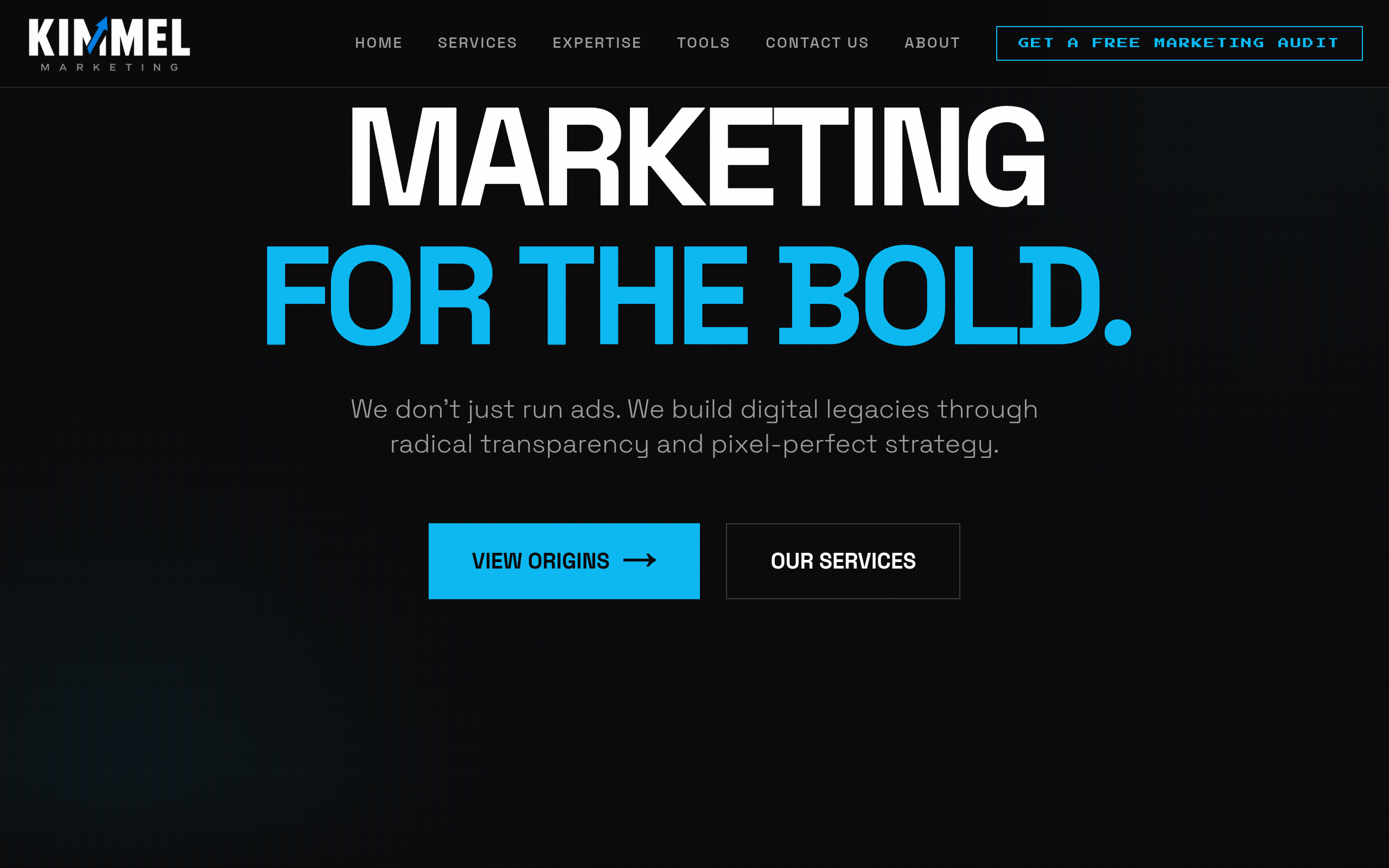
Kimmel Marketing provides brand strategy, creative development, media buying, and performance optimization for brands seeking transparent, data-driven growth. It is a sensible option when brand clarity and acquisition efficiency need to improve together, rather than being assigned to disconnected vendors. The agency’s [ [SELF:1] ] service overview is the appropriate place to confirm the current scope; remove the spaces around the placeholder when publishing so it renders correctly.
The operating idea is to connect the promise a brand makes with the reason a customer converts, then use media and performance data to refine both. That can be useful for a company whose ads attract clicks but whose offer, message hierarchy, or landing-page experience is not doing enough work. It is less suitable when the buying team requires a large enterprise delivery structure, a highly specialized marketplace-only operation, or a procurement process built around a global holding-company network.
Buyer verdict
- Best for: Growth-stage brands that want strategy, creative, media buying, and optimization connected to revenue and acquisition efficiency.
- Does not suit: Teams seeking only commodity campaign trafficking or a platform-specific operator with no strategic involvement.
- Implementation burden: The work still depends on access to analytics, ad accounts, customer data, website owners, and prompt creative decisions.
- Commercial model: Request a custom scope that identifies strategy, creative, media management, testing, reporting, and any implementation fees separately.
- Standout: Test whether the proposed reporting explains business outcomes in plain language rather than presenting platform metrics as the answer.
For teams comparing partners, the agency’s marketing expertise perspective can help frame the connection between brand strategy, creative choices, media buying, and optimization. A useful discovery question is what the agency will stop doing when the evidence shows that an activity is not improving qualified growth.
Comparison
The table is a screening tool, not a ranking. “Best starting fit” describes the buyer job each model is most likely to address; it does not guarantee capability, results, or commercial suitability. Verify current services and pricing in the proposal.
| Agency | Best starting fit | Core operating emphasis | Implementation burden | Commercial questions to resolve |
|---|---|---|---|---|
| Wpromote | Broad, coordinated digital growth | Cross-channel media, creative, analytics, and strategy | Moderate to high; requires shared data and approvals | Which workstreams and reporting layers are included? |
| Tinuiti | Complex ecommerce and commerce media | Catalog, marketplace, paid acquisition, and lifecycle coordination | High when feeds, margins, and promotions are fragmented | How are media, feed, creative, and analytics fees separated? |
| NP Digital | Search-led demand and conversion improvement | Paid search, organic search, content, and conversion work | Moderate; depends on content and website ownership | Which services are recurring versus project-based? |
| Power Digital | Multi-disciplinary growth transformation | Media, creative, commerce, SEO, and data | Moderate to high; many workstream dependencies | What are the deliverables and decision rights by team? |
| Disruptive Advertising | Focused paid media and conversion execution | Account structure, landing pages, testing, and lead quality | Moderate if tracking and CRM feedback are usable | Are testing, creative, landing pages, and management bundled? |
| Merkle | Enterprise customer journeys and data complexity | Customer experience, data, technology, commerce, and media | High when governance and systems span departments | What is transformation work versus ongoing service? |
| Kimmel Marketing | Connected brand and performance growth | Brand strategy, creative, media buying, and optimization | Moderate; requires access and active client collaboration | How are strategy, creative, media, testing, and reporting scoped? |
How to choose a performance marketing agency
Start with the failure mechanism
Do not begin with “Which agency is best?” Begin with “What is preventing profitable growth?” The answer may be a tracking defect, weak offer, poor landing-page relevance, creative fatigue, bad lead qualification, an unprofitable product mix, or a media allocation problem. Each failure mechanism calls for a different engagement.
- Tracking failure: prioritize event design, data validation, attribution rules, and a reconciliation process.
- Message failure: prioritize positioning, customer research, creative strategy, and offer clarity before increasing spend.
- Conversion failure: prioritize landing-page diagnosis, experiment design, checkout friction, and sales feedback.
- Allocation failure: prioritize channel economics, marginal return logic, audience exclusions, and budget governance.
- Retention failure: include lifecycle marketing, cohort analysis, repeat purchase behavior, and customer-value definitions.
For example, a paid-social campaign with inexpensive leads may look attractive until sales representatives report that most submissions are outside the service area or cannot afford the offer. The next move is not automatically a new audience. It may be a qualification question, a clearer price signal, a revised offer, or an offline conversion event that teaches the platform what a valuable lead looks like.
Make the commercial proposal falsifiable
Ask each agency to put assumptions in writing. A credible proposal should identify what must be true for the plan to work, what the agency can change directly, what requires your team, and which evidence would cause a change in direction. It should also define reporting language before launch.
- Business outcome: revenue, qualified pipeline, contribution margin, or another agreed commercial measure.
- Leading indicators: conversion rate, qualified-lead rate, product-level demand, creative response, or checkout progression.
- Guardrails: exclusions, margin rules, brand-safety requirements, geographic limits, and inventory constraints.
- Decision cadence: who reviews results, who approves changes, and how quickly blockers are resolved.
- Exit criteria: what evidence would pause a channel, revise the offer, or end the engagement.
Be precise about pricing without demanding a false sense of certainty. Agencies may structure work through retainers, project fees, media-management fees, performance components, or blended arrangements. The important comparison is not the lowest quoted fee; it is what labor and responsibility the fee buys. A low management fee can be expensive if analytics, creative, feed work, and landing-page changes are all treated as extras.
If you are preparing an early-stage launch rather than scaling an established acquisition engine, you can also submit your product launch to gain visibility among early adopters and a founder community. That route supports product discovery and startup visibility; it is not a substitute for a full-funnel paid-media operating partner.
Choose the operating model your team can sustain
The right partner is the one whose working method matches your internal capacity. An enterprise organization may need governance, regional coordination, and data architecture. A founder-led ecommerce company may need fast decisions, direct communication, and a small number of high-leverage tests. A regulated business may need approval workflows before any creative or audience change.
Before signing, request a sample first-phase plan that includes the tracking audit, account diagnosis, creative hypotheses, landing-page priorities, reporting format, and client responsibilities. Make the agency distinguish implementation work from optimization work: installing an event is different from learning from it, and launching a campaign is different from proving its incremental value.
For most growth-stage brands, the strongest shortlist will contain one broad partner, one focused paid-media specialist, and one partner whose strategic model matches the organization’s brand and data maturity. Compare them against the same business objective and the same access constraints, then choose the team that can explain both how it will create growth and how it will know when the plan is wrong.
Kimmel Marketing is worth considering when your next stage requires brand strategy, creative development, media buying, and performance optimization in one accountable relationship. Review the proposed scope carefully at Kimmel Marketing, and choose the engagement only if its measurement plan and responsibilities fit your team.
Authored with NotFair SEO