Proposed Marketing Strategy Examples: 6 Practical Plans for Growth
Proposed marketing strategy examples are practical plans that connect a business objective to a target audience, message, channel mix, budget policy, measurement model, and decision rule. For example, an ecommerce brand might propose a 90-day acquisition plan built around new customer revenue, a target CAC, paid social creative testing, search demand capture, landing-page improvements, and weekly budget reallocation. The strongest proposals do not merely list tactics; they explain what will change, why it should work, how success will be measured, and what happens if the evidence disagrees.
What a proposed marketing strategy should contain
A proposed strategy is a testable operating plan, not a collection of campaign ideas. It sits between business goals and execution: leadership needs to know how marketing will contribute to revenue, while channel specialists need enough specificity to launch, measure, and optimize the work.
A useful proposal makes five connections explicit:
- Business outcome: revenue growth, qualified pipeline, first purchases, repeat orders, or improved contribution margin.
- Customer and problem: the segment being prioritized, its purchase trigger, and the friction preventing conversion.
- Strategic bet: the message, offer, audience, or experience believed to create a commercial advantage.
- Activation plan: creative, landing pages, media channels, lifecycle programs, and the sequence in which they will operate.
- Measurement and decisions: primary metrics, guardrails, testing conditions, and the action attached to each result.
For a growth-stage brand, “increase paid media” is not a strategy. “Increase new-customer revenue by improving the economics of high-intent demand, while using paid social to discover new creative angles” is closer. It identifies a growth mechanism: capture existing demand efficiently, then create more qualified demand with better messages.
Strategy versus campaign plan
A campaign plan usually answers what launches and when. A strategy answers why this audience, promise, channel, and sequence should produce a better business result. A campaign might contain six ads and two landing pages. The strategy explains the customer tension those assets address and the evidence that will determine whether the investment expands.
This distinction matters when a channel underperforms. If the strategy is “run paid social,” a weak result leaves the team unsure whether to change targeting, creative, offer, landing page, or the channel itself. If the strategy is “use creator-style proof to reduce skepticism among first-time buyers,” the team can diagnose the specific hypothesis before abandoning the entire approach.
Why these strategies matter to revenue teams
Marketing proposals create alignment before money and production time are committed. That is especially important when a company is balancing brand refresh work, acquisition targets, limited creative capacity, and pressure to report a reliable CAC.
The main value is not presentation quality. It is making trade-offs visible. A proposal can show that a plan prioritizes new customers over short-term blended ROAS, or that it protects brand consistency even when a direct-response message might produce more clicks. Those choices are easier to debate when they are written as assumptions rather than hidden inside a media plan.
The economics behind the proposal
Suppose an illustrative ecommerce plan spends $60,000 over a quarter and expects 1,000 first orders. The illustrative acquisition cost is $60 per first order. If the average first-order contribution after product and fulfillment is $75, the plan has only $15 of contribution before overhead, refunds, and retention effects. That may be acceptable if repeat purchase is strong, or unacceptable if most customers buy once.
The proposal should therefore distinguish reported platform performance from business-level economics. Useful questions include:
- Is the target CAC based on first-order revenue, contribution margin, or expected customer value?
- Are returning customers being counted as acquisition wins?
- How much of the proposed growth depends on discounting?
- Can operations support the volume if the plan works?
- Which result would cause the team to increase, hold, or reduce investment?
Attribution also needs a defined role. Google Analytics documents attribution settings and reporting considerations in its official help materials, but an attribution report should inform decisions rather than replace financial reconciliation. See Google’s documentation on attribution models when deciding how a measurement plan will assign credit.
What makes a proposal credible
A credible proposal states uncertainty. It might say, “We believe product-demonstration creative will improve qualified traffic because customers need to see setup before purchase.” That is stronger than “Video will increase conversions,” which presents an untested assumption as a fact.
Include confidence levels and dependencies where they matter:
- High confidence: the product solves a documented customer problem.
- Medium confidence: the proposed audience has enough reachable demand.
- Low confidence: a new message will outperform the current control.
- Dependency: tracking, inventory, landing-page speed, creative approvals, or sales follow-up must be reliable.
Six Proposed Marketing Strategy Examples with numbers
The following examples use illustrative numbers and policies, not universal benchmarks. Their purpose is to show how a proposal turns an idea into a measurable plan. Each example identifies the mechanism, the likely failure point, and what another team can adapt.
- Demand-capture strategy for a high-intent ecommerce category. An illustrative plan allocates $30,000 to search campaigns aimed at product and problem-aware queries, with a $50 target CAC and a landing page organized around proof, comparison, and delivery information. It demonstrates that existing demand should be captured before expansion. It works when searchers already understand the category and the page resolves purchase objections. It fails when the category has low search volume or competitors make the auction uneconomical. Adapt it by separating branded, category, and high-intent nonbrand demand, then assigning each a distinct profitability rule rather than one blended target.
- Creative-led prospecting strategy for a saturated product. An illustrative brand produces 12 ad concepts across four customer tensions: time saved, visible product results, risk reduction, and social proof. It spends $24,000 over eight weeks, treating $2,000 per concept as a planning allocation rather than a promise of equal performance. This demonstrates message discovery before budget expansion. It works when the product is difficult to distinguish through targeting alone. It fails when every concept uses the same opening, proof, and offer. Adapt it by changing the customer problem and evidence structure, not only colors, music, or headline wording.
- Conversion strategy for paid traffic that does not scale. A store receives an illustrative 20,000 qualified sessions per month and converts 1.5% of them, producing 300 orders. A proposed test improves product-page clarity, shipping disclosure, reviews, and mobile checkout while keeping the acquisition mix stable. If conversion rises to an illustrative 1.8%, the same traffic produces 360 orders. This demonstrates increasing output from existing demand. It works when users are interested but uncertain. It fails when traffic quality is poor or inventory and offer constraints are the real problem. Adapt it by diagnosing the largest user objection before changing page design.
- Lifecycle strategy for improving customer value. An illustrative subscription brand spends $15,000 on post-purchase education, replenishment reminders, and win-back messages, with success measured through second-order contribution rather than email clicks. This demonstrates using retention to change allowable acquisition cost. It works when customers have a natural replenishment or repeat-use cycle. It fails when the product is inherently one-time, the onboarding experience is weak, or messages arrive without regard to actual usage. Adapt it by defining the customer event that predicts a second purchase and measuring incremental revenue against an appropriate holdout where practical.
- Brand repositioning paired with performance media. An established company clarifies its category, audience, proof points, and tone before launching a new campaign. The illustrative media plan reserves 70% of spend for efficient demand capture and 30% for prospecting around the new positioning. This demonstrates sequencing brand clarity with acquisition execution. It works when inconsistent messaging is creating weak recall or poor-quality leads. It fails when the repositioning is only a visual refresh and does not change the reason to choose the brand. Adapt it by translating the positioning into ad hooks, sales language, landing-page structure, and customer research questions.
- Geographic or segment expansion strategy. A company with a stable domestic acquisition model proposes entering one additional region or customer segment with a limited test. The illustrative policy is to cap the test at $20,000, require localized creative and fulfillment checks, and continue only if CAC, conversion rate, refund rate, and contribution remain within agreed guardrails. This demonstrates controlled expansion rather than automatic scaling. It works when the existing proposition transfers to the new market. It fails when shipping, regulation, pricing, competition, or cultural expectations change the economics. Adapt it by testing operational feasibility before interpreting media results.
How to turn an example into an operating plan
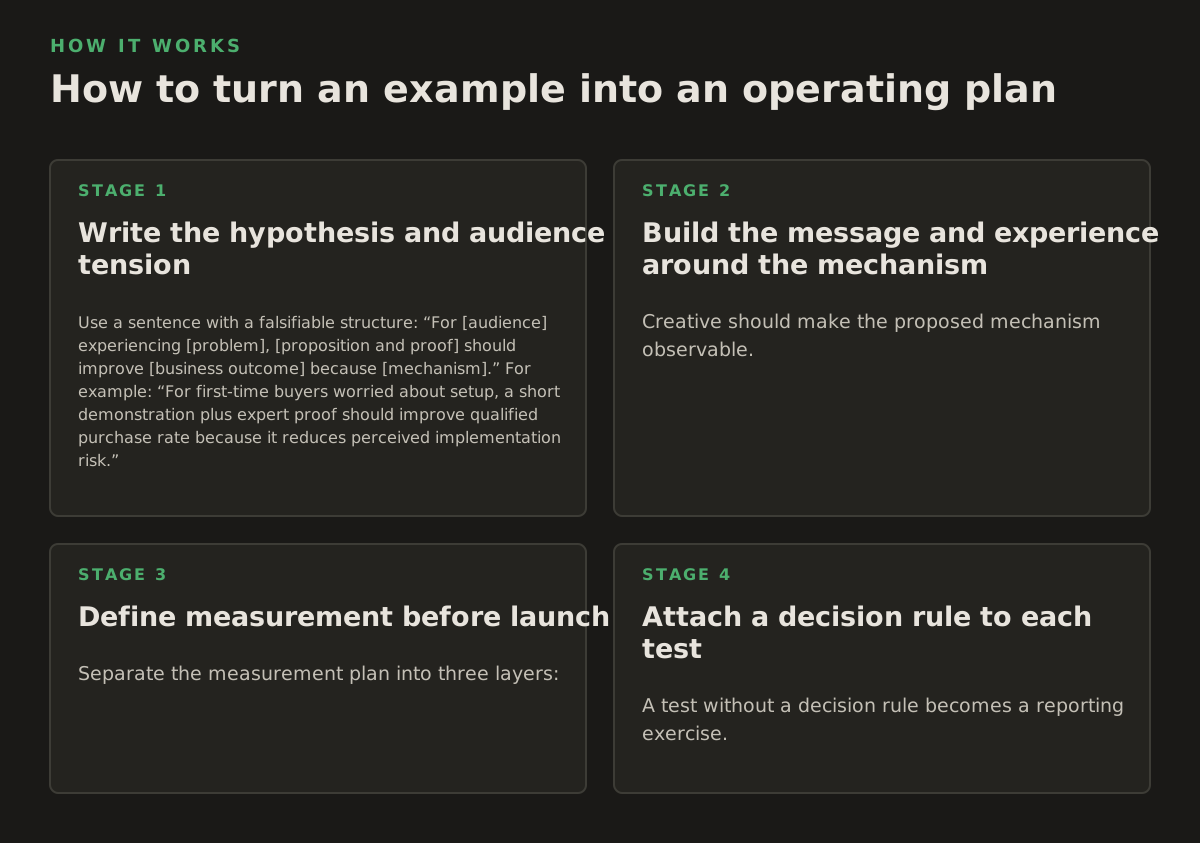
Once the strategic direction is chosen, convert it into a sequence that a marketing, creative, and media team can execute. The sequence should reduce uncertainty in the order that matters commercially.
1. Write the hypothesis and audience tension
Use a sentence with a falsifiable structure: “For [audience] experiencing [problem], [proposition and proof] should improve [business outcome] because [mechanism].” For example: “For first-time buyers worried about setup, a short demonstration plus expert proof should improve qualified purchase rate because it reduces perceived implementation risk.”
Then specify who is excluded. A new-customer acquisition strategy should not quietly optimize toward existing customers simply because they convert more easily. Define the audience using customer state, need, purchase history, or intent rather than vague demographics alone.
2. Build the message and experience around the mechanism
Creative should make the proposed mechanism observable. If the strategy is risk reduction, show the process, guarantee, support, or independent proof. If it is superior performance, demonstrate the result under a credible use case. If it is convenience, expose the steps removed from the customer’s routine.
The landing page must continue the same argument. A mismatch between ad promise and page experience creates a false diagnosis: the team may blame media when the actual problem is that the visitor cannot find the proof implied by the ad. Align ad hook, page promise, evidence, offer, and call to action.
3. Define measurement before launch
Separate the measurement plan into three layers:
- Primary outcome: new-customer contribution, qualified pipeline, first purchase, or another business result.
- Diagnostic metrics: qualified sessions, click-through rate, product-view rate, lead quality, checkout initiation, or repeat purchase.
- Guardrails: refund rate, discount cost, margin, frequency, customer complaints, sales capacity, or brand-safety requirements.
For Google Ads, conversion tracking is the foundation for reporting actions such as purchases or leads; Google explains the setup and measurement considerations in its official conversion tracking documentation. For Meta activity, server-side event implementation may support more resilient event transmission, but it does not make poor event definitions or weak business reconciliation disappear; the Meta Conversions API documentation outlines the product’s role and implementation requirements.
4. Attach a decision rule to each test
A test without a decision rule becomes a reporting exercise. State what will happen if the evidence is positive, neutral, or negative. For example:
- If qualified CAC is within the illustrative target and margin guardrail holds, increase budget gradually while monitoring efficiency.
- If clicks rise but checkout initiation does not, inspect message-to-page continuity and product objections before changing targeting.
- If conversion improves only after a deeper discount, calculate contribution and repeat purchase before declaring success.
- If results are inconclusive, continue only when the test can generate materially better evidence or resolve a known dependency.
Where a platform supports controlled experiments, use its experimental structure rather than treating every before-and-after comparison as proof. Google describes campaign experiments and testing workflows in its official Google Ads experiments guidance. The practical principle is broader: define the comparison, period, audience, and success metric before the result is visible.
Where proposed strategies break
Most weak proposals do not fail because the team lacks channels. They fail because the plan hides a contradiction or makes measurement carry more certainty than it can support.
- Vague objective: “Grow awareness and sales” does not identify a priority or trade-off.
- Channel-first planning: selecting platforms before defining the customer problem makes the channel do the work of the strategy.
- Metric substitution: using clicks, impressions, or platform ROAS as a substitute for profitable customer growth.
- Creative underinvestment: asking one asset to serve awareness, consideration, conversion, and retention audiences.
- Unresolved economics: setting a CAC target without accounting for margin, refunds, discounts, sales costs, or customer value.
- False precision: presenting a forecast as a commitment when the audience, offer, or message has not been validated.
Another common failure is scaling a measurement problem. If purchase events are duplicated, offline revenue is missing, or new and returning customers are mixed, more spend produces a larger but less trustworthy report. Establish event definitions, naming conventions, ownership, and reconciliation procedures before making budget decisions.
Do not confuse a bad first result with a bad strategic idea. Diagnose the level of failure:
| Observed signal | Likely question | Next decision |
|---|---|---|
| Low qualified click rate | Does the message earn attention from the intended audience? | Revise the hook, audience premise, or offer. |
| Strong clicks, weak product engagement | Does the landing page deliver the ad’s promise? | Fix relevance, proof, speed, or page structure. |
| Strong checkout starts, weak purchases | Is there friction in price, delivery, payment, or trust? | Investigate checkout and commercial objections. |
| Purchases rise but contribution falls | Is growth being purchased through discounts or poor mix? | Recalculate allowable CAC and offer economics. |
How practitioners use the strategy in 2026
In 2026, a useful proposal should be short enough to govern decisions and detailed enough to survive execution. A practical format is a one-page strategic brief supported by a measurement plan, creative matrix, channel role definition, and financial model.
Before approval, ask the team to complete this checklist:
- What revenue or customer outcome has priority for this planning period?
- Which audience or customer state is being prioritized, and which is excluded?
- What customer tension does the proposition resolve?
- What evidence supports the strategic bet, and what remains uncertain?
- Which channel captures demand, which creates demand, and which improves conversion or retention?
- What is the illustrative budget policy, and what conditions permit expansion?
- Which metrics are primary, diagnostic, and guardrails?
- Who owns creative production, tracking quality, landing-page changes, and weekly decisions?
The best proposals also define a review cadence without pretending that every decision needs the same speed. Media pacing may need frequent monitoring, while brand positioning and customer research require a broader evidence window. Use fast reviews for delivery problems and slower reviews for strategic questions such as whether the proposition is resonating with a new segment.
For companies combining brand work, paid acquisition, and conversion optimization, the operating model matters as much as the initial idea. A coherent digital marketing services engagement should connect the strategic hypothesis to creative production, media buying, measurement, and commercial outcomes rather than treating each discipline as a separate project. That integrated approach is part of the marketing expertise needed to decide whether a weak result calls for a new message, a better experience, a different audience, or less investment.
Choose the proposal that reduces the biggest constraint
Do not select a strategy because it contains the most channels or the most activity. Select it because it addresses the constraint currently limiting growth. If demand exists but conversion is weak, prioritize experience and offer clarity. If conversion is healthy but volume is limited, test new audiences and creative angles. If acquisition looks efficient but customer value is weak, improve onboarding, retention, or product-market fit before scaling spend.
Start with one clearly stated hypothesis, one primary business outcome, and a small set of guardrails. Then make the next budget decision conditional on evidence. Kimmel Marketing can help connect brand strategy, creative development, media buying, and performance optimization into that kind of accountable plan through Kimmel Marketing.
Authored with NotFair SEO