Sample Brand Strategy for Growth-Stage Brands
A sample brand strategy is useful only when it helps a growth-stage company make better decisions about customers, positioning, creative, channels, and revenue. The practical job is not to produce a polished brand document; it is to decide what the business should be known for, who it should prioritize, why those buyers should believe it, and how marketing will turn that preference into efficient acquisition. This guide gives ecommerce teams, founders, and marketing leaders a working framework for building or evaluating that strategy before committing more budget to media.
The decision is straightforward but consequential: do you need a sharper brand strategy, a better execution system, or both? If your paid campaigns generate clicks but weak conversion, your positioning may be unclear. If customers convert but acquisition costs rise as you scale, your audience, offer, creative, or measurement model may be limiting growth. If every channel describes the company differently, the problem is usually strategic consistency rather than a lack of content.
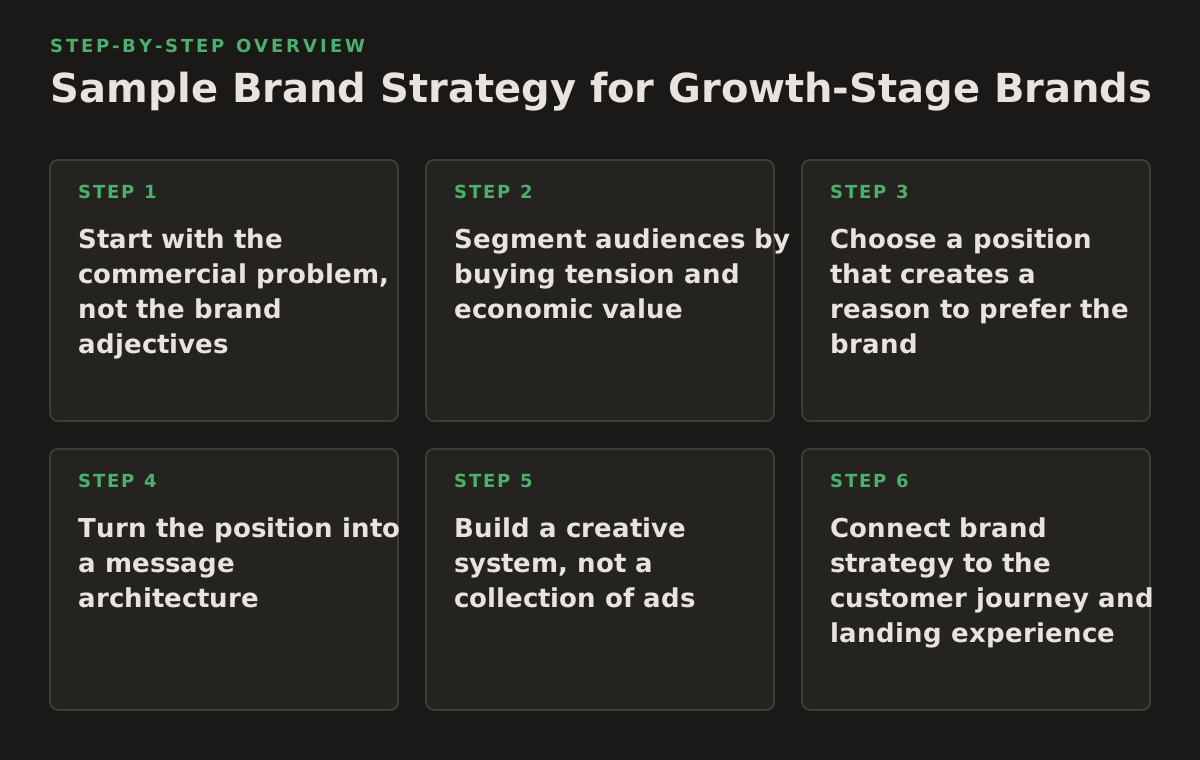
1. Start with the commercial problem, not the brand adjectives
Apply this principle when a strategy brief begins with words such as “premium,” “innovative,” or “customer-centric” but does not explain what growth problem the brand must solve. Those adjectives may be directionally useful, yet they do not tell a media buyer which audience to prioritize, a designer what to show, or a founder which trade-off to make.
A useful strategy connects brand work to a measurable commercial constraint. That could be low first-order conversion, weak repeat purchase, high dependence on discounts, poor differentiation in a crowded category, or an inability to expand beyond a founder-led audience. The brand strategy then becomes a set of choices that influence customer acquisition cost, conversion rate, retention, and lifetime value.
What to define
- Primary business objective: the revenue or growth outcome the strategy must support.
- Current constraint: the factor preventing the company from reaching that objective.
- Strategic audience: the customer group where the brand can create a meaningful advantage.
- Decision horizon: whether the strategy is intended for an immediate campaign, a six-month growth cycle, or a broader repositioning.
- Evidence standard: which customer, product, media, or financial signals will confirm or challenge the strategy.
For example, an ecommerce skincare company may say its objective is “grow revenue.” That is too broad to guide decisions. A stronger brief might be: “Increase new-customer contribution without making permanent discounts the main reason to buy.” That problem points toward a brand promise based on confidence, efficacy, proof, or routine simplicity rather than another generic promotion.
Why it works: starting with the constraint prevents brand strategy from becoming detached from commercial reality. It also forces the team to identify what must change in customer perception or behavior. A brand platform that cannot influence a purchase decision, a sales conversation, or retention behavior is unlikely to improve growth.
Failure mode: treating the business objective as a slogan. “Become the leading brand” is not a decision rule. It does not tell the team whether to prioritize category education, premium perception, distribution, repeat purchase, or share of voice.
Implementation example: write a one-page “strategy contract” before developing messaging. Include the objective, constraint, priority audience, target action, and three things the brand will not do. For the skincare company, “do not compete primarily on lowest price” may be as useful as “increase qualified first purchases.”
If the internal team needs a practical starting point for connecting marketing strategy to execution, معسكر التسويق الرقمي can help build a practical marketing strategy for a brand or small business, including digital marketing, social media marketing, digital advertising, content marketing, and online education choices.

2. Segment audiences by buying tension and economic value
Use this principle when the target audience is described demographically but not behaviorally: “women aged 25–44,” “small businesses,” or “health-conscious consumers.” Demographics can help with media planning, but they rarely explain why one person buys now, another delays, and a third chooses a competitor.
A stronger audience model describes the job to be done, the moment that creates urgency, the perceived risk, and the value of winning that customer. For performance marketing, this matters because different buying tensions require different proof and different creative. A first-time buyer may need reassurance about quality and returns. A repeat buyer may need convenience, replenishment, or a reason to expand the basket.
Build an audience matrix
| Audience or situation | Buying tension | Proof required | Message angle | Business priority |
|---|---|---|---|---|
| Problem-aware prospect | Wants a solution but doubts the category | Education, demonstrations, credible explanation | Make the problem easier to understand and act on | Demand creation |
| Active category shopper | Comparing alternatives and reducing risk | Reviews, specifications, guarantees, clear differentiation | Explain why this option is the better fit | Efficient acquisition |
| First-time customer | Concerned about making the wrong choice | Onboarding, social proof, shipping and returns clarity | Make the first purchase feel safe | Conversion |
| Existing customer | Needs a reason to return or buy more | Product relevance, usage guidance, replenishment cues | Show the next useful step | Lifetime value |
Why it works: the matrix links audience selection to message selection and economics. It prevents the common mistake of creating one broad persona and forcing every campaign to speak to it. It also clarifies where brand investment should go: a high-value audience with an unresolved buying tension may deserve more research and creative development than a large but low-margin segment.
Failure mode: creating too many personas. If the team has eight “priority” segments, it has probably avoided prioritization. Start with two or three commercially meaningful situations, then expand only when the message, offer, or buying path genuinely changes.
Implementation example: for a premium meal-kit company, separate “busy professional seeking predictable weekday dinners” from “parent seeking variety for a household.” Both may share age and income characteristics, but they need different demonstrations, objections, landing-page proof, and retention prompts.
Use evidence without pretending it is certainty
Combine customer interviews, search behavior, sales objections, support tickets, review language, conversion data, and cohort economics. Treat each source as directional. A survey can reveal stated preference; behavior can reveal actual friction; profitability can reveal whether a segment is worth pursuing.
Document what is known, inferred, and unknown. This makes the strategy falsifiable and keeps the team from turning one anecdote into a market truth.
3. Choose a position that creates a reason to prefer the brand
Apply this principle when competitors appear interchangeable, when the category is crowded with similar claims, or when the company has a long list of features but no clear reason to choose it. Positioning is not a clever tagline. It is the disciplined decision to occupy a particular meaning in a particular customer’s mind.
A practical position contains five elements:
- Category frame: what kind of solution the customer should consider you to be.
- Priority customer: whose problem receives the strongest focus.
- Problem or tension: what the customer is trying to resolve.
- Distinctive advantage: why this brand can solve it credibly.
- Proof: what makes the claim believable before and after purchase.
A useful positioning statement might read: “For independent retailers that need reliable growth without adding a large internal team, Kimmel Marketing is a transparent growth partner that connects brand strategy, creative development, media buying, and performance optimization to revenue, acquisition cost, and lifetime value.” The statement is not intended to appear unchanged in every ad. It is a decision tool for deciding what belongs in the brand story.
Why it works: a clear position reduces message dilution. It gives creative teams a boundary, helps media teams select relevant contexts, and gives landing pages a coherent promise to fulfill. It can also expose a weak business advantage. If the only differentiation is “high quality,” the team still needs to define quality in observable, valuable terms.
Failure mode: claiming a benefit the business cannot consistently deliver. A promise of speed fails if fulfillment is unreliable. A promise of transparency fails if pricing, reporting, or terms are difficult to understand. Positioning should make operational weaknesses visible rather than hide them.
Implementation example: a B2B software company serving ecommerce operators may choose “fewer disconnected growth decisions” as its position rather than “advanced analytics.” Its proof could include a unified planning process, clear reporting definitions, and examples of decisions the system supports. The position then influences the homepage, sales deck, paid search copy, and onboarding—not just the tagline.
Separate the category promise from the brand proof
The category promise explains the outcome customers want. The brand proof explains why they should believe this company can deliver it. Keep these distinct. “Improve conversion” is an outcome; “guided experiments tied to revenue events” is a possible mechanism. The second is more useful for creative and sales enablement because it gives the audience something concrete to evaluate.
4. Turn the position into a message architecture
Use this principle when campaigns are individually polished but collectively inconsistent. One ad emphasizes price, the homepage emphasizes craftsmanship, email emphasizes convenience, and sales emphasizes flexibility. Each message may be reasonable, yet the customer receives no accumulating impression of what the brand stands for.
A message architecture creates message hierarchy. It tells the team which idea leads, which supporting claims explain it, and which proof points reduce risk. It should be flexible enough for different audiences and channels without becoming a collection of disconnected taglines.
A practical hierarchy
- Core promise: the most important value the brand wants associated with it.
- Three supporting pillars: the reasons the promise is credible or valuable.
- Evidence library: product facts, processes, testimonials, demonstrations, comparisons, or guarantees.
- Objection responses: the concerns most likely to stop the target customer.
- Action language: the next step appropriate to awareness and buying intent.
For an ecommerce apparel brand, the core promise might be “well-made essentials that make daily dressing easier.” Supporting pillars could be fit consistency, fabric durability, and versatile styling. Evidence might include measurement guidance, close-up product demonstrations, care instructions, and customer photography. The architecture gives the creative team multiple ways to express the same strategic idea without repeating one line.
Why it works: repetition of meaning builds recognition, while variation in execution keeps creative useful across placements. A prospecting video can dramatize the daily problem; a product page can explain construction; a retargeting ad can address fit risk. All three can still reinforce the same position.
Failure mode: turning every feature into a pillar. A message hierarchy with ten pillars is a product catalog. Limit the top-level ideas and place secondary features in the evidence library.
Implementation example: create a message map with columns for audience, stage, barrier, lead message, proof, and call to action. Require every new ad or landing page to identify which pillar it serves. If a creative concept cannot name its strategic role, it may be visually attractive but commercially unfocused.
Make claims safe and supportable
Before publishing, classify claims as product fact, comparative claim, customer opinion, or future-oriented promise. Product facts need to remain accurate. Comparative claims need a defensible basis. Customer opinions should be clearly represented as such. Future promises should not imply guaranteed outcomes the business cannot control.
This discipline protects trust and improves optimization. When a claim is specific, the team can test whether it attracts the intended audience and whether the landing experience fulfills it.
5. Build a creative system, not a collection of ads
Apply this principle when the brand has inconsistent visual output, frequent creative fatigue, or a production process that depends on one founder or designer. A brand strategy becomes commercially useful when it can generate many relevant executions without losing its recognizable character.
A creative system should define creative territories, visual behavior, tone, proof formats, and rules for adaptation. It should not prescribe every image or force every ad to look identical. The goal is controlled variation: enough consistency to build memory, enough variation to learn which angles motivate action.
Define the system in four layers
- Distinctive assets: recurring colors, shapes, framing, typography, sonic cues, or product treatments that support recognition.
- Story territories: recurring ways to dramatize the customer problem, product mechanism, result, or brand belief.
- Format rules: how ideas adapt to short video, static placements, product pages, email, and creator content.
- Conversion requirements: what every performance asset must make clear, such as product, audience, benefit, proof, and next action.
For a direct-to-consumer cleaning brand, territories could include “the mess that interrupts the day,” “the mechanism in action,” “comparative demonstration,” and “routine simplification.” The visual system might use close product framing and recognizable color blocking, while the formats vary between creator demonstrations, product photography, and customer scenarios.
Why it works: separating strategic territory from execution lets the team learn without reinventing the brand each week. It also makes briefing faster. A creative brief can specify the territory, audience tension, proof requirement, and placement rather than asking for an undefined “on-brand ad.”
Failure mode: confusing visual consistency with strategic consistency. Identical templates can preserve colors while producing interchangeable messages. If the customer tension and proof change, the creative should change too.
Implementation example: create a quarterly creative matrix with rows for audience tensions and columns for demonstrations, testimonials, founder explanations, product comparisons, and objection handling. Mark each concept as prospecting, consideration, conversion, or retention. This creates a balanced pipeline instead of producing ten variations of the same testimonial.
For digital measurement, define the conversion event before production begins. Google Ads’ official guidance explains that conversion tracking is used to understand actions after interactions with ads, which is why the business should distinguish meaningful outcomes from shallow engagement when designing creative briefs and reporting: Google Ads conversion tracking documentation.
6. Connect brand strategy to the customer journey and landing experience
Use this principle when media performance appears weak but the team is evaluating ads in isolation. A strong promise can still fail if the landing page changes the language, hides proof, creates uncertainty, or asks for too much commitment. Brand strategy should govern the sequence from first exposure to purchase and post-purchase experience.
Map the journey by customer question rather than by channel:
- Recognition: “Is this problem relevant to me?”
- Understanding: “What is this product or service, and how does it work?”
- Preference: “Why should I choose this option instead of another?”
- Risk reduction: “What could go wrong, and how is that handled?”
- Action: “What should I do next?”
- Reinforcement: “Did I make the right decision, and what comes next?”
Why it works: each stage has a different information requirement. Prospecting creative may need to establish relevance; a comparison page may need proof and specifications; a checkout experience may need clarity about delivery, returns, or payment. Sending every audience to the same generic page makes the campaign carry more persuasive work than it should.
Failure mode: optimizing for message match so narrowly that the page becomes repetitive or awkward. The landing page should continue the promise, not copy the ad word for word. It needs to answer the next customer question.
Implementation example: suppose a paid social ad promises “a simpler way to manage recurring inventory.” The landing page should show the workflow, identify the operator it is for, explain the setup effort, provide relevant proof, and offer a next step suited to buying intent. A page that only repeats “simpler inventory management” has not completed the argument.
For ecommerce teams, event planning should reflect the actual shopping journey. Google’s GA4 ecommerce documentation covers recommended ecommerce events and item-level information, which can help teams design a measurement model around product views, cart actions, purchases, and related behaviors rather than relying only on sessions: Google Analytics ecommerce measurement guidance.
Keep brand and conversion optimization in the same conversation
Conversion optimization should not mean removing every distinctive brand element in favor of a generic direct-response layout. Test high-impact uncertainties first: the promise, proof order, offer framing, audience relevance, friction, and call to action. Preserve elements that support recognition or trust unless evidence shows they obstruct the task.
An illustrative starting policy is to review the highest-traffic landing page every two weeks, but this is a workflow example, not a universal benchmark. The correct cadence depends on traffic quality, buying cycle, operational capacity, and the size of the decision being evaluated.
7. Create a measurement model that protects both efficiency and memory
Apply this principle when reporting focuses exclusively on last-click revenue, platform-reported conversions, or short-term return on ad spend. Those metrics can be useful for operational decisions, but they may undervalue demand creation, repeat purchase, branded search, and the cumulative effect of consistent positioning.
A practical measurement model has three layers:
- Business outcomes: revenue, contribution margin, new-customer value, retention, and lifetime value.
- Marketing efficiency: acquisition cost, conversion rate, qualified demand, payback, and channel or audience economics.
- Brand and behavior signals: direct traffic, branded searches, consideration actions, repeat engagement, message recall research, and qualitative feedback.
Do not assume every metric is equally reliable. Define the source of truth, attribution window, customer definition, and reporting period. If a platform reports a conversion but the order system does not, investigate the discrepancy instead of blending the numbers into an attractive average.
Why it works: the model lets leaders make different decisions at different speeds. Daily optimization may use spend, delivery, conversion signals, and creative diagnostics. Monthly business review may use contribution economics and cohort behavior. Quarterly brand review may examine whether the intended associations and demand signals are strengthening.
Failure mode: assigning a precise revenue value to every soft signal. Brand metrics can inform direction without pretending to prove incremental sales. Likewise, a high click-through rate does not prove that the position is strong if the resulting customers are unprofitable or unlikely to return.
Implementation example: an online furniture company can report first-order acquisition cost separately from 90-day customer value, while tracking product-category mix, branded search behavior, repeat visits, and qualitative reasons for purchase. A campaign that looks expensive on first order may deserve continued investment only if the cohort economics and strategic audience value justify it.
For campaigns that use server-side event transmission, Meta’s official Conversions API documentation describes sending marketing events directly to Meta’s systems, making it relevant when teams are planning how browser and server signals should support measurement: Meta Conversions API documentation. The implementation still requires careful consent, data governance, event definitions, and reconciliation with the company’s own transaction records.
Use a decision table, not a dashboard dump
Every recurring report should connect a signal to an action. For example: “new-customer acquisition cost rose while conversion rate held steady; investigate audience mix and auction pressure before changing the position.” This is more useful than listing fifteen metrics without a decision owner.
Illustrative thresholds can be used as starting policies—for example, requiring a creative concept to show both a clear audience and a measurable conversion event before scale—but they are not universal performance benchmarks. Calibrate policies to margin, sales cycle, data volume, and operational risk.
8. Operationalize the strategy through governance and testing
Use this principle when the strategy is approved once and then disappears into a shared folder. Growth-stage brands need a light governance system that preserves strategic coherence while allowing campaigns to learn. Without it, every channel gradually invents its own positioning.
Assign clear ownership for:
- Strategic decisions: who can change the target audience, position, promise, or brand boundaries.
- Message decisions: who maintains the message architecture and approves high-risk claims.
- Creative decisions: who translates territories into assets and maintains recognizable cues.
- Measurement decisions: who defines events, names metrics, and resolves data conflicts.
- Learning decisions: who records results, rejects weak assumptions, and selects the next test.
Why it works: governance reduces rework and makes learning cumulative. A test should change what the team believes or does. If results are not documented, the organization repeats the same experiments with different labels.
Failure mode: creating approval layers that make the brand too slow to operate. Governance should protect strategic choices and material claims, not require a committee to approve every headline variation.
Implementation example: maintain a living strategy sheet with five sections: current position, priority audiences, approved message pillars, evidence and objections, and active learning agenda. Review it monthly with brand, creative, media, and commercial owners. Change the strategy only when new evidence challenges a core assumption—not because one ad underperformed.
Write tests as decisions
A weak test asks, “Which ad performs better?” A stronger test asks, “For active category shoppers, does mechanism-focused proof reduce hesitation more effectively than outcome-focused proof?” The second version identifies the audience, variable, expected mechanism, and decision that follows.
Use a simple record:
- Assumption being challenged.
- Audience and context.
- Single primary variable.
- Success metric and guardrail metric.
- Decision rule after the learning period.
- Implication for the message architecture or creative system.
This approach prevents performance optimization from becoming random variation and prevents brand strategy from becoming immune to evidence.
Implementation plan: build the strategy in the right sequence
Follow this sequence when developing a new strategy or repairing one that no longer guides execution. The order matters because later decisions depend on earlier ones.
- Diagnose the commercial constraint. Interview commercial, customer service, sales, creative, and media owners. Review acquisition economics, conversion paths, retention behavior, and the reasons customers choose or reject the brand. Write the problem in observable terms.
- Select two or three priority buying situations. Group customers by need, urgency, objection, and economic value. Avoid treating every demographic segment as a separate strategy.
- Write the position and test its credibility. Define the category, priority customer, tension, advantage, and proof. Remove any promise the operation cannot reliably deliver.
- Build the message architecture. Establish one core promise, a small set of supporting pillars, an evidence library, objection responses, and stage-appropriate actions.
- Translate strategy into creative territories. Choose repeatable ways to show the problem, mechanism, outcome, proof, and brand belief. Define distinctive assets and adaptation rules for each important format.
- Map the customer journey. Align ads, landing pages, product pages, sales materials, checkout, onboarding, and retention messages around the customer’s next question.
- Define the measurement model. Agree on business outcomes, efficiency metrics, brand signals, event definitions, attribution conventions, and data ownership before scaling campaigns.
- Launch a focused learning agenda. Prioritize tests that could change the position, audience, proof, offer framing, or creative territory. Record the decision attached to each test.
- Review and refine on a fixed operating rhythm. Use short-term reviews for execution, monthly reviews for learning, and periodic strategy reviews for core assumptions. Keep the strategy stable enough to build memory but flexible enough to respond to evidence.
For teams that need outside support across planning, creative, media, and optimization, Kimmel Marketing’s digital marketing services offering is relevant when the work requires coordinated execution rather than an isolated brand exercise. Its marketing expertise explains the broader areas of marketing expertise that can inform the operating model.
Use the framework as a starting policy, then adapt it to your margin structure, buying cycle, category dynamics, and internal capacity. When the brand promise, creative system, media plan, and measurement model reinforce one another, Kimmel Marketing can help turn the strategy into a transparent growth program tied to acquisition efficiency and long-term customer value.
Authored with NotFair SEO