Social Media Strategy Template: A Practical Growth-Stage Worksheet
A social media strategy template helps a growth team decide who it needs to reach, what each channel should do, what to publish, and how to judge whether it is working. Use the worksheet below to connect social activity to a business goal before building a calendar; it includes prompts, a filled ecommerce example, and a practical rollout sequence.
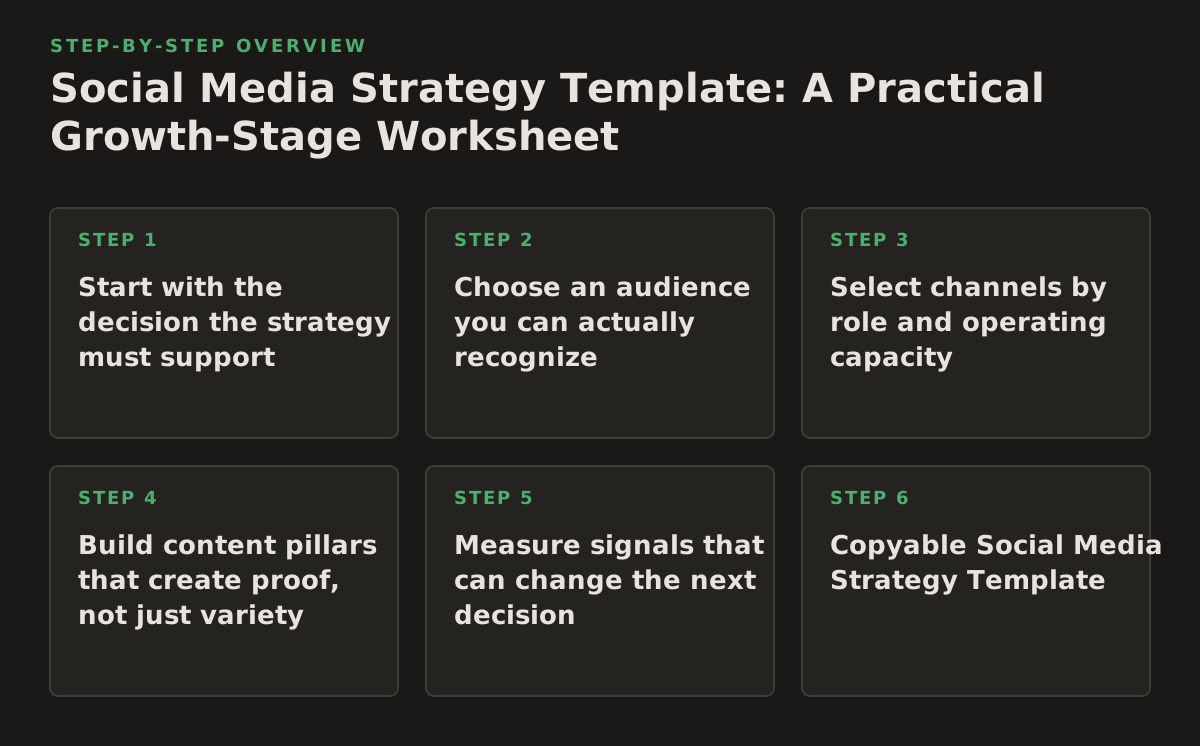
Start with the decision the strategy must support
When it applies: Use a strategy when teams are posting regularly but cannot explain how the work supports acquisition, retention, or brand demand—or when a new product, audience, or channel requires a change in direction.
Why it works: A strategy is a set of choices, not a list of post ideas. It makes trade-offs visible: which audience matters most, which business outcome social can influence, and what the team will not prioritize. That focus helps growth-stage brands avoid spreading limited creative and measurement capacity across every platform.
Failure mode: Writing a goal such as “increase engagement” without defining the business reason. Engagement can be useful evidence, but it does not automatically indicate qualified demand or revenue. Specify what decision a result should inform, such as whether to develop more product education or send qualified visitors to a collection page.
Turn the business goal into a social role
Pick a primary role for the next planning period, then name a secondary role only if the team has enough capacity to support it. For example, an ecommerce brand launching a new product line might use social to build consideration among existing customers, while using paid campaigns separately to capture high-intent demand. The roles can overlap, but the strategy should state which one takes priority.
- Acquisition: introduce the offer and give likely buyers a next step.
- Consideration: answer objections with demonstrations, comparisons, or customer questions.
- Retention: help customers use the product, discover related items, or return for another purchase.
- Brand demand: build recognizable associations that can inform future creative and campaign decisions.
Write a testable objective rather than a promise: “Use short demonstrations to learn which product benefit earns qualified product-page visits.” That gives the team a hypothesis to evaluate without assuming social alone caused a sale.
Choose an audience you can actually recognize
When it applies: This step matters when a brand’s audience description is so broad that it cannot guide a creative brief—for example, “people who like wellness” or “online shoppers.”
Why it works: Useful audience definitions connect a person’s situation to a need, objection, or trigger. They give creative teams a reason to choose one message over another and help media teams distinguish a relevant response from general attention.
Write for a buying situation, not a demographic label
Describe a priority audience with four ingredients: what they are trying to do, what makes the decision difficult, what proof they need, and what action would be meaningful. Use customer research, site search terms, support questions, sales feedback, and campaign data where available. Treat assumptions as hypotheses until the team has evidence to support them.
- Need: the job, problem, or desired outcome.
- Barrier: the uncertainty that delays a choice.
- Proof: the demonstration, explanation, or evidence that could address it.
- Next step: a behavior that fits the person’s readiness, not just the brand’s preferred CTA.
Failure mode: Defining an audience only by age, location, or broad interests. Those labels may help with some targeting decisions, but they do not tell a creator what concern to address. A more useful illustrative ecommerce audience is “first-time buyers comparing refillable household products who want to know how refills work before replacing their current option.”
For that audience, a practical post could show the refill process, name what a first-time buyer needs to order, and link to a page with the details. If the company cannot yet verify a claim about savings, durability, or environmental impact, leave that claim out and identify what evidence would be needed before using it.
Select channels by role and operating capacity
When it applies: Use this decision when a team is considering a new platform, or when several channels compete for the same limited production time.
Why it works: A channel is useful only when the audience, content behavior, business role, and team capacity fit together. Platform features and ranking systems can differ across surfaces; Instagram’s explanation of how ranking works describes distinct systems for areas such as Feed, Stories, Explore, and Reels. That is a reason to plan for the actual surface rather than assume one post will perform identically everywhere. See Instagram’s explanation of how it works.
Score the opportunity before adding it to the plan
Use the table as a simple selection framework. Give each factor a low, medium, or high rating based on current evidence, not enthusiasm. A channel with a strong audience fit but no workable production owner may be a later test, not an immediate commitment.
| Selection factor | Question to answer | Decision signal |
|---|---|---|
| Audience fit | Do priority buyers use this channel for a need we can address? | Prefer evidence from customer interviews, referrals, or qualified traffic. |
| Content fit | Can our proof or story work naturally in this channel’s formats? | Identify a repeatable format, not a one-off stunt. |
| Business role | What job should the channel perform in the customer journey? | Name one primary outcome or learning objective. |
| Production capacity | Who can create, approve, publish, and respond? | Do not launch without a named owner and realistic workflow. |
| Measurement | Can we observe a useful signal and connect it to a decision? | Define the signal before publishing. |
Failure mode: Choosing a channel because a competitor is active there or because a format is popular. Those are reasons to investigate, not proof of fit. For example, a brand might run a limited test of product demonstrations on a video-first surface only after confirming it can produce the demonstrations and measure meaningful downstream visits.
Build content pillars that create proof, not just variety
When it applies: Use pillars when the feed is repetitive, the team has a backlog of unrelated ideas, or a brand refresh has left people uncertain about how to express the new positioning.
Why it works: A small set of content pillars links the audience’s questions to the brand’s point of view and available evidence. Each pillar should have a purpose, a proof source, and formats the team can repeat. Variety then comes from addressing different buyer questions—not from inventing a new theme every week.
Make every pillar operational
- Product in use: show how the offer works in a real, clearly described scenario.
- Buyer education: explain a choice, term, or trade-off customers ask about.
- Proof and trust: use substantiated customer feedback, demonstrations, or documented processes.
- Brand perspective: express a useful point of view tied to the company’s positioning.
Failure mode: Treating a pillar as a vague label like “community” or “inspiration.” It will not help a creator decide what to make. Convert the label into a repeatable brief. For example: “Buyer education: answer one first-order question in a short demonstration, then direct viewers to the relevant product information.” The example is a format to adapt, not a claim that any particular post will produce a result.
Build creative variations around a consistent message: change the opening question, demonstration, or proof point while keeping the audience need and intended action clear. For claims that depend on customer endorsement, disclose material connections clearly; the FTC’s Disclosures 101 guidance explains that influencers should disclose relevant relationships with a brand. Add disclosure review to the workflow rather than hoping a creator remembers it at publication time.
Measure signals that can change the next decision
When it applies: Use this approach when reporting is dominated by follower counts, impressions, or engagement totals that do not tell the team what to do next.
Why it works: A useful measurement plan separates the intended outcome from the signals that help explain it. A social post may support discovery or consideration without receiving last-click credit for a purchase. Pair platform signals with site behavior and business outcomes where the available data allows, and state the limits of that connection.
Build a small measurement chain
- Business outcome: the result the plan is intended to support, such as qualified product-page visits or repeat purchase consideration.
- Diagnostic signal: a behavior that helps explain response, such as saves, meaningful comments, video retention, or link clicks.
- Tracking method: the consistent naming and analytics setup used to identify campaign traffic.
- Decision rule: what the team will change, continue, or investigate after reviewing the evidence.
For links to a site, use consistent campaign tags and naming conventions. Google Analytics documents campaign URL parameters such as source, medium, and campaign name in its guide to URL builders and campaign parameters. Agree on lowercase naming and a shared campaign vocabulary before publishing; inconsistent tags can split reporting for traffic that belongs to the same effort.
Failure mode: Treating correlation as proof that a post caused a sale. Use platform analytics to understand on-platform response and site analytics to observe tagged visits or actions, then report what each source can and cannot establish. YouTube, for example, provides channel and video performance information through YouTube Analytics; use the metrics available there to assess the video’s role rather than treating views as a revenue measure by themselves.
Copyable Social Media Strategy Template
Complete this worksheet in one working session with the people who own the business goal, creative, publishing, and measurement. Keep answers specific enough to guide a post brief. If a field is unknown, write “validate” and assign someone to find the evidence instead of filling the gap with a guess.
| Field | Prompt / question | Your answer |
|---|---|---|
| Business objective | What business outcome should social support, and why now? | [Outcome and reason] |
| Priority audience | Who is trying to do what, and what makes the decision difficult? | [Buyer situation and barrier] |
| Social role | What job should social do: discovery, consideration, retention, or another defined role? | [Primary role] |
| Channel choice | Which channel and surface fit the audience, content, and team capacity? | [Channel and rationale] |
| Content pillars | What recurring topics will answer buyer needs or demonstrate the brand’s value? | [Pillars and proof sources] |
| Creative approach | What repeatable formats will carry the message, and what variations will be tested? | [Format and variations] |
| Measurement | Which business outcome, diagnostic signals, and tracking method will be reviewed? | [Metrics and method] |
| Ownership | Who creates, approves, publishes, responds, and reviews results? | [Owners and handoffs] |
Filled illustrative example: ecommerce product launch
Objective: Help prospective customers understand a new refill product and support qualified product-page visits.
Audience: First-time buyers comparing refillable household products; they need to understand how the refill works and what to order.
Social role: Consideration, with product education as the primary job.
Channel: One existing channel where the team can publish demonstrations and review resulting site visits; validate audience fit before expanding.
Pillars: Refill demonstration, first-order questions, and substantiated product details.
Creative: Short demonstrations that vary the opening question while showing the same key steps.
Measurement: Tagged product-page visits plus relevant on-platform responses; review whether the questions suggest missing information.
Ownership: Product lead verifies details; marketer briefs and publishes; analyst reviews tagged traffic; customer support flags recurring questions.
Adapt the fields to your operating model: a retention program may prioritize existing-customer education, while a brand refresh may need a defined message and creative guardrails before channel selection. Keep the example’s specificity, but replace its assumptions with verified audience evidence, real channel capacity, and metrics your team can access.
Put the strategy into operation in sequence
When it applies: Use this sequence when the worksheet is complete but the team needs to turn it into a manageable pilot. A strategy should produce a brief, a publishing workflow, and a review decision—not an open-ended commitment to post more.
- Confirm the objective and evidence. Align the business owner on the outcome, audience, and assumptions that still need validation. Resolve unsupported product claims before they enter creative.
- Select one initial channel-role combination. Apply the selection framework and document why the team is not prioritizing other channels yet. A narrow test makes production and interpretation easier to manage.
- Write a compact creative brief. Include the audience situation, key message, proof available, desired action, format, and any claim or disclosure review needed. Give creators room to vary the execution without changing the strategic point.
- Set owners and tracking before publication. Confirm who approves the work, who responds to audience questions, and how links will be tagged. Test the destination and naming convention before the first post goes live.
- Review evidence and make one explicit next decision. Compare the intended outcome with diagnostic signals. Decide whether to repeat, revise the creative, improve the destination, or gather more audience evidence. Record why; do not scale solely because a post attracted attention.
Failure mode: Treating the first review as a final verdict on the channel. A weak result may reflect the creative, offer, destination, timing, or tracking—not simply platform fit. State what the evidence can support and choose the next test accordingly. For broader help connecting brand strategy, creative development, media buying, and performance optimization, review Kimmel Marketing’s digital marketing services and marketing expertise. If outside support would help align those decisions, Kimmel Marketing is a place to learn about Kimmel Marketing’s approach.
Authored with NotFair SEO