What a Digital Marketing Consultant Should Do for Your Growth Strategy
A digital marketing consultant should turn your business goals into a prioritized marketing plan, clarify who will carry out the work, and help you judge whether the results support the next decision. For a growth-stage brand, ecommerce team, or marketing leader, that means more than a list of channels: expect a diagnosis grounded in your offer and economics, useful measurement, and recommendations that explain what to do next—and what evidence could change the plan.
What should a Digital Marketing Consultant own?
The consultant’s central responsibility is to improve the quality of your marketing decisions. That may involve identifying a growth constraint, setting priorities, advising on channel mix, or helping your team evaluate performance. It does not automatically mean the consultant will manage campaigns, build creative, implement analytics, or change your website. Advice and execution are different scopes, so agree on what the engagement includes before work begins.
A useful plan links each marketing activity to a business objective. “Increase paid social” is an activity; “test whether a clearer product benefit can bring in more qualified first-time buyers” is a decision-oriented objective. The second gives the team something to investigate, a reason for the work, and a basis for deciding whether to continue, revise, or stop it.
The consultant should also clarify what they need from your team. A campaign recommendation might depend on product margins, lead-quality feedback, customer purchase patterns, or access to current reporting. If an essential input is unavailable, that should be surfaced as a limitation—not quietly replaced with confidence in a platform metric.
- For a growth-stage brand: Identify whether the immediate constraint is demand, the offer, the customer journey, or the ability to measure results.
- For an ecommerce team: Separate a traffic problem from a product-page, checkout, pricing, or repeat-purchase problem before changing media spend.
- For a marketing leader: Turn competing requests into a sequence of priorities, with a decision owner and a reason for each priority.
- For a brand team: Connect a positioning or messaging change to the audiences and customer touchpoints it is intended to affect.
These responsibilities are especially important when a company is refreshing its brand while trying to protect near-term acquisition. A consultant should help make the trade-off visible: which decisions concern the brand’s longer-term meaning, which affect current campaigns, and how the team will tell whether the two are working together. A channel plan alone cannot settle that question.
How should a consultant diagnose a growth problem?
Start with the business problem, not a predetermined channel recommendation. Rising acquisition costs, weak sales, and a low conversion rate can each have several causes. For example, paid traffic may be reaching the intended audience but the offer may be unclear; reported leads may be plentiful but poorly qualified; or a campaign may appear weak because tracking does not reflect the relevant business outcome.
A sound diagnosis turns the broad concern into a question that the team can investigate. It should distinguish what is known from what is assumed, then identify the next useful check. Diagnosis is not an audit for its own sake: examine the evidence needed to make the decision rather than expanding the scope to every possible marketing issue.
Trace the customer journey and the business constraint
For ecommerce, follow the path from ad exposure or site arrival through product consideration, cart, checkout, and subsequent purchase behavior where that information is available. For a lead-generation business, distinguish a form completion from a sales-qualified opportunity or closed revenue. The point is not that every business must track every step; it is to find where the observable journey stops matching the business’s definition of progress.
Consider an illustrative case: a campaign brings visitors to a product page, but few add the product to their cart. Increasing traffic may not address the problem. The consultant should help check whether the product value is clear, the offer is understood, and key purchase information is easy to find. If visitors add to cart but fail to complete checkout, investigate the later step instead of assuming the ad message is the cause.
Gather more than campaign reports when the question calls for it. Customer-support themes can reveal recurring objections; sales feedback may show that leads misunderstand the offer; and site behavior can indicate where visitors leave. Each source has a different role: behavioral data can show where a journey breaks down, while conversations may help explain why. Recommendations should name the evidence behind them and explain what would make the team revisit the diagnosis.
- If clicks are strong but the landing page receives little meaningful engagement, check the match between the ad promise and the page.
- If lead volume looks healthy but sales rejects many leads, examine qualification criteria and the audience or promise attracting submissions.
- If purchase reporting differs from finance records, inspect event definitions and reporting scope before treating the gap as a media problem.
- If a brand refresh is underway, identify which message or customer understanding is changing before judging the new work by a single campaign outcome.
How should performance measurement support decisions?
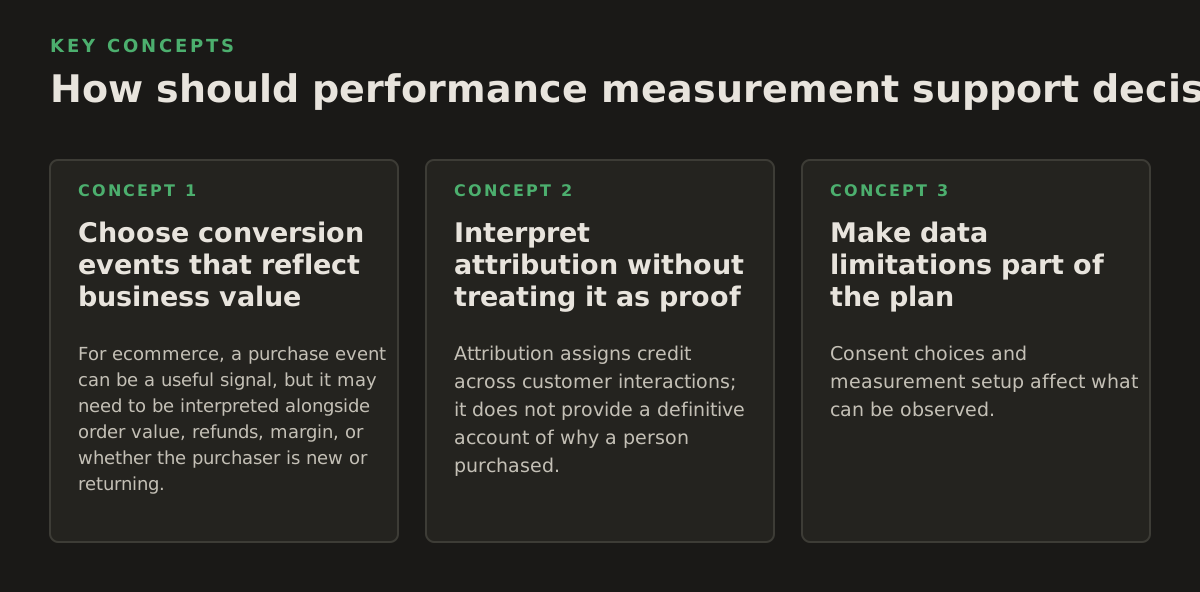
Measurement begins by agreeing on what counts as a valuable outcome and where that outcome is recorded. A platform may report a conversion, but the business may care about a qualified lead, a new customer, a profitable order, or repeat purchasing. Define the event and its business meaning before using it to compare channels or direct investment.
Choose conversion events that reflect business value
For ecommerce, a purchase event can be a useful signal, but it may need to be interpreted alongside order value, refunds, margin, or whether the purchaser is new or returning. For lead generation, a form submission may be an early indication of interest rather than the outcome the sales team values. Decide which events are suitable for campaign optimization and which are better used to evaluate lead or customer quality later.
Google Ads describes conversion tracking as a way to measure actions that happen after an interaction with an ad, such as a purchase or sign-up. That makes the configured action consequential: if it represents an early or low-value action, the resulting campaign report should not be mistaken for a complete account of business value. See Google Ads’ conversion tracking guidance when reviewing what a reported conversion represents.
Google Analytics distinguishes key events—events identified as important to the business—from the broader set of events collected in Analytics. A consultant can help your team decide which actions merit that designation and whether the reporting language is clear. The distinction is described in Google’s key events documentation. Tracking more events is not automatically better if the team cannot explain what those events mean or which decisions rely on them.
Interpret attribution without treating it as proof
Attribution assigns credit across customer interactions; it does not provide a definitive account of why a person purchased. Someone might encounter an ad, search for a brand later, return through email, and then buy. Different attribution approaches can distribute credit differently, so a consultant should identify the view being used and describe which decisions it can reasonably inform.
Google Analytics documents attribution models and how they allocate credit across touchpoints in its attribution reporting guidance. Use that information to ask whether a selected model fits your customer journey and available data, rather than treating any model as the final answer. When reports disagree, compare what each report counts and how it assigns credit, then consider other relevant business evidence, such as lead qualification or order records.
Make data limitations part of the plan
Consent choices and measurement setup affect what can be observed. Google’s Consent Mode documentation describes how Google tags can adjust behavior based on consent signals. This is useful context for discussing measurement, but it does not establish that a particular account is configured correctly or that every customer interaction will be recorded.
Ask the consultant to document what is measured, who owns the setup, and where reporting may be incomplete. For campaigns using Meta’s advertising tools, Meta describes the Conversions API as a way for businesses to send web and other event data directly to Meta in its Conversions API overview. Discuss what data would be sent, who would implement it, and how the events would be checked; the existence of an option is not proof that it suits every business or replaces appropriate consent and data governance.
How should a consultant choose channels and improve campaigns?
Channel recommendations should follow the customer, offer, and business need—not a claim that one platform is best for every company. Search may be relevant when people are actively looking for a product or solution; paid social may put creative in front of potential customers who are not yet searching. The consultant should explain the job each proposed channel is intended to do and what evidence the team will use to assess it.
The business context changes how results should be interpreted. A brand building awareness may need to understand how its work supports future demand, not only immediate last-click sales. A business focused on near-term orders may need a different balance of activity and a clear explanation of the trade-offs. A channel plan should state its assumptions, what it expects each channel to contribute, and what evidence would prompt a change.
- Capturing existing demand: Specify which searches or audience signals indicate intent and how the team will assess the relevance of resulting traffic.
- Generating demand: Identify the audience and message, then decide what early evidence would justify continuing the test.
- Encouraging repeat purchase: Explain how the activity relates to retention and how returning customers will be distinguished from new acquisition where possible.
- Adding a channel: State what it is expected to add to the current mix and what creative, data, or team capacity it requires.
Media buying should operate as a feedback loop. The team reviews delivery, creative response, conversion quality, and business outcomes, then chooses a specific next action. Depending on the evidence, that may mean changing the audience, revising the offer, replacing creative, improving a landing page, or checking measurement. If every weak result leads to “spend more,” the process has not identified what needs to change.
Make creative and conversion work answer a question
Creative tests are easier to learn from when each variation tests a deliberate idea. An ecommerce team might compare a product-benefit message with a use-case message while keeping the offer and destination steady. A lead-generation team might compare a specific customer problem with a broader service promise. These are illustrative test designs, not predictions of which message will win.
Before a test, agree on what changes, what stays constant, which audience sees it, and what result would affect the decision. If the audience, ad, offer, and landing page all change at once, an observed difference may not reveal which change mattered. Choose a test the team can interpret, especially when traffic, creative resources, or implementation capacity are limited.
Apply the same discipline to conversion optimization. Connect page changes to observed friction or a clear hypothesis instead of treating redesign as the default fix. If visitors reach a product page but do not add to cart, inspect whether the value, price presentation, shipping information, and next step are clear. If they add to cart but do not complete checkout, investigate that later point in the journey. Changing fewer things at once can make the learning more useful.
How can you assess a consultant and set up the engagement?
Assess how the consultant reasons about a problem, not just the polish of a presentation or the number of channels they mention. Give them a situation relevant to your business: acquisition costs are rising, campaign conversions do not match sales records, or creative response is uneven. Ask what they would inspect first, what information they need, and what they would avoid concluding from the initial evidence.
Look for questions about your business model. Depending on the company, those may concern product margins, order economics, customer mix, repeat behavior, lead qualification, sales capacity, or internal approval processes. Recommendations should fit the economics and operating reality of your business, not only what an ad platform can report.
- Ask how priorities are chosen: If several explanations are plausible, what evidence will the consultant use to decide which to investigate first?
- Define the scope: Which work is advisory, which is hands-on, and which requires your team or another specialist?
- Test measurement judgment: How will they explain differences between platform reporting, analytics, and sales or finance records?
- Ask what could change their mind: Which findings would lead them to revise or stop a recommendation?
- Clarify account and data ownership: Who controls access and assets, and how will decisions and work be documented if the engagement ends?
Be cautious of guaranteed revenue outcomes, claims that platform attribution captures every customer journey, or channel recommendations made before the consultant asks about your customers and offer. Ask for a sample of the decision-making you will receive, with confidential details removed if needed. A useful example explains the problem, evidence considered, recommendation, limitations, and next decision; an impressive result claim alone may not show how the work was done or whether its lessons apply to your business.
Before work starts, agree on the objective, scope, implementation owners, and a reporting rhythm that suits the campaign and your team’s capacity. Record what changed, why it changed, what evidence was available, and what the next review will examine. A focused learning agenda—such as determining whether qualified demand is limited by audience reach or by the offer—helps prevent an engagement from becoming a disconnected list of tasks.
Kimmel Marketing describes its work across brand strategy, creative development, media buying, and performance optimization. Review its digital marketing services and marketing expertise to see whether those areas align with the decision your team needs help making. If you are considering outside support, Kimmel Marketing.
Authored with NotFair SEO