What Are The Components Of A Marketing Strategy? A Practical Framework
If you are asking what are the components of a marketing strategy, the practical answer is a connected system of market analysis, business objectives, audience definition, positioning, offer, customer journey, channels, creative, budget, measurement, and optimization. A strategy is not a list of platforms or a quarterly content calendar. It explains who the business needs to acquire, why those customers should choose it, how demand will be created and converted, and how investment will be managed against revenue and lifetime value.
What a marketing strategy actually contains
A marketing strategy is the decision-making layer between a company’s commercial goals and its day-to-day marketing activity. It sets priorities before a team decides whether to launch a paid social campaign, redesign a landing page, publish an email sequence, or change a brand message.
The components are interdependent. A new audience may require a different promise. A different promise may require new creative. New creative may perform well only after the landing page reflects the same message. And a channel that looks efficient on first purchase may be unattractive once refunds, repeat purchases, gross margin, or retention are included.
A useful strategy normally answers these questions:
- Business objective: What commercial result matters, and by when?
- Market and customer: Which customer segments have a meaningful problem, need, or desire?
- Positioning and offer: Why should the chosen customer select this brand instead of an alternative?
- Journey and conversion model: What must happen from first exposure through purchase, repeat purchase, or referral?
- Channel and media plan: Where will the brand reach, persuade, and convert demand?
- Creative system: Which messages, proof points, formats, and experiences make the offer understandable and credible?
- Measurement and optimization: What evidence determines whether to scale, revise, or stop an activity?
These components should not be treated as equal-sized sections in a presentation. Their importance depends on the business constraint. A mature ecommerce brand may need better media efficiency and retention economics. A new category entrant may first need sharper positioning and proof. A company with strong traffic but weak sales may have a conversion or offer problem rather than a reach problem.
Why the components matter to growth economics
Strategy matters because growth is constrained by more than audience volume. It is constrained by the relationship between demand, conversion, acquisition cost, contribution margin, and customer value. If those relationships are not explicit, teams can improve a local metric while weakening the business.
Connect objectives to an economic outcome
“Grow awareness” is an objective category, not an operating target. A more useful objective states the business outcome and the boundary around investment: for example, increasing new-customer revenue while holding an illustrative starting policy of a maximum acquisition cost or contribution-margin requirement. The exact threshold must come from the company’s margins and cash position; it is not a universal benchmark.
For ecommerce, a simple planning model might be:
Allowable acquisition cost = first-order contribution profit + expected contribution from future orders
The model becomes more useful when finance and marketing agree on what counts as contribution profit, how returns are treated, and how much confidence to place in future purchases. A channel can look attractive on revenue ROAS while failing the company’s actual margin requirement.
Make trade-offs visible
Every strategy allocates scarce resources: budget, creative capacity, sales attention, engineering time, and customer goodwill. Choosing one audience often means deprioritizing another. Promoting a discount may increase short-term conversion while training customers to wait for promotions. Expanding into a broad audience may increase reach while reducing message relevance.
Documenting the trade-offs prevents a common failure mode: a team changes the goal whenever performance becomes uncomfortable. A strategy should state what is being optimized, what is protected, and what can be sacrificed.
- Optimize: qualified new-customer revenue and repeat purchase contribution.
- Protect: brand trust, gross margin, and customer experience.
- Accept as a short-term cost: learning spend on a new audience or creative angle.
- Do not accept: untracked conversions, misleading claims, or scaling before operations can fulfill demand.
For a growth-stage company, this is where transparent digital marketing services should connect execution to commercial definitions rather than report platform metrics in isolation.
How the components work together
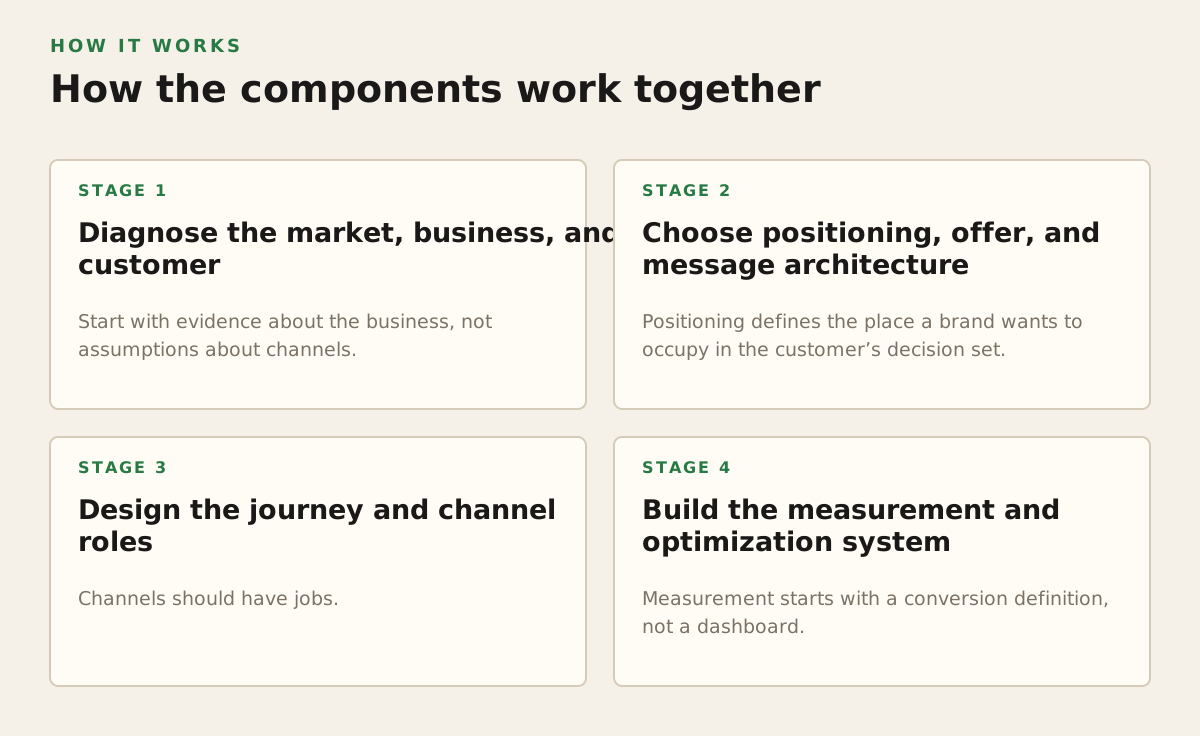
The strongest strategies move from diagnosis to choices, then from choices to an operating system. The sequence below is not rigid, but skipping a layer usually creates expensive ambiguity later.
1. Diagnose the market, business, and customer
Start with evidence about the business, not assumptions about channels. Review sales data, customer interviews, search behavior, product reviews, support tickets, competitor alternatives, margins, retention, and current campaign performance. The objective is to identify a commercially meaningful problem, not to collect every possible demographic attribute.
Segment customers by a difference that changes the marketing decision. Useful differences can include urgency, use case, buying sophistication, category awareness, order size, or switching barrier. “Women aged 25–44” may be useful for media planning, but it is rarely sufficient positioning guidance. “First-time parents who need a simpler nighttime routine” gives creative and offer teams more to work with.
Then write a concise strategic hypothesis:
- Customer: Who has the problem and enough motivation to act?
- Problem: What friction, risk, cost, or desired outcome matters most?
- Alternative: What do they use or do now?
- Advantage: What can this brand credibly do better or differently?
- Evidence: What proof reduces doubt at the moment of choice?
2. Choose positioning, offer, and message architecture
Positioning defines the place a brand wants to occupy in the customer’s decision set. It is broader than a tagline. It should guide the promise, reasons to believe, tone, visual language, product presentation, and objections the brand must answer.
The offer converts that strategic position into a reason to act now. An offer might involve the product, bundle, trial, guarantee, service level, financing, onboarding, or educational value. It should not be used to compensate indefinitely for weak product-market fit or unclear value.
A practical message architecture has layers:
- Core promise: the outcome the customer wants.
- Supporting benefits: the mechanisms that make the outcome relevant.
- Proof: demonstrations, reviews, credentials, comparisons, or transparent terms.
- Objection handling: answers to price, risk, switching effort, timing, or suitability concerns.
- Action: the next step appropriate to the customer’s level of intent.
That architecture gives creative teams room to produce many executions without changing the underlying strategy. It also makes performance feedback more useful: a weak ad may indicate a poor hook, insufficient proof, or an offer problem rather than a need to abandon the entire positioning.
3. Design the journey and channel roles
Channels should have jobs. Paid search can capture existing intent; paid social can create demand and develop a category story; email and SMS can support retention and conversion; organic content can answer questions and build discoverability; partnerships or creators can transfer credibility. These are typical roles, not guarantees. The right mix depends on customer behavior, buying cycle, creative assets, sales process, and available measurement.
Map the customer journey by decision stage:
- Problem recognition: the customer names a need or notices a cost.
- Exploration: the customer compares approaches, brands, or products.
- Evaluation: the customer looks for proof, fit, terms, and risk reduction.
- Conversion: the customer completes the intended action.
- Retention: the business earns a second order, renewal, referral, or expansion.
Do not force every channel to perform every job. A prospecting campaign judged only by last-click purchases may be undervalued; a retargeting campaign judged without frequency or incremental impact may be overvalued. The strategy should specify what each channel is expected to influence and which downstream evidence will be reviewed.
Tracking must reflect those roles. Google Analytics documents campaign parameters such as source, medium, and campaign name for identifying traffic from marketing activities in reports: Google’s campaign URL guidance. Consistent naming is operationally important because inconsistent parameters can split one activity into multiple reporting categories.
4. Build the measurement and optimization system
Measurement starts with a conversion definition, not a dashboard. Define the primary business event, supporting events, revenue treatment, and data owner. For an ecommerce company, a primary event may be a completed purchase, with product view, add-to-cart, checkout start, and email signup as diagnostic events.
Google Ads distinguishes conversion actions and provides guidance for setting up conversion tracking across website, app, phone, and offline activity; the implementation should match the actual customer journey rather than count every interaction as a success. See the official Google Ads conversion tracking guide.
A measurement plan should document:
- Primary KPI: the metric tied most directly to the business objective.
- Guardrails: margin, refund rate, lead quality, frequency, or service capacity.
- Diagnostic metrics: click-through rate, landing-page engagement, conversion rate, and checkout completion.
- Attribution limits: what the system can observe and what it cannot establish.
- Decision cadence: when campaigns, creative, audiences, and landing pages will be reviewed.
Google’s documentation on enhanced conversions describes using first-party customer-provided data to improve conversion measurement when implemented according to its requirements; it does not turn modeled or instrumented data into perfect causal truth. Treat measurement as evidence with uncertainty, not as an unquestionable scoreboard. The relevant implementation guidance is available in Google Ads’ enhanced conversions documentation.
Where marketing strategies break
Most strategic failures are connection failures. The individual activities may look reasonable, but the system does not carry a consistent promise or produce trustworthy learning.
Activity replaces prioritization
A calendar full of posts, campaigns, and tests can conceal the absence of a decision. “We need more content” is not a diagnosis. Ask which customer belief is missing, which stage is underperforming, and what evidence would change the next action.
Similarly, adding channels before establishing a repeatable message usually multiplies confusion. More placements create more reporting noise, more creative requirements, and more opportunities for inconsistent claims.
Attribution is mistaken for causation
Platform-reported conversions are useful for optimization, but they are not a complete account of incremental demand. A conversion may have encountered several touchpoints, been influenced by offline activity, or occurred because the customer was already planning to buy. Compare platform reporting with blended revenue, cohort behavior, controlled tests where practical, and changes in new-customer volume.
Privacy restrictions, consent choices, browser behavior, ad blockers, cross-device journeys, and offline sales can all create gaps. Meta’s developer documentation describes the Conversions API as a way to send events from a server or other direct integration to Meta systems; implementation can improve signal coverage, but it does not remove the need for valid consent, event quality, and sound business analysis. See Meta’s Conversions API documentation.
Creative and conversion experience disagree
An ad promising speed that leads to a page emphasizing premium craftsmanship creates friction even if both claims are true. The customer must reconstruct the story, which reduces clarity and makes performance harder to interpret.
Audit the handoff across the journey:
- Does the ad promise match the landing-page headline?
- Does the page explain the same audience problem as the creative?
- Does proof answer the objection raised by the message?
- Is the call to action appropriate for the customer’s intent?
- Does the checkout or lead form introduce an avoidable barrier?
Conversion optimization is therefore not just a button-color exercise. It is the process of removing uncertainty and effort at the point where the customer must act.
How practitioners apply the framework
Turn the strategy into a one-page operating brief before building campaigns. The brief should be specific enough that a media buyer, creative strategist, analyst, and landing-page owner can make consistent decisions without inventing separate goals.
For example, an illustrative direct-to-consumer brief might say:
- Objective: acquire 1,000 new customers in a quarter while protecting a contribution-based acquisition-cost ceiling set by finance.
- Priority audience: customers replacing an inconvenient product, rather than bargain hunters seeking the lowest price.
- Positioning: a simpler solution for a defined use case, supported by demonstration and transparent terms.
- Channel roles: search captures high intent, social demonstrates the problem and solution, email supports recovery and repeat purchase.
- Creative system: three problem-led angles, two proof formats, and one objection-handling sequence.
- Measurement: completed purchase and contribution revenue as primary measures; add-to-cart, checkout completion, refund rate, and repeat purchase as diagnostics.
The numbers in that example are illustrative planning inputs, not performance benchmarks. A team should replace them with its forecast, capacity, margin structure, and historical data.
Use decision rules, not constant opinion
Set rules for what happens when evidence changes. For instance, an illustrative starting policy could be to preserve a campaign when it is within the approved acquisition-cost range and producing qualified orders, refresh creative when attention is weak but downstream conversion is healthy, and investigate the offer or landing page when traffic is adequate but checkout progression is poor.
Rules should include a learning window appropriate to volume and sales cycle. Do not make a judgment after a handful of impressions or conversions merely because a dashboard updates instantly. Conversely, do not keep funding an activity for months without a defined question or review date.
Run a connected planning cadence
A useful cadence separates strategic review from execution review:
- Monthly: review revenue, acquisition cost, margin, retention signals, customer quality, and major customer or market changes.
- Weekly: review spend pacing, creative fatigue, conversion-path friction, tracking anomalies, and operational constraints.
- Per test: state the hypothesis, audience, change, primary metric, guardrails, and decision that follows each possible result.
This is where brand strategy, creative development, media buying, and performance optimization should operate as one system. Brand work protects meaning and preference; performance work makes response measurable; conversion work removes friction; media work allocates reach and demand capture. Separating them into unrelated departmental targets creates the very gaps the strategy is meant to prevent.
A practical recommendation for building your next strategy
Begin with the commercial constraint, then work backward: define the profitable customer and desired outcome, identify the customer belief that blocks action, choose the positioning and offer that address it, assign clear jobs to channels, and instrument the journey before scaling spend. Keep the brief short, but make the decisions and trade-offs explicit.
For teams that need an outside partner to connect brand, creative, media, and measurement around acquisition cost and lifetime value, Kimmel Marketing can help shape and operate that system through its Kimmel Marketing and broader marketing expertise.
Authored with NotFair SEO