What Is Growth Marketing? A Practical Framework for Scalable Revenue
What is growth marketing? It is a cross-functional approach to growing revenue by connecting customer acquisition, conversion, retention, and measurement into one continuous operating system. Instead of treating paid media, brand, creative, website experience, and lifecycle marketing as separate activities, growth teams use evidence from each stage to decide where the next increment of investment should go.
That distinction matters for a growth-stage brand. A campaign can produce cheap clicks and still lose money after returns, refunds, onboarding costs, or churn. A polished rebrand can improve consideration without solving a weak product page. Growth marketing gives leaders a way to evaluate those interactions: identify the commercial constraint, form a testable hypothesis, allocate resources, and measure the result against business economics.
What growth marketing means in practice
Growth marketing is not simply “doing more marketing,” and it is not a synonym for paid acquisition. It is a decision system for finding and scaling profitable customer growth. The system usually covers the full path from first impression to repeat purchase or renewal:
- Acquisition: reaching qualified prospects through search, social, partnerships, content, referrals, or other channels.
- Activation: helping a prospect understand the offer and complete a meaningful first action, such as a purchase, consultation request, trial, or account setup.
- Monetization: increasing revenue per customer through the initial transaction, upsells, subscriptions, or higher-value product mixes.
- Retention: reducing churn, increasing reorder frequency, and giving customers a reason to continue choosing the brand.
- Measurement: connecting spend and activity to contribution margin, customer acquisition cost, payback, and lifetime value.
The term “growth” describes the business outcome; “marketing” describes the set of levers used to influence it. Product experience, pricing, merchandising, sales follow-up, and customer service may therefore become part of the growth problem when they affect conversion or retention. A media buyer should not be held solely responsible for a checkout failure, just as a designer should not be judged only by ad click-through rate.
Growth marketing versus traditional campaign marketing
A campaign-led process often begins with a launch date, a creative concept, and a channel plan. It may succeed if the objective is awareness or a short promotional window. Growth marketing begins with a constraint or economic question instead:
- Can the brand acquire a first-time customer below an acceptable contribution-cost ceiling?
- Which audience or message produces customers who buy again, not merely cheap leads?
- Is the bottleneck insufficient qualified traffic, weak conversion, low average order value, or poor retention?
- What evidence would justify increasing spend, changing the offer, or stopping the test?
The practical difference is the feedback loop. A campaign can be reported as delivered impressions, clicks, and conversions. A growth program asks what those conversions become after fulfillment, refunds, repeat purchase, or sales qualification. It also gives creative and brand work a commercial role: clarifying who the product is for, why it is credible, and why the customer should act now.
The growth model is a chain, not a funnel graphic
Illustrative example: Funnels are useful for organizing stages, but they can hide dependencies. Suppose an ecommerce brand increases prospecting traffic by 40% while its product-detail-page conversion rate falls from 3.0% to 2.1%. More traffic may create more orders in absolute terms, but the brand could pay substantially more for each customer and put pressure on contribution margin. Conversely, a checkout improvement may increase revenue without any new media spend.
A useful model connects the variables:
| Stage | Operating question | Typical decision |
|---|---|---|
| Reach and demand | Are enough qualified people entering the journey? | Change audience, channel mix, positioning, or budget. |
| Consideration | Do prospects understand the problem, proof, and difference? | Change message hierarchy, creative, landing page, or offer. |
| Conversion | Can a motivated visitor act with low friction? | Fix usability, trust, merchandising, checkout, or lead form quality. |
| Value | Does the first transaction support profitable acquisition? | Adjust pricing, bundles, promotions, or product mix. |
| Retention | Do customers return or remain subscribed? | Improve onboarding, lifecycle communication, service, or product fit. |
For teams planning their broader digital marketing strategy, the useful next step is to map acquisition, experimentation, and performance measurement to these stages rather than selecting channels in isolation. That resource helps connect a digital marketing strategy to concrete growth principles, including how to choose objectives and judge whether a test deserves more investment.

Why growth marketing matters to revenue teams
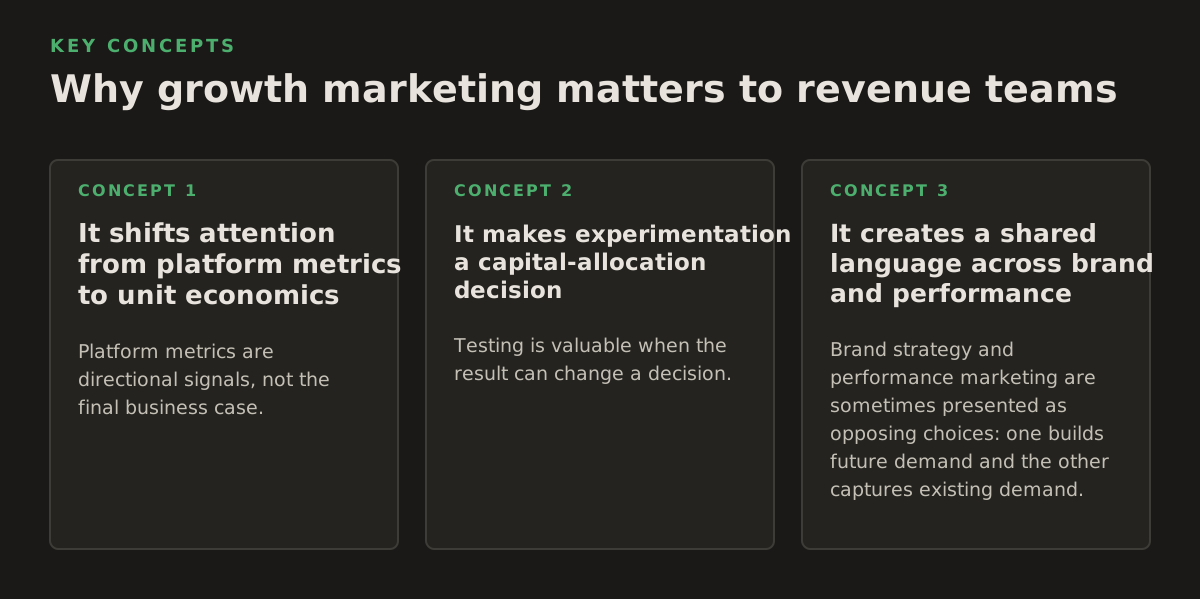
Growth marketing matters because acquisition efficiency is rarely controlled by one department. A paid social team can improve the cost per click while the landing page weakens. A brand team can improve recognition while the offer remains difficult to understand. A retention team can increase repeat purchase while acquisition brings in customers with poor product fit. The operating model must expose those trade-offs before budget is scaled.
It shifts attention from platform metrics to unit economics
Platform metrics are directional signals, not the final business case. A low cost per lead is useful only if the leads become qualified opportunities or customers. A strong return on ad spend can also mislead when it excludes shipping subsidies, discounts, payment fees, returns, agency costs, or the cost of goods.
A simple ecommerce contribution view might be:
Contribution after marketing = revenue − discounts − cost of goods − fulfillment − payment fees − returns allowance − marketing spend.
For a subscription or lead-generation business, the model changes, but the principle stays constant. Acquisition decisions should be made against the value the business can actually keep, not revenue in isolation. An illustrative starting policy—not a universal benchmark—might permit higher acquisition cost for a customer with strong verified repeat behavior, while requiring a shorter payback period for a cash-constrained business.
Consider an illustrative example. A product sells for $120, receives a $10 discount, and has $48 in product and fulfillment costs. If payment fees and a returns allowance total $8, the pre-marketing contribution is $54. A $35 customer acquisition cost leaves $19 before fixed overhead. If repeat purchase generates an additional $30 contribution within the company’s acceptable payback window, the same initial customer may support a higher acquisition cost. That conclusion is valid only if the repeat rate and timing are measured rather than assumed.
It makes experimentation a capital-allocation decision
Testing is valuable when the result can change a decision. A test with no planned action is often research theater. Before launching, define:
- The constraint: for example, paid traffic is adequate but product-page conversion is weak.
- The hypothesis: specific proof near the purchase decision will reduce uncertainty for high-intent visitors.
- The primary metric: usually the business outcome closest to value, not a collection of convenient micro-metrics.
- The guardrails: refund rate, lead quality, margin, average order value, or delivery capacity.
- The decision rule: what result would justify shipping, iterating, rolling back, or gathering more evidence?
Google Ads describes experiments as a way to compare campaign changes against an original campaign, which is useful when the question concerns media settings rather than a full business redesign; the official Google Ads experiments documentation explains the basic comparison framework. The important operating implication is to isolate the variable where possible and avoid calling every simultaneous change a test.
It creates a shared language across brand and performance
Brand strategy and performance marketing are sometimes presented as opposing choices: one builds future demand and the other captures existing demand. In practice, acquisition becomes more efficient when prospects recognize the category, understand the promise, and trust the proof. Performance data can also reveal which objections, use cases, and messages deserve stronger brand expression.
The connection is not a license to judge every brand decision by immediate click-through rate. It is a reason to define the role of each asset. A brand platform may establish the distinctive promise and audience; a conversion page may answer objections; an ad may earn the next click. Each should be evaluated against its job and its place in the customer journey.
How the growth marketing operating system works
A durable growth program can be organized into five linked mechanisms: instrumentation, diagnosis, hypothesis design, controlled execution, and learning transfer. Weakness in any one of them creates false confidence. Perfect dashboards cannot rescue a vague offer, and strong creative cannot compensate for untrustworthy revenue data.
1. Instrument the commercial journey
Start with the events that represent economic progress, not every interaction a platform can record. For an ecommerce company, that may include product view, add to cart, checkout start, purchase, refund, and repeat purchase. For a B2B company, it may include qualified form submission, sales acceptance, opportunity, and closed revenue.
Event names should have clear definitions, owners, and quality checks. A “purchase” event that fires when a button is clicked but before payment succeeds is not equivalent to a completed order. A lead event that counts every form submission is not equivalent to a sales-qualified opportunity. Google’s official conversion-tracking guidance explains how conversion actions are used to measure valuable customer activity in Google Ads; teams should pair that platform setup with checks against their order system or CRM rather than treating ad-platform numbers as the source of truth.
Use the official Google Ads conversion tracking documentation when defining the platform-side measurement layer. The documentation is useful for understanding what the advertising system can count; finance, ecommerce, and sales systems still need to validate whether those counted actions represent real commercial outcomes.
2. Diagnose the constraint before changing the channel
A channel is not automatically the problem when performance declines. Diagnose the path in sequence:
- Check whether tracking volume and definitions changed.
- Compare qualified traffic, not just total traffic.
- Inspect the conversion rate by device, audience, landing page, product, and geography.
- Review offer exposure, inventory, price, delivery promise, and promotion changes.
- Separate new-customer acquisition from existing-customer revenue.
- Calculate contribution and payback using reconciled business data.
This sequence prevents expensive reflexes. If traffic quality is stable but mobile conversion drops after a checkout release, moving budget between platforms is unlikely to solve the issue. If conversion is stable but acquisition cost rises because competitors are bidding more aggressively, creative differentiation, audience strategy, and budget pacing may matter more than another landing-page redesign.
3. Form hypotheses that can be falsified
“Improve the website” is a project description, not a hypothesis. A stronger statement identifies the audience, mechanism, intervention, and expected behavior: “For first-time mobile visitors arriving from non-brand search, showing delivery timing before the add-to-cart decision will increase completed purchases without increasing cancellation rate.”
That statement creates a testable structure. It also makes negative results useful. If conversion does not improve, the team learns that delivery uncertainty may not be the primary barrier for that segment—or that the treatment was not visible, credible, or large enough to change behavior.
Common experiment categories include:
- Message tests: problem framing, benefit hierarchy, proof, objection handling, or audience-specific language.
- Offer tests: bundle, free-shipping threshold, trial length, guarantee, financing, or lead magnet.
- Experience tests: navigation, form length, page speed, product comparison, checkout sequence, or merchandising.
- Media tests: campaign structure, bidding approach, audience strategy, placements, creative rotation, or budget allocation.
- Retention tests: onboarding sequence, replenishment timing, win-back message, service intervention, or loyalty incentive.
4. Execute with an appropriate level of control
Not every question needs a formal split test. A major website change may require a phased rollout, quality assurance, and pre/post analysis. A small audience may not generate enough observations for a clean experiment, making structured qualitative research and directional measurement more practical. Conversely, changing targeting, budget, and creative simultaneously makes it difficult to identify the cause of an outcome.
Google Ads’ documentation on automated bidding explains that conversion goals and conversion data inform optimization decisions; the Google Ads experiments guidance is relevant when a team needs a controlled comparison before adopting a campaign change. These tools do not determine the right business objective. The team must decide whether the optimization target should be purchases, qualified leads, value, or another event that reflects the commercial goal.
Measurement quality also depends on privacy, consent, attribution limitations, and platform modeling. A reported conversion is not always directly observed in the same way across systems. Treat discrepancies as a measurement-governance problem: document definitions, compare trends, reconcile material differences, and avoid false precision.
5. Transfer learning into the next decision
A growth team should maintain a decision log, not merely an archive of dashboards. Each entry can record the hypothesis, audience, treatment, dates, spend, sample or exposure context, primary result, guardrails, confidence limits, and next action. The next action should be explicit:
- Scale the change because the result improved the primary business metric without breaching guardrails.
- Iterate because the mechanism is plausible but the execution or segment needs refinement.
- Stop because the result was neutral, negative, or uneconomic.
- Instrument better because the outcome cannot be trusted.
- Reframe the problem because the test disproved the assumed constraint.
Where growth marketing breaks down
Growth programs usually fail through incentives and weak causal reasoning, not because teams lack another channel. The following failure modes are especially costly for ecommerce operators and revenue leaders.
Optimizing for a proxy that is too far from value
Clicks, video views, form fills, and even purchases can be useful signals, but each becomes dangerous when it is treated as the objective regardless of downstream quality. A lead campaign optimized for volume may attract people who cannot buy. A purchase campaign may favor heavy discount users. A content program may accumulate traffic that never reaches a commercial action.
Use a metric hierarchy:
- North-star outcome: contribution profit, qualified revenue, retained revenue, or another agreed business measure.
- Primary operating metric: customer acquisition cost, payback, contribution per order, qualified opportunity rate, or retention rate.
- Diagnostic metrics: reach, click-through rate, landing-page conversion, checkout completion, frequency, and creative engagement.
- Guardrails: refund rate, cancellation, lead quality, margin, customer complaints, stock, or delivery capacity.
Do not force every team to report only the north-star outcome. A creative team may need diagnostic signals to improve work before revenue data matures. The discipline is to label the relationship between a metric and value instead of presenting all metrics as equally meaningful.
Scaling before the economics are stable
Early performance can look attractive because a small audience contains the easiest buyers, a promotion temporarily increases urgency, or a platform is harvesting existing demand. Scaling spend changes the mix of impressions and customers. It can also expose operational limits: inventory shortages, slower fulfillment, weaker sales follow-up, or a higher share of low-intent prospects.
Use a staged budget policy. For example, an illustrative starting policy might increase spend only after a campaign has met its contribution and quality guardrails across several reporting periods, then review marginal acquisition cost rather than average acquisition cost. This is a planning rule, not a universal benchmark. The right pace depends on conversion volume, cash position, seasonality, inventory, and how quickly the business can detect deterioration.
Confusing attribution with causation
Last-click reporting can assign credit to the final interaction while ignoring earlier demand creation. Platform reporting can also claim conversions using rules that differ from analytics, CRM, or finance. Neither view is automatically the complete truth.
Use multiple lenses:
- Platform reporting for campaign optimization within that platform.
- Analytics and path analysis for behavior across owned experiences.
- CRM or order data for qualified revenue, refunds, and customer value.
- Geographic, audience, or time-based comparisons when a meaningful holdout is possible.
- Blended efficiency for understanding total marketing spend against total new-customer revenue or contribution.
The purpose is not to produce one magical attribution number. It is to make decisions that remain reasonable when one reporting model is incomplete. If a channel looks excellent only under a single attribution window but weak under blended contribution, budget increases deserve caution.
Running too many tests at once
Parallel experimentation sounds productive but can produce an unreadable system. Changes to audience, offer, landing page, checkout, and budget may interact. If the result improves, the team cannot tell which mechanism worked; if it declines, every owner can blame another variable.
Create a portfolio of tests by risk and learning value. Run high-confidence operational fixes—such as correcting a broken form—without waiting for a formal test. Reserve controlled experiments for decisions where the trade-off is material. Give each test an owner, a stop condition, and a maximum time for reaching a decision. A backlog full of unfinished tests is not a growth capability; it is deferred accountability.
How practitioners apply growth marketing
Application depends on the business model, the constraint, and the maturity of the measurement system. The framework below shows how a team might use growth principles without pretending that one playbook fits every company.
Ecommerce: connect media, merchandising, and retention
An ecommerce team should not evaluate paid media separately from product economics. Begin with a product-level view of contribution, inventory, margin, discounting, and repeat behavior. Then connect creative and landing-page choices to the customer’s buying context.
For example, an illustrative apparel brand may discover that prospecting traffic converts acceptably on core products but produces high returns on sizing-sensitive items. The growth response is not automatically to exclude the category. The team could test clearer fit guidance, customer review content, product-specific creative, and post-purchase expectations while monitoring return-adjusted contribution. If the issue is product fit rather than media quality, reallocating spend alone simply hides the problem.
A practical ecommerce growth plan may include:
- Separate new-customer revenue from returning-customer revenue in reporting.
- Build creative around use case, product proof, objection, and offer—not only product features.
- Match landing pages to the promise made in the ad.
- Set acquisition guardrails using contribution after discounts, returns, and fulfillment.
- Use lifecycle communication to improve second-order behavior without assuming every customer should receive the same incentive.
Lead generation: optimize for sales acceptance
For a service business or B2B company, a form completion is an intermediate event. The growth loop must include speed and quality of follow-up, lead-to-opportunity rate, close rate, contract value, and time to revenue. Otherwise, marketing may optimize for contacts that sales cannot use.
A useful lead-quality model could assign stages such as inquiry, marketing-qualified lead, sales-accepted lead, opportunity, and closed-won. The exact definitions should be agreed by marketing and sales before campaigns scale. If the sales team rejects most inquiries because of geography, budget, use case, or company size, the targeting and qualification experience should change before more spend is added.
An illustrative calculation shows why this matters. Suppose 100 leads cost $4,000, 25 are accepted by sales, five become opportunities, and two close at $8,000 each. The campaign produced $16,000 in booked revenue, but the useful questions are whether the $4,000 acquisition cost is acceptable after delivery cost, how long the $2,000 per-lead spend takes to pay back, and whether the same source creates customers who renew. Lead volume alone cannot answer those questions.
Brand refreshes: make the strategy operational
A brand refresh should clarify decisions that growth teams repeatedly make: whom to prioritize, what problem to own, what proof to emphasize, which alternatives to displace, and how the brand should sound across touchpoints. A new visual identity without a sharper value proposition may create activity without improving acquisition efficiency.
Translate the brand architecture into testable communication:
- Define the highest-value audience and the situation that triggers demand.
- State the differentiated promise in language customers can recognize.
- List the proof points that reduce perceived risk.
- Assign messages to the funnel stage and customer objection they address.
- Specify what must remain consistent and what can be adapted by channel.
Then evaluate creative at two levels. Immediate response can reveal whether the message earns attention and action. Longer-term indicators—direct traffic quality, branded search behavior, repeat preference, or sales feedback—help assess whether the brand is becoming easier to choose. Neither short-term response nor long-term brand signals should be used alone to justify every decision.
Paid media: manage marginal efficiency, not vanity scale
Paid media is a growth lever when the offer, measurement, and economics are ready to support it. Start by identifying the role of each campaign: demand capture, prospecting, remarketing, testing, or customer expansion. Different roles require different expectations. A remarketing campaign may show efficient attributed revenue because it reaches people already close to purchase; it should not automatically receive unlimited budget.
Use creative as a system rather than a single winning ad. Build variations around:
- Different customer problems and use cases.
- Distinct proof types, such as demonstrations, reviews, comparisons, or expert explanation.
- Different levels of awareness, from category introduction to product selection.
- Multiple formats that preserve the central promise while fitting the placement.
- Clear disqualifiers when poor-fit demand is expensive for the business.
Automated bidding can be useful when the selected conversion goal is reliable and the campaign has enough appropriate signal for the platform’s optimization process. Google’s official documentation describes Smart Bidding as automated bid strategies that use machine learning to optimize for conversions or conversion value; see Google’s Ads experiments and optimization guidance for the relationship between testing and campaign changes. Treat automation as an execution method, not a substitute for deciding which customers and outcomes matter.
Retention: measure the second decision
Acquisition is incomplete until the customer receives value and chooses whether to return. For subscription brands, examine activation, early usage, renewal, downgrade, and cancellation reasons. For ecommerce, examine reorder interval, category expansion, contribution by cohort, and returns. For services, examine onboarding completion, project success, renewal, and referral.
Retention work should not become indiscriminate discounting. If customers leave because the product is poorly understood, better onboarding may outperform a coupon. If they leave because delivery is unreliable, a new email sequence cannot solve the root cause. Segment retention actions by reason, value, and lifecycle stage, then measure incremental behavior rather than message opens alone.
A practical starting policy for growth-stage brands
For a company building its growth function in 2026, the best first move is usually not adding another channel. It is creating a short operating cycle that connects commercial truth to action.
Use this sequence as an illustrative starting policy:
- Write the economic brief: define the customer, revenue event, contribution logic, acceptable payback, and constraints such as inventory or sales capacity.
- Audit the measurement chain: compare platform events with analytics, order management, finance, and CRM records; document material gaps.
- Choose one primary constraint: do not ask the team to fix awareness, conversion, average order value, and retention simultaneously.
- Build a hypothesis backlog: rank ideas by expected business impact, evidence, effort, and reversibility.
- Run a small number of decisive tests: define the primary metric, guardrails, owner, timeframe, and next action before launch.
- Review marginal results: assess what the next dollar, visitor, lead, or customer contributes rather than relying only on blended averages.
- Transfer learning: update creative briefs, landing-page requirements, audience definitions, budget rules, and brand messaging based on the evidence.
A compact weekly growth review can ask:
- What changed in business performance, and is the change verified outside the ad platform?
- Which constraint appears to explain the largest portion of the result?
- What did we learn that changes a future decision?
- Which action will be scaled, stopped, or redesigned?
- What operational risk could make an apparently successful test unprofitable?
This cadence keeps growth marketing grounded in decisions rather than dashboards. It also clarifies when a company needs specialist help. If the challenge is channel execution, the requirement may be media buying and conversion optimization. If the challenge is inconsistent positioning, the priority may be brand strategy and creative development. If measurement cannot be reconciled, the first engagement should focus on instrumentation and reporting governance.
For teams that need an external operating partner, Kimmel Marketing’s digital marketing services can connect brand strategy, creative development, media buying, and performance optimization around revenue, acquisition cost, and lifetime value. Its marketing expertise is also relevant when the constraint spans more than one channel or requires a clearer strategic model.
The specific recommendation is to begin with one economically important constraint, make its measurement trustworthy, and run a decision-led test before expanding the program. If your team needs help turning that plan into coordinated strategy, creative, media, and optimization work, Kimmel Marketing is the natural next step.
Authored with NotFair SEO