What Is Included In A Brand Strategy? 7 Decisions Growth Teams Need
What is included in a brand strategy is a practical set of decisions about whom a brand serves, what it should mean to those people, how it differs from alternatives, and how that meaning shows up in words, visuals, and customer experiences. For a growth-stage or ecommerce business, the useful deliverable is not just a logo or a positioning statement: it is a shared framework teams can use to make acquisition, creative, and customer-experience choices more consistent.
This guide breaks the work into seven components, explains when each matters, and offers a sequence for putting the decisions into practice. Use it to assess a strategy proposal or identify what your team still needs to decide before commissioning a refresh. The right scope depends on the problem: a business entering a new category may need sharper positioning, while a company with a clear position but inconsistent ads may need better identity rules and governance.
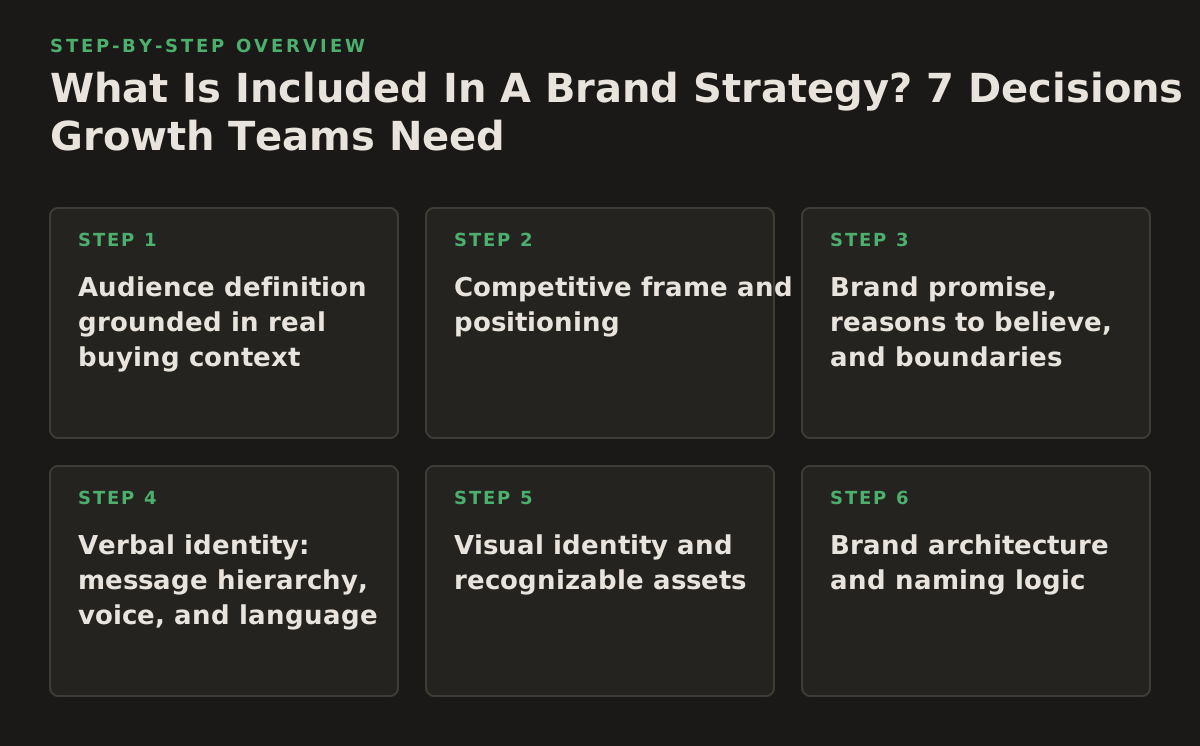
1. Audience definition grounded in real buying context
Audience definition is the starting point when a brand is attracting the wrong prospects, struggling to explain its relevance, or expanding into a new market. It should describe more than age, job title, or company size. Teams need to understand the buyer’s situation: what triggers a search, what alternatives they consider, what makes a purchase feel risky, and who else influences the decision.
This matters because positioning and creative have to respond to a specific problem. “Ecommerce companies” is too broad to guide a campaign. A more useful description might be “marketing leaders at growing online stores who need to improve acquisition efficiency without sacrificing the quality of new customers.” That framing suggests relevant objections, proof requirements, and use cases. The U.S. Small Business Administration recommends examining demand, market size, location, saturation, and competitor alternatives as part of market research; its market research and competitive analysis guidance is a practical checklist for this discovery work.
Make the audience usable by the team
Use evidence before persona polish. Start with customer interviews, sales conversations, support themes, search behavior, or existing analytics where available. Separate observed patterns from assumptions, and note which segments are most important to the business now. Don’t imply that a small set of anecdotes represents every buyer.
- Record the purchase trigger and the job the buyer is trying to complete.
- Capture the main alternative: another provider, an in-house approach, or doing nothing.
- List the objection that could block purchase and the evidence that would address it.
- Mark each insight as observed, inferred, or still unverified.
Failure mode: A persona document can become a fictional character profile that never changes a decision. For example, “busy founder who values innovation” does not tell a creative team what claim to make. A usable brief might instead say: “When evaluating a new acquisition partner, this founder needs to understand how channel decisions will be tied to revenue, not just clicks.” The distinction directs messaging toward a real evaluation criterion.
2. Competitive frame and positioning
Positioning defines the space you intend to own in a buyer’s mind: the category or context in which they compare you, the audience you serve, the benefit you emphasize, and the reason to believe your offer. It is especially important when prospects confuse your business with competitors, when your products serve distinct needs, or when growth plans depend on entering a new segment.
A strong position is selective. It gives the business a reason to be chosen, but also makes clear which claims it should not lead with. “High quality and great service” is not a useful distinction if every competitor can say the same thing. Look for a meaningful difference in the problem addressed, the operating model, the expertise applied, or the kind of outcome the product is designed to support. The American Marketing Association’s branding resources provide a useful grounding in how brands create meaning and differentiation; use that as context, then test whether your own proposed distinction is specific and supportable.
Write a position that can guide a choice
A working statement can follow this structure: “For [priority audience] facing [important situation], [brand] is the [category or alternative] that [distinctive benefit], because [credible support].” Treat it as an internal decision tool, not necessarily finished customer-facing copy.
For an illustrative ecommerce example, a platform serving independent home-goods retailers might position around helping teams manage complex product catalogs, rather than claiming to be “the easiest platform for every retailer.” The narrower territory may better fit the product and make campaign concepts more concrete. But if the product cannot support the catalog needs implied by the statement, the position creates a promise the experience will disappoint.
Failure mode: Choosing a differentiator because it sounds compelling, without checking whether customers notice it or the business can consistently deliver it. Ask sales and customer-facing teams for examples, compare competitor claims, and identify what evidence exists. The final strategy should distinguish what customers value from what the company merely wants to be known for.
3. Brand promise, reasons to believe, and boundaries
The brand promise translates the position into the expectation a customer should carry from one interaction to the next. It applies when a company’s marketing makes attractive claims but the sales process, product experience, or support does not reinforce them. A promise should describe a meaningful benefit while staying inside what the organization can deliver.
Pair every central promise with reasons to believe: product capabilities, service practices, relevant expertise, or verifiable evidence. This does not mean making every piece of marketing a proof-heavy case study. It means the strategy identifies what substantiates the claim so teams know which proof to use and which claims need more validation.
- Promise: the expectation the customer should reasonably have.
- Proof: the product feature, process, or evidence that supports it.
- Boundary: the condition or limitation that prevents overclaiming.
For example, an online retailer might want to promise “a simpler way to choose the right fit.” The proof could be a detailed sizing guide and clear product measurements. A boundary might be that fit varies by style, so the brand should not imply a perfect fit for everyone. The example is illustrative; each company needs to establish its own proof from its actual product and customer experience.
Failure mode: Writing an ambitious promise first and asking operations to make it true later. That creates a gap customers can expose in reviews, returns, or support interactions. Check the promise against the whole customer journey, not only the ad that introduces it.
4. Verbal identity: message hierarchy, voice, and language
A verbal identity tells teams what to say, in what order, and how the brand should sound. It is valuable when multiple people create landing pages, paid ads, email, sales materials, and product copy. Without shared guidance, each channel may describe a different benefit or use a different vocabulary for the same offer.
Build a message hierarchy rather than a pile of slogans. A typical framework includes the core proposition, supporting messages, proof points, audience-specific emphasis, and language to avoid. Voice guidance should describe choices teams can apply, such as direct versus playful or technical versus plainspoken. Avoid vague traits like “bold” unless the guide shows what that means in a headline, product explanation, and response to a customer concern. Mailchimp’s public content style guide is one example of a documented approach to voice, tone, and editorial conventions; adapt the level of operational detail to your own team and channels.
Turn principles into usable copy rules
For a performance creative team, the strategy might state that the brand leads with a specific customer problem, explains the mechanism, then presents evidence. It could also identify words that overstate product capability. For instance, replace “guaranteed growth” with a substantiated description of what the product or service actually does.
- Define one primary message for each priority audience or use case.
- List supporting claims and the proof required before using them.
- Give examples of the voice in short-form ads and longer explanatory copy.
- Specify terminology, capitalization, and phrases that create confusion.
Failure mode: Treating voice as a personality exercise with no effect on copy decisions. If a writer cannot use the guide to revise a real ad or product page, it is not operational enough. Keep rules short, show before-and-after examples, and leave room for channel constraints.
5. Visual identity and recognizable assets
Visual identity is the system of visual choices that makes the brand recognizable and supports its intended meaning. It matters when a company is refreshing its look, expanding into new channels, or producing creative through multiple teams. The scope may include a logo, color and type systems, photography or illustration direction, layout patterns, and rules for using those elements together.
Strategy should explain the role of the design, not prescribe every execution. A business that needs to feel clear and dependable might favor legible typography and product imagery that helps buyers evaluate options. A brand built around expressive discovery may need more room for editorial storytelling. Either way, recognition depends on repeatable choices, while channel performance still requires creative variations that suit the placement and message.
One implementation example: create a small set of ad templates that preserve the same logo treatment, type hierarchy, and product-image standards, while allowing the headline, offer, and featured use case to change. Test distinct creative ideas without changing every brand cue at once; otherwise, it becomes harder to diagnose whether the message or the visual system caused a difference.
Failure mode: Confusing a visual refresh with a brand strategy. A new color palette may improve consistency, but it cannot resolve an unclear audience or an undifferentiated offer. Also, an overly rigid template can make every campaign look alike. Define which elements are fixed, which can flex, and who approves exceptions.
6. Brand architecture and naming logic
Brand architecture explains how the main brand relates to products, services, sub-brands, and acquired or future offers. It becomes important when a company adds product lines, serves distinct audiences, or has names that compete for attention. Without a clear structure, customers may not understand whether an offer is part of the main business, a separate product, or a new company.
Choose a logic that reflects how customers make sense of the offer. A single master brand can concentrate recognition, while separate product brands may help distinguish offerings with different audiences or propositions. A hybrid system can work, but it needs explicit rules for naming, endorsement, visual relationships, and when a new name is justified. There is no universally correct architecture: the trade-off is between clarity and flexibility on one side, and the effort of maintaining multiple identities on the other.
For example, a growing retailer with a core store and a new private-label range could decide whether the range uses the store name, a distinct product name endorsed by the store, or an independent identity. The decision should consider customer expectations, shelf or site navigation, and the role of each name in acquisition and repeat purchase.
Failure mode: Approving a name based only on internal preference or a quick domain check. Before committing, assess customer meaning, potential confusion, and legal availability. The United States Patent and Trademark Office’s trademark search resources can help identify existing marks in the U.S.; search results are not a substitute for a legal assessment, and businesses operating elsewhere need to verify the relevant jurisdictions.
7. Activation, governance, and measurement
A strategy becomes useful when it changes execution. Activation connects the decisions above to the places customers encounter the brand: advertising, landing pages, product pages, email, sales materials, and service interactions. Governance establishes who maintains the system, how teams get guidance, and how exceptions are handled. This section is essential when a business has multiple channels or external creative partners.
Measurement should distinguish brand consistency from business outcomes. A review can check whether priority messages and identity elements appear as intended; campaign and commercial reporting can assess whether the work is supporting acquisition and revenue goals. Do not treat a new brand asset as proof of impact. Where possible, preserve a clear test question, such as whether a new positioning-led landing page improves qualified lead quality versus the current page. The outcome still depends on the offer, audience, media, and measurement design.
| Decision | Evidence to review | First practical action | Failure signal |
|---|---|---|---|
| Audience priority | Customer conversations, sales themes, analytics | Name the buyer situation and key objection | Teams describe different “ideal” customers |
| Positioning | Alternatives, customer value, available proof | Draft a position and test it against actual offers | The claim could describe any competitor |
| Identity system | Existing assets and channel requirements | Define fixed elements and flexible elements | Every asset needs a one-off interpretation |
| Activation | Campaign goals and customer touchpoints | Choose one priority journey to update first | New guidelines are published but unused |
Failure mode: Publishing a polished brand book without assigning ownership or choosing a first application. The strategy then sits apart from the work it was meant to guide. Assign a decision owner, give channel teams access to concise tools, and review exceptions for patterns. If teams repeatedly request the same exception, the rule may need revision rather than stricter enforcement.
For teams connecting brand decisions with channel execution, Kimmel Marketing’s digital marketing services and marketing expertise pages identify the relevant areas of the business; confirm the scope needed for a specific engagement rather than assuming it from a page label.
Implementation plan: move from decisions to a live test
Use this sequence to turn a strategy into a working system without trying to revise every customer touchpoint at once. The order helps prevent a common waste: producing new creative before teams agree on the audience, position, and proof.
- Choose the business problem. State what needs to change—such as unclear differentiation, inconsistent campaign messaging, or a confusing product portfolio. Identify the decision the strategy must enable.
- Gather evidence and mark uncertainty. Review customer and sales input, current claims, competitor alternatives, and relevant business data. Separate confirmed patterns from hypotheses so the team knows what it must validate.
- Agree on audience, position, and promise. Write a concise internal position, list its supporting proof, and document boundaries. Ask people outside the project to explain the intended distinction in their own words; revise if the meaning is not clear.
- Build only the identity tools execution needs. Establish the message hierarchy, voice rules, visual principles, and naming logic relevant to the business problem. Use examples from actual ads, pages, or product communication.
- Apply the strategy to one priority journey. Update a defined set of connected materials, such as an ad and its landing page, or a product listing and follow-up email. Keep the rest of the experience in view so the promise does not break after the first click.
- Review, learn, and govern. Check whether teams applied the strategy as intended and whether the chosen business indicators answer the original question. Record what should stay fixed, what can flex, and what evidence would justify changing the strategy.
Start with the smallest journey that can reveal whether the strategy is usable, not the largest rebrand your organization can announce. Kimmel Marketing works across brand strategy, creative development, media buying, and performance optimization; if those areas need to connect in your plan, learn more at Kimmel Marketing.
Authored with NotFair SEO