What Is Marketing Strategy Examples? 7 Practical Patterns for Growth
What is marketing strategy examples? A marketing strategy is the coordinated plan for choosing a valuable customer, creating a compelling reason to buy, reaching that customer, and improving the economics of acquisition over time. The seven examples below show how growth-stage brands can turn that plan into action across positioning, paid media, content, conversion, retention, partnerships, and measurement.
What a marketing strategy actually includes
A marketing strategy is broader than a campaign, channel, or content calendar. A campaign has a defined promotion and time period. A channel is a way to reach people. A content calendar schedules outputs. Strategy connects those activities to a commercial objective, such as acquiring profitable customers, entering a new market, increasing repeat purchases, or improving brand preference.
A useful strategy answers five linked questions:
- Who is the priority customer? Define the customer by problem, buying context, economics, and readiness—not only by age or job title.
- What problem or desire creates demand? Identify the outcome the customer is already trying to achieve.
- Why should the customer choose this brand? State the differentiated promise and the proof supporting it.
- Where should the brand create and capture demand? Separate channels that generate interest from channels that convert existing intent.
- How will the business decide whether it is working? Choose measures that connect marketing activity to revenue, margin, customer acquisition cost, or lifetime value.
For example, “run paid social ads” is an activity. “Reach first-time parents seeking simpler meal preparation with demonstrations of a lower-effort product, then convert them through a product quiz and subscription offer” is a strategy pattern. The second version contains an audience, need, message, route to purchase, and mechanism for increasing customer value.
Measurement must be designed before launch. Google Ads describes conversion tracking as a way to understand which interactions lead to valuable actions, including purchases, sign-ups, and calls; see its official conversion-tracking guidance. That does not make every conversion equally valuable. A strategy should distinguish a completed purchase from a low-intent event such as a page view.
Why marketing strategy matters for growth-stage brands
Without a strategy, teams often optimize visible activity rather than business progress. More impressions can coexist with weaker demand. More leads can create a sales bottleneck. A lower cost per click can still produce customers with poor retention. The strategic job is to manage trade-offs between reach, conversion rate, acquisition cost, margin, and future customer value.
Strategy creates a decision hierarchy
A practical hierarchy prevents teams from changing everything at once:
- Business outcome: revenue, contribution margin, qualified pipeline, or repeat-purchase growth.
- Customer behavior: purchase, inquiry, trial, subscription, or retention event.
- Funnel constraint: weak demand, poor message fit, low landing-page conversion, or expensive acquisition.
- Intervention: positioning, creative, audience, offer, experience, or budget allocation.
- Evidence: a defined test and a decision rule for scaling, revising, or stopping.
Consider an illustrative ecommerce target: grow monthly contribution profit from $40,000 to $55,000 without reducing gross margin. The team might discover that media is not the first constraint; a low repeat-purchase rate is. In that case, a post-purchase education sequence or replenishment offer may be more strategic than increasing prospecting spend.
Strategy aligns brand and performance
Brand strategy and performance marketing are not competing departments. Positioning gives creative and media a consistent reason to believe. Performance data can reveal which customer problems, claims, and offers generate qualified demand. Brand creates preference; performance captures and improves response.
That relationship is especially important when a company is refreshing its brand architecture. A new visual identity without clearer audience priorities or proof points may improve recognition while leaving acquisition economics unchanged. Conversely, performance creative that chases short-term clicks can weaken the distinctive promise that makes future campaigns easier to remember.
7 practical marketing strategy examples
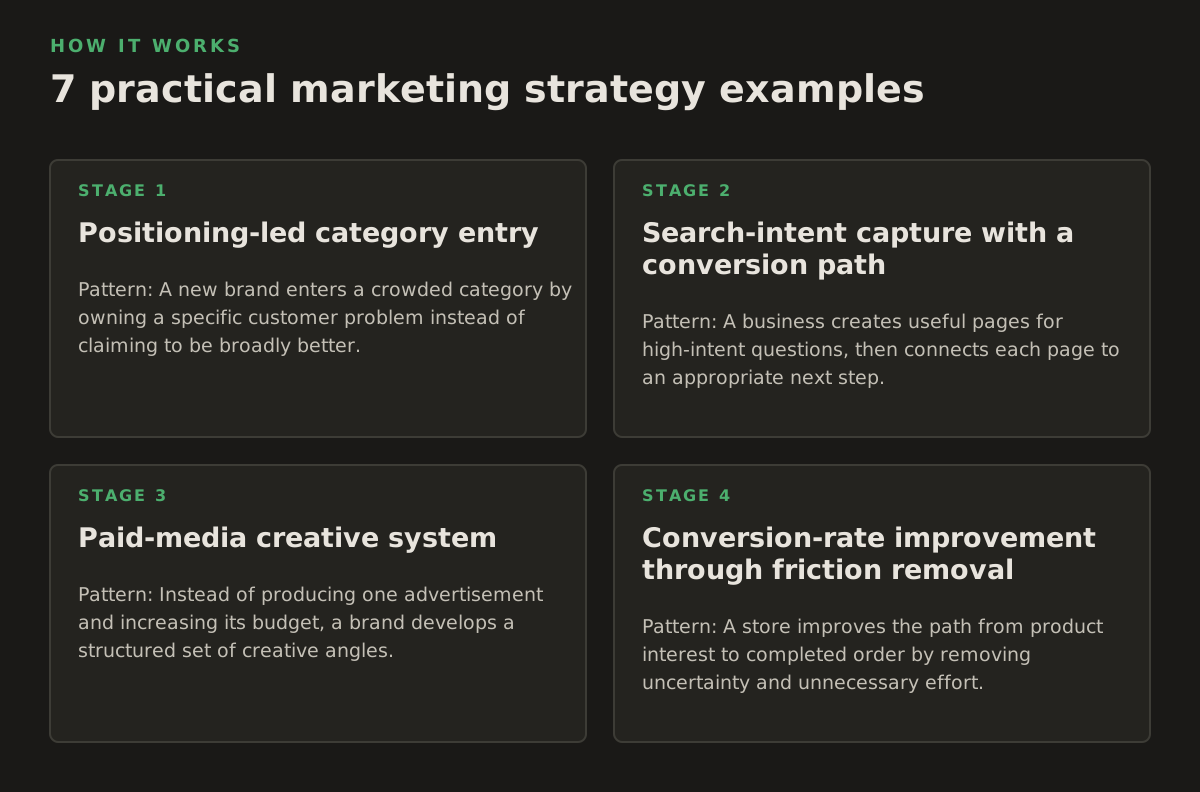
Each pattern below is a reusable strategy, not a recommendation to copy the exact channel or numbers. The figures are illustrative starting scenarios designed to show the decision logic.
1. Positioning-led category entry
Pattern: A new brand enters a crowded category by owning a specific customer problem instead of claiming to be broadly better. An illustrative home-cleaning brand could position around “faster cleanup for small-space renters,” supported by compact packaging, short demonstrations, and a starter bundle.
- What it demonstrates: Narrower positioning can make creative, landing pages, and offers more coherent.
- Why it can work: The message maps to a recognizable situation rather than asking customers to evaluate a vague superiority claim.
- What to adapt: Write one audience-problem-outcome statement, then create proof that is specific to that situation.
Where it fails: The segment may be too small, or the claimed problem may not influence purchase. Validate the problem through customer interviews, search behavior, sales objections, and conversion evidence before investing heavily in a full repositioning.
2. Search-intent capture with a conversion path
Pattern: A business creates useful pages for high-intent questions, then connects each page to an appropriate next step. An illustrative B2B software company could publish a comparison page for buyers evaluating two solution types, offer a requirements checklist, and route qualified visitors to a consultation rather than a generic homepage.
Why it can work: The page addresses an existing decision, while the call to action matches the visitor’s stage. A visitor researching options may not be ready for “buy now,” but may accept a calculator, checklist, or guided assessment.
What to adapt: Build a page around one job-to-be-done, include limitations and decision criteria, and measure qualified actions rather than traffic alone. Google’s SEO Starter Guide emphasizes helping search engines understand content and users find useful information; search visibility is not a substitute for a persuasive offer.
3. Paid-media creative system
Pattern: Instead of producing one advertisement and increasing its budget, a brand develops a structured set of creative angles. An illustrative apparel company could test four angles: fit confidence, material durability, customer styling, and a seasonal use case.
Why it can work: Different prospects may respond to different motivations, and creative fatigue can reduce response even when targeting remains stable. A system also makes learning transferable: the winning claim can inform landing-page copy, email subject lines, and merchandising.
What to adapt: Change one meaningful variable at a time when possible, label every asset by angle and audience, and judge results against a defined business event. For example, a starting policy might require at least 20 purchases per creative angle before making a directional decision; that is an illustrative testing policy, not a universal statistical threshold.
Where it fails: Teams may call several cosmetic variations a test while leaving the core promise unchanged. They may also optimize to cheap clicks. Connect ad events to purchase or qualified lead data, and use platform reporting as one input rather than the entire measurement system.
4. Conversion-rate improvement through friction removal
Pattern: A store improves the path from product interest to completed order by removing uncertainty and unnecessary effort. An illustrative store might simplify a five-field checkout, clarify delivery timing, add comparison information, and show returns before the customer reaches payment.
What it demonstrates: Growth does not always require more traffic. If 10,000 monthly sessions produce 250 orders, a 2.5% illustrative conversion rate, improving the experience to 3.0% would produce 300 orders at the same traffic level.
Why it can work: Customers abandon when they cannot answer basic questions about fit, price, delivery, risk, or compatibility. The intervention should address observed uncertainty, not add generic persuasion.
What to adapt:
- Review analytics for step-level abandonment.
- Watch session recordings or conduct usability sessions where appropriate.
- List the customer questions blocking confidence.
- Change one journey element and define the primary outcome before release.
For ecommerce teams, event quality matters. Google’s GA4 ecommerce documentation describes recommended events and parameters for measuring product views, carts, purchases, and related actions. Implementing events correctly does not prove that a redesign caused growth; it makes the decision more observable.
5. Retention and lifetime-value expansion
Pattern: A subscription or repeat-purchase brand treats the second order as a designed experience rather than an accident. An illustrative skincare company might send usage education after delivery, remind customers based on expected consumption, and offer a relevant replenishment option.
Why it can work: Better onboarding can reduce product misuse, increase perceived value, and create a timely reason to return. It also changes the allowable acquisition cost: a customer who buys repeatedly may support more prospecting investment than a one-time buyer with the same first-order revenue.
What to adapt: Segment by purchase frequency, product usage, margin, and time since last order. Measure repeat purchase, refund behavior, contribution margin, and unsubscribe rate together. Do not treat every additional email or discount as retention strategy; a discount can increase orders while reducing profit or training customers to wait.
6. Partnership-led demand generation
Pattern: A brand reaches a trusted adjacent audience through a partner whose customers share a relevant problem. An illustrative meal-planning company could collaborate with a fitness coach on a practical planning series, with a tracked offer and clear audience fit.
What it demonstrates: Distribution can be borrowed from an existing relationship, but credibility depends on relevance. The partner should contribute genuine expertise or access, not merely a logo placement.
Why it can work: The recommendation arrives in a context where the problem is already salient. It may also produce qualitative insight about objections that paid-media dashboards do not reveal.
What to adapt: Define the partner’s audience, the shared customer problem, the content or offer exchanged, ownership of leads, and the measurement window. An illustrative starting policy could compare 500 referred visits, 40 leads, and 8 purchases against the partner cost; actual thresholds must reflect margin and sales cycle.
7. Full-funnel measurement and budget reallocation
Pattern: A marketing team connects awareness, consideration, conversion, and retention signals to decide where the next dollar or hour should go. An illustrative brand might learn that paid search converts efficiently but has limited scale, while video introduces a larger audience whose later branded-search behavior is rising.
Why it can work: Different channels assist different stages. Judging every activity by last-click revenue can overfund demand capture and underfund demand creation.
What to adapt: Create a measurement map that includes:
- Reach signals: qualified audience exposure and completed video views, where relevant.
- Engagement signals: product detail views, useful content actions, or initiated assessments.
- Commercial signals: purchases, qualified opportunities, revenue, and contribution margin.
- Customer signals: repeat purchase, retention, refund rate, and lifetime value.
Use experiments when possible rather than assuming attribution reports prove incrementality. Google Ads provides guidance on campaign experiments, but an experiment still needs a clear hypothesis, stable success metric, and decision rule. If a channel cannot be measured perfectly, document its role and uncertainty instead of assigning false precision.
How to choose the right strategy pattern
The best pattern depends on the binding constraint. Start with the symptom, then identify the mechanism before choosing a channel.
| Observed constraint | Likely strategy pattern | First question to answer |
|---|---|---|
| People do not understand the difference | Positioning-led category entry | Which customer problem can the brand own credibly? |
| Existing demand is not converting | Search-intent capture or conversion improvement | What uncertainty or friction blocks the next step? |
| Acquisition works but creative decays | Paid-media creative system | Which motivations and proofs have not been explored? |
| First orders are unprofitable | Retention and lifetime-value expansion | What would make the second purchase more likely and valuable? |
| Reach is limited by owned channels | Partnership-led demand generation | Which trusted audience shares the customer problem? |
| Budget decisions are disputed | Full-funnel measurement | Which evidence would change the allocation decision? |
Choose one primary constraint for the next planning cycle. A company with weak positioning should not expect better bidding to solve demand quality. A company with strong demand but a confusing checkout should not immediately add new acquisition channels. Fix the constraint closest to the business outcome, then reassess the next constraint revealed by the improvement.
Where marketing strategies break
Vague audiences produce vague learning
“Adults interested in wellness” is too broad to guide a differentiated promise. Define the situation, desired outcome, barriers, and buying trigger. The goal is not to exclude every possible customer; it is to give the team a clear initial hypothesis.
Metrics are mistaken for strategy
A dashboard can report impressions, clicks, and conversions without explaining why performance changed. Pair each metric with a mechanism: a message should improve qualified response, a landing-page change should reduce friction, and a retention intervention should increase profitable repeat behavior.
Attribution is treated as proof
Platform-reported results are useful for optimization, but they can reflect overlapping exposures, modeled conversions, or customer actions that would have happened anyway. Use consistent tracking, compare cohorts, and reserve strong causal claims for credible tests.
Short-term wins damage long-term economics
Heavy discounting can lift conversion while lowering margin and reference price. Aggressive frequency can create attention while increasing fatigue. Cheap leads can overwhelm sales teams. Before scaling, check profitability, customer quality, operational capacity, and brand effects.
How practitioners turn a pattern into an operating plan
Convert the chosen pattern into a one-page brief that someone outside the marketing team can challenge. Include:
- Objective: the business result and its time horizon.
- Customer hypothesis: who has the problem, when it matters, and what they currently do.
- Strategic promise: the outcome the brand can credibly deliver.
- Proof: evidence, demonstration, product experience, expertise, or policy that supports the promise.
- Journey: how a person moves from exposure to purchase and, where relevant, repeat purchase.
- Economics: acceptable acquisition cost, margin considerations, and customer-value assumptions.
- Test plan: the variable, audience, primary metric, observation period, and action after the result.
Then establish a review cadence. Weekly reviews can focus on delivery problems and obvious tracking issues. A longer review should examine customer quality, creative learning, cohort behavior, and whether the original constraint still explains performance. Avoid rewriting the strategy after every noisy daily fluctuation.
For teams that need outside support, the useful question is not “Which agency can run every channel?” It is “Which partner can connect brand, creative, media, measurement, and commercial decisions without hiding the trade-offs?” Kimmel Marketing provides digital marketing services across brand strategy, creative development, media buying, and performance optimization; explore its marketing expertise when you need a transparent plan tied to acquisition efficiency and growth. Kimmel Marketing
Authored with NotFair SEO