What Is The Market Penetration Strategy? A Practical Growth Guide
When a growth-stage brand asks what is the market penetration strategy, it is usually asking a practical question: how can we win more customers in a market we already serve without destroying contribution margin? Market penetration is the disciplined effort to increase sales of an existing product or service to an existing market. It is not simply “run more ads.” It combines audience expansion, purchase frequency, conversion improvement, distribution, pricing, positioning, and retention into a plan for earning a larger share of reachable demand.
That distinction matters for ecommerce teams and marketing leaders. A brand can increase traffic while losing money, add customers who never reorder, or reach more people without becoming more relevant. A sound penetration strategy connects incremental demand to unit economics, then determines which constraint to remove first. The objective is not maximum exposure. It is profitable, repeatable growth in a market where the company already has a credible right to win.
What a market penetration strategy actually means
Market penetration is one of the four classic growth directions: sell existing products to existing customers or markets, sell existing products to new markets, develop new products for current customers, or enter new products and markets. The penetration option generally carries less product and market uncertainty than launching an unfamiliar offer in an unfamiliar category, but it is still not risk-free. Competitors can respond, existing audiences can saturate, and acquisition costs can rise as the easiest buyers are captured.
A useful working definition is:
A market penetration strategy increases the proportion of category purchases captured by a brand from a defined market, using existing or lightly modified offers, channels, and capabilities.
“Defined market” is the important phrase. A national consumer brand, a regional specialty retailer, and a B2B software company should not use the same denominator. Define the market by geography, customer profile, use case, channel, and time period. For example, “women in the United States” is too broad to manage. “First-time US customers shopping for fragrance-free moisturizer online in 2026” is more useful because the audience, buying occasion, competitors, and available demand can be investigated.
Penetration is not the same as market development
If a home-goods ecommerce brand begins selling its existing cookware in Canada, that may be market development because geography and logistics have changed. If it sells the same cookware to more US households by improving product pages, increasing branded demand, and winning customers from competitors, that is market penetration. The distinction is operational: penetration improves share within the current arena; development changes the arena.
Some initiatives sit between the two. A new bundle aimed at existing customers can support penetration if it increases basket size or purchase frequency. A product translated for a new country may involve market development even if the underlying product is unchanged. Classifying the move correctly prevents a team from underestimating localization, legal, fulfillment, or competitive risks.
The four levers behind penetration
Most practical plans use one or more of four levers:
- Acquire more buyers: reach qualified noncustomers through paid media, partnerships, search visibility, retail distribution, or referrals.
- Convert more of the reachable audience: improve message-market fit, landing pages, merchandising, trust signals, checkout, and offer clarity.
- Increase buying frequency: use replenishment, lifecycle messaging, subscriptions, cross-sells, or better post-purchase education.
- Increase value per transaction: use bundles, tiered offers, quantity breaks, and merchandising that make a larger order useful rather than merely expensive.
These levers are connected but not interchangeable. More traffic cannot repair a product-page mismatch. A discount may increase conversion while lowering contribution margin. A retention campaign can improve lifetime value but cannot solve a product that customers do not want to buy again. The first decision is therefore diagnostic: which growth constraint is binding, and what evidence would prove that diagnosis wrong?
Why penetration matters for revenue and acquisition efficiency
For a growth-stage company, penetration is valuable because it turns a vague ambition—“grow the brand”—into a share-of-demand problem. The team can ask where current customers come from, which buyers remain unserved, what prevents conversion, and whether the economics improve as the brand becomes more familiar.
It also creates a better relationship between brand strategy and performance marketing. Brand work can increase mental availability and clarify why the offer is different. Performance activity can capture demand and reveal which messages, audiences, and objections affect action. Neither should be judged in isolation. Reach without relevance is waste; conversion without retention can be fragile.
Start with a measurable market denominator
The denominator should be narrow enough to estimate and broad enough to matter. A practical market-sizing worksheet might include:
- Eligible customers in the chosen geography and category.
- Annual category purchase occasions or expected contract value.
- Share currently served by the brand.
- Share served by direct competitors and substitutes.
- Reachable demand through the brand’s available channels.
- Constraints such as price, delivery area, inventory, eligibility, or awareness.
Official guidance from the US Small Business Administration recommends examining demand, market size, economic indicators, location, market saturation, and pricing when conducting market research. For a 2026 planning process, that is a useful reminder that “market size” is not a single top-down number; it must be tested against the customers and competitive conditions the business can actually serve. The SBA’s market research guidance provides a primary reference for those research dimensions.
Illustrative example: Suppose an ecommerce brand estimates 200,000 annual category buyers in its serviceable market. If it has 8,000 first-time buyers, its penetration is not automatically 4%; the number of purchases, category definition, repeat behavior, and overlap with competitors may make that calculation misleading. Use the estimate as a planning model, not as a claim of truth. Then validate it with customer surveys, platform data, search behavior, retailer data, and sales records.
Connect penetration to contribution margin
Revenue growth can conceal an acquisition problem. A simple starting model is:
Contribution after acquisition = revenue − variable costs − discounts − fulfillment costs − payment costs − acquisition cost
For a subscription or repeat-purchase business, the model can extend over a defined period. Do not treat projected lifetime value as cash already earned. Separate first-order contribution, expected repeat contribution, and uncertainty around retention. If the first order loses money, the business needs a credible reason to believe repeat purchases or later margin will repay that investment.
For an illustrative example, assume:
- Average first order: $80.
- Product, fulfillment, payment, and discount costs: $48.
- Contribution before acquisition: $32.
- Illustrative target CAC: $24 or less for first-order contribution neutrality.
- Expected repeat contribution: modeled separately, not assumed.
That example is a starting policy, not a universal benchmark. If the team raises the target CAC to $40 because repeat orders are expected, it should document the retention rate, timing, gross margin, refund rate, and cash-flow risk supporting that choice. A penetration plan that cannot state its payback logic is a reach plan, not a scalable acquisition plan.
How to build the strategy: from diagnosis to channel plan
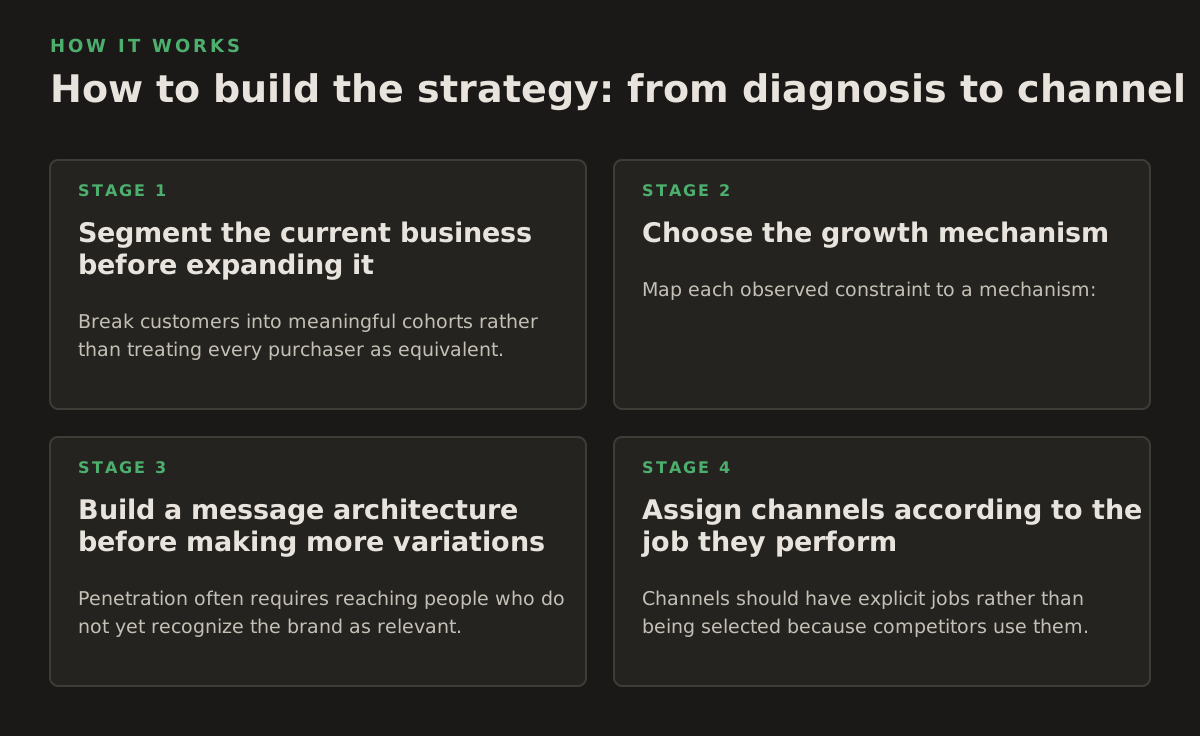
A strong plan moves from market definition to a specific constraint, then assigns tactics to that constraint. The sequence below is designed for teams managing paid media, ecommerce conversion, and revenue accountability.
1. Segment the current business before expanding it
Break customers into meaningful cohorts rather than treating every purchaser as equivalent. Useful dimensions include first-order product, acquisition source, geography, device, margin tier, order frequency, and time since purchase. Look for differences in:
- Conversion rate and average order value.
- Refund, cancellation, or return behavior.
- Second-purchase rate within a defined period.
- Contribution margin by product and channel.
- Customer service objections and delivery friction.
This analysis often reveals that the best penetration opportunity is not “more customers everywhere.” It may be more buyers for one hero product, a reactivation program for lapsed customers, or a better landing experience for a high-intent segment that already clicks but rarely purchases.
2. Choose the growth mechanism
Map each observed constraint to a mechanism:
| Observed constraint | Likely mechanism | Primary measurement | Risk to monitor |
|---|---|---|---|
| High qualified traffic, low purchase rate | Offer, message, merchandising, or checkout improvement | Conversion rate and contribution per session | Discount dependence |
| Strong first orders, weak repeat rate | Product education, replenishment, lifecycle, or service improvement | Repeat contribution by cohort | Over-messaging or poor product fit |
| Good economics in a narrow audience | Creative variation and adjacent audience expansion | Incremental customers at target CAC | Audience saturation |
| High branded demand, low nonbranded demand | Category education and problem-led creative | Qualified new-user demand | Long payback period |
| Sales concentrated in one channel | Distribution or channel diversification | Marginal contribution by channel | Attribution confusion |
The point is to avoid assigning every problem to media buying. If a customer does not understand the product, adding impressions may create more confusion. If a product is unavailable, demand generation may waste money and damage trust.
3. Build a message architecture before making more variations
Penetration often requires reaching people who do not yet recognize the brand as relevant. A message architecture should specify the category problem, audience tension, differentiated promise, proof, objection, and action. The same strategy can then be adapted for search ads, paid social, landing pages, email, retail placements, and sales enablement.
For example, a premium meal-kit brand may have one message for existing customers—“make weeknight planning easier”—and another for noncustomers—“replace the expensive last-minute takeaway decision with a prepared plan.” Both support penetration, but they address different stages of awareness. Creative strategy is a demand mechanism, not decoration around media buying.
Keep claims proportional to evidence. Product demonstrations, customer reviews, certifications, guarantees, and comparative statements should be substantiated before they become scalable creative. A stronger promise can improve response, but an unsupported promise creates refunds, distrust, and regulatory exposure.
4. Assign channels according to the job they perform
Channels should have explicit jobs rather than being selected because competitors use them. A basic allocation might distinguish:
- Demand capture: search, shopping, retargeting, and high-intent marketplace placements.
- Demand creation: video, creator content, social prospecting, partnerships, and editorial education.
- Conversion support: landing pages, product detail pages, reviews, chat, and merchandising.
- Retention: email, SMS where appropriate, replenishment reminders, loyalty, and customer education.
- Measurement: analytics, CRM, cohort reporting, and controlled tests.
Google Ads describes conversion tracking as a way to understand actions such as purchases, sign-ups, and calls after interaction with an ad. For a 2026 media plan, the practical implication is to define the business action and value before optimizing toward a platform event. Google’s official conversion tracking documentation explains the role of conversion actions and measurement in campaign evaluation.
Platform-reported conversions are useful for optimization, but they are not identical to incremental conversions. A retargeting campaign may receive credit for people who were already close to purchasing. Compare platform reporting with analytics, CRM revenue, geographic or audience holdouts where feasible, and blended contribution. Do not shut off a channel solely because its last-click share looks small, and do not scale it solely because its platform-reported ROAS looks large.
5. Set a test ladder, not a pile of disconnected experiments
Tests should progress from high-impact strategic uncertainty to lower-level execution:
- Test whether the segment has a meaningful problem and willingness to pay.
- Test the offer and value proposition against the main objection.
- Test creative angles and proof formats.
- Test landing-page structure, merchandising, and checkout friction.
- Test bidding, budget distribution, placements, and audience expansion.
Changing all five layers at once may produce a better result, but it will not tell the team why. When traffic is limited, prioritize tests that can change the decision, not tests that produce a tidy statistical story after months of waiting. Record the hypothesis, primary metric, guardrails, audience, duration policy, and decision rule before launch.
Google’s documentation on experiments and campaign measurement is a useful official reference for structuring comparisons within its advertising ecosystem. Google Ads experiments guidance describes the purpose of controlled campaign comparisons; the broader principle is to change one material decision at a time when causal learning matters.
Where market penetration strategies break
Penetration plans fail less often because the team lacks tactics than because it mistakes a local improvement for scalable demand. The most common failure modes are operational and economic.
They confuse reach with penetration
Reach is exposure. Penetration is a change in purchasing behavior or share. A video campaign can achieve broad reach while failing to move qualified buyers. A discount can create a sales spike without increasing the number of customers who would choose the brand again. Track leading indicators such as qualified reach and branded search, but require a commercial outcome: new-customer contribution, repeat contribution, or share within the defined segment.
They scale before proving the constraint
Increasing spend against a weak product page makes the weakness more expensive. Increasing email frequency against a poor product experience accelerates unsubscribes. Expanding inventory before understanding demand can create working-capital pressure. Use a constraint review before each scale decision:
- Is demand limited, or is conversion limited?
- Is conversion limited by trust, price, relevance, friction, or availability?
- Does the offer work without a margin-destructive incentive?
- Can operations fulfill the additional demand at the promised service level?
- What is the earliest signal that the expansion should pause?
They rely on one attribution view
Attribution is a decision aid, not a physical ledger of causality. Cookie loss, device changes, view-through exposure, modeled conversions, repeat purchases, and cross-channel journeys all make the true contribution of a touchpoint difficult to observe. Meta’s official business documentation describes its ad auction as considering factors such as bid, estimated action rate, and ad quality; this means delivery is shaped by platform systems as well as the advertiser’s budget. Meta’s official ad auction explanation provides context for why reported delivery and performance can change when creative, audience, or estimated action behavior changes.
Use a measurement stack with clear roles:
- Platform reporting for in-platform delivery and optimization.
- Analytics for onsite behavior and conversion paths.
- CRM or order data for revenue, margin, and cohort outcomes.
- Blended reporting for total spend against total incremental-looking business results.
- Controlled tests or geographic comparisons when the investment justifies them.
Do not manufacture precision. If the business cannot isolate incrementality, label the result as attributed revenue, modeled contribution, or blended performance rather than claiming that every reported conversion was caused by the ad.
They use discounting as the entire strategy
Discounts can reduce a first-purchase barrier, clear inventory, or create a legitimate event. Used continuously, they can train customers to wait, lower perceived value, attract low-retention buyers, and hide weak positioning. Test non-price value first where possible: bundles that improve utility, free shipping thresholds that increase basket economics, education that reduces uncertainty, guarantees that address risk, or proof that makes the price understandable.
They ignore capacity and brand coherence
A successful penetration campaign can expose stockouts, slow fulfillment, customer-service gaps, or inconsistent creative. Growth-stage companies should include operational guardrails in the media plan. If a hero SKU has only limited inventory, the campaign should have a substitution path or a pause rule. If the brand is moving upmarket, a short-term promotion should not undermine the reason customers pay a premium.
How practitioners apply the strategy in real planning
The strategy becomes useful when it produces a sequence of decisions for a specific business, not when it remains a framework on a slide. Consider an illustrative direct-to-consumer skincare brand selling an existing moisturizer to customers in one country.
Illustrative scenario: increasing share without buying unprofitable volume
The brand has steady branded demand, a high-performing product, and a meaningful base of one-time purchasers. Its initial diagnosis shows three different opportunities:
- Existing customers understand the product but do not receive timely replenishment education.
- Nonbranded visitors reach the product page but do not understand why the formula costs more than mass alternatives.
- Paid social prospecting produces purchases, but the strongest creative speaks only to a narrow skin concern.
A sensible penetration plan would not immediately double prospecting spend. It might sequence the work as follows:
- Improve product-page proof, ingredient explanation, comparison framing, and objection handling.
- Create a post-purchase education path tied to expected usage without promising a universal replenishment interval.
- Develop three prospecting angles: sensitive-skin problem, routine simplification, and cost-per-use value.
- Use a small, explicitly illustrative test budget to compare new-customer contribution by angle.
- Scale only the angle that meets the documented CAC and margin guardrails while monitoring repeat behavior.
The insight is not that every skincare brand should use these tactics. It is that each tactic corresponds to a diagnosed barrier. If the product page improves but conversion does not, the price, product-market fit, traffic quality, or proof may still be wrong. If prospecting works but repeat purchases do not, the brand has acquired customers without yet building durable penetration.
Build a one-page operating brief
Before launch, write down:
- Target market: the precise customer, geography, category, and period.
- Penetration objective: the behavior or share change sought.
- Primary constraint: the reason growth is currently limited.
- Economic guardrails: CAC, contribution, payback policy, return rate, and inventory limits.
- Message: the problem, differentiated promise, proof, and objection response.
- Channel job: demand capture, creation, conversion, or retention.
- Measurement plan: platform, analytics, CRM, blended, and experimental views.
- Scale and stop rules: what must be true before increasing investment.
For teams that need outside support, the useful partner is not merely one that can launch campaigns. It should be able to connect brand architecture, creative development, media buying, conversion optimization, and revenue reporting without hiding trade-offs. Kimmel Marketing’s digital marketing services and its broader marketing expertise are relevant when the business needs those disciplines organized around acquisition cost, revenue, and lifetime value.
Use a 2026 review cadence
Set different review rhythms for different questions. Daily monitoring can catch spend anomalies, outages, broken tracking, or inventory issues. Weekly review can evaluate creative fatigue, search terms, landing-page behavior, and budget pacing. Monthly or cohort-based review is better for repeat purchase, payback, contribution, and retention. A quarterly strategy review should revisit the market definition, competitive positioning, channel mix, and whether the original constraint still exists.
Do not let a short-term platform fluctuation force a strategic rewrite. Conversely, do not let a favorable weekly ROAS conceal declining new-customer quality. A penetration strategy is working when it creates a larger pool of profitable customers or category purchases under repeatable conditions—not merely when one dashboard reports an efficient period.
The specific recommendation for a growth-stage brand in 2026 is to begin with one narrowly defined market, one diagnosed constraint, and one economic guardrail. Then connect the creative, media, conversion, and retention work to that decision; Kimmel Marketing can help structure that process through its Kimmel Marketing, especially when growth requires both sharper brand positioning and accountable performance execution.
Authored with NotFair SEO